

What if you could achieve the museum-grade detail of a bespoke brass locomotive without ever picking up a soldering iron? For many enthusiasts, the narrow gauge world is a place of immense character, yet it's often hindered by the complexity of traditional kit building. You might feel frustrated by the steep learning curve of white metal or the limited availability of niche prototypes in the ready-to-run market. One of the primary benefits of 3d printed model railway kits is their ability to bridge this gap, offering a level of precision that was once reserved for professional scratch-builders.
While traditional casting often struggles with fine textures, modern resin printing provides a proactive solution through high-resolution SLA technology. This guide explores how these kits provide incredible detail while making assembly more accessible. You'll learn how they reduce build times and provide access to unique locomotives in OO9, GN15, and O-16.5 scales. We'll also examine how these bodies are designed to fit standard commercial chassis, ensuring that your unique models run as well as they look on your layout.
Key Takeaways
- Traditional kit building often presents technical hurdles like complex soldering; 3D printing provides a proactive solution by offering high-detail assembly without the need for specialist heat tools.
- One of the primary benefits of 3d printed model railway kits is the use of high-resolution SLA resin, which addresses the issue of visible layer lines to ensure a professional, smooth finish.
- While white metal kits require extensive cleaning and preparation, resin kits reduce construction time while allowing for finer cab interiors and more precise boiler fittings.
- Modifying standard models can be difficult; resin kits are easily drilled and adapted, making them the ideal choice for enthusiasts looking to create unique narrow gauge prototypes.
- Motorisation is often a point of frustration in scratch-building; choosing kits designed for specific commercial chassis ensures reliable running for OO9, GN15, and O-16.5 layouts.
The Evolution of Kit Building: Why 3D Printing is the Future
For decades, the narrow gauge community has relied on white metal and etched brass kits to fill the gaps left by major manufacturers. These materials formed the backbone of the hobby, allowing dedicated modellers to recreate the charm of Welsh slate lines or industrial tramways. However, the legacy of these traditional kits often comes with a steep price in terms of technical difficulty. The primary hurdle has always been the soldering iron. For many enthusiasts, the prospect of wrestling with high-heat tools and molten metal is enough to keep a kit inside its box for years.
One of the key benefits of 3d printed model railway kits is the removal of these high-stakes construction methods. We're seeing a fundamental shift from industrial craft to digital precision. Instead of hoping a casting hasn't warped or degraded, you're now able to work with a medium that offers consistency and incredible fidelity. This transition isn't just about making things easier; it's about making professional-grade results achievable for everyone, regardless of their metalworking skills.
This transition toward digital precision and modularity is mirrored in other industries; for those interested in modern architecture, Wikidoma offers the ability to купить модульный дом под ключ, applying similar principles of efficiency and high-quality prefabrication to the housing market.
The Problem with Traditional Casting
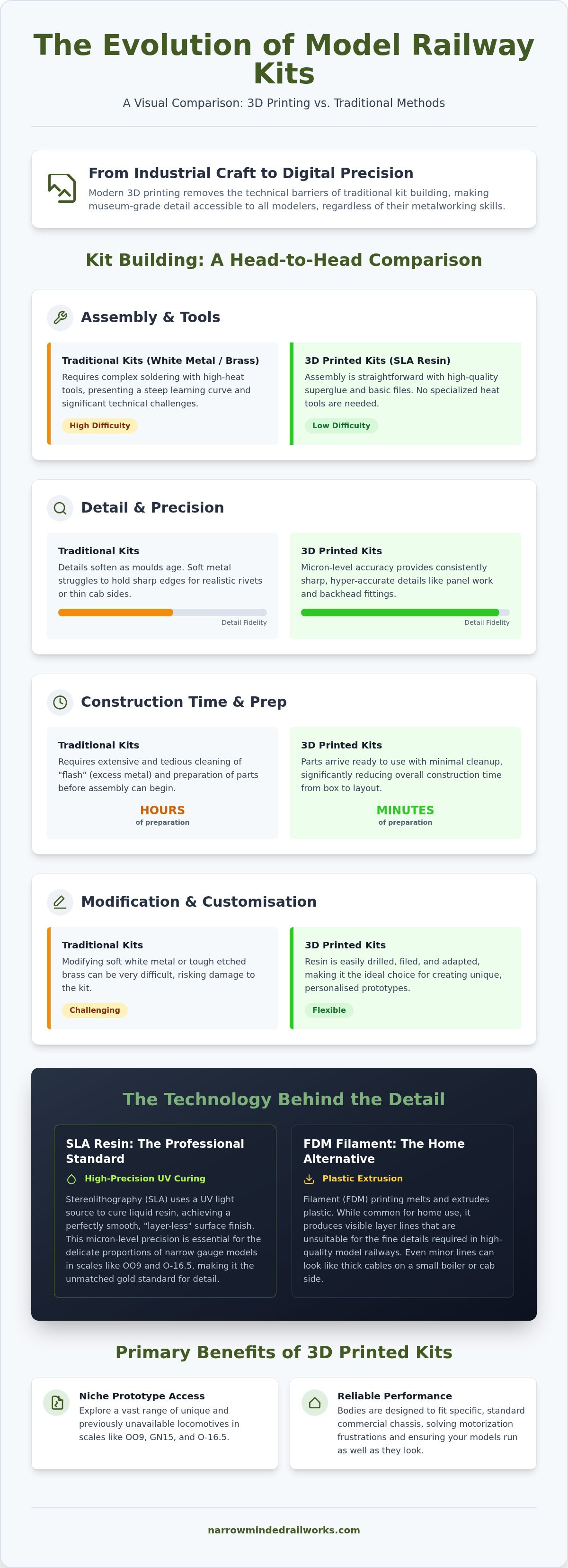
Traditional centrifugal casting served the hobby well for a long time, but it has inherent limitations. As rubber moulds age through repeated use, they inevitably lose their crispness. This leads to "flash"-excess metal that requires hours of tedious filing-and a general softening of fine details. There's also a significant trade-off between weight and detail. While white metal provides excellent traction, it's a soft material that struggles to hold the sharp edges required for realistic rivets or thin cab sides. Because the setup costs for these kits were so high, manufacturers often ignored niche prototypes, leaving modellers with a very limited selection of "safe" locomotive choices.
How 3D Printing Removes Technical Barriers
Modern 3D printing, specifically Stereolithography (SLA), provides a proactive solution to these historical frustrations. By using light to cure liquid resin, this technology produces components that are consistently accurate to within microns. This digital precision means that every kit fits its intended chassis perfectly every time. You don't need a workshop full of specialised tools; a bottle of high-quality superglue and a few basic files are often all that's required to assemble a locomotive body. This approach allows for hyper-accurate panel work and backhead detail that would be impossible to cast in metal. It's the perfect bridge for those who want to move beyond ready-to-run models without the stress of complex scratch-building.
Technical Superiority: The Benefits of SLA Resin Kits
Stereolithography (SLA) resin printing represents a significant leap forward from the early days of additive manufacturing. While many modellers are familiar with the "plastic string" approach of FDM printers, SLA uses a high-precision UV light source to cure liquid resin layer by layer. This process allows manufacturers to reduce material waste while achieving a level of surface smoothness that was previously impossible without industrial injection moulding. One of the standout benefits of 3d printed model railway kits is this "layer-less" finish. High-resolution printers in 2026 operate at such fine tolerances that the visible stepping associated with older technology has been virtually eliminated.
Professional curing is the final, vital step in ensuring long-term model stability. By using calibrated UV stations, we ensure that the resin reaches its full chemical potential, preventing the shrinkage or "weeping" that sometimes plagues home-printed efforts. This professional approach guarantees that your locomotive body remains dimensionally accurate for years to come. It's a proactive solution that addresses the reliability concerns modellers often have with newer materials.
SLA vs. FDM: Why Resin is the Standard
Filament-based (FDM) printing is often unsuitable for the delicate proportions of narrow gauge modelling. In 1:76 (OO9) or 1:43 (O) scales, even a minor layer line can look like a thick cable on a boiler or cab side. SLA resin offers micron-level precision, allowing for the reproduction of microscopic details like safety valves, door handles, and individual rivets. SLA resin stands as the gold standard for model railway detail in 2026. If you're looking for museum-quality results, the resolution of resin is simply unmatched by traditional filament methods.
Durability and Longevity in 2026
There's a common myth that resin kits are inherently brittle and prone to shattering. While early hobbyist resins were fragile, modern engineering-grade resins are designed for durability and handling. These materials offer a proactive solution to the fragility of traditional thin-walled plastic kits. Because a 3D printed body is often produced as a single, solid piece, it possesses superior structural integrity compared to multi-part kits held together by glue seams. These models resist warping and can withstand the rigours of a busy exhibition layout. If you want to see these robust designs in action, you can explore the latest OO9 and GN15 locomotive kits currently available.
Resin vs. White Metal: A Modeller's Comparison
Choosing between materials often feels like a trade-off between detail and ease of use. While white metal has been the industry standard for decades, resin is quickly becoming the preferred choice for those who value their time. One of the primary benefits of 3d printed model railway kits is the dramatic reduction in preparation work. Instead of spending hours filing away "flash" from a metal casting, you can often have a resin body ready for the paint shop in under fifteen minutes. This shift allows you to spend more time on the creative aspects of the hobby rather than the tedious ones.
| Feature | SLA Resin | White Metal | Etched Brass |
|---|---|---|---|
| Assembly Method | Cyanoacrylate / Epoxy | Soldering / Glue | Soldering |
| Detail Resolution | High (Micron-level) | Moderate | High (2D focus) |
| Prep Time | Low (Minutes) | High (Hours) | Very High |
| Weight | Light (needs ballast) | Heavy | Moderate |
Resin does lack the natural heft of metal, which can impact traction on steep gradients. Modellers can easily address this by adding liquid lead or adhesive-backed weights to the hollow interiors of the boiler or tanks. When it comes to painting, resin provides a proactive solution for primer adhesion. Unlike white metal, which often requires aggressive etching primers to prevent flaking, cured resin accepts standard hobby primers with minimal surface preparation.
The End of the Soldering Iron?
For many, the biggest barrier to narrow gauge modelling is the heat. Soldering requires a specific skill set and carries risks, especially when working with low-melt alloys. By switching to resin, you replace the iron with Cyanoacrylate (super glue) or two-part epoxy. This change makes the hobby safer and more accessible for younger modellers or those working in limited spaces. If you're just starting out, you might find Your First OO9 Loco Kit: A Beginner's Guide to Choosing and Buying helpful for navigating your initial purchase.
Detail Comparison: Rivets, Grills, and Louvres
Traditional moulds are limited by "draw angles," meaning they can't easily produce complex "undercuts" without expensive multi-part tooling. 3D printing bypasses this constraint entirely. One of the benefits of additive manufacturing is the ability to create complex, interlocking parts as a single piece. The rivet detail on a 3D printed wagon is significantly sharper and more consistent than the often-rounded rivets found on a worn white metal casting. This crispness extends to grills and louvres, where the thin walls of resin allow for genuine depth that metal simply cannot match.
Customisation and Finishing: The Modeller's Digital Toolkit
One of the standout benefits of 3d printed model railway kits is the ease with which they can be modified to suit your specific prototype. Unlike white metal, which can be stubborn to drill, or thin plastic that risks melting under friction, high-quality resin is remarkably stable. If you're a "kit-basher" or a customiser, you'll find that resin provides a proactive solution for adding fine details. Using a standard pin vice, you can easily drill precise holes for brass handrails, whistles, or lamp irons without the risk of the material cracking or deforming.
While support marks are an inevitable part of the 3D printing process, they don't have to be a deterrent. These small nibs are easily removed with a few strokes of a fine-grit sanding stick, leaving a surface that's ready for paint. Because the resin is consistent throughout, you won't encounter the air bubbles or "pitting" often found in traditional resin castings. For those ready to move to the paint shop, our guide on Painting 3D Printed Models: A Beginner's Guide to a Perfect Finish offers a step-by-step approach to achieving professional results.
Seamless Integration with Commercial Chassis
A common frustration in narrow gauge modelling is the difficulty of motorising a kit. We address this constraint by designing locomotive bodies specifically to fit widely available commercial chassis from manufacturers like Kato, Graham Farish, or Minitrains. This "body kit" philosophy ensures that you don't have to spend weeks troubleshooting a temperamental scratch-built mechanism. Instead, many of our designs utilise snap-fit or simple screw-mount systems, allowing you to focus on the aesthetic details of your build. This approach is particularly helpful for those Getting Started in GN15 Scale: Your Complete Guide, where matching larger scales to smaller tracks can be a technical challenge.
Advanced Finishing Techniques
The surface texture of a resin kit is ideal for modern weathering techniques. Because the material is non-porous, you can use washes and powders to highlight the rivets and panel lines we discussed in previous sections without the paint soaking in and dulling the effect. To ensure longevity, it's best to use a high-quality automotive primer, such as those found at Halfords, which provides a robust "key" for hobby paints. You can further enhance your layout by adding 3D scanned figures, which offer a level of realism that traditional moulded figures often lack. If you're ready to start your next project, you can browse our full range of OO9 and O-16.5 kits to find a unique prototype for your layout.
Why Choose Narrow Minded Railworks 3D Kits?
Narrow Minded Railworks understands that the transition from ready-to-run models to kit building can be daunting. We recognise that modellers often struggle with the lack of niche prototypes in the mass market. To address this, we provide a proactive solution through our "modeller-first" design philosophy. Every kit in our range is developed by active enthusiasts who understand the practicalities of assembly and layout operation. One of the greatest benefits of 3d printed model railway kits from our collection is that they aren't just digital files; they're physical products tested for fit, finish, and performance on real layouts.
Our commitment to transparency means we don't hide the realities of the 3D printing process. Instead, we offer clear guidance on how to get the most out of our resin components. Whether you're looking for OO9, GN15, or O-16.5 / 7mm scale kits, our products are designed to bridge the gap between basic plastic kits and complex scratch-building. We also provide the diorama tools and scenery kits needed to ensure your rolling stock has a high-detail environment to call home.
Expanding Your Narrow Gauge World
The narrow gauge world is defined by its diversity, yet many manufacturers focus only on the most famous locomotives. This constraint can lead to layouts that feel repetitive or uninspired. We solve this by offering a unique range that includes everything from rugged Quarry Hunslets to distinctive industrial tram engines. If you're fascinated by the history of these specialised vehicles, you'll find our A Modeller's Guide to Tram Locos: Types, History & Kits a valuable resource. For those who are new to the scale entirely, we recommend starting with our guide on What is a Narrow Gauge Railway? A Beginner's Guide to the Model Hobby.
Ready to Start Your Next Build?
Finding the right kit shouldn't be a chore. While some digital storefronts can be overwhelming, we've organised our collection to make browsing by scale or prototype straightforward. We maintain transparent communication regarding our production times and provide reliable worldwide shipping from our UK base. If you have questions about chassis compatibility or assembly, our team is here to offer proactive support to ensure your project is a success. You don't have to settle for the same models as everyone else; you can browse our latest 3D printed locomotive and wagon kits today and experience the benefits of 3d printed model railway kits for yourself.
Transforming Your Narrow Gauge Modelling Journey
Traditional kit building often presents a technical barrier that prevents enthusiasts from expanding their layouts. We provide a proactive solution by utilising high-resolution SLA resin to eliminate visible layer lines and complex soldering. Fully embracing the benefits of 3d printed model railway kits allows you to access unique prototypes that were once the sole domain of master scratch-builders. This shift in technology ensures that every modeller can achieve museum-quality results with basic tools.
Our kits are expertly designed to fit Kato and Minitrains chassis, ensuring your locomotives run with the same reliability they display on the shelf. With high-resolution resin providing maximum detail and the convenience of worldwide shipping, there's never been a better time to diversify your rolling stock. We're here to support your creative vision through transparent communication and a modeller-first approach that prioritises clarity and quality.
Start your next narrow gauge project with our precision 3D printed kits and see how modern technology can breathe new life into your layout. It's time to build the railway you've always imagined.
Frequently Asked Questions
Are 3D printed model railway kits more brittle than plastic or metal?
Modern engineering resins are significantly more durable than early hobbyist materials. While they don't possess the sheer impact resistance of white metal, they're robust enough for regular handling and layout operation. If a part does snap, it usually breaks cleanly, which allows for a proactive solution through simple super glue repairs. This stability ensures your narrow gauge models remain intact through years of exhibition use and frequent handling.
What glue should I use for 3D printed resin kits?
You should use high-quality Cyanoacrylate (super glue) or two-part epoxy for assembly. Standard plastic cements won't work because they're designed to melt polystyrene, a process that doesn't affect cured resin. Choosing the right adhesive provides a proactive solution for a permanent bond. For heavier components or structural joints, a slow-setting epoxy allows you more time to ensure everything is perfectly aligned before the adhesive fully sets.
Do I need to wash or clean my 3D printed kit before painting?
It's best practice to wash your kit in warm, soapy water before you begin painting. While our professional curing process removes most residues, microscopic oils can occasionally linger on the surface. Taking five minutes to scrub the body with an old toothbrush ensures your primer creates a strong bond. This simple preparation step acts as a proactive solution to prevent paint from peeling during the later weathering process.
Can I use standard model railway paints on 3D printed resin?
Standard hobby paints like acrylics and enamels are perfectly compatible with resin models. The constraint is surface adhesion, which you can solve by applying a high-quality primer first. Automotive primers from brands like Halfords are popular because they're designed to grip smooth surfaces firmly. Once primed, you can use your preferred model railway paints to achieve a professional finish that won't flake or rub off over time.
How do I remove support marks from a 3D printed locomotive body?
Support marks are easily addressed with a sharp hobby knife and a fine sanding stick. You should gently flick away the nibs and then sand the area flush with the surrounding surface. Because our SLA resin is consistent throughout, you don't have to worry about uncovering air bubbles as you sand. This straightforward process provides a proactive solution for achieving the smooth, professional finish required for high-detail narrow gauge models.
What is the best way to add weight to a 3D printed locomotive for better traction?
The most effective way to improve traction is by adding weight to the hollow spaces inside the boiler or tanks. Resin is naturally lighter than traditional white metal, but you can solve this by using liquid lead shot or adhesive lead strips. Securing these weights with a non-shrinking glue ensures the locomotive has the necessary heft to pull heavy trains up steep narrow gauge gradients reliably.
Are 3D printed kits compatible with standard OO9 or N gauge chassis?
Most of our locomotive bodies are designed specifically to fit onto widely available Kato, Minitrains, or Graham Farish chassis. This compatibility is one of the major benefits of 3d printed model railway kits, as it removes the frustration of complex motorisation. By utilizing a proven commercial power unit, you ensure your model runs smoothly while benefiting from the unique, high-detail appearance of a 3D printed body.
Can I modify or 'kit-bash' a 3D printed model easily?
Resin is an ideal material for kit-bashing because it's easy to drill, saw, and file without cracking. If a standard kit doesn't quite match your specific prototype, you can proactively modify it using basic hand tools. This versatility is one of the standout benefits of 3d printed model railway kits, allowing you to add brass handrails or swap chimneys to create a truly unique locomotive for your layout.