

Ever seen a peculiar, boxy engine chuffing along a roadside or through a bustling goods yard and wondered what it was? Chances are, you've spotted a tram loco. These characterful little engines, with their distinctive enclosed motion and tramway-style cowcatchers, have a rich history working everywhere from industrial sidings to coastal promenades. For the modeller, they offer a unique and eye-catching addition to any narrow gauge layout, but knowing where to start can be a real head-scratcher.
If you're confused by the different types, daunted by the variety of kits available, or simply struggling to match a body to the right chassis, then you're in the right place. This guide is your complete introduction to the world of tram locomotives. We’ll explore their history, break down the key differences between steam, diesel, and electric variants, and help you confidently choose, build, and finish the perfect model for your skill level and layout. Get ready to add some serious personality to your railway!
Key Takeaways
- Discover how historical UK laws shaped the distinctive, enclosed designs of tram locomotives, giving you authentic detailing ideas for your model.
- Explore the wide variety of prototypes, from iconic steam engines to gritty industrial diesels, to find the perfect inspiration for your layout's era.
- Learn the essential steps for selecting the correct motorised chassis to power your chosen tram loco kit, a common challenge for modellers.
- Get practical tips on 'kitbashing' and creating a unique freelance locomotive, a popular approach for which tram engines are perfectly suited.
What is a Tram Loco? A Quick History for Modellers
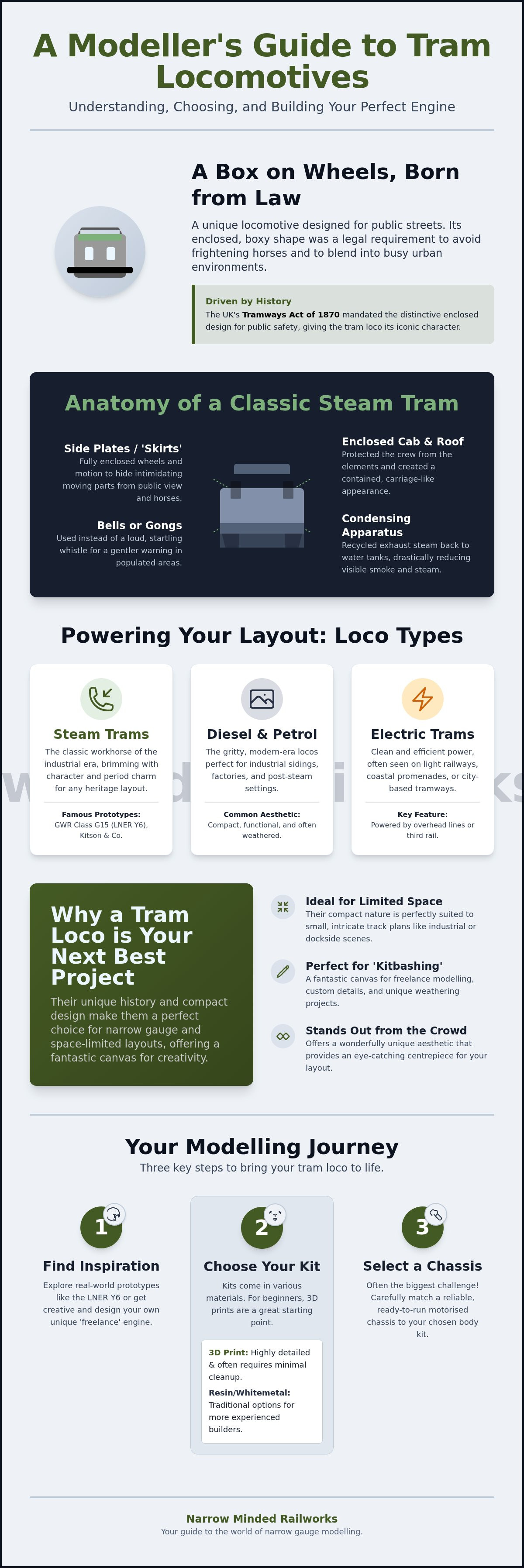
A tram loco, or tram engine, is a type of locomotive specifically designed to operate on railways running along public streets. Unlike conventional steam engines, their design was heavily regulated to ensure public safety and minimise disruption in busy urban environments. The history of these unique machines in the United Kingdom is intrinsically linked to the Tramways Act of 1870, which set out strict rules for any steam-powered vehicle sharing the road with horse-drawn traffic and pedestrians. For a detailed overview, the Wikipedia article on What is a Tram Engine? provides excellent background information.
To see how these concepts translate into the modelling world, this video offers a great look at a custom OO gauge tram build:
The primary goal was to make a powerful steam engine appear as innocuous as possible. The regulations required features designed to avoid frightening horses, such as enclosing all moving parts and suppressing loud noises and visible emissions. This resulted in a locomotive that often looked more like a small railway carriage or a "box on wheels" than a traditional engine, giving the tram loco its distinctive character.
Key Features of a Classic Tram Engine
To comply with the Board of Trade regulations, steam tram engines were fitted with several unique features not typically found on their mainline counterparts:
- Side plates or 'skirts': These panels fully enclosed the wheels and motion, hiding the intimidating sight of moving rods from public view.
- Condensing apparatus: This system recycled exhaust steam back to the water tanks, drastically reducing the visible clouds of steam and smoke.
- Bells or gongs: Instead of a startlingly loud whistle, trams used a bell or gong to announce their approach more gently.
- Enclosed cab & roof: This provided the crew with protection from the elements and further contributed to the engine's contained, carriage-like appearance.
Why Tram Locos are Perfect for Narrow Gauge Layouts
The historical characteristics of tram engines make them an excellent choice for model railway enthusiasts, particularly those working with limited space. Their compact, self-contained nature is perfectly suited to small, intricate track plans found in industrial, dockside, or quaint light railway scenes. They offer a wonderfully unique aesthetic that stands out from standard locomotives, providing a fantastic canvas for modellers to showcase their skills in weathering, detailing, and kit-bashing.
Modelling Classic Steam Tram Locomotives
For many railway modellers, the classic steam tram represents the pinnacle of character and charm. These distinctive engines, with their enclosed bodywork designed for street running, were the workhorses of industrial sidings, dockyards, and light railways across the UK. Their unique appearance makes a steam tram loco the perfect centrepiece for any period layout, instantly capturing a bygone era of British industry and transport.
Available in a variety of scales, they are particularly popular in narrow gauge modelling, with OO9 (4mm scale on 9mm track) and On30 being the most common. This allows for the creation of wonderfully detailed and compact scenes, from bustling quaysides to rural branch lines, all centred around these fascinating machines.
Famous Prototypes to Inspire Your Build
Inspiration is never far away. The Great Eastern Railway's Class G15 (later LNER Y6) is a quintessential British design, and many kits capture its classic shape. For a more international flavour, consider the numerous designs by Kitson & Co., which were exported globally. Even geared locomotives from makers like Sentinel, while not strictly trams, often worked in similar environments and share a compact, industrial aesthetic. These real-world examples, a fascinating niche in the overall history of the locomotive, have also inspired countless freelance and fictional designs.
Choosing Your First Steam Tram Kit
Getting started with a steam tram kit is easier than ever. Kits are typically available in resin, whitemetal, or modern 3D prints. For beginners, a 3D printed body kit is an excellent choice, often requiring only minimal cleanup before painting. It provides a highly detailed and accurate shell that fits onto a readily available ready-to-run chassis. When choosing, look for a high level of detail and clear instructions regarding the required donor chassis. Explore our range of OO9 steam loco kits to find a project that's right for you.
Finishing Touches: Painting and Weathering
Bringing your model to life is the most rewarding stage. Liveries can range from simple, unlined industrial black or green to the more ornate, lined colours of a passenger-carrying company. Weathering is key to realism; think about where dirt would accumulate.
- Soot and Coal Dust: Apply black and dark grey powders around the chimney, roof, and coal bunker.
- Grime and Oil: Use dark washes around the motion and underframe to simulate leaking oil and road dirt.
- Rust Effects: A light touch of rust-coloured paint on toolboxes or buffer beams can add years of character.
Finally, add small details like crew figures in the cab, a set of lamps, and a realistic load of scale coal to complete the scene and make your tram loco truly stand out.
Diesel, Electric & Petrol Tram Locos: The Modern Era
As steam power waned in the early 20th century, a new generation of motive power emerged. The internal combustion engine and electric motor offered greater efficiency, cleaner operation, and instant availability, making them ideal for industrial settings. This technological shift gave rise to a diverse range of diesel, petrol, and electric locomotives that took over from steam in factories, quarries, and mines across the UK.
These modern workhorses were defined by their function. Their primary role was shunting wagons in confined spaces, meaning they were typically small, powerful, and built with a focus on practicality. This resulted in a distinct, often boxy and utilitarian aesthetic, a stark contrast to the ornate designs of the Victorian era. Their enclosed bodies and simple controls made them perfect for the tight clearances and demanding environments of industrial light railways.
For modellers, this era offers a wealth of opportunities. These locos fit perfectly on layouts set anywhere from the 1930s right through to the present day. Because of their simple, functional designs, many kits are straightforward to build and motorise, making a diesel tram loco an excellent project for both newcomers and seasoned builders looking for a quick and satisfying build.
Modelling Small Industrial Diesels
The UK was home to prolific builders like Ruston & Hornsby, Lister, and Simplex, whose small diesel shunters became ubiquitous. While many weren't fully skirted like their steam predecessors, their compact nature embodies the industrial spirit. Kits for these models are widely available in various scales and are perfect for micro-layouts or industrial dioramas where every inch of space counts, bringing a scene to life with minimal footprint.
Electric Tram Engines: Overhead Wires and Batteries
Electric traction in industry typically took two forms. Locomotives with pantographs or trolley poles drew power from overhead lines, a feature that adds incredible visual interest and a rewarding modelling challenge to a layout. Alternatively, battery-electric locos provided a self-contained solution, ideal for scenes like munitions factories or mines where sparks from overhead lines posed a significant risk. A battery-powered industrial tram loco model offers a modern look without the complexity of constructing a catenary system.
Freelance Modelling: Designing Your Own Tram Loco
While replicating a real-world locomotive is rewarding, there's a unique satisfaction in freelance modelling-creating a railway that exists only in your imagination. This is where you become the chief engineer, designing a fictional history, purpose, and identity for your line. Tram locos, with their characteristically simple and enclosed bodywork, are exceptionally popular subjects for this creative pursuit, a practice often called 'kitbashing'. Their basic form provides a perfect blank canvas, inviting you to add your personal touch and tell a unique story.
Using a 3D Printed Kit as Your Starting Point
Modern 3D printed kits offer an unparalleled starting point for a custom project. The resin material is easy to cut, sand, and glue, making modifications far simpler than with traditional metal or plastic kits. A basic body shell can be transformed by adding details like toolboxes, extra riveting, different chimneys, or even new windows. Don't be afraid to combine parts from different kits to create a truly one-of-a-kind tram loco. Our 3D printed loco bodies are designed to be versatile, making them perfect for your custom freelance projects.
Inspiration for Your Freelance Railway
Every great model needs a story. What is the purpose of your railway? This backstory will guide your design choices, from the weathering to the livery. Consider these themes for inspiration:
- Industrial Grit: A quarry line, a peat bog railway, or a sprawling factory system where locomotives work hard in tough conditions.
- Light Railway Charm: A small, independent line serving rural villages, carrying everything from passengers to local produce.
- Dockside Shunter: A compact engine navigating tight curves and bustling quaysides, moving wagons between ships and warehouses.
Once you have a theme, you can develop a unique livery and name for your locomotive. A grimy, unlined black might suit a colliery engine, while a passenger loco could sport a proud, brightly coloured scheme. This narrative approach turns a simple model kit into a piece of your own fictional world.
The Essential Guide to Chassis for Tram Loco Kits
So, you've found the perfect body kit, but one question looms: 'What chassis do I need for this?' It's the most common query in narrow gauge modelling. Most kits are supplied as a 'body only' item, giving you the freedom to choose a motorised chassis that suits your budget and performance needs. This guide will demystify the process, empowering you to match the right running gear to your chosen model.
Understanding Chassis Specifications
Choosing the right chassis comes down to three key measurements. Getting these right is the difference between a simple project and a frustrating one.
- Wheelbase: This is the distance between the centre of the front and rear axles. It's the most critical dimension, especially for a tram loco with side skirts or outside frames, as the wheels must align perfectly with the openings in the body.
- Wheel Diameter: Smaller wheels are often more prototypical for industrial locomotives. Ensure the diameter you choose allows the model to sit at the correct ride height and doesn't look out of scale.
- Motor & Drivetrain Size: Before purchasing, check the dimensions of the motor and chassis block. It must fit comfortably inside the body shell without needing major modifications or fouling internal details.
Popular Ready-to-Run Chassis for OO9 Kits
The OO9 community benefits from a great selection of reliable N gauge 'donor' chassis. These are our top recommendations, available from most UK model railway specialists:
- Kato 11-109 / N-Drive Chassis: Often considered the gold standard, this Japanese-made chassis is renowned for its compact motor, smooth performance, and exceptional slow-speed control. It's a fantastic, reliable choice for many kits.
- Bachmann Percy or Minitrains: Chassis from the Bachmann 'Thomas & Friends' range (like Percy) or from the Minitrains line are also popular donors. They are robust, readily available, and often have a suitable wheelbase for smaller industrial models.
- Peco N Gauge Chassis: Peco offers several N gauge chassis that are ideal for smaller, more delicate models where space is at a premium.
Tips for Fitting the Body to the Chassis
Securing the body is the final step. Start by accurately measuring your kit's internal dimensions with digital calipers. Many kits are designed for a specific chassis and will be a simple 'drop-in' fit, secured with screws or retaining clips. For others, you may need to add small plasticard tabs inside the body that clip over the chassis block. If the wheels rub, carefully file the inside of the body for clearance, and always double-check that the motor doesn't sit too high, preventing the body from seating correctly. With the right measurements and a suitable donor chassis, you'll have your new model running smoothly in no time.
Bringing Your Tram Loco Project to Life
From the shrouded steam giants of the Victorian era to the quirky diesel and electric workhorses of the modern age, we've covered the rich and varied world of these unique locomotives. We've seen how choosing the right chassis is fundamental to success and how freelance design offers limitless creative freedom for your layout. A well-chosen kit is often the perfect starting point for building an exceptional tram loco model that you can be proud of.
Now, it’s time to turn that inspiration into reality. Ready to find the perfect centrepiece for your street-running scene? Browse our unique range of tram loco kits. As passionate narrow gauge modellers ourselves, we craft every model with care. You’ll discover a growing collection of high-resolution 3D printed designs, featuring both unique freelance concepts and faithful prototype models to bring your railway to life.
Whatever your vision, your next charming locomotive is just a workbench away. Happy modelling!
Frequently Asked Questions
What's the difference between a tram loco and a steam dummy?
The terms are often used interchangeably, but "tram loco" is the more common and technically accurate term in the UK. Both refer to locomotives with their motion and wheels enclosed, designed for use on street-running railways or tramways. This enclosure was legally required to avoid frightening horses and pedestrians. "Steam dummy" is a more colloquial term, historically used more frequently in the United States, for the same type of disguised engine.
What is the most common scale for modelling tram locos?
In the United Kingdom, the most popular scales for modelling these locomotives are OO gauge (1:76.2) and O gauge (1:43.5). OO gauge offers a wide variety of kits and ready-to-run models that fit with the most common UK layout size. O gauge provides more opportunity for adding fine detail. While less common, dedicated modellers can also find kits and components for them in N gauge (1:148) and even larger scales like Gauge 1.
Do I need special track to run a tram locomotive model?
No, you do not need special track. A tram locomotive model will run on standard model railway track that corresponds to its scale, such as standard OO or O gauge track. For a more realistic appearance, modellers often embed this standard track into a road surface using scenic materials like filler, card, or scribed plastic sheet. This creates the "in-street" look, but it is a scenic technique rather than an operational requirement for the model itself.
Are 3D printed kits difficult to build for a beginner?
The difficulty varies by manufacturer. Many modern resin 3D printed kits can be easier for beginners than traditional etched brass kits because they often have a lower parts count. However, they require different skills. You will need to carefully remove support structures and use superglue or epoxy, as plastic cement will not work. We recommend beginners start with a kit from a reputable supplier that is specifically described as being suitable for those new to the hobby.
Where did tram locos typically operate in the real world?
In the UK, tram locos were most common on light railways that ran through public streets, in dockyards, and serving large industrial sites. Famous examples include the Wisbech and Upwell Tramway in Cambridgeshire, which was operated by the Great Eastern Railway, and the Glyn Valley Tramway in Wales. They were a common sight in industrial towns across the country, particularly in the North of England, moving goods through urban environments from the late 19th to mid-20th century.
Can I add DCC sound and lights to a tram loco kit?
Yes, adding DCC sound and lights is a very popular upgrade, though it can be challenging. The compact nature of a typical tram loco model means internal space is extremely limited. This often requires the use of the smallest "micro" decoders and compact "sugar cube" speakers. While it's certainly achievable for an experienced modeller, a beginner might find it a difficult first project. Some newer kits are designed with DCC fitting in mind, simplifying the process.