

The obvious choice for a club project might be a sweeping standard gauge mainline, but the massive footprint often leads to unfinished boards and logistical nightmares. Narrow gauge model railway club layout ideas offer a smarter alternative, allowing teams to build high-impact, detailed scenes that actually fit within a standard clubroom or a small van. We recognize that coordinating multiple members on a single board is difficult, so a modular approach focusing on individual dioramas provides a clear, proactive solution for your next exhibition piece.
You likely want a project that involves everyone without the frustration of unmanageable storage requirements. This guide promises to show you how to plan and exhibit a narrow gauge layout that fosters collaboration while captivating crowds with high-detail scenery. We'll explore how to leverage resources like the 9th Edition PECO Catalogue and ensure your layout meets 2026 UK safety regulations, including RCD protection set to trip at 30 milliamps. By focusing on 7mm or OO9 scale kits and cohesive diorama tools, your club can build a diverse fleet and a professional-grade display that is both portable and impressive.
Key Takeaways
- Large-scale projects are often too bulky for transport, but narrow gauge modules fit easily into a small van. Learn how to maximize your scenic impact without exceeding your clubroom's storage capacity.
- Member collaboration is often difficult to coordinate, so setting clear track standards provides a structured path for modular interoperability. Discover how to implement narrow gauge model railway club layout ideas that ensure every member’s board aligns perfectly.
- Maintaining public interest requires constant action, but kit-built layouts can face reliability issues without proper preparation. Gain strategies for applying the "Three-Minute Rule" to keep your display moving and the exhibition crowds engaged.
- Building a unique fleet is challenging when relying on mass-produced items, but kit-building offers a path to professional distinctiveness. Learn how to use specialized locomotive and wagon kits to create a cohesive club roster that stands out at exhibitions.
Why Narrow Gauge is the Perfect Choice for Model Railway Clubs
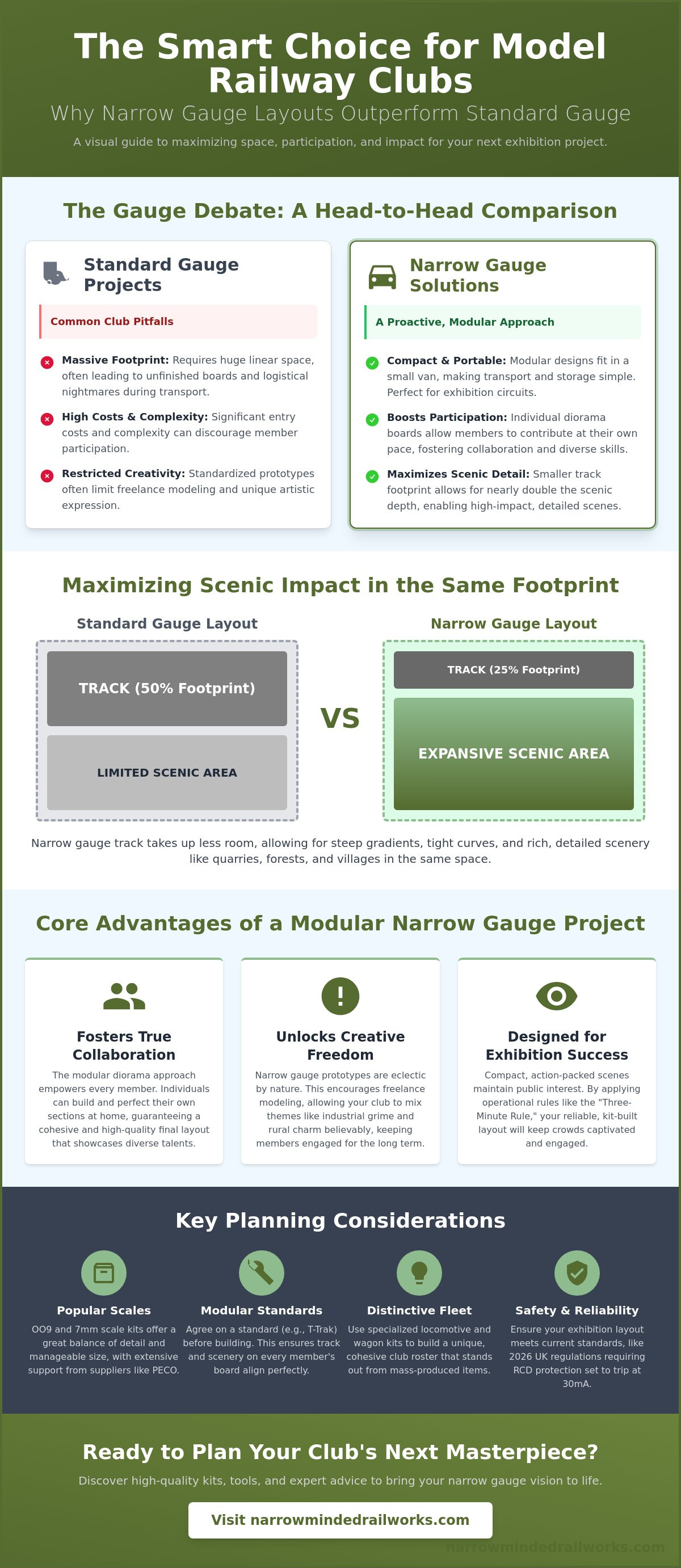
Clubs often face "standard gauge fatigue" when massive mainline projects stall due to their sheer scale and high entry costs. Shifting focus toward narrow gauge model railway club layout ideas provides a refreshing alternative that prioritizes character over length. While a standard gauge layout requires significant linear space for realistic curves, narrow gauge lines thrive on the tight radii and vertical scenery common in industrial or mountainous prototypes. This shift allows your club to build a complete, operational world within the same footprint that might only hold a single standard gauge station throat.
Witness the charm of a compact club project in this exhibition footage:
Maximising Limited Clubroom Space
Space constraints are a reality for most organizations, yet a smaller footprint shouldn't mean less ambition. When you compare an OO gauge layout to an OO9 equivalent, the narrow gauge version offers nearly double the scenic depth because the track takes up less room. You can incorporate steep gradients and sharp turns that look perfectly prototypical for a slate quarry or a rural tramway. If your clubroom is small, consider vertical storage solutions for your modular boards. This proactive approach ensures your layout stays protected between sessions without cluttering the social area.
Encouraging Member Participation
Large projects often suffer when only a few members feel confident working on the main boards. Narrow gauge layouts solve this by breaking the project into manageable diorama boards. Each member can take responsibility for a specific scene, from a gritty industrial brickworks in O-16.5 to a sleepy GN15 village halt. This variety is supported by a comprehensive guide to narrow gauge scales, which helps clubs decide which gauge fits their collective vision. By using OO9 or 7mm scale kits, members can contribute at their own pace, focusing on fine-tuning their building skills or scenery artistry. This shared workload transforms the layout from a daunting chore into a collaborative celebration of diverse modeling talents.
Standardized prototypes often restrict creativity, but narrow gauge encourages freelance modeling. If a club wants to run a timber line alongside a historical slate railway, the eclectic nature of narrow gauge makes it believable. This creative freedom is a proactive way to keep members engaged over long-term builds. Instead of debating the exact position of a signal on a mainline, your team can focus on the artistic details of weather-beaten sheds and idiosyncratic rolling stock using specialized diorama tools and scenery kits.
Mastering Modular Narrow Gauge: Planning for Interoperability
Planning a multi-member project is difficult when individual building styles and technical preferences clash. A proactive solution is to agree on a specific modular standard before the first piece of timber is cut. This ensures that your narrow gauge model railway club layout ideas result in a functional circuit rather than a collection of mismatched boards. By establishing fixed interface points for both track and scenery, you allow members to work independently at home while guaranteeing that everything will align perfectly on exhibition day.
Choosing Your Modular Standard
Selecting the right scale and modular format is the foundation of any successful club project. While the Freemo approach offers operational flexibility for point-to-point running, many UK clubs prefer more rigid standards like T-Trak or custom specifications to ensure stability during transport. OO9 remains the most popular choice for modular builds because it allows for high-detail scenes in a compact footprint. For those looking at larger scales, technical resources from the 16mm Narrow Gauge Modellers provide excellent data on standards that prioritize interoperability across different groups. Whether your club chooses GN15 for its quirky character or O-16.5 for its visual presence, consistency in your chosen standard is the key to a professional finish.
The Technical Handshake: Track and Electrics
The biggest challenge in modular modeling is "The Join," where mismatched rail heights or misaligned track can cause constant derailments. A proactive solution involves using a club-owned jig to set track height and setback from the board edge with absolute precision. This eliminates the guesswork for members building their dioramas in isolation. Standardizing your electrical bus is equally critical for a smooth-running layout. While this business doesn't sell DCC systems, your club must decide on a unified power delivery method. Using universal connectors like XLR or Anderson Powerpoles ensures that any board can plug into any other without the need for custom wiring or soldering at the show.
Safety is another non-negotiable factor for the 2026 exhibition season. Current regulations for UK model railway exhibitions require that all mains connections are made through a Residual Current Detector (RCD) set to trip at no more than 30 milliamps in less than 40 milliseconds. Implementing these safety and technical standards early makes the final assembly straightforward. If you're ready to start building your individual module, you can find specialized OO9 and O-16.5 locomotive kits to begin your contribution to the club fleet. By focusing on these technical handshakes, your club ensures that the final layout is reliable, safe, and ready to impress the public.
3 Inspiring Club Layout Themes: From Industrial Grime to Rural Charm
While many individual enthusiasts focus on shelf-sized dioramas, clubs have the unique capacity to build sprawling, cohesive worlds. Selecting a theme is the first step in aligning your narrow gauge model railway club layout ideas with a shared vision. A well-chosen concept allows different members to contribute specific scenes, such as a busy quay or a remote mountain pass, while maintaining a unified narrative across the entire display. Finding a theme that satisfies every member is a common hurdle, but adopting a multi-board industrial network or a scenic rural branch provides enough variety to keep everyone engaged.
The Industrial Powerhouse Theme
Industrial settings provide high operational value through shunting puzzles and complex track work. By integrating GN15 scenery kits, your club can add vertical interest with slate inclines or timber mills that draw the eye upward. These gritty environments are perfect for weathering enthusiasts who enjoy applying layers of rust and grime to wagons and infrastructure. Researching historical prototypes through the Narrow Gauge Railway Society ensures that your industrial network feels authentic rather than just a collection of random sidings. This proactive approach to research translates into a layout that tells a story of hard work and mechanical ingenuity.
The Scenic Rural Masterpiece
If your club prefers a more relaxed pace, a rural branch line offers the perfect canvas for wide-open landscapes. Understanding the unique aesthetic of a narrow gauge railway allows you to feature dramatic bridges and ravines that standard gauge mainlines often lack. These "parade" layouts focus on trains moving through vast, detailed scenery rather than complex shunting. Standard exhibition layouts often feel repetitive, so choosing a winter or autumn theme provides a proactive way to capture the public's attention. A layout covered in frost or golden leaves creates a memorable atmosphere that stands out in a crowded exhibition hall.
For something truly distinctive, a quirky estate railway theme allows for high-detail modeling on a smaller scale. These private lines often featured idiosyncratic rolling stock and immaculate, park-like scenery that appeals to GN15 enthusiasts. Alternatively, your club might consider dual-gauge integration, where narrow gauge tracks act as feeders to a standard gauge mainline. While the standard gauge portion might serve as a static backdrop, the narrow gauge activity provides the intricate detail and constant movement that exhibition crowds love. By focusing on these diverse themes, your club can avoid the pitfalls of uninspired design and create a layout that is both a joy to build and a highlight of the show circuit.
Exhibition Operations: Designing for Public Engagement and Reliability
Exhibiting a club layout is a logistical challenge that requires more than just attractive scenery. If the public sees a stationary train for too long, they quickly lose interest and move to the next stand. A proactive solution is the "Three-Minute Rule," which ensures that some form of movement occurs on your narrow gauge model railway club layout ideas at least every three minutes. Whether it is a locomotive emerging from a tunnel or a small shunting movement in a siding, constant activity keeps the crowd engaged. To manage this, your club should create an "Operation Manual" that assigns specific roles, such as fiddle yard management and public relations, ensuring the display runs like a professional production.
Technical failures often disrupt exhibition schedules and frustrate both operators and viewers. A proactive solution is to implement a strict track-cleaning schedule and a "kit-tuning" protocol before the layout leaves the clubroom. Because narrow gauge locomotives are often lightweight, even a small amount of oxidation on the rails can cause embarrassing stalls. Ensuring that all kit-built wagons are properly weighted and that track joints are perfectly aligned will significantly reduce derailments. This focus on reliability transforms a collection of boards into a dependable exhibition piece that represents your club's excellence.
Operational Variety and Interest
Balancing automated "tail-chasing" loops with manual shunting provides the best experience for both the operators and the audience. A hidden fiddle yard is essential for maintaining a diverse sequence of trains, allowing your team to swap out slate wagons for passenger stock without breaking the visual narrative. You can vary the visual pace of the layout by incorporating different tram loco types. These slow-moving, geared locomotives contrast effectively with faster branch line trains, adding layers of mechanical interest to the display. This variety ensures that the layout remains dynamic throughout a long show weekend.
The Exhibition 'Wow Factor'
Presentation is just as important as the models themselves. A professional fascia and a dedicated lighting rig eliminate the harsh, flat light of exhibition halls, making your scenic work pop. While your club might use sound or lights for impact, the most effective engagement often comes from "spotter cards" that encourage children to find hidden details in the scenery. When the public asks about your narrow gauge model railway club layout ideas, having a friendly member ready to explain the kits or the prototype history builds a lasting connection. Ready to add those final exhibition-standard details? You can find professional diorama tools and scenery kits to help your layout stand out from the crowd.
Building the Club Fleet: Sourcing High-Quality Kits and Accessories
The obvious hurdle for any club project is amassing enough rolling stock to keep the layout busy throughout a show weekend. While individual members might have their own collections, these often lack the visual consistency required for a professional display. A proactive solution is to develop a dedicated club fleet using high-quality kits that can be built and decorated to a single standard. By focusing on narrow gauge model railway club layout ideas that prioritize kit-building, your group can create a unique identity that stands out from layouts using mass-produced models.
The Advantages of 3D Printed Kits
3D-printed kits represent the most efficient way to expand a roster without the financial burden of traditional brass or white metal castings. These models allow for the inclusion of rare or freelance prototypes that might never be available in any other format. For a successful build, your members should follow a structured approach to painting 3D printed models; this ensures a professional finish that hides print lines. When selecting your first kit-009 or 7mm scale body, remember that while this business doesn't sell donor chassis, our kits are designed to fit common, reliable power units. This standardized approach to power ensures that every club locomotive performs consistently during long exhibition hours.
Unified Branding for Your Rolling Stock
Maintaining a cohesive look across dozens of wagons and locomotives is difficult when multiple people are involved in the construction. A proactive solution is to establish a club-specific livery and weathering style before any paint is applied. You might choose a specific shade of industrial blue or a weathered wood finish for all freight stock to tie the scene together. Using 3D printing to create custom nameplates for club members is a great way to acknowledge individual contributions while keeping the fleet unified. Once the models are painted, applying a consistent layer of grime using specialized diorama tools ensures the entire train looks like it belongs in the same environment.
A high-impact fleet needs to be populated with figures and scenery that match the chosen scale perfectly. Whether you're working in GN15 or O-16.5, sourcing figures that reflect the era and theme of your layout is essential for public engagement. By combining high-quality locomotive kits with carefully selected accessories, your club can build a diverse and reliable fleet. These narrow gauge model railway club layout ideas ensure that your 2026 exhibition season is defined by collaborative excellence and a truly unique presence on the circuit.
Launching Your Club's Next Exhibition Success
Managing a large-scale project is difficult when space and member availability are limited. Narrow gauge model railway club layout ideas provide a proactive solution by shifting the focus to manageable, high-detail modules. By establishing clear technical standards and adopting a unified theme, your club can ensure every board aligns perfectly. You don't need a massive hall to create a world-class display when you prioritize the high space-to-detail ratio that narrow gauge offers.
Building a unique fleet often feels like a daunting task for a single modeller. We offer a proactive path forward with our range of specialist 3D-printed designs for OO9, GN15, and O-16.5. These kits are specifically designed to fit reliable, commercially available chassis and are available with global shipping for international modelling societies. Explore our range of OO9 and GN15 kits for your next club project to begin crafting a professional and cohesive exhibition roster. Your club's vision for 2026 is within reach; we're excited to see what you build.
Frequently Asked Questions
What is the best scale for a narrow gauge club layout?
OO9 is often the most practical scale for clubs due to its popularity and space efficiency. It uses 9mm track to represent narrow gauge in 4mm scale, allowing for a high density of scenery. While O-16.5 offers a more significant visual presence, OO9 remains the standard for many narrow gauge model railway club layout ideas because it balances detail with portability. The choice ultimately depends on your club's storage capacity and the specific prototype you wish to model.
How much space does a modular OO9 layout typically require?
A modular OO9 layout can be surprisingly compact, with a basic loop fitting into a 4-foot by 2-foot footprint. Individual modules are often built in 2-foot or 3-foot lengths to ensure they are easy to handle. Because narrow gauge lines utilize tight curves, you can pack substantial operational interest into a small area. This compact nature provides a proactive solution for clubs that need to transport their entire layout in a single small van.
Can we mix different narrow gauge scales on the same club layout?
Mixing scales on a single layout is possible but requires a careful approach to maintain a realistic appearance. You might use OO9 for a distant mountain line while featuring O-16.5 in the foreground to create a forced perspective effect. However, most clubs prefer to stick to one scale to ensure that all rolling stock and scenery look cohesive. Standardizing on a single scale like GN15 simplifies the build process and makes the final display more professional for exhibition crowds.
How do we ensure different members' boards will actually fit together?
Precision is difficult when members work in isolation, so using a standardized club jig is a proactive solution. This tool defines the exact height and horizontal position of the track ends and the bolt holes for the baseboards. By requiring every member to use the same template, you eliminate the risk of misaligned rails at the joins. This technical handshake is the most critical part of planning any collaborative narrow gauge project.
Is narrow gauge too difficult for beginners in a club setting?
Narrow gauge is an ideal entry point for beginners because the projects are often smaller and more manageable than standard gauge mainlines. Building a simple wagon kit or a small scenic module provides a sense of achievement without a massive financial or time commitment. Clubs can proactively support new members by assigning them a small diorama board, allowing them to learn scenery and kit-building skills at their own pace while contributing to the larger group goal.
What are the most reliable chassis for kit-built narrow gauge locomotives?
Reliable running is essential for exhibition layouts, so choosing a proven donor chassis is a high priority. While this business doesn't sell motors or chassis, many club members find that N gauge power units from manufacturers like Kato or Bachmann offer the most consistent performance. Standardizing on a few specific chassis models ensures that your kit-built fleet runs smoothly. This proactive choice makes maintenance much easier for the club's technical team during long exhibition weekends.
Should a club layout be DCC or traditional DC?
The decision between DCC and traditional DC depends on your club's operational complexity and the technical skills of your members. DCC allows for independent control of multiple locomotives on the same track, which is excellent for busy exhibition displays. Traditional DC is often simpler to wire for modular layouts where boards are frequently swapped. Although we don't sell DCC systems, we recommend making this choice early to ensure all narrow gauge model railway club layout ideas are wired correctly from the start.
How do we handle the cost of building a large club exhibition piece?
Managing the budget for a large layout is difficult, but a modular approach provides a proactive financial solution. Instead of the club treasury funding the entire project, individual members can own and fund their specific boards and locomotive kits. The club then focuses its budget on shared infrastructure like the lighting rig, fascia, and main power bus. This shared responsibility makes even the most ambitious narrow gauge projects affordable for clubs of any size.