

You might assume that N scale is the only way to fit a railway into a spare room, but the most effective solution for tight corners is actually shrinking the track width rather than the locomotives themselves. Most modellers in the UK struggle with the reality that a standard OO gauge loop requires at least 1.2 metres of width just to function. It's a common frustration for the 45 percent of hobbyists who report that lack of room is their primary barrier to building a permanent layout. Finding the right model railway scales for limited space shouldn't mean you're forced to work with tiny parts that are difficult to handle or detail.
We agree that a simple oval of track often feels more like a toy than a realistic slice of the British countryside. You don't have to settle for boring designs or fiddly scales that strain your eyes. This article reveals how narrow gauge modelling allows you to use larger, highly detailed stock on track that handles incredibly tight curves without looking out of place. You'll discover how to create a character-rich scene that fits perfectly on a 90-centimetre desk or a narrow bookshelf. We are going to break down the best scale and gauge combinations to help you build a professional-grade layout in the smallest of footprints.
Key Takeaways
- Understand why traditional OO gauge layouts often struggle in modern UK homes and how to overcome the "geometry problem" of wide turning circles.
- Compare the space-saving benefits of N Gauge against the new TT:120 "Goldilocks" scale to find your ideal balance of size and detail.
- Discover why OO9 and GN15 are the ultimate model railway scales for limited space, offering high-impact character on a fraction of the footprint.
- Learn how to design micro-layouts, such as the "Pizza" style, that utilize tight 6-inch radii to fit a fully functional railway onto a bookshelf.
- Explore how modern 3D printing and specialized kits allow you to create bespoke, high-quality rolling stock tailored for niche, compact environments.
The Small Space Dilemma: Why Traditional OO and HO Scales Struggle
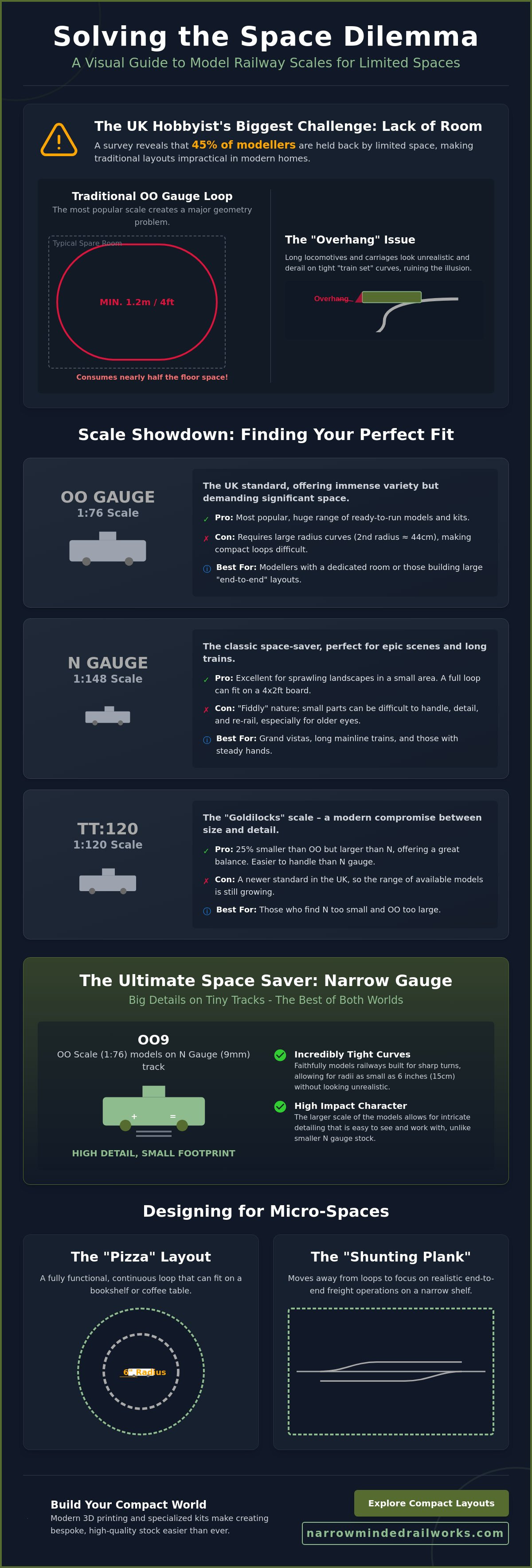
Finding the right model railway scales for limited space often feels like a battle against physics. Most UK modellers start with OO gauge, which uses a 1:76 scale. While it's the most popular choice, it creates a significant geometry problem in modern British homes. A standard double-track loop requires a minimum width of 4 feet (122cm) to allow for 2nd radius curves. When you consider that the average UK spare bedroom often measures just 8 feet by 10 feet, a permanent 4-foot wide board consumes nearly half the floor space.
To better understand how these measurements impact your hobby, watch this helpful video:
The trade-off between layout size and operational interest is a constant struggle. You might fit a loop into a tight corner, but you'll likely sacrifice the ability to perform complex shunting or include realistic scenery. In the hobby, "limited space" usually describes anything from a 4-foot shelf in an alcove to a "pizza" micro-layout that sits on a coffee table. While some people suggest switching to N or Z scale to save space, these tiny models aren't for everyone. Many enthusiasts find the smaller components difficult to handle or feel they lack the mechanical presence of larger scales.
The Minimum Radius Reality Check
Standard gauge locomotives, such as a Class 47 or a Black 5, have long, rigid wheelbases that won't navigate tight corners. If you force them around "train set" curves, they look unrealistic and frequently derail. Overhang occurs when the front or rear of a long locomotive or carriage swings out far beyond the track centreline on a sharp bend, which completely ruins the illusion of a real railway. This physical limitation is why many modellers look for a comprehensive list of narrow-gauge scales to find a better fit for tight radii.
The "Shelf Layout" Revolution
Many British modellers are moving away from the traditional "round-and-round" oval in favour of the "end-to-end" shunting plank. These layouts focus on moving wagons between sidings rather than watching a train orbit a loop. This shift encourages higher levels of scenery detail because you're viewing the scene from a fixed perspective. Historically, narrow gauge railways are perfectly suited to these shelf layouts. In the real world, these lines were built to navigate steep hills and sharp curves that standard tracks couldn't handle, making them the ideal prototype for a model railway scales for limited space project.
Comparing Compact Standards: N Gauge, TT:120, and the Rise of OO9
Choosing between model railway scales for limited space involves balancing physical size with the level of detail you can actually see. For decades, N Gauge (1:148 in the UK) was the default choice for anyone without a spare room to dedicate to the hobby. It's excellent for watching long freight trains wind through a sprawling landscape. The trade-off is the "fiddly" nature of the stock. Rerailing a tiny wagon or cleaning delicate 1:148 scale components requires steady hands and sharp eyesight. Many modellers find that as they get older, the charm of N gauge is outweighed by the frustration of handling such small parts.
The landscape changed in 2022 when Hornby threw its weight behind TT:120. This 1:120 scale is often called the "Goldilocks" standard. It's larger than N gauge but roughly 25% smaller than traditional OO gauge. It offers a middle ground where you can still fit a continuous loop on a standard 4x2 foot MDF board without sacrificing the ability to see individual rivets on a locomotive. However, because it's a relatively new push in the UK market, the variety of ready-to-run models is still catching up to more established scales.
If you only have a 4x1 foot shelf, the comparison becomes even more stark. In OO gauge, this space only allows for a simple shunting plank. In N gauge, you can fit a full station, but it can feel visually "thin." This is where OO9 scale excels. By using 1:76 scale bodies on 9mm track, you get the chunky, detailed feel of a standard UK model with a footprint that fits almost anywhere. Because narrow gauge prototypes used incredibly tight curves in real life, a 9-inch radius curve on your layout looks perfectly natural rather than a toy-like compromise.
N Gauge vs. OO9: The Gauge vs. Scale Debate
Both N gauge and OO9 use 9mm track, but they look nothing alike. OO9 models are nearly twice the size of their N gauge counterparts because they represent narrow gauge trains (like those in North Wales) built to 1:76 scale. This allows for realistic steam locomotive cabs and intricate valve gear that you can actually enjoy without a magnifying glass. If you want to explore this further, this beginner’s guide to OO9 kits explains how to start building your own high-detail fleet.
Is TT:120 Right for You?
TT:120 is a strong contender for modern UK housing. It solves the space issue while maintaining a presence on the track that N gauge lacks. The main hurdle is the track geometry. Even though the trains are smaller than OO, they still require relatively wide curves to look realistic. If your goal is a compact, winding mountain railway, OO9 remains the superior choice for model railway scales for limited space. TT:120 is better suited for those who want a "mainline" feel in a smaller room. You might find that starting with a small kit is a more manageable way to test your skills before committing to a full-sized TT:120 project.
The Narrow Gauge Advantage: Big Details on Tiny Tracks
Narrow gauge equipment is designed for agility and economy. In the real world, these railways served mines, quarries, and rural farms where standard gauge track was too expensive or bulky to install. Because the prototypes relied on short wheelbases, model versions can handle incredibly tight curves. You can build a layout with a radius as small as 150mm or 225mm without it looking unrealistic. This makes narrow gauge one of the most effective model railway scales for limited space because it fits where standard OO gauge simply cannot turn. The tight-radius capability allows for complex, winding track plans in corners of a room that would otherwise be wasted.
The Magic of GN15
GN15 is a unique "minimum space" scale that offers a surprising shortcut for modellers. It uses 16.5mm track, which is the same width as standard OO gauge, to represent 15-inch gauge railways in 1:24 scale. This means you get the heft and presence of a large-scale locomotive on a track that fits on a standard 30cm deep bookshelf. It's the ultimate way to achieve "minimum space, maximum personality" dioramas. Many hobbyists use this scale to create whimsical estate railways or industrial scenes where the focus is on heavy weathering and characterful figures. You can find detailed layout inspiration in this GN15 scale guide. It provides a way to enjoy large-scale modelling without needing a garden or a massive shed.
On30 and 7mm Narrow Gauge
If you find N gauge too fiddly to handle, On30 is a brilliant alternative. This scale uses 16.5mm track to represent 30-inch gauge railways in O scale (1:48). In the United Kingdom, many modellers prefer 7mm narrow gauge (O16.5), which uses the same track width but at 1:43.5 scale. The larger size of the rolling stock is a massive benefit for hobbyists with poor eyesight or shaky hands. You don't have to sacrifice detail for space. You can build characterful industrial scenes, such as a Victorian brickworks or a timber yard, in a space as small as 60cm by 60cm. This introduction to On30 gauge explains how to use readily available track to build a professional-looking O scale world. These model railway scales for limited space work because the industrial prototypes they mimic were naturally cramped and cluttered.
Narrow gauge prototypes justify these compact designs. A 19th-century slate quarry in North Wales didn't have room for sweeping curves; they used narrow tracks that twisted around rock faces and through tight tunnels. When you model these specific industries, a layout that would look "too small" for a standard passenger train suddenly looks perfectly prototypical. You can fit a full circuit, a small engine shed, and a loading wharf into a space no larger than a kitchen tray.
Designing for Micro-Spaces: Minimum Radii and the Pizza Layout
When you're comparing model railway scales for limited space, the physics of the curve dictates your entire design. Narrow gauge scales like OO9 allow for radii as tight as 6 to 9 inches without looking unrealistic. Compare this to standard OO gauge, where a "First Radius" curve requires roughly 15 to 18 inches of clearance. This geometric advantage means you can fit a full continuous loop on a circular baseboard no larger than a standard 18-inch pizza box. These "Pizza Layouts" aren't just novelty items; they're masterclasses in scenic density where every square inch is utilised for storytelling.
Traditional points take up significant linear room. A standard OO gauge point often exceeds 160mm in length. By using a sector plate, which is a pivoting section of track, or a traverser that slides laterally, you eliminate the need for a long throat of pointwork. This approach saves roughly 30% of your total baseboard length. It's a vital tactic when model railway scales for limited space require you to cram maximum functionality into a shelf that's only 3 or 4 feet long. You can also gain depth by building upwards. Incorporating a high-level narrow gauge line over a standard gauge interchange adds vertical complexity without requiring a wider footprint.
Planning Your First Micro-Layout
Micro-layouts thrive on specific, narrow themes. Industrial settings or rural Welsh slate quarries are perfect because sharp curves look prototypical rather than forced. The "Box File" layout is a classic British project where a working shunting puzzle fits inside a standard A4 stationery folder. When laying track for these ultra-tight turns, use a track gauge tool to ensure the rails don't pinch. Even a 1mm deviation on a 6-inch radius curve will cause constant derailments for longer wheelbases.
Scenery Tricks for Small Layouts
You can make a 6-inch deep shelf feel like a vast landscape through forced perspective. Place OO9 stock in the foreground and use N scale or even Z scale buildings in the background to trick the eye. View blocks like tall warehouses, thick treelines, or bridge overpasses are essential. They break the line of sight so the viewer doesn't see the train enter and exit the same loop simultaneously. For urban environments, tram locos are ideal because their short wheelbases handle tight street corners without the unsightly overhang seen on larger locomotives.
Ready to start your own compact project? Explore our range of narrow gauge kits to find the perfect fit for your micro-layout.
Building Your Compact World: Kits and 3D Printing for Niche Scales
Narrow gauge modelling thrives on individual creativity rather than off-the-shelf convenience. While mainstream OO gauge relies on mass-produced locomotives from industrial giants, model railway scales for limited space often require a more hands-on approach. Major manufacturers typically focus on high-volume sales, which leaves a gap for the quirky, regional prototypes that make narrow gauge so charming. This is where kits become the lifeblood of the hobby. Since 2020, the shift from traditional white metal or etched brass toward high-quality resin has lowered the barrier to entry for beginners.
The 3D printing revolution has fundamentally changed how we build layouts. You're no longer limited to what's available in a local hobby shop's glass cabinet. Instead, you can source a highly detailed locomotive body designed to fit directly onto a mass-produced, reliable chassis. This "kitbashing" method combines the best of both worlds: the smooth running of a modern motor and the unique aesthetics of a niche prototype. As we move into 2026, the precision of home and commercial 3D printers means that even the smallest 009 or N-scale components boast incredible detail.
The Power of 3D Printed Kits
3D printing solves the problem of variety by allowing designers to produce small batches of unique models that major brands ignore. You aren't stuck with the same three locomotives everyone else owns. You can easily fit a custom 3D printed body onto an N-gauge chassis from brands like Kato or Graham Farish, which often cost between £30 and £60. This creates a bespoke engine that fits perfectly within model railway scales for limited space. To get the best results, you'll need to master the finishing process. Learning the right techniques for painting 3D printed models is essential to hide print layers and achieve a professional, factory-quality look. A well-painted resin kit is often indistinguishable from a die-cast model.
Sourcing Parts for Niche Scales
Finding the right "donor" chassis is the first step in your build. For 009 layouts, the Kato 11-103 or 11-109 power units are industry standards in the UK, providing excellent slow-speed crawling for small shunting yards. If you're exploring the larger GN15 scale, you might use a standard OO gauge chassis from a Hornby or Bachmann 0-4-0 locomotive. Narrow Minded Railworks bridges the gap for modellers by providing the essential components that bring a scene to life. Their range includes:
- Bespoke rolling stock: Wagons and carriages designed for tight radii.
- Scenery items: Scale-accurate details that define the narrow gauge atmosphere.
- Ready-to-paint kits: High-resolution resin prints that save hours of scratch-building.
Don't let a lack of space stop your ambitions. By combining reliable Japanese or British chassis with custom bodies, you can build a functional, beautiful railway on a shelf or in a suitcase. Start your small-space journey with a Narrow Minded kit today and discover the secret to a high-detail, low-footprint hobby.
Start Your Narrow Gauge Journey Today
Choosing model railway scales for limited space doesn't mean sacrificing detail for size. While traditional OO gauge requires at least 438mm for a standard first-radius curve, OO9 layouts thrive on tight 152mm radii, making them perfect for bookshelves or "pizza" style micro-layouts. You can now pack the character of a Welsh slate quarry or a rural industrial line into a footprint smaller than a standard laptop. These niche scales offer a creative escape from the rigid constraints of mainline modeling.
At Narrow Minded Railworks, we're specialists in these unique narrow gauge scales. We provide expertly designed 3D printed locomotive and wagon bodies that bring high-end realism to your compact project. Whether you're building a tiny OO9 scene or a rugged GN15 layout, our kits help you maximize every square inch of your hobby room. We offer worldwide shipping to modellers everywhere, ensuring you have the parts you need regardless of your location.
Explore our range of space-saving OO9 and GN15 kits and see how easy it is to build a professional-grade railway in the smallest of corners. It's time to stop worrying about your floor plan and start building your dream layout.
Frequently Asked Questions
What is the smallest model railway scale for a very limited space?
T gauge, at 1:450 scale, is the smallest commercially available model railway scale for limited space. It runs on 3mm gauge track, allowing a complete oval to fit on a standard A4 sheet of paper. While Z gauge is more common in the UK market, T gauge offers a 50 percent reduction in size compared to its closest rivals. This makes it the only viable option for modellers who only have a desktop or a small shelf available.
Can I run OO9 trains on N gauge track?
You can run OO9 trains on N gauge track because both systems use a 9mm rail width. OO9 represents narrow gauge prototypes at 4mm to the foot scale, while N gauge uses the same track width for standard gauge at 2mm to the foot. Most UK modellers prefer Peco Streamline SL-400 track for these layouts; standard N gauge sleepers look too small and are spaced too closely for realistic narrow gauge prototypes.
How much space do I need for a basic TT:120 layout?
A basic TT:120 layout typically requires a minimum space of 1200mm by 600mm for a simple oval. This scale is exactly 1:120, sitting perfectly between OO and N gauge. Hornby reintroduced this scale to the UK in 2022, providing a solution for enthusiasts who find N gauge too small to handle but lack the room for traditional OO layouts. A 1200mm length allows for a small station and a passing loop with ease.
Is narrow gauge modelling harder for beginners than standard scales?
Narrow gauge modelling isn't harder than standard scales, though it often involves more kit-building than ready-to-run alternatives. Since 2015, manufacturers like Peco and Bachmann have released numerous OO9 locomotives, making it much easier for novices to start without soldering. It offers more creative freedom because narrow gauge prototypes often used mismatched rolling stock and tight curves that wouldn't be acceptable on a standard mainline.
What is a "shunting plank" and why is it good for small spaces?
A shunting plank is a small, linear layout designed for moving wagons between sidings rather than running continuous loops. These layouts often measure just 1200mm by 300mm, making them ideal model railway scales for limited space projects. They focus on operational puzzles, such as the Inglenook Sidings design. This specific track plan uses three tracks to test a driver's ability to sort wagons in a specific order using limited headshunt space.
What is the minimum radius for an OO9 locomotive?
The standard minimum radius for most OO9 locomotives is 228mm, which is approximately 9 inches. Some smaller 0-4-0 engines can handle 150mm curves, but 228mm ensures reliable running for longer 0-6-0 wheelbases. Using this tight radius allows you to create a 180 degree turn in just 500mm of total shelf depth. This is 40 percent less space than a standard OO gauge second-radius curve requires for a successful turn.
Do I need special tools to build 3D printed railway kits?
You don't need specialized industrial tools, but a set of fine needle files and high quality CA glue are essential for success. 3D printed resin is more brittle than injection-moulded plastic; a 0.5mm micro-drill bit is necessary for clearing out pre-printed holes without cracking the body. Since 2020, many UK enthusiasts have moved to 8K resolution resin prints. These require minimal sanding compared to older filament-based models from a decade ago.
Can I build a GN15 layout on a standard bookshelf?
You can definitely build a GN15 layout on a standard 800mm wide bookshelf. GN15 uses 1:22.5 scale figures on 16.5mm track, representing 15-inch gauge estate railways. Because the prototypes were tiny, a layout with a 200mm radius curve fits comfortably on a shallow shelf. This makes it one of the most effective model railway scales for limited space when you want large, detailed models in a tiny footprint.