

What if you could build a complete, functioning layout for less than the price of a single high-end digital locomotive? It's easy to feel overwhelmed by the rising prices in hobby shops across the UK, especially when a single ready-to-run engine can now retail for over £250. You likely worry that the total cost of starting a model railway will spiral out of control once you add up the track, controllers, and those sneaky hidden extras like soldering irons or scenic scatters.
I'll show you exactly how to budget for your first project in 2026 without any nasty surprises. You'll learn where to find the best value between OO and N scales and how building your own kits can slash your initial investment by 30 percent. From a basic £150 entry-level loop to a sophisticated £1,200 digital masterpiece, this guide provides a realistic shopping list to help you get your trains moving without breaking the bank.
Key Takeaways
- Learn to distinguish between budget-friendly "Entry Tier" setups and high-end layouts to avoid the common "starter set trap" that can cost more over time.
- Uncover the hidden infrastructure costs, from timber baseboards to essential workbench tools, that are often overlooked by beginners.
- Compare the financial impact of different scales like OO, N, and Narrow Gauge to find the perfect balance between your available space and your wallet.
- Discover how 3D printing and kit-building can significantly reduce your locomotive expenses compared to buying expensive ready-to-run alternatives.
- Follow a practical 6-month roadmap to effectively manage the cost of starting a model railway with a sample £250 starter budget.
The Initial Investment: Breaking Down Model Railway Costs in 2026
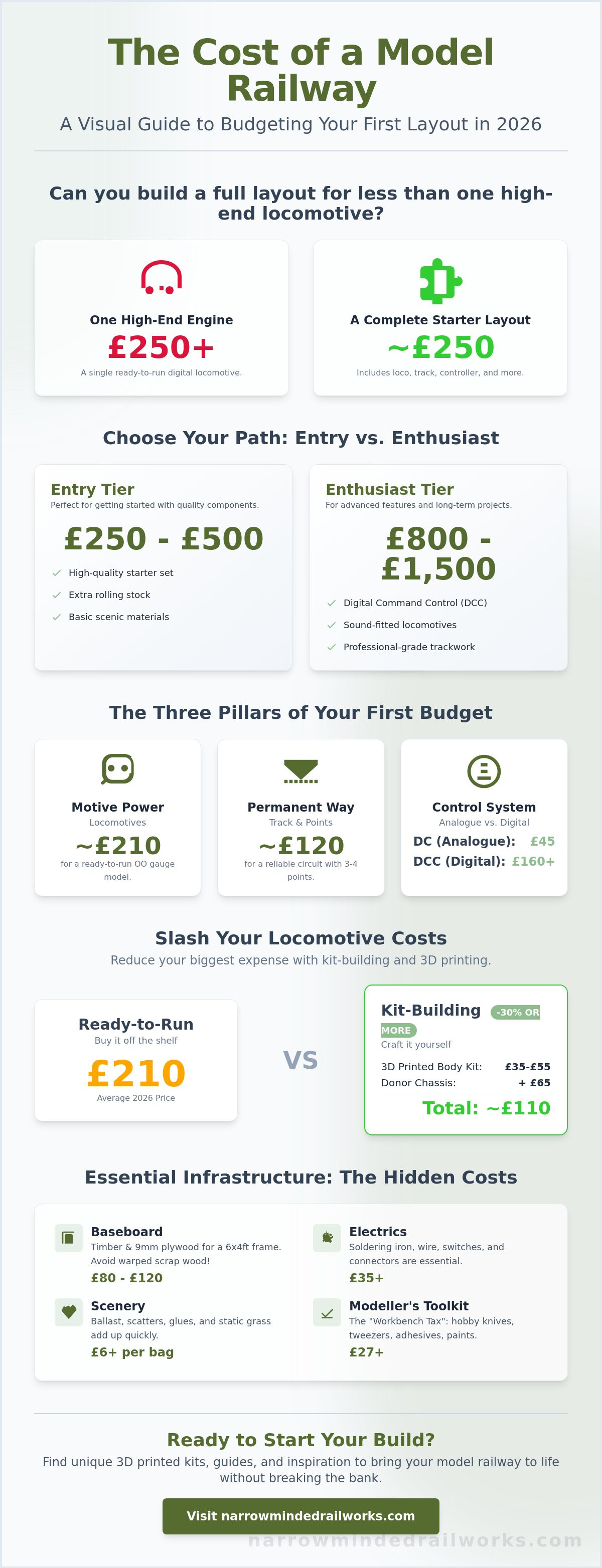
Starting a model railway in 2026 requires a clear-eyed look at your bank balance before you buy your first locomotive. The cost of starting a model railway is largely determined by your choice between the Entry Tier and the Enthusiast Tier. An Entry Tier budget typically sits between £250 and £500, which secures a high-quality starter set, a few extra pieces of rolling stock, and basic scenic materials. Conversely, the Enthusiast Tier ranges from £800 to £1,500. This higher bracket accounts for digital control systems, sound-fitted locomotives, and professional-grade track work. For a standard 4x2 foot layout, most UK modellers spend approximately £450 to achieve a finished, functional loop with basic scenery.
You might feel tempted by the "Starter Set" trap. These boxes, often priced under £150, look like a bargain. However, they frequently include basic plastic controllers and simplified rolling stock that serious hobbyists outgrow within months. Replacing these components later means you've paid for them twice. Before committing your funds, it's wise to read a model railway overview to understand which scales and standards will best suit your long-term goals. Planning for quality from the start prevents the frustration of unreliable running and poor electrical contact.
To better understand how these expenses add up, watch this helpful video:
The Total Cost of Ownership for a first-year modeller represents the combined price of the initial hardware, the ongoing investment in maintenance tools, and the incremental cost of expanding the layout's scenery and rolling stock.
The Three Pillars of Your First Budget
Motive power is your largest single expense. In 2026, a single high-specification locomotive is the heart of your layout, but it's nothing without the permanent way. A reliable circuit of track with three or four points costs roughly £120. Finally, your control system dictates the cost of starting a model railway experience. While a basic analogue (DC) controller costs about £45, a modern Digital Command Control (DCC) system starts at £160, offering far more realistic multi-train operation.
Ready-to-Run vs. Kit Building Costs
The average price of a brand-name OO gauge locomotive in 2026 has reached approximately £210 for a standard steam or diesel model. If you're looking to save money or build something unique, 3D-printed body kits are a viable alternative, costing between £35 and £55. You'll still need a donor chassis, which adds another £65 to the total. Interestingly, narrow gauge modelling often provides more "modelling per pound." Because the engines are smaller and the layouts more compact, your budget goes further in creating a dense, detailed environment compared to standard gauge mainline projects.
Essential Infrastructure: The Hidden Costs Beginners Miss
The cost of starting a model railway often balloons because beginners overlook the foundation. You can't simply run a locomotive on the carpet without risking motor damage from dust and fibres. A sturdy baseboard is essential. For a standard 6ft by 4ft layout, expect to pay between £80 and £120 for quality 9mm birch plywood and planed timber framing from UK DIY retailers like B&Q or Wickes. While scrap wood is cheaper, it often warps in damp garages or lofts, leading to derailed trains and a wasted investment.
Electrics represent another hidden layer of expenditure. Even a basic DC analogue loop requires 16/0.2mm equipment wire and a soldering iron. A decent 25W iron costs roughly £20, while a 100m reel of layout wire adds £15. if you plan to automate your points, budget an additional £5 to £8 per motor plus the cost of toggle switches. Scenery also adds up quickly. A single 500g bag of ballast covers about 3 metres of track and costs around £6; a mid-sized layout might need five bags just to finish the trackbed surfaces.
The Modeller’s Toolkit
Every hobbyist pays a "Workbench Tax" during their first year. You'll need a sharp hobby knife (£10), precision tweezers (£5), and various adhesives like PVA and plastic cement (£12 total). Investing in quality painting 3D printed models supplies early prevents the frustration of thick, streaky finishes on your rolling stock. Cheap brushes shed hairs and ruin expensive kits, which inevitably leads to higher costs when you have to buy replacements or strip paint from a ruined model.
Powering Your World
Control systems dictate the long-term cost of starting a model railway. A basic analogue controller from brands like Gaugemaster typically starts between £35 and £60. This is perfect for running one train at a time, but if you want to control multiple locos independently on the same track, you need Digital Command Control (DCC). Entry-level DCC systems, such as the Hornby Select or NCE PowerCab, begin at £150. You must also account for DCC decoders, which cost approximately £25 for every locomotive you own. Larger layouts may require a 5-amp power booster to maintain consistent voltage across all track sections.
Scale and Gauge: How Choice Affects Your Wallet
Choosing your scale is the most significant financial decision you'll make. Most beginners gravitate toward OO gauge because it's the UK standard. Since manufacturers like Hornby and Bachmann produce items in huge volumes, the entry price for a basic starter set often sits between £100 and £160. N gauge offers a space-saving alternative, but don't assume it's cheaper. While the locomotives are smaller, the intricate engineering often keeps prices level with their OO counterparts. A standard N gauge locomotive in 2026 typically costs between £90 and £170.
Narrow gauge modeling provides a unique way to control the cost of starting a model railway. By following a narrow gauge railway guide, you'll see that these layouts focus on character rather than sprawling mainlines. You can build a complete, highly detailed scene in the space of a small bookshelf. This reduces the amount of track and scenery you need to purchase, which are often the hidden "budget killers" in larger projects.
OO9 and GN15: The Sweet Spot for Kit Builders
For those who enjoy a hands-on approach, OO9 and GN15 scales are budget-friendly options. You can source a reliable Kato or Bachmann four-wheel chassis for approximately £35 to £50. Adding a 3D-printed or resin body kit for £25 creates a unique locomotive for under £80. This is significantly cheaper than buying a premium ready-to-run model. A small GN15 scale industrial layout might only require three or four wagons and a single locomotive to feel complete. This minimalist approach keeps your initial investment low while maximizing the creative output.
Large Scale Modelling (7mm/O Scale)
Stepping up to 7mm or O scale usually means a jump in price. A single O gauge locomotive can easily exceed £300. You can mitigate these costs by building "Micro Layouts." Focusing on a tiny shunting plank or a small engine shed allows you to invest in high-quality items without needing a massive inventory. If you're interested in narrow gauge in this larger size, read this On30 gauge intro. It explains how using HO track with O scale stock keeps expenses manageable. This strategy is a popular way to lower the cost of starting a model railway when you want the physical presence of a larger scale.
The Kit-Building Advantage: Reducing Costs Through Craftsmanship
The financial barrier to entry in this hobby often feels steep, but savvy hobbyists in 2026 are bypassing high retail prices through craftsmanship. 3D printing technology has fundamentally changed the cost of starting a model railway by offering high-fidelity alternatives to mass-produced items. While a premium Ready-to-Run (RTR) locomotive might set you back £200, a high-quality 3D printed body kit costs roughly £40. When you pair this with a reliable £60 chassis, you've created a unique piece of motive power for half the price of a store-bought equivalent.
This approach extends to rolling stock. A single detailed wagon often retails for £30 or more. By purchasing multi-packs of 3D printed frames or laser-cut wood kits, you can often assemble three or four wagons for the same price. Beyond the financial savings, there's a psychological benefit. Building your own models fosters a slower, more intentional pace. It discourages the box-opening culture that leads to overspending, making the hobby more sustainable for your bank balance in the long run.
Locomotive Body Kits
Choosing your first kit-009 is the most effective way to lower the cost of starting a model railway without sacrificing detail. Most modern kits are designed to fit onto standard, mass-produced power units from brands like Kato or Bachmann. The assembly process usually involves cleaning the 3D print, priming the surface, and securing it to the chassis with a few screws or adhesive. You save approximately 50% per locomotive compared to premium RTR models, allowing you to build a diverse fleet on a modest budget.
Scenery and Buildings on a Budget
Structures often consume a large portion of a layout budget. Resin-cast buildings are beautiful but expensive; they often cost between £40 and £80 for a single station. 3D printed building kits or downloadable card models offer a more affordable path. You can achieve high-end looks by using diorama tools like weathering powders and static grass. A scratch-building hybrid approach is even more effective. Use a basic kit for the core structure and add detail using household materials like cereal boxes or coffee stirrers. This technique reduces the cost of a town scene by 70% while ensuring no two layouts look identical.
Budgeting Your First Build with Narrow Minded Railworks
Managing the cost of starting a model railway in 2026 is simpler when you break the project into manageable financial milestones. You don't need to spend thousands of pounds upfront to create a professional looking layout. By focusing on high quality kits and a "slow modelling" approach, you can build a stunning narrow gauge scene for a total investment of approximately £250. This budget covers everything from the baseboard to the rolling stock. Here is a sample shopping list to get you started:
- Micro-layout baseboard materials: £30
- Short length of flexible track and one point: £35
- Narrow Minded Railworks wagon kit: £20
- Locomotive body kit: £35
- Compatible motorised power chassis: £65
- Basic tool kit and adhesives: £35
- Scenery starters (static grass and ballast): £30
It's often tempting to buy a ready-to-run train set, but these frequently lack the character of a custom build. Choosing a tram loco or a small industrial engine is the smartest strategy for beginners. These kits are designed to fit onto affordable, pre-made chassis. Because they are compact, they require less space and fewer materials to look "finished," which keeps your initial 2026 hobby budget under control.
Phase 1: The Micro-Layout Foundation
During the first three months, your goal is to establish a workspace and build your first piece of rolling stock. You can set up a dedicated modelling station for under £50 by purchasing a self-healing cutting mat, a sharp craft knife, and a bottle of high quality plastic glue. Spend this time assembling a single wagon kit. Focus on the fine details, such as painting and weathering, before you even think about buying a locomotive. This approach ensures you develop the necessary skills without feeling overwhelmed by a massive "to-do" list.
Phase 2: Motive Power and Detail
Months four through six focus on bringing movement to your rails. This is when you invest in your primary locomotive body and its matching chassis. By spreading the cost of starting a model railway over half a year, the £100 investment for a powered engine feels much more manageable. Once your loco is running, you can add life to the scene with a few figures and basic scenery. You'll find that a small, highly detailed layout is far more satisfying than a large, empty one.
Ultimately, this hobby is an investment in your own skills. Every pound spent on a Narrow Minded Railworks kit is a pound spent learning about engineering, history, and artistry. You aren't just purchasing a product; you're building a miniature world that reflects your own creativity. Start small, focus on quality over quantity, and you'll find that 2026 is the perfect year to become a master modeller.
Launch Your Narrow Gauge Journey Today
Navigating the cost of starting a model railway in 2026 doesn't have to be a daunting financial hurdle. By choosing versatile scales like OO9 or GN15, you can maximise your layout space and your budget simultaneously. Industry data suggests that infrastructure and track often account for 30% of an initial £300 setup, but kit building offers a clear path to substantial savings. Crafting your own rolling stock reduces retail markups while adding a unique, personal touch to your scene. Narrow Minded Railworks specialises in high-quality 3D printed narrow gauge kits designed specifically to fit common, affordable chassis found throughout the UK. We provide worldwide shipping to ensure every modeller can access our precision designs. You'll find that starting with a kit-first approach allows for better detail and more manageable spending as your skills grow. Don't let the rising prices of ready-to-run models stop you from enjoying this rewarding hobby. Browse our range of affordable OO9 and GN15 kits to start your journey and see how easy it is to build something remarkable. Your first engine is waiting to take shape on your workbench.
Frequently Asked Questions
How much should a beginner spend on their first model railway?
A beginner should budget between £150 and £250 for a reliable entry into the hobby. This amount covers a high-quality OO gauge starter set from brands like Hornby, which includes a locomotive, rolling stock, a track oval, and a power controller. If you opt for second-hand items from local hobby shops, you can often reduce this initial outlay by 30%.
Is it cheaper to build a model railway from kits or buy ready-to-run?
Building from kits is almost always cheaper than buying ready-to-run models. For example, a plastic wagon kit might cost you £12, whereas a finished version of the same model often retails for £28. You'll need to invest about £15 in basic tools like side cutters and plastic glue, but these tools will last for dozens of future projects.
What is the most expensive part of a model railway?
The locomotive is the most expensive single component of any layout. A modern, highly detailed steam engine typically costs between £150 and £250. If you want "DCC Sound" features, expect to pay an additional £100 premium. Track and scenery are cheaper individually, but their cumulative cost can surprise you if you're building a large, permanent display.
Can I build a model railway on a budget of £100?
You can definitely begin with £100 if you focus on the second-hand market. The cost of starting a model railway drops significantly when you purchase pre-owned locomotives from reputable UK dealers or local swap meets. A basic analogue setup with a single engine and a small loop of track fits comfortably within this three-figure budget.
Which scale is the cheapest to start in?
OO gauge is typically the cheapest scale because it's the most popular size in the UK. Since it dominates about 70% of the domestic market, there's a massive supply of affordable new and used equipment. N gauge items are often 10% to 20% more expensive because the precision engineering required for smaller components carries a higher manufacturing price.
Do I need expensive digital controllers (DCC) to start?
You don't need a Digital Command Control (DCC) system to enjoy your first layout. Standard analogue (DC) controllers are much cheaper, usually costing around £35 compared to £130 for a basic DCC unit. While DCC allows you to run multiple trains independently, starting with DC keeps your initial expenses low while you learn the basics of track wiring.
How much space do I need for a budget-friendly layout?
You only need a space measuring 4 feet by 1 foot to build a functional "shunting plank" layout. Small shelf layouts are budget-friendly because they require fewer materials, such as 50% less track and ballast compared to a traditional 6x4 foot loop. This compact approach allows you to focus your funds on higher quality models rather than sprawling infrastructure.
Are 3D printed kits durable enough for beginners?
Modern 3D printed kits are durable enough for beginners, provided you choose the right materials. Resin prints produced with "ABS-like" or "tough" resins offer 20% better flexibility than standard resins, making them less likely to snap during assembly. These kits are a cost-effective way to add unique buildings or wagons to your layout without the high price of die-cast models.