

What if you could build an entire, character-filled railway system on a single bookshelf without sacrificing the detail of larger scales? Many enthusiasts feel restricted by the footprint of standard gauge layouts; however, narrow gauge modelling offers a creative way to maximise small environments. While the terminology of scale versus gauge often causes initial confusion, getting started with oo9 model railways is more straightforward than it first appears. This guide helps you bridge that gap by utilising the compact nature of N gauge track to support highly detailed 4mm scale models.
You might find that ready-to-run models are less prevalent in this niche compared to standard scales. We address this constraint by providing a roadmap for using 3D-printed resin kits, which serve as an affordable and high-quality entry point for the modern hobbyist. By the end of this article, you'll have a clear understanding of the technical requirements for OO9 and the confidence to begin your first locomotive project. We'll explore how to select the right components and provide practical steps for finishing your models to a professional standard.
Key Takeaways
- While standard gauge layouts often require significant room, OO9 allows you to build a complete 1:76 scale world on a compact bookshelf or micro-board.
- Ready-to-run models may be limited in variety; however, 3D-printed kits provide an affordable way to recreate hundreds of unique UK narrow gauge prototypes.
- Technical specifications can be confusing for beginners, but we clarify how 4mm scale models operate seamlessly on standard 9mm N gauge track.
- Starting a new project can feel daunting, so we provide a clear roadmap for getting started with oo9 model railways using easy-to-find donor chassis.
- Complex kit building might seem intimidating, but modern resin prints offer a smooth surface that simplifies the painting and finishing process for newcomers.
What is OO9 Model Railway Modelling?
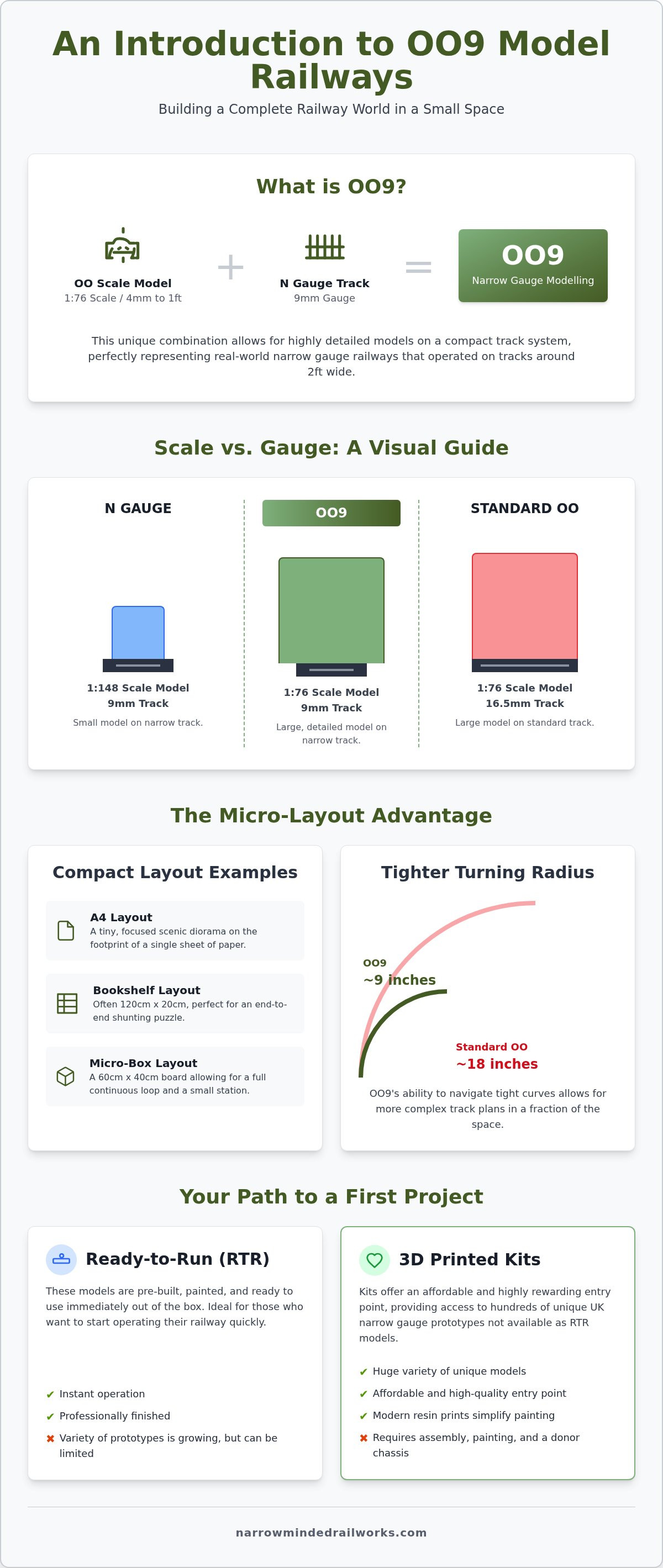
OO9 modelling represents a specific niche within the hobby that combines the popular 4mm to the foot scale (1:76) with a 9mm track gauge. While "OO" refers to the scale of the models, the "9" denotes the width of the rails in millimetres. This combination allows modellers to recreate narrow gauge prototypes, specifically those that operated on tracks between 2 feet and 2 feet 3 inches wide. These railways were once common across the British Isles, serving industries like slate quarrying, agriculture, and remote passenger communities.
Modellers often face the constraint of limited space in modern UK homes, which makes traditional OO gauge layouts difficult to accommodate. Getting started with oo9 model railways provides a proactive solution to this challenge. Because the track is narrower, the curves can be much tighter, allowing for a complete, scenic circuit to fit on a modest bookshelf or a small diorama board. Unlike standard gauge OO, which focuses on heavy mainline traffic, OO9 captures the charm of smaller, often eccentric locomotives and rolling stock.
The Relationship Between Scale and Gauge
A common point of confusion for beginners is why OO9 uses N gauge track despite the models being significantly larger than N gauge stock. The answer lies in the prototype's dimensions. In the real world, narrow gauge rails are physically closer together than the standard 4 feet 8.5 inches. By using 9mm track, which is the standard for N gauge, 1:76 scale models accurately represent these narrow lines. This results in locomotives that have the height and detail of standard OO models but sit on a much narrower footprint. Beginners should note that while the track gauge is the same as N gauge, the clearances for tunnels and platforms must accommodate the larger 4mm scale bodies.
A Brief Intro to Narrow Gauge Railways
The inspiration for OO9 comes from iconic British lines such as the Ffestiniog, Talyllyn, and Welsh Highland Railways. These railways were built to navigate difficult terrain and tight corners that standard mainline engines couldn't manage. This heritage makes the scale perfect for creating characterful, quirky layouts with steep gradients and sharp bends. If you're unfamiliar with the history of these lines, you can find a deeper context in our guide on what is a narrow gauge railway. Understanding these real-world constraints helps you design a more authentic miniature world where every curve and siding serves a clear industrial or passenger purpose.
Why Choose OO9 for Your Next Layout?
While a standard OO gauge layout often requires a dedicated spare room, OO9 provides a proactive solution for those with limited space. You don't need a loft or a garage to enjoy the hobby. Instead, you can build a complete, scenic world on a single bookshelf or a compact "micro" board. This space efficiency is a primary reason why many hobbyists are getting started with oo9 model railways today. You get the benefit of 4mm scale detailing, which is much easier to paint and weather than N gauge, without the sprawling footprint of mainline railways.
While the availability of ready-to-run models is currently growing, it remains limited compared to standard scales; however, the kit-building community provides a proactive solution through 3D-printing technology. The OO9 community is notably helpful and focuses heavily on sharing innovations. Because the scale is 1:76, you can use the vast range of standard OO gauge figures, vehicles, and buildings already available in UK model shops. You gain the benefits of a massive accessories market while maintaining the compact layout size of a smaller gauge.
The "Micro-Layout" Advantage
Standard OO gauge locomotives usually require a minimum curve radius of about 17 or 18 inches. Narrow gauge prototypes were designed for tight environments, so your models can comfortably navigate 9-inch radius curves. These smaller projects lead to much higher completion rates. You can finish a high-quality layout in weeks rather than years, providing a sense of achievement that keeps the hobby engaging. Typical dimensions for a beginner OO9 diorama often include:
- A4 Layout: A tiny scenic scene built on the footprint of a single sheet of paper.
- Bookshelf: 120cm by 20cm, perfect for an end-to-end shunting plank.
- Micro-Box: 60cm by 40cm, allowing for a full continuous loop and a small station.
Character Over Uniformity
Narrow gauge railways were rarely uniform. They often used a mix of second-hand equipment and bespoke builds, giving you immense creative freedom. You aren't tied to a specific region or era. You can mix a Welsh quarry engine with a colonial-style coach if it fits your story. This "freelance" approach is perfect for those who enjoy the character of steam "tram locos" or vertical boiler engines. If you find inspiration in creating atmospheric settings and backstories for your layouts, you may also wish to check out Lonely Ballerina to explore the evocative novels of David Williams. Many hobbyists find that getting started with oo9 model railways allows them to experiment with these unique designs without the rigid rules of mainline modelling.
For those interested in these unique designs, our a modellers guide to tram locos offers plenty of inspiration. If you're ready to begin your own unique build, exploring our OO9 locomotive and wagon kits is an excellent way to find a prototype that speaks to you.
Essential Equipment: Track, Power, and Chassis
Selecting the right hardware is a vital step when getting started with oo9 model railways. While the 9mm gauge is identical to N gauge, the visual requirements for 4mm scale are different. Many beginners feel overwhelmed by the technical choices between track types and power systems; however, following a "chassis-first" approach simplifies the process. By securing your mechanical components before choosing a locomotive body, you ensure a reliable runner that fits your chosen prototype perfectly.
To assemble your first kit, you only need a few basic tools. A sharp hobby knife, a set of fine tweezers, and high-quality cyanoacrylate (super glue) are essential. For finishing, fine-grit sandpaper helps smooth any remaining support marks on resin prints. While complex metal kits may require soldering, our 3D-printed resin bodies are designed for simple adhesive assembly, making them an accessible entry point for those who don't own a soldering iron.
Choosing the Right Track
You can use standard N gauge track, such as Peco Streamline, to save on costs. It's readily available in most UK model shops and works perfectly for hidden sidings. The constraint is visual realism; N gauge sleepers are too small and spaced too closely for 1:76 scale. A proactive solution is to use dedicated OO9 "crazy track" for scenic areas. This track features larger, irregularly spaced sleepers that better represent the rugged nature of narrow gauge lines. When laying track on tight 9-inch radius curves, always use flexible track carefully to avoid "kinks" at the joints that could cause derailments.
The Power of the Donor Chassis
Reliability in OO9 often depends on the quality of the donor chassis. Since the locomotives are small, they require high-quality motors to maintain smooth movement at low speeds. Most modellers use reliable chassis from established brands like Kato, Bachmann, or Graham Farish. These units are designed for N gauge but provide the perfect motorised base for a narrow gauge locomotive.
Matching a chassis to a 3D-printed body is the most critical part of your build. You should always verify the wheelbase measurements before purchasing your components. For a detailed breakdown of which motors work best for different prototypes, read our guide on your first OO9 loco kit. This resource helps you navigate the UK market to find affordable, high-performing donors that fit our resin bodies without complex modifications.
Regarding power, you must choose between traditional DC (analogue) and DCC (digital). While DCC offers independent control of multiple engines, it requires installing small decoders into cramped locomotive bodies. For a simple bookshelf layout, a high-quality DC controller often provides more than enough control for a single engine or a small shunting operation.
Starting Your First Project: Kits vs. Ready-to-Run
While the UK market has seen an increase in high-quality Ready-to-Run (RTR) models from major manufacturers, these items often command a high price point and cover only a small selection of famous prototypes. This limited choice can be a hurdle when getting started with oo9 model railways if you wish to model a specific local line or an industrial scene. A proactive solution is to embrace the world of kit building, which provides access to hundreds of unique locomotives and wagons that will likely never see a mass-market release. Kit building isn't just about saving money—though for younger hobbyists, using Billy to save for their next project is a great way to learn financial responsibility—it's also about the creative satisfaction of owning a model that isn't available in every high street shop.
The traditional barrier to entry for narrow gauge was the perceived difficulty of soldering white metal or etching brass. While these materials are still used by experienced modellers, modern 3D-printed resin has transformed the hobby. These prints provide the essential bridge between a box of parts and a finished model, offering high levels of detail with minimal assembly. By choosing a kit designed for a specific donor chassis, you bypass the most difficult mechanical hurdles and focus on the artistic side of the hobby.
Why Beginners Should Embrace 3D Printed Kits
Many newcomers fear that kit building requires advanced engineering skills or expensive equipment. Traditional kits can be intimidating; however, modern 3D-printed resin bodies offer a significantly more accessible entry point. These kits are often designed as single-piece bodies that require only light cleaning before they are ready for the workbench. They don't require complex soldering, as parts can be joined using standard cyanoacrylate. This approach lowers the entry cost and allows you to build a unique fleet for a fraction of the price of RTR alternatives. To ensure a professional result, you can follow our guide on painting 3D printed models to achieve a factory-standard finish with basic acrylic paints.
Wagons and Rolling Stock
If you're nervous about your first locomotive, starting with a wagon kit is an excellent way to practice. Freight stock, such as slate wagons or timber bolsters, is generally simpler to assemble and allows you to test your painting and weathering techniques. When building rolling stock, you must consider weight and wheel standards. Narrow gauge models are physically light, so adding small weights inside a wagon helps prevent derailments on tight curves. Most kits are designed to accept standard 9mm wheelsets, ensuring they run smoothly alongside your locomotives. You can browse our full range of OO9 locomotive and wagon kits to find a project that matches your interest and skill level.
Next Steps: Joining the OO9 Community
The transition from research to active modelling often presents a hurdle for newcomers. While the variety of options might seem daunting, following a four-step roadmap offers a proactive solution to the "where do I start" anxiety. Getting started with oo9 model railways is most successful when you break the process into manageable phases, beginning with the mechanical foundations before moving on to the aesthetic details.
Step 1 involves acquiring a small length of N gauge track and a reliable donor chassis. As discussed previously, the chassis is the heart of your locomotive. Once you have a runner, Step 2 is to select a beginner-friendly 3D-printed body kit from Narrow Minded Railworks. These are specifically designed to fit standard chassis, removing the need for complex engineering. Step 3 focuses on support; joining the OO9 Society or participating in online forums provides access to a wealth of expert advice from seasoned modellers. Finally, Step 4 encourages you to start with a small diorama. Building a 60cm micro-layout allows you to master scenery and track-laying without the pressure of a large-scale project.
Where to Find Inspiration
Visiting UK heritage lines, such as the Ffestiniog or the Welshpool & Llanfair Light Railway, provides invaluable first-hand research for your projects. Observing the weathered textures of real slate wagons or the compact proportions of narrow gauge stations helps you create a more authentic model. You can also explore the Narrow Minded Railworks blog for updates on new kit releases and assembly tips. Social media groups and YouTube channels dedicated to narrow gauge modelling have become essential modern tools, offering step-by-step visual guides that complement written instructions.
Final Checklist for Your First Order
Before you begin your first project, ensure you have all the necessary components to avoid delays. A complete starter kit usually includes:
- Locomotive Body: A high-quality resin print from a specialist supplier.
- Matching Chassis: A verified motor unit from a brand like Kato or Graham Farish.
- Couplers: Standard OO9 or N gauge couplers to ensure compatibility with your rolling stock.
- Paint and Primer: Basic acrylics and a suitable primer for resin surfaces.
By preparing these items in advance, you can focus entirely on the joy of construction. If you're ready to take the first step, you can browse the Narrow Minded Railworks shop for beginner-friendly kits designed to make getting started with oo9 model railways a rewarding experience.
Build Your Miniature Narrow Gauge World Today
You now understand that limited space doesn't have to limit your creativity in the hobby. While traditional layouts often require dedicated rooms, OO9 provides a proactive solution for modellers working with compact bookshelves or micro-boards. By combining 4mm scale details with the narrow footprint of 9mm track, you can create a characterful railway that fits perfectly into modern living spaces. Getting started with oo9 model railways is a manageable and rewarding pursuit once you understand the relationship between your donor chassis and the locomotive body.
While ready-to-run variety can be restricted, modern resin kits offer an affordable and accessible bridge to unique prototypes. These designs simplify the building process, allowing you to focus on the artistic side of painting and weathering. Start your narrow gauge journey with our beginner-friendly OO9 kits. We provide specialist 3D-printed designs that are expertly scaled for common chassis, supported by global shipping for all modellers. With your first kit and a reliable motor, you're well on your way to mastering this charming scale.
Frequently Asked Questions
Is OO9 the same as N gauge?
No, they're not the same, though they share the same 9mm track width. OO9 is 4mm scale (1:76), while N gauge is approximately 2mm scale (1:148 in the UK). This means OO9 models are physically much larger than N gauge models. While they run on the same rails, you cannot mix the rolling stock because the size difference would look completely incorrect on your layout.
Can I use regular N gauge track for my OO9 layout?
Yes, you can use standard N gauge track, and it's a cost-effective way of getting started with oo9 model railways. The constraint is that N gauge sleepers are too small and spaced too closely for 1:76 scale realism. A proactive solution is to use dedicated OO9 track for visible areas while using cheaper N gauge track for hidden sidings or tunnels where the sleepers aren't visible.
What is the best chassis for a beginner OO9 loco kit?
The Kato 11-103 or 11-109 four-wheel chassis are generally considered the best options for beginners. These units are affordable, reliable, and widely available in the UK. Many beginners find matching a body to a motor difficult; however, we design our kits specifically to fit these common chassis to ensure your first project runs smoothly without complex mechanical adjustments.
Do I need to be good at soldering to build OO9 kits?
No, you don't need any soldering skills to build our modern resin kits. While older white metal or brass kits require a soldering iron, our 3D-printed locomotive and wagon bodies are designed for assembly with high-quality cyanoacrylate (super glue). This provides a proactive solution for modellers who want high levels of detail without the steep learning curve of traditional metalwork.
Is OO9 scale larger or smaller than OO gauge?
OO9 is the exact same scale as standard OO gauge, which is 4mm to the foot (1:76). The difference lies entirely in the track gauge. Standard OO gauge uses 16.5mm track to represent 4ft 8.5in rails, while OO9 uses 9mm track to represent narrow gauge lines. This allows you to use standard OO scale figures, vehicles, and buildings alongside your narrow gauge trains.
How much space do I need for an OO9 layout?
You can build a complete, scenic layout in a space as small as 60cm by 40cm. Because narrow gauge prototypes used very tight curves, your models can navigate a 9-inch radius comfortably. While a standard gauge layout might require a spare room, getting started with oo9 model railways provides a proactive solution for those who only have a bookshelf or a small desk available.
Can OO9 trains run on DCC?
Yes, OO9 locomotives can certainly run on Digital Command Control (DCC). Many modern donor chassis are either DCC-ready or have enough space for a micro-decoder to be hard-wired. The constraint is often the tiny amount of room inside a narrow gauge boiler; however, using "nano" sized decoders provides a proactive solution that fits into even the smallest locomotive bodies.
Where can I buy OO9 locomotive kits in the UK?
You can purchase a variety of specialized kits directly from our online shop at Narrow Minded Railworks. While high-street model shops often have limited narrow gauge stock, we provide a proactive solution by offering a wide range of 3D-printed bodies designed for the UK market. We specialize in kits that fit easy-to-source chassis, making it simpler for you to build a unique and reliable fleet.