

What if your "expensive hobby" wasn't a clutter-filled drain on the bank account, but a compact piece of art that fits on a single bookshelf? You've likely felt the sting of skepticism when bringing up layout plans at the dinner table. It's tough when your family sees a room-consuming project while you see a vital creative outlet. Successfully convincing family on a model railway often feels like an uphill battle against myths about cost and space. With the global model train market valued at USD 1.25 billion in 2022, you aren't alone in wanting to carve out a corner for this craft.
We understand that modern homes have limited footprints. You don't need a basement to build something beautiful. This guide will show you how to turn objections into enthusiasm by reframing the hobby as a space-efficient, budget-friendly activity. You'll learn to pitch narrow gauge kits as sophisticated dioramas rather than toys. We'll provide a roadmap to secure a formal space agreement, establish a clear budget, and invite your family into the creative process so everyone feels included in the project's success.
Key Takeaways
- Discover how narrow gauge scales like OO9 and GN15 allow you to build a complete world on a small shelf or "pizza" layout.
- Master the art of convincing family on a model railway by presenting a clear "Hobby Zone" plan that avoids communal traffic areas.
- Learn why kit building offers superior "pound per hour" value compared to ready-to-run models, making your hobby budget go much further.
- Explore ways to involve your partner and children in scenery creation and historical research to turn a solo hobby into a shared household project.
- Use a five-step proposal strategy to secure a formal agreement on space and funding that keeps everyone in the household happy.
Understanding Why Your Family Says "No"
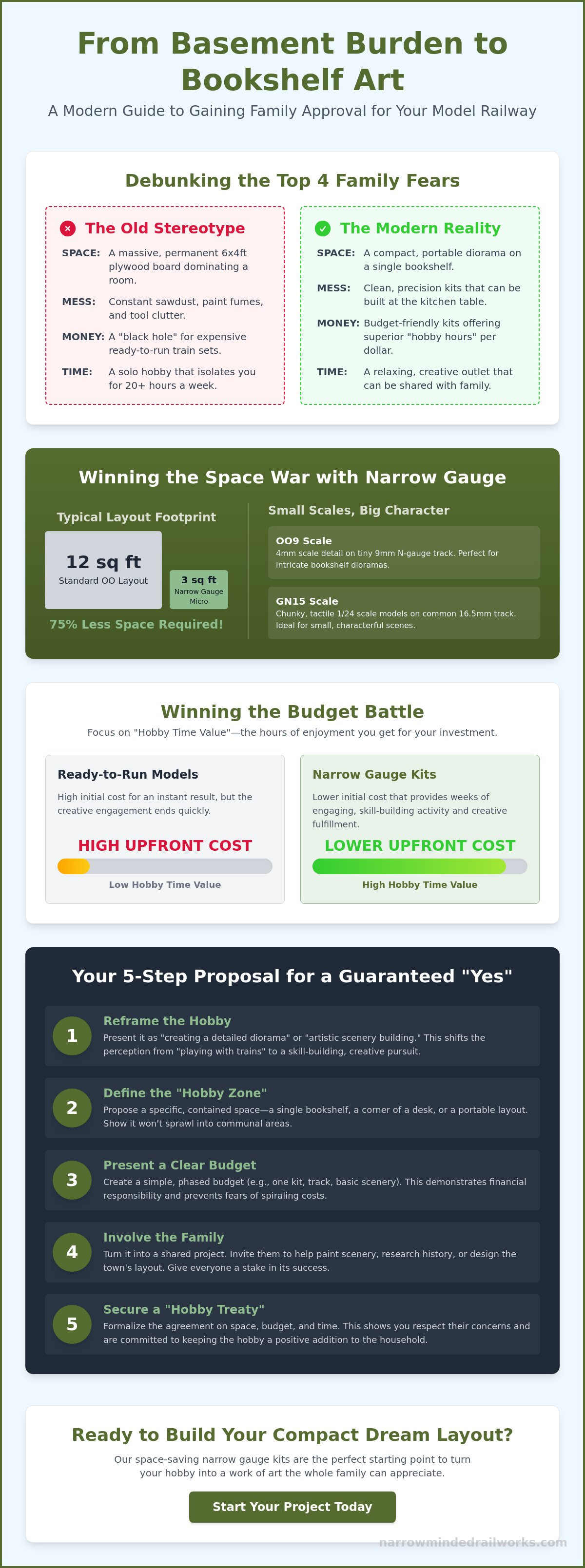
Resistance to a new hobby usually stems from four core fears: space, mess, money, and time. When you start convincing family on a model railway, you're often fighting an image of a dusty, room-sized plywood board from the 1970s. Most household gatekeepers aren't rejecting your happiness; they're protecting communal living space and the family budget. They see a permanent fixture that requires power tools and creates a constant layer of fine grey dust. They also worry about the "black hole" effect, where a spouse or parent disappears into a shed for 15 or 20 hours a week, leaving chores undone and conversations forgotten.
Cost is the other major hurdle. If your family has seen high prices for ready-to-run train sets in high-street windows, they'll assume every locomotive represents a massive financial hit. They don't yet realize that focusing on narrow gauge kit building provides weeks of entertainment for a fraction of that cost. By identifying these specific objections early, you can address them with facts rather than emotions. It's about proving that your hobby won't compromise the household's quality of life.
The Psychology of Hobby Resistance
Most partners or parents give a reflex "no" because the request feels like a burden rather than a benefit. If you ask for permission without a plan, they hear "Can I clutter the house?" It's more effective to reframe the hobby as creative engineering or historical research. This shifts the perception from "playing with trains" to a skill-building pursuit that adds value to your mental health. Focus on showing the gatekeeper how the project will be contained and managed before you even ask for the space. A well-presented plan shows respect for their concerns.
Common Misconceptions About Modern Modelling
The hobby has evolved significantly from the massive, fixed layouts of the past. To understand what model railroading is today, one must look at the rise of portable dioramas. Modern builders often use precision kits that are clean to assemble at a kitchen table. Instead of a permanent room-sized installation, many enthusiasts now choose narrow gauge scales like OO9 or GN15. These allow for high levels of detail on a footprint no larger than a laptop. This shift makes convincing family on a model railway much easier because you're proposing a piece of art, not a construction site.
The Narrow Gauge Solution: Winning the Space War
Vertical modelling is another secret weapon in the space war. Instead of expanding outward, you build upward with steep rock faces, tall timber trestles, and multi-level scenery. This approach creates a sense of scale and drama without stealing floor space. When a layout is treated as a portable diorama, it can be tucked under a bed or stored in a cupboard when guests visit. To ensure your living environment remains both functional and stylish, you can visit Sheepbridge Sofas & Beds for high-quality furniture solutions. This portability proves to your family that the hobby won't permanently alter the home's layout or traffic flow. It turns the railway into a flexible activity rather than a fixed construction site.
Scales That Save the Day: OO9 and GN15
Choosing the right scale is critical for small-space success. OO9 kits are a perfect starting point because they use 9mm track (the same width as N gauge) to represent narrow gauge trains in 4mm scale. You get the detail and presence of a larger model with the tight-turning radius of a much smaller one. For those who prefer a chunkier, more tactile feel, GN15 scale offers 1/24 scale models that run on 16.5mm track. While a standard gauge OO layout might require 12 square feet for a basic loop, a narrow gauge micro-layout can provide a more complex operating experience in just 3 square feet.
Integration into the Home Decor
To win the argument, stop treating the railway like a construction project and start treating it like furniture. A bookshelf layout fits seamlessly into a living room or home office. High-quality scenery turns the track into a piece of 3D art that guests will actually want to look at. You can even highlight the educational benefits of model railroading to show that this "art" is actually a sophisticated teaching tool for the whole family. Using acrylic dust covers or custom display cases ensures the project stays clean and doesn't create the "mess" your family fears. If you're ready to start small, exploring these compact scales is the most practical first step toward a compromise everyone enjoys.
Budgeting for Peace: Managing the Cost Objection
Money is often the loudest "no" in the room. When you're convincing family on a model railway, you need to speak the language of value rather than just total expense. A common mistake is comparing a model railway to a simple toy purchase. Instead, frame it as a long-term investment in a great family-oriented hobby that provides hundreds of hours of engagement. By breaking down the costs and showing a clear financial plan, you remove the fear of "runaway spending" that often worries partners or parents.
Consider the "Pound per Hour" metric. A mass-produced locomotive might offer immediate satisfaction, but its entertainment value can peak quickly. In contrast, a high-quality kit offers 15, 20, or even 30 hours of creative work through assembly, detailing, and painting. When you divide the kit's cost by the hours spent building it, the hobby becomes one of the most affordable forms of entertainment available. It's often cheaper than a monthly gym membership or a family trip to the cinema, yet it leaves you with a tangible piece of art at the end.
The Kit-Building Advantage
Choosing 3D printed locomotive kits is a strategic financial move that benefits the whole household budget. These kits are generally more accessible than pre-assembled models because you're providing the "sweat equity." You aren't just buying a train; you're investing in a project that develops skills in soldering, mechanical assembly, and fine-scale painting. Because the building process is slow and rewarding, you won't feel the need to buy something new every week. You can spread the cost of a single project over several months, keeping your monthly hobby allowance predictable and low.
Avoiding "Sticker Shock"
Transparency is your best tool for maintaining household harmony. Don't hide your purchases or let boxes pile up in secret. Instead, present a "Project Budget" that outlines exactly what you need for a specific diorama. Start with basic diorama tools and scenery materials before you even look at rolling stock. This "bottom-up" approach proves you're focused on the craft rather than just collecting. A "One Locomotive, One Wagon" entry strategy is a great way to start small and prove that you can enjoy the hobby without a massive fleet. Quality kits also hold their resale value well on the secondary market, providing a safety net that many other hobbies simply don't offer.
Making it a Shared Family Experience
The most effective strategy for convincing family on a model railway is to stop treating it as a solo retreat. When a hobby feels like a "black hole" that consumes time and money without giving back, resistance is natural. You can flip this narrative by inviting your family into the creative process from day one. By framing the project as a shared household activity, you transform a potentially divisive topic into a source of connection. Modern model railroading is a multi-disciplinary craft that offers something for everyone, whether they enjoy history, digital technology, or fine art.
One of the strongest arguments for this hobby is its status as a "steam" education powerhouse. It combines science, technology, engineering, arts, and math in a tactile way that screens cannot replicate. For children, building a narrow gauge layout teaches patience and fine motor skills. For adults, it provides a "no screens" sanctuary that encourages conversation. You can even bridge the gap for tech-savvy teenagers by showing them the digital side of the hobby. With the global model train market projected to reach USD 1.68 billion by 2031, you're introducing them to a thriving, modern community rather than a stagnant past.
The Artistic Side of the Hobby
Scenery building and detailing are often the most accessible entry points for family members who aren't interested in the mechanical side. Think of a layout as a form of "3D scrapbooking." You can recreate a favorite holiday spot or a local historical scene, making the railway a physical piece of family history. Learning the techniques for painting 3D printed models can be a therapeutic weekend activity for a partner or older child. You can even go as far as scanning family members to create custom scale figures, literally placing your loved ones into the world you're building together.
Building Skills Together
To keep everyone engaged, consider assigning "department heads" based on individual strengths. One person might be the "Chief of Scenery" responsible for the "green bits" and landscaping, while another manages the historical research or the intricate assembly of wagon kits. This collaborative approach ensures that the project moves forward at a steady pace and that everyone feels a sense of ownership. It also helps justify the space and budget because the layout is no longer just "your" project; it's a family legacy in the making. If you're ready to start your first collaborative build, explore our range of narrow gauge kits designed for high-detail results on a compact scale.
The 5-Step Action Plan to Present Your Proposal
Success in convincing family on a model railway isn't about being pushy; it's about being prepared. Many online forums suggest "just doing it" and asking for forgiveness later, but this is often poor relationship advice that leads to resentment or the hobby being banned entirely. A formal proposal demonstrates that you respect your family's space and finances. By treating your hobby like a planned project rather than a sudden whim, you build trust and excitement. This five-step plan provides a structured framework to move from a "no" to a collaborative "yes."
- Step 1: Research your "Compact Scale": Focus on OO9 or GN15 to prove space efficiency. Show how these scales pack incredible detail into tiny footprints.
- Step 2: Define a "Hobby Zone": Identify a specific area, like a 2-foot bookshelf or a desk corner, that doesn't interfere with communal traffic or family activities.
- Step 3: Create a "Phase 1" Budget: Present a plan for a single wagon kit or a small diorama. This prevents the fear of a massive, open-ended financial commitment.
- Step 4: Draft a "Cleanliness Contract": Commit to a specific storage solution for paints and tools. This addresses the "mess factor" before it becomes an issue.
- Step 5: Hold a "Family Pitch" meeting: Present your research with visual examples. Physically show the dimensions with a tape measure to demystify the project.
Drafting Your "Hobby Charter"
A "Hobby Charter" is a simple, written agreement that sets clear boundaries for your work. It should define "No-Go" times, such as avoiding loud assembly work or using strong adhesives after 9 PM. Agree on exactly where tools will be stored when they aren't in use; a dedicated toolbox or under-bed storage bin works well. Finally, set a "Review Date" for three months in the future. This gives everyone a chance to discuss if the arrangement is working or if the layout needs to be adjusted. This level of organization proves you're serious about maintaining household harmony.
Visual Aids for Your Pitch
Don't just describe your vision; show it. Use photos of tram locos and small industrial scenes to prove that narrow gauge modelling creates a piece of art rather than a sprawling eyesore. Use a tape measure to physically demonstrate how a 24-inch shelf layout takes up less room than a standard microwave. By highlighting the "Narrow Minded" philosophy of focused, small-scale, and high-quality builds, you show that your goal is a sophisticated craft. This visual proof often overcomes the final hurdles of skepticism, turning the conversation from "where will it go?" to "when can we start?"
Start Your Miniature Adventure Today
Successfully convincing family on a model railway is finally within reach when you swap sprawling standard gauge layouts for the charm of narrow gauge. You now have the tools to prove that a detailed, working world can thrive on a single bookshelf without breaking the bank or cluttering the living room. By focusing on the 3.4% projected annual growth in the hobby and the educational benefits for children, you've turned a solo interest into a shared family asset. You don't need a massive spare room; you just need a clear plan and the right scale to make it happen.
As specialists in OO9 and GN15 micro-modelling, we offer high-detail 3D printed kits specifically designed to fit the smallest modern spaces. Whether you're looking for industrial charm or rural scenery, our kits provide the perfect starting point for your new project. We provide worldwide shipping to support modellers everywhere in their quest for compact creativity. Explore our range of space-saving Narrow Gauge kits and start your micro-layout journey today! Your family will appreciate the thoughtfulness of a compact design, and you'll finally have the creative outlet you've been dreaming of. It's time to clear a shelf and start building.
Frequently Asked Questions
How much space do I actually need for a model railway?
You can build a functional layout in as little as 1 or 2 square feet. Micro-layouts, often built on a single A3 board or a 12-inch deep shelf, provide a complete operating experience. Narrow gauge scales allow for much tighter curves than standard trains, meaning a full circle of track can fit within a 9-inch radius.
Is model railroading too expensive for a teenager or student?
Model railroading is very accessible on a student budget if you prioritize kit building over buying pre-built items. A single wagon or locomotive kit provides 10 to 15 hours of assembly and painting work. This slow-burn approach means you spend less per month while gaining more satisfaction from the creative process.
How do I stop my model railway from looking like a mess in the house?
Keeping your project on a portable workstation or a large lipped tray prevents small parts from wandering. When convincing family on a model railway, showing them a stackable storage box that holds your entire project between sessions proves the hobby won't take over the dining room. A clean workspace is the best way to maintain household harmony.
Can I build a model railway if I don’t have a spare room?
You don't need a dedicated room for this hobby. Many enthusiasts use bookshelf layouts that sit at eye level in a hallway or living area. Because narrow gauge kits are designed for compact scenes, a 4-foot by 8-inch shelf is enough space to create a realistic industrial or rural branch line that looks like a piece of art.
What is the best scale for a beginner with limited space?
OO9 and GN15 are the premier choices for small-space beginners. OO9 uses 9mm track to represent narrow gauge in 4mm scale, allowing for high detail in a tiny footprint. GN15 offers a larger 1/24 scale feel on 16.5mm track, making it perfect for those who want tactile, chunky models without needing a garden-sized area.
How do I explain to my partner that this is a "real" hobby?
Focus on the tangible skills you're developing, such as historical research, fine-scale painting, and mechanical engineering. Convincing family on a model railway is easier when you describe it as a technical study or a 3D diorama project. It's a disciplined pursuit that results in a high-quality display piece, showing off 100 or more hours of dedicated craftsmanship.
What tools do I need to start without cluttering the kitchen table?
You only need a few basic hand tools like a fine file, tweezers, and specialized glue to begin. Keeping these in a small, organized caddy ensures you can set up and pack away in under 5 minutes. Using a dedicated cutting mat protects your furniture from any accidental scratches or spills while you work.
Are 3D printed kits harder to build than plastic ones?
Modern 3D printed kits are often simpler to build because they require less assembly than traditional multi-part plastic kits. Many components are printed as a single piece, which reduces the number of glue joints you need to manage. They take paint exceptionally well and offer a level of surface detail that was nearly impossible to achieve 10 years ago.
The precision of 3D printing technology is also being applied to practical home maintenance. To ensure your home remains tidy and professional during any renovations or hobby setups, you can learn more about 2d6 Designs and their innovative 3D-printed solutions for home improvement.