

The most impressive narrow gauge layouts aren't found in a ready-to-run box; they're built by hand from a collection of specialized components. While standard gauge hobbyists enjoy endless shelf options, you likely feel that generic models lack the unique character your railway deserves. Locating specific narrow gauge model railway parts for niche scales like GN15 or OO9 is often a challenge. However, choosing high-quality 3D-printed kits allows you to bypass these limitations and create something truly prototypical.
You probably agree that the frustration of matching a kit to a commercial chassis can stall a project before it even begins. This guide provides a clear path forward by showing you how to source and select the precise parts needed for a successful build. We'll examine how to identify compatible bodies for common motors, where to find reliable scale accessories, and the best ways to customize commercial models into one-of-a-kind locomotives.
Key Takeaways
- Identify the specific requirements for OO9, GN15, and O-16.5 scales to ensure your components match your layout's footprint.
- Source specialized narrow gauge model railway parts that provide a prototypical appearance while maintaining compatibility with reliable commercial chassis.
- Learn professional finishing methods for 3D-printed kits, including techniques for removing support marks and achieving a smooth paint surface.
- Enhance your diorama's realism by incorporating unique scenery accessories and life-like figures scanned from real-world prototypes.
- Explore how moving away from generic models toward 3D-printed "cottage industry" kits allows for greater creative freedom and layout individuality.
Understanding Narrow Gauge Model Railway Parts and Scales
Modeling a narrow gauge line allows you to explore unique prototypes that standard gauge sets often ignore. By definition, narrow gauge model railway parts represent equipment used on tracks narrower than the standard 4ft 8.5in. These smaller prototypes were originally built for cost-efficiency in tight spaces like mines, quarries, and rural estates. For the hobbyist, this translates into the ultimate space-saving solution. You don't need a massive basement to build a realistic scene; a small diorama or micro-layout can provide a complete modeling experience. These specialized parts allow you to capture a rugged, industrial character that feels more personal and less generic than mass-produced models.
The Big Three: OO9, GN15, and O-16.5 Explained
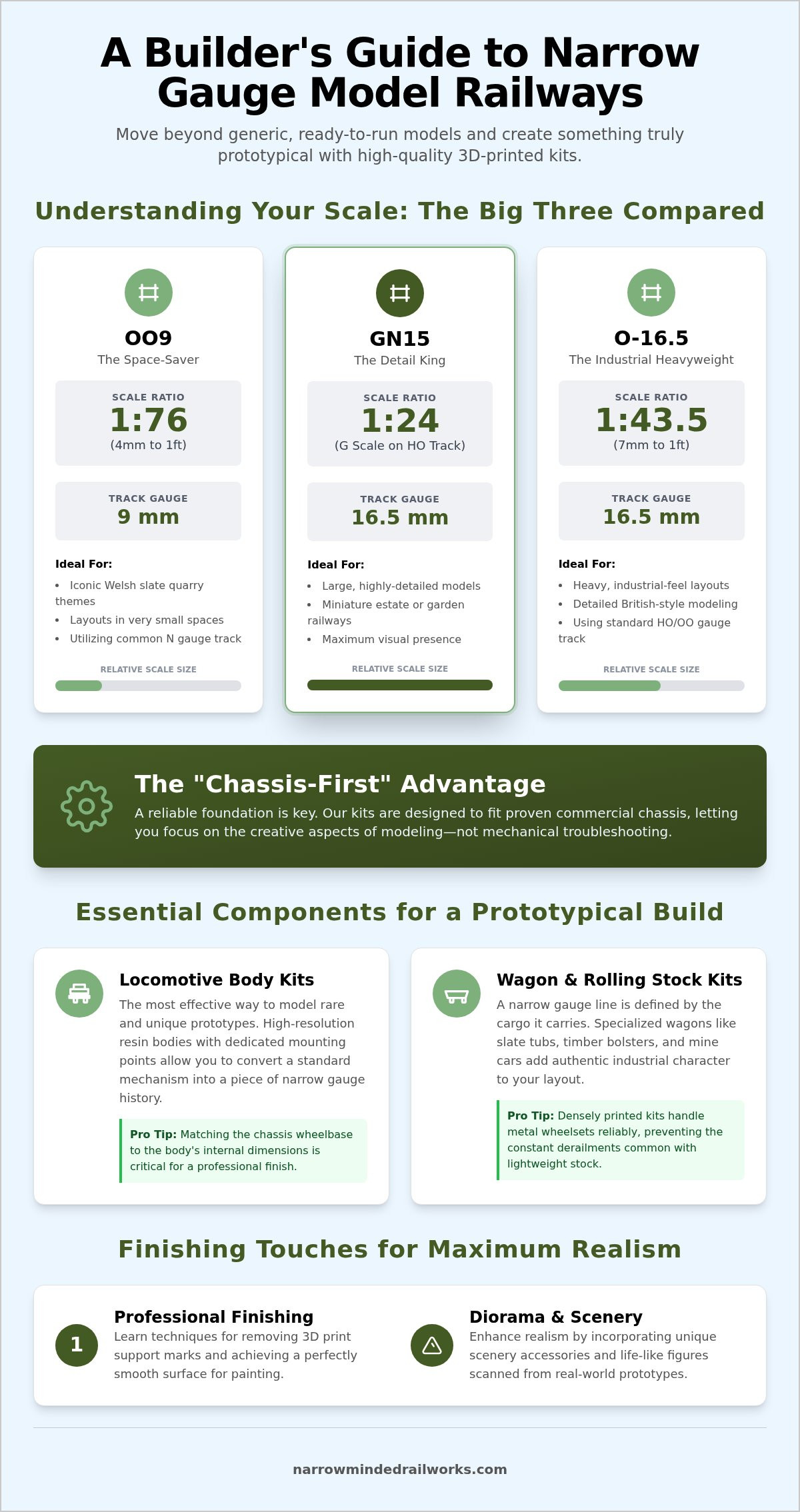
Choosing the right scale is the first step in sourcing your parts. OO9 is a popular 4mm scale that runs on 9mm track, making it ideal for recreating iconic Welsh slate quarry themes in a small space. If you prefer a larger, more detailed presence, GN15 uses a 1:24 scale on 16.5mm track. This scale is perfect for modeling miniature estate railways or garden-style lines. For those who enjoy a heavy, industrial feel, O-16.5 offers 7mm scale modeling on 16.5mm track. Locating the right narrow gauge model railway parts depends on your chosen scale, as each requires specific accessories to maintain the correct visual weight and detail.
Scale vs. Gauge: Why It Matters for Part Selection
Confusion often arises when hobbyists distinguish between scale and gauge. Gauge refers strictly to the distance between the rails, while scale is the ratio of the model to the real thing. You can find many different model railway scales that share the same track gauge, which often leads to selection errors. A common pitfall is mixing wagon bodies and locomotive kits that don't share the same scale, even if they fit the same track. This often results in mismatched coupler heights or locomotives that look too small for their wagons. We understand that matching specialized bodies to existing motors is a complex task. To solve this, our kits are specifically engineered to sit on common commercial chassis. This ensures that your locomotives look prototypical and run reliably from the start.
Essential Components for Narrow Gauge Kit Building
Building a layout that stands out requires a shift away from generic, off-the-shelf models. While ready-to-run options are convenient, they often fail to capture the gritty, specialized nature of industrial lines. The foundation of a successful build starts with a "chassis-first" approach. Since we don't sell motors or mechanisms, we design our kits to fit proven commercial power units. This strategy ensures that your unique locomotive has a reliable heart, solving the common frustration of kit-built engines that struggle to stay on the rails. By selecting high-quality narrow gauge model railway parts designed for specific chassis, you can focus on the creative aspects of modeling rather than mechanical troubleshooting.
Locomotive Body Kits and Conversions
3D-printed locomotive bodies are the most effective way to model rare prototypes. Historically significant engines, like those preserved at the Nevada County Narrow Gauge Railroad Museum, often lack mass-produced equivalents. It's difficult to find a body that fits perfectly onto an N gauge or HOe chassis without extensive modification. We address this by providing transparently designed resin bodies with dedicated mounting points. This precision allows you to convert a standard mechanism into a unique piece of narrow gauge history. When you're choosing a chassis for a GN15 model, matching the wheelbase to the body's internal dimensions is the most critical step for a professional finish.
Wagon Kits and Industrial Rolling Stock
A narrow gauge line is defined by the cargo it carries. Whether you're modeling a Welsh slate quarry or a rural timber tramway, your rolling stock needs to look the part. Common narrow gauge model railway parts for wagons include slate tubs, timber bolsters, and specialized mine wagons. The weight of these kits is a frequent pain point for modelers. Lightweight rolling stock often tracks poorly, leading to constant derailments during operation. Our 3D-printed kits provide the necessary structural density to handle metal wheelsets reliably. If you're new to the hobby, building OO9 wagon kits for success starts with ensuring your axles are perfectly aligned within the printed frames.
Small details like chimneys, buffers, and couplings provide the final touch of prototypical accuracy. These components aren't just decorative; they establish the era and purpose of your railway. Adding these specialized parts helps you escape the "out-of-the-box" look and creates a cohesive, realistic world. If you're ready to start your next project, you can browse our latest OO9 and GN15 locomotive kits to find the perfect match for your layout.
Scenery Parts: Bringing Your Narrow Gauge World to Life
Creating a believable narrow gauge environment requires a departure from the "clean" aesthetics often seen in standard gauge modeling. Narrow gauge lines were typically built for utility, winding through tight valleys or squeezed between industrial buildings. To capture this atmosphere, you need specialized narrow gauge model railway parts that reflect a sense of organic growth and history. Unlike standard gauge layouts that often feature wide-open spaces, narrow gauge thrives on the "micro-scene." These are small, highly detailed areas like a cluttered workshop or a rustic fuel depot that tell a story without requiring a large footprint. Using unique accessories such as vintage petrol pumps or weathered phone boxes helps anchor your layout in a specific era.
Diorama Tools and Scenery Accessories
The human element is often the hardest part of a layout to get right. Generic figures frequently look stiff or out of scale, which ruins the realism of a well-built kit. We solve this by offering figures scanned from real people. These 3D-printed parts capture natural poses and realistic clothing textures that injection molding often misses. For enthusiasts modeling in larger scales, the 7mm Narrow Gauge Association provides excellent resources on how to match your figures to specific historical prototypes. These details are what transform a collection of models into a convincing scene.
Achieving a cohesive look across your layout requires careful finishing. If your figures and accessories look too new, they'll clash with your weathered locomotives. Learning the correct techniques for painting 3d printed models is a vital skill for any kit builder. This process allows you to blend your scenery and rolling stock into a single, convincing world. We prioritize transparency in our printing process, ensuring that every accessory you receive is ready for priming and painting with minimal preparation. This focus on detail ensures that your narrow gauge world looks as authentic as the prototypes that inspired it.
How to Customize and Finish Your Narrow Gauge Parts
Transforming raw narrow gauge model railway parts into a finished locomotive requires patience and a structured approach. While 3D printing offers incredible detail, the parts arrive with small support marks that need careful removal. You can't simply apply paint to a resin body and expect a professional result. Preparation is the most critical phase for ensuring your model looks prototypical rather than plastic. By following a clear finishing sequence, you can turn a basic kit into a centerpiece for your layout.
Finishing 3D Printed Resins
3D printed resins require specific handling compared to traditional white metal or plastic kits. You must remove support marks carefully to avoid pitting the surface. A proactive approach to cleaning ensures that your primer adheres correctly and won't flake off during the weathering stage. We recommend the following steps for a smooth finish:
- Sanding: Use 400 to 600 grit wet-and-dry paper to smooth out support nibs. Wet sanding is preferred as it keeps dust to a minimum and provides a finer finish.
- Cleaning: Wash the parts in warm soapy water to remove any residual resin or oils. This step is essential for paint adhesion.
- Priming: Apply a high-quality automotive primer or a dedicated resin primer. This creates a "key" for your topcoat and helps reveal any remaining surface imperfections.
- Safety: Always wear a dust mask when sanding resin. The fine particles are irritants; work in a well-ventilated area to maintain a safe environment.
Weathering and Decal Application
Narrow gauge lines rarely looked pristine. These railways worked hard in dusty quarries and damp forests, so a clean model often looks out of place. Weathering is the process that bridges the gap between a plastic kit and a realistic miniature. Because 3D printing captures such fine surface textures, it's easy to highlight these details using simple techniques.
- Washes: Apply a thin dark wash to settle into the recesses of your narrow gauge model railway parts. This naturally defines rivets, door hinges, and panel lines.
- Weathering Powders: Use powders to simulate rust on wagon frames or soot on locomotive roofs. These are best applied over a matte surface.
- Decals: Use a decal setting solution to help transfers conform to the textured surfaces of the resin body. This prevents the "silvering" effect that can ruin a model's appearance.
- Varnish: Seal your work with a matte or satin varnish. This protects the delicate weathering and gives the entire model a consistent, non-reflective finish.
Once the paint and varnish are fully cured, you can proceed with the final assembly by fitting the body onto your chosen commercial chassis. Ensure the mounting points remain clear of thick paint to maintain a precise fit. If you're ready to test these techniques on a new project, you can explore our range of 3D-printed locomotive kits to find your next build.
Sourcing Quality Narrow Gauge Parts from Specialist Makers
Finding high-quality narrow gauge model railway parts often requires looking beyond the shelves of mainstream retailers. Major manufacturers typically focus on high-volume standard gauge models, which leaves narrow gauge enthusiasts with limited ready-to-run options. This constraint has led to the flourishing of a specialized "cottage industry." Independent designers now use advanced technology to provide the variety that larger corporations cannot justify. By choosing parts from specialist makers, you gain access to a wider range of prototypes while supporting the creative growth of the hobby. It's a shift from mass-market convenience to bespoke quality. For those interested in how large-scale retailers manage such specialized and diverse inventories, you can explore PIM (Product Information Management) to learn about modern commerce operations.
Why Choose 3D Printed Kits over Mass-Produced Plastic?
3D printing has revolutionized niche railway modeling. Traditional injection molding requires expensive tooling, which limits production to only the most famous locomotives. In contrast, 3D-printed resin kits offer superior surface detail and allow for small-batch production of obscure industrial and rural prototypes. When you purchase from independent designers, you aren't just buying a kit; you're investing in a model that has been researched by someone who understands the specific requirements of scales like OO9, GN15, and O-16.5. This technology allows for crisp rivets, realistic wood grain, and intricate cab details that often appear soft on mass-produced plastic models.
The Narrow Minded Railworks Difference
We recognize that kit building can be intimidating if you don't have the right guidance. Our brand addresses this by providing a professional and transparent service that prioritizes the success of your project. We don't sell the chassis or motors ourselves, but we proactively design our locomotive and wagon bodies to fit common commercial mechanisms. This ensures you spend less time modifying parts and more time enjoying the build. Our commitment to global accessibility means we offer worldwide shipping, ensuring that specialized components are available to you regardless of your location.
Beyond locomotives, we apply the same high standards to our scenery items. Many of our figures are scanned from real people to ensure high realism, capturing natural poses that traditional molding techniques miss. We provide clear expectations regarding our 3D printing process and offer proactive support for every kit builder. Whether you are modeling a Welsh quarry in OO9 or a heavy-duty industrial line in O-16.5, we provide the narrow gauge model railway parts and expertise needed to bring your layout to life. Our goal is to help you build a railway that is as unique as the prototypes that inspired it.
Building Your Unique Narrow Gauge Layout
Transitioning from generic ready-to-run models to a custom-built layout allows you to capture the specific character of industrial and rural lines. You've learned that selecting the right narrow gauge model railway parts is a balance of scale accuracy and mechanical reliability. While finding unique prototypes is often difficult, utilizing 3D-printed kits that fit proven commercial chassis provides a proactive solution to common building frustrations. By focusing on detailed finishing techniques and realistic, scanned figures, you can create a miniature world that feels both authentic and personal.
Narrow Minded Railworks is committed to supporting your project with professional 3D-printed designs and specialist support for OO9 and GN15 builders. We offer worldwide shipping on all parts to ensure every modeler has access to the components they need. Whether you're starting your first slate wagon or detailing a complex diorama, we're here to help you achieve a prototypical finish. Explore our full range of narrow gauge locomotive and wagon kits today and begin crafting a railway that stands out from the crowd. Your next unique build is just a few steps away.
Frequently Asked Questions
What is the most common scale for narrow gauge model railways?
OO9 is widely considered the most popular narrow gauge scale in the UK. It uses a 4mm scale running on 9mm track. Other common scales include O-16.5 and GN15. Choosing a popular scale ensures better availability of track and accessories. While we specialize in these niche scales, we provide kits that help you build unique prototypes that mainstream brands often overlook.
Can I use N gauge track for my OO9 narrow gauge parts?
Yes, you can use N gauge track for your OO9 narrow gauge model railway parts because both systems utilize a 9mm gauge. However, standard N gauge track features sleepers that are too small and closely spaced for a prototypical narrow gauge look. To solve this, you can use dedicated OO9 track or modify N gauge track by removing every other sleeper. This proactive adjustment creates a more realistic appearance.
How do I know if a locomotive body kit will fit my chassis?
We design our locomotive bodies to match specific commercially available chassis from brands like Kato or Bachmann. To ensure a perfect fit, you should check the product description for the recommended donor mechanism. While we don't sell the motors ourselves, we provide transparent mounting instructions for each kit. If a specific chassis is discontinued, we often offer advice on alternative power units that maintain the correct wheelbase.
Are 3D printed model railway parts as durable as plastic kits?
Modern 3D-printed resin parts are highly durable and offer finer detail than traditional injection-molded plastic. While resin can be more brittle if dropped, it handles the rigors of normal layout operation and handling without issue. We utilize high-quality resins that provide a stable foundation for painting and weathering. This technology allows us to produce complex narrow gauge model railway parts with structural integrity that matches standard plastic kits.
Do I need special tools to build narrow gauge wagon kits?
You don't need a workshop full of expensive equipment to build our wagon kits. Basic tools like a sharp hobby knife, fine-grit sandpaper, and cyanoacrylate glue are usually sufficient for assembly. While we provide the 3D-printed bodies and frames, you'll need to source your own metal wheelsets and couplings. Using a dedicated diorama tool for positioning small details can help you achieve a more professional finish with less effort.
What is the difference between GN15 and O-16.5 scales?
GN15 and O-16.5 both run on 16.5mm track, but they represent different sizes of the real world. GN15 is a large scale modeling 15-inch gauge lines, often used for estate railways. O-16.5 is a 7mm scale modeling roughly 2-foot gauge lines. Although they share the same track, the figures and buildings for GN15 are much larger. We offer specialist kits for both scales to suit your specific modeling goals.
How do I remove the support marks from 3D printed resin parts?
Support marks are a natural byproduct of the 3D printing process, but they are easy to manage. You should use a fine-grit sandpaper, such as 400 or 600 grit, to gently level the surface nibs. Wet sanding is a proactive way to keep dust down while achieving a smoother finish. Once the marks are flush with the body, applying a high-quality primer will hide any remaining imperfections and prepare the resin.
Can I buy ready-to-run narrow gauge models from Narrow Minded Railworks?
We do not sell ready-to-run models, as our focus is entirely on providing high-quality 3D-printed kits for builders. This constraint allows us to offer unique prototypes that aren't available in the mass market. To help you complete your project, we design our locomotive bodies to fit easily onto reliable commercial chassis that you source separately. This approach gives you the creative freedom to customize your model while ensuring it runs perfectly.