

The most rewarding layouts aren't found in a pre-packaged box; they're built on a workbench. While the "alphabet soup" of narrow gauge model railway scales can feel intimidating, these designations offer the perfect balance of large-scale detail and small-scale space requirements. You've likely felt the frustration of trying to decode why OO9 doesn't use standard OO track or worried that a lack of ready-to-run models will stall your progress. While commercial manufacturers often overlook these niche prototypes, kit building provides a proactive way to bypass limited retail stock and create something truly unique.
We understand that compatibility and scale math are significant hurdles for many modellers. This 2026 guide simplifies the complex relationship between scale and gauge, giving you the confidence to choose a specific path for your next project. We'll explore the differences between popular choices like OO9, GN15, and O-16.5, while highlighting where to find the detailed kits and scenery needed to bring your vision to life.
Key Takeaways
- Understand the fundamental difference between scale ratios and track gauges to ensure your rolling stock matches your modelling environment.
- Navigate the variety of narrow gauge model railway scales by comparing the space-saving benefits of OO9 with the high-detail potential of GN15.
- Align your choice with your specific layout goals, whether you prefer building a compact micro-layout or a detailed, scenery-focused diorama.
- Overcome the scarcity of ready-to-run models by adopting 3D-printed kits that offer greater variety and personalisation for your fleet.
- Simplify your entry into the hobby by learning how to mount high-quality locomotive body kits onto existing commercial chassis.
Scale vs Gauge: The Foundation of Narrow Gauge Modelling
In the context of Rail transport modelling scales, scale is the fixed ratio of the model to the real-world prototype. Gauge refers specifically to the physical distance between the two running rails on your layout. While standard gauge modelling maintains a consistent relationship between these two, narrow gauge modelling utilizes a smaller track gauge for a larger scale ratio. Because narrow gauge track is physically narrower than standard gauge, locomotives and rolling stock can navigate much tighter curves, which makes it an ideal solution for layouts in small rooms or on bookshelves.
Understanding narrow gauge model railway scales is the first step toward building a successful layout. The terminology can seem like a barrier to entry, but a quick breakdown of the math provides a clear path forward. This hobby allows you to enjoy the high detail of larger models without the massive footprint usually required for standard O or OO gauge track.
The Math of Narrow Gauge Naming
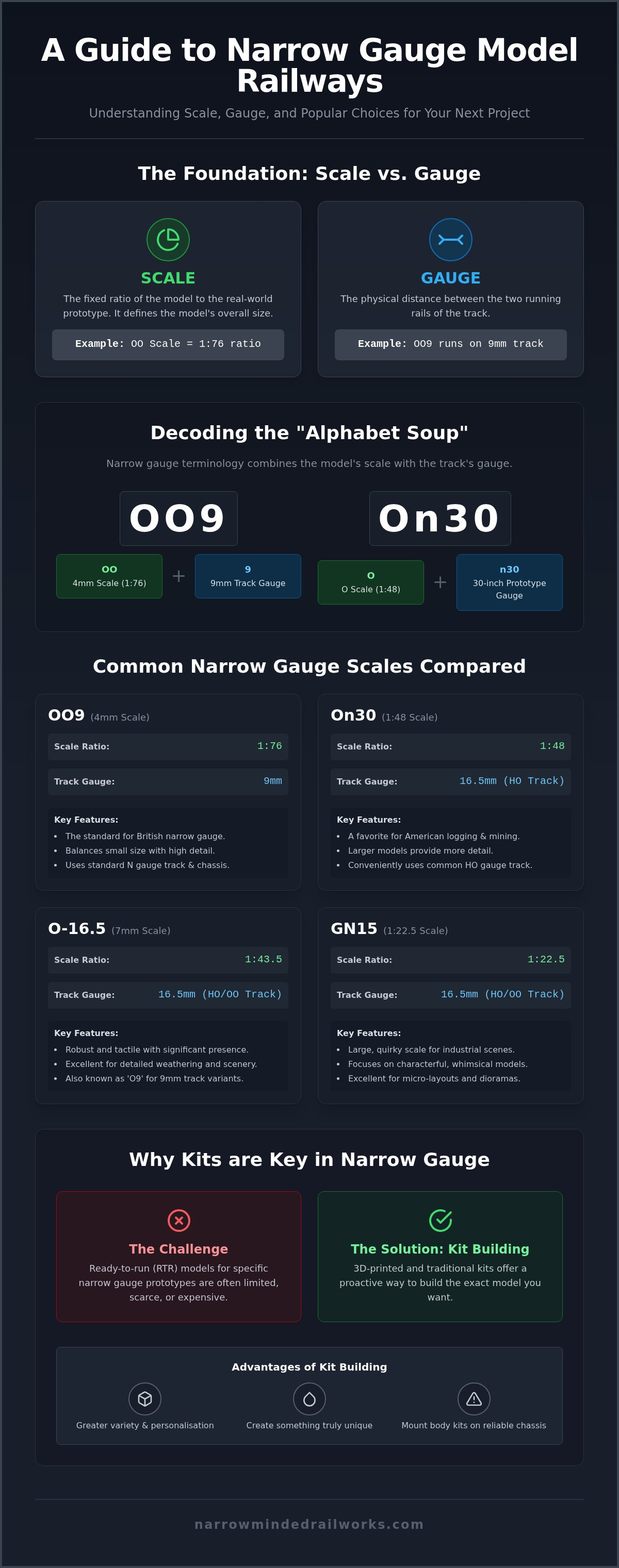
Deciphering the "alphabet soup" of naming conventions is easier than it looks. Take OO9 as an example; the "OO" tells you it's 4mm scale (1:76), while the "9" indicates it runs on 9mm track, which is the same width as N gauge. Similarly, US modellers use terms like On30. In this case, the "O" signifies O scale (1:48), and the "30" represents a 30-inch prototype gauge track. These scale/gauge combinations are the secret to unique model railway layouts. They allow you to run chunky, characterful locomotives on track that takes up very little space, effectively mixing the best of both worlds.
Why Prototypical Accuracy Matters
Selecting from different narrow gauge model railway scales often depends on whether you want to model a specific historical line or "freelance" your own railway. If you're recreating a specific Welsh slate quarry or a steep mountain pass, prototypical accuracy will dictate your choice. The physical width of the track influences the entire aesthetic of your scene. Industrial lines often look cluttered and functional, while mountain railways require sharp turns and steep grades. For more background on how these lines functioned in the real world, see our Introduction to Narrow Gauge Railways.
While ready-to-run models for these specific niches are often limited or expensive, kit building offers a proactive solution. By choosing a high-quality 3D-printed body kit, you can create a detailed locomotive that fits perfectly on a reliable commercial chassis. This approach ensures you aren't restricted by what's currently on the shelf at a hobby shop, allowing you to build the exact railway you've imagined.
Common Narrow Gauge Scales and Their Unique Appeal
Choosing between the various narrow gauge model railway scales often comes down to the specific atmosphere you want to create on your layout. While standard gauge modelling follows rigid commercial patterns, narrow gauge is where creativity thrives. Each scale offers a distinct personality, from the bustling industrial vibe of a miniature quarry to the scenic grandeur of a Welsh mountain pass. Understanding these differences helps you select a project that matches your available space and your interest in fine detail.
The following scales represent the most popular choices for modern modellers:
- OO9 (4mm Scale): The standard for British narrow gauge, balancing small size with high detail.
- On30 (1:48 Scale): A favourite for American logging and mining prototypes using HO track.
- GN15 (1:22.5 Scale): A large, quirky scale that focuses on characterful industrial scenes.
- O-16.5 (7mm Scale): A robust, tactile scale that provides significant physical presence.
OO9: The British Favourite
OO9 stands as the king of British narrow gauge modelling. This scale utilizes 4mm to the foot (1:76) proportions running on 9mm track. It's the perfect choice if you want to recreate the iconic Ffestiniog or Talyllyn railways in a compact space. One primary advantage is the ability to use standard N gauge track and chassis components, which simplifies the technical side of the hobby. If you're just beginning your journey, our Beginner Guide to OO9 Loco Kits provides a clear path for your first purchase.
For those who prefer a more robust experience, O-16.5 (7mm scale) provides a sense of weight and presence that smaller scales often lack. While finding ready-to-run models in these scales can be difficult, building from kits allows you to bypass retail shortages. This proactive approach ensures your layout isn't limited by what a major manufacturer decides to produce in a given year.
GN15 and Large Scale Quirks
GN15 is perhaps the most creative of all narrow gauge model railway scales. It places large 1:22.5 scale bodies and G scale figures onto 16.5mm track, which is the same width as standard OO or HO gauge. This combination represents "minimum gauge" estate railways or small industrial lines. Because the models are physically larger, GN15 is the premier scale for those who love highly detailed scenery, weathered textures, and characterful figures. It turns a simple loop of track into a living diorama. For a broader look at how these standards are maintained across the hobby, the National Model Railroad Association's Beginner's Guide offers excellent foundational knowledge.
If you find yourself limited by the lack of ready-made options in these scales, don't let that stop your progress. We offer a range of OO9 and GN15 kits designed to fit easily onto commercial chassis, making high-level modelling accessible to everyone.
Choosing the Right Scale for Your Space and Style
Selecting from the available narrow gauge model railway scales requires an honest assessment of your physical workspace and your patience for fine detail. While a spare bedroom might accommodate a sprawling empire, many modellers find themselves working within the constraints of a single shelf or a small corner desk. Narrow gauge is the proactive solution for these limited environments, offering a way to build a functional railway without needing a dedicated outbuilding.
You must also decide whether you value a high volume of rolling stock or a single, highly detailed scene. Larger scales prioritise individual character and texture, while smaller scales allow for longer trains and more complex track layouts in the same footprint. Regardless of the scale you choose, the limited availability of ready-to-run models can be a hurdle. We solve this by providing 3D-printed body kits that fit reliably onto existing commercial chassis, ensuring your project isn't stalled by manufacturer stock levels.
The Micro-Layout Advantage
OO9 is the premier choice for the space-starved enthusiast. Because it uses 9mm track, you can achieve a complete railway circuit in a footprint no larger than a standard bookshelf. A hallmark of narrow gauge track planning is the ability to use much tighter radius curves than standard gauge allows. This flexibility means you can even build a charming "pizza" layout or a compact industrial diorama using GN15, where the large scale of the models provides a striking contrast to the small track diameter. These small projects allow you to finish a layout in weeks rather than years.
Tactile Modelling and Visibility
For those who find the tiny components of OO9 a challenge, larger options like O-16.5 and On30 offer a more tactile experience. These scales are often better for modellers with limited dexterity or those who simply prefer the visual impact of larger figures and scenery items. If you're interested in the American side of this hobby, our Guide to On30 Gauge explains how this scale utilizes HO track to simplify construction. The 7mm Narrow Gauge Association is an excellent resource for those pursuing O-16.5, providing community support for this robust, 7mm scale.
As noted in our Guide to On30 Gauge, the balance between scale size and the physical weight of the rolling stock creates a more realistic "feel" during operation. Larger models track better over imperfect rails and are easier to handle during the kit-building process. If you're looking for a specific industrial prototype that isn't available in shops, our Guide to On30 Gauge can help you identify the right components to start your build. By focusing on kits, you gain total control over the look and feel of your railway.
The Role of Kits in Narrow Gauge Modelling
Finding ready-to-run models in specific narrow gauge model railway scales often presents a significant challenge for enthusiasts. Major manufacturers typically focus on high-volume standard gauge releases; this leaves narrow gauge modellers with limited options and high price points for second-hand stock. We offer 3D-printed kits as a proactive solution to these supply constraints. Building from a kit allows you to bypass retail shortages while gaining the satisfaction of owning a unique locomotive that isn't found on every other layout. This approach turns a potential frustration into a rewarding creative process.
Modern 3D printing technology has transformed the hobby by offering precision that was previously only available to master craftsmen. Complex shapes, such as the curved tanks of a Quarry Hunslet, are now produced with high accuracy in a single piece. This level of detail ensures that even those new to the hobby can achieve professional results. By choosing a kit, you aren't just buying a model; you're gaining the flexibility to customise every detail from the livery to the amount of weathering. You are no longer restricted by what a factory decides to produce.
Why 3D Printed Kits are the Modern Standard
Traditional kit building often involved complex brass folding or white metal soldering, which created a steep learning curve for beginners. Modern 3D-printed bodies remove these technical barriers. Most kits are designed to fit directly onto a reliable commercial chassis, combining the custom look of a kit with the smooth running of a factory-made motor. This method ensures your model performs as well as it looks. Once your assembly is complete, you can follow our guide on Painting 3D Printed Models to achieve a flawless finish that rivals any ready-to-run alternative.
From Locomotives to Scenery
The benefits of kit building extend beyond the engine shed. To truly capture the atmosphere of your chosen narrow gauge model railway scales, you need a variety of wagons and rolling stock that match your prototype. We provide highly detailed wagon kits and scale-accurate scenery items, such as petrol pumps and phone boxes, to populate your layout. 3D scanning technology even allows for realistic figures that bring a sense of life and scale to your scenes. These small details are what transform a collection of trains into a believable miniature world. If you're ready to start building, you can browse our full range of OO9, GN15, and O-16.5 kits to find the perfect project for your workbench.
Getting Started with Your Narrow Gauge Journey
While the selection of narrow gauge model railway scales can feel overwhelming, starting with a single locomotive body kit and a compatible chassis provides a clear focus for your first build. This approach prevents you from becoming bogged down in the technical complexities of multiple standards and gets a train running on your workbench quickly. Narrow gauge is a hobby that rewards those who take a proactive, hands-on approach to building their own rolling stock.
Although you might worry about the technical skills required for kit assembly, 3D-printed models only require a few basic tools to achieve a professional result. You will need high-quality cyanoacrylate (superglue), a set of fine needle files for removing support marks, and suitable acrylic primers and paints. You should embrace the inherent "imperfections" of narrow gauge prototypes, as the charm of these railways lies in their weathered, non-standardised appearance rather than clinical perfection. Joining the community through online forums or dedicated societies offers a wealth of shared knowledge to help you overcome any initial hurdles.
Your First Project: OO9 or GN15?
If you're hesitant to start with a locomotive, beginning with a simple OO9 wagon kit offers excellent practice for assembly and painting. This allows you to familiarise yourself with the material before moving on to more complex builds. For those interested in larger, more scenic projects, our GN15 Scale Guide provides inspiration for creating detailed industrial dioramas. The "Narrow Minded" philosophy prioritises the unique character and history of the railway over rigid standardisation, giving you the freedom to build a layout that reflects your personal interests within the narrow gauge model railway scales ecosystem.
Next Steps with Narrow Minded Railworks
While ready-to-run options remain limited, our shop provides a consistent supply of 3D-printed solutions to keep your project moving. You can browse our extensive range of locomotive bodies and rolling stock kits to find the specific prototype that fits your chosen scale. Beyond the trains themselves, we offer the diorama tools and detailed scenery items necessary to finish your scene to a high standard. Take the next step in your modelling journey and Explore our latest 3D printed narrow gauge kits today to start building your unique narrow gauge empire.
Build Your Unique Narrow Gauge Layout Today
While the retail market often lacks diverse rolling stock, kit building offers a proactive way to bypass these limitations and create a truly custom railway. You now have the knowledge to navigate the various narrow gauge model railway scales with confidence, ensuring your next project fits your physical space and your modelling goals. Whether you choose the compact efficiency of OO9 or the high-detail charm of GN15, the modern approach to narrow gauge modelling prioritises creativity over commercial availability. You don't have to wait for a major manufacturer to release your favourite prototype when you can build it yourself.
We understand that precision and reliability are essential for a successful build. Our 3D-printed kits are designed by modellers for modellers; they're specifically engineered to be compatible with popular commercial chassis to ensure smooth operation. We provide worldwide shipping to support enthusiasts across the globe, making it easier than ever to access the specific prototypes you need. Browse our range of 3D-printed narrow gauge kits and start your next project today. Your perfect miniature railway is just one kit away, and it's time to bring your vision to life on the workbench.
Frequently Asked Questions
What is the most popular narrow gauge scale in the UK?
OO9 is currently the most popular choice for narrow gauge modellers in the UK. This 4mm scale runs on 9mm track, which allows enthusiasts to recreate iconic Welsh lines like the Ffestiniog Railway in a small footprint. While ready-to-run options are sometimes limited by manufacturer production cycles, the scale's popularity is sustained by high-quality 3D-printed kits. These kits provide a proactive way to build a diverse fleet that standard retail shops cannot match.
Can I run OO9 trains on standard N gauge track?
You can run OO9 trains on standard N gauge track because both utilize the same 9mm gauge width. However, standard N gauge track features sleepers that are too small and spaced too closely for a 4mm scale model. To achieve a realistic appearance, you should use dedicated narrow gauge track with wider, more irregular sleepers. This proactive choice ensures your layout looks like a rugged industrial line rather than a miniature mainline.
What does the "n30" stand for in On30?
The "n30" in On30 stands for narrow gauge with a 30-inch prototype track width. This scale uses O scale (1:48) proportions but runs on 16.5mm track, which is the same width as standard HO gauge. It's a popular choice for those who want the physical presence of O scale without the massive space requirements of standard O gauge track. Many modellers utilize reliable commercial HO chassis to power their On30 kit builds.
Is narrow gauge modelling more expensive than standard gauge?
Narrow gauge modelling can be more expensive if you only purchase limited-run ready-to-run models from specialist manufacturers. However, kit building provides a proactive solution to these higher costs. By using 3D-printed body kits and mounting them on reliable, mass-produced commercial chassis, you can build a unique locomotive fleet for a fraction of the price of a brass model. This approach keeps the hobby accessible for all budgets and skill levels.
What chassis should I use for a 3D printed locomotive kit?
The appropriate chassis depends on the specific design of your kit. Most OO9 locomotive bodies are engineered to fit standard N gauge chassis from brands like Kato or Bachmann. Kits for GN15 or O-16.5 typically require standard OO or HO gauge power units. While we don't sell motors or chassis ourselves, we proactively design our 3D-printed bodies to fit these reliable commercial components. This ensures your finished model performs with factory-level smoothness.
What is the difference between HOe and OO9?
The primary difference lies in the scale ratio, though both run on 9mm track. HOe is the European standard at 1:87 scale, while OO9 is the British standard at 1:76 scale. While they are physically compatible on the same track, OO9 models will appear slightly larger than their HOe counterparts. Understanding these narrow gauge model railway scales ensures you choose the correct figures and scenery to match the proportions of your rolling stock.
Do I need special tools to build 3D printed model railway kits?
You don't need heavy machinery or specialist engineering tools to assemble 3D-printed kits. A basic toolkit including sharp craft knives, fine needle files, and cyanoacrylate (superglue) is sufficient for most builds. While the resin material requires careful handling during the cleaning stage, it's much easier to work with than traditional white metal or etched brass. We provide the diorama tools and guidance needed to help you achieve a professional finish.
Which scale is best for a very small shelf layout?
OO9 is the best choice for a very small shelf layout due to its compact 1:76 scale and 9mm track width. It allows for tight radius curves and complex track plans in a footprint as small as 60cm long. If you prefer larger models, GN15 is an excellent alternative for micro-layouts. It provides a high-detail diorama experience on standard 16.5mm track within a similarly small space. Both are excellent narrow gauge model railway scales for space-constrained modellers.