

The best-looking narrow gauge model railway kits may not suit your track, chassis or modelling experience. Scale and gauge labels can be confusing, and some kits need a separately sourced mechanism or other parts before they can be completed.
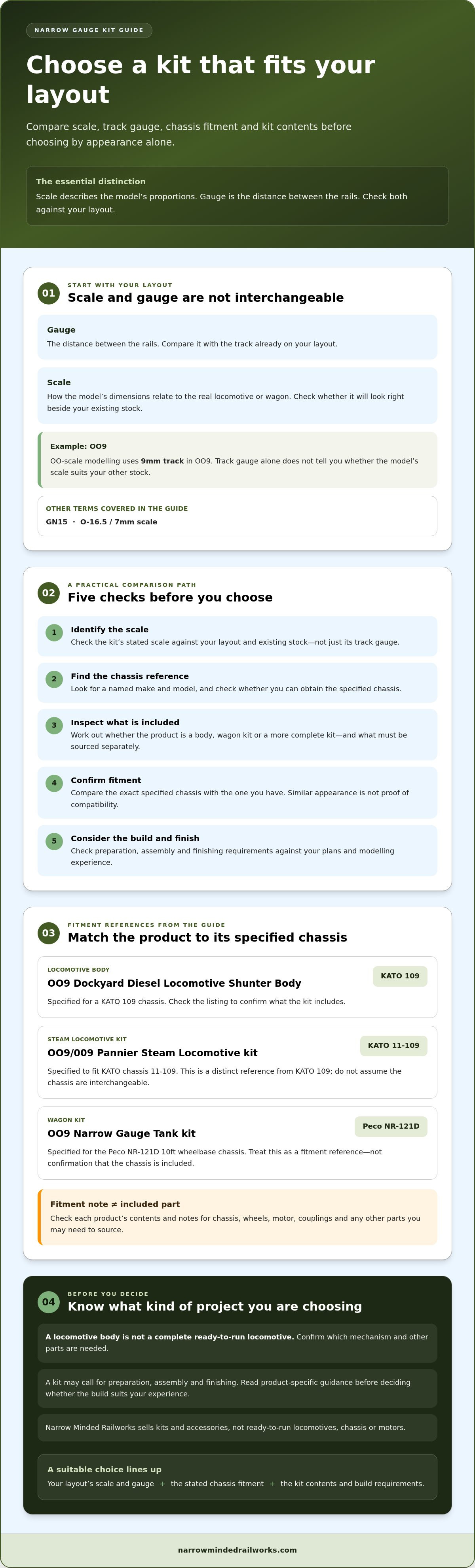
To avoid an unsuitable purchase, compare scale and track gauge, check chassis compatibility, and find out exactly what the kit includes and what finishing it may require. For example, the OO9 Dockyard Diesel Locomotive Shunter Body is specified for a KATO 109 chassis, while the OO9/009 Pannier Steam Locomotive kit is specified to fit KATO chassis 11-109. These fitment details matter, but don’t assume a chassis or motor is included. Check each listing’s contents and notes before deciding. This guide also explains how OO9, GN15 and O-16.5 / 7mm scale relate to your layout, so you can narrow down your next project.
Key Takeaways
- Compare narrow gauge model railway kits by scale and track gauge to check they suit your layout.
- Look for a specific chassis reference and confirm fitment rather than relying on dimensions that appear similar.
- Check the listing to see what the kit includes and which parts you may need to source separately.
- Allow for preparation and finishing, and check product-specific guidance before choosing a build that matches your experience.
- Use the final checklist to identify a suitable kit type, remembering that the store sells kits and accessories, not ready-to-run locomotives or chassis.
What to Check Before Choosing Narrow Gauge Model Railway Kits
Two narrow gauge model railway kits can look similar in a product photo but suit very different layouts. They may use different scales, require different chassis, or involve more preparation and finishing than you expect. Check these practical details before choosing by appearance alone.
Gauge is the distance between the rails; scale describes how model dimensions relate to the real locomotive or wagon. OO9, for example, combines OO-scale modelling with 9mm track. The terms aren’t interchangeable. Check the standards used by your existing track and rolling stock, then compare a kit’s scale, intended use, contents and build requirements. For background on the real-world railway, see this overview of the narrow-gauge railway.
For a visual example of narrow gauge modelling in a larger scale, watch this video from PECO TV:
Scale and gauge: confirm what your layout uses
Start with your layout, not the product photo. Check the scale of your existing rolling stock, the track gauge and any conventions you follow for sleeper spacing or appearance. OO9 uses 9mm track, but track gauge alone doesn’t tell you whether a model’s scale will look right beside your other stock. If you’re new to the terminology, the narrow gauge railway beginner's guide can help clarify the basics.
Choose the kind of kit that fits your next project
Decide what you want to add: a locomotive body, wagons for operating interest, or scenery and visual detail. Each is a different project, with its own parts and build requirements. A kit body isn’t a complete ready-to-run locomotive. Narrow Minded Railworks sells kits and accessories, but not ready-to-run models, chassis or motors, so check what you’ll need to source separately.
Before browsing, use this quick checklist:
- Scale and gauge: Do they suit your layout and existing stock?
- Chassis: Is a specific chassis reference given, and can you obtain it?
- Contents: What’s included, and what must be sourced separately?
- Skill and finishing: Are you comfortable with the assembly, preparation and finish required?
These checks give you a clear starting point. Once you know your layout requirements and project type, compare kit fitment and build requirements with fewer surprises.
Match Narrow Gauge Kits to the Chassis and Parts You Have
After identifying a kit’s scale, check which mechanism and parts it’s designed to work with. A stated chassis reference is more useful than a visual guess: two chassis may look similar but differ in ways that affect fit. Use this process to compare narrow gauge model railway kits before buying:
- Identify the scale. Check that it matches your layout and the kit’s stated scale, not just its track gauge.
- Find the chassis reference. Look for a named make and model, or a clear note that the chassis must be sourced separately.
- Inspect the contents. Establish whether it’s a body, wagon kit or a more complete kit.
- Confirm fitment. Compare the specified chassis with the one you have, and read product-specific notes before assuming it will fit.
- Compare what remains to be done. Check which parts and finishing steps are required, then decide whether they suit your plans and experience.
How to check a locomotive kit’s chassis compatibility
Start with the exact chassis reference. The OO9 Dockyard Diesel Locomotive Shunter Body is specified for a KATO 109 chassis, while the OO9/009 Pannier Steam Locomotive kit is specified to fit KATO chassis 11-109. These are distinct references, so don’t assume they’re interchangeable. For more on selecting a locomotive project, read the first OO9 locomotive kit buying guide.
Check wagon kits and separately sourced components
Compatibility notes can apply to wagon kits as well as locomotive bodies. The OO9 Narrow Gauge Tank kit is specified for the Peco NR-121D 10ft wheelbase chassis. Treat that as a fitment reference, not confirmation that the chassis or other parts come with the kit. Check each listing for details about wheels, chassis, motor, couplings and any other components you may need. Don’t infer what’s included from a product photo or title.
Published standards can help explain modelling terminology, but they don’t replace product-specific fitment information. The National Model Railroad Association (NMRA) provides standards and recommended practices. For a UK layout, use the kit’s stated compatibility details and your own track and stock as practical checks.
Once you’ve noted your chassis and any parts to source, compare the relevant narrow gauge kits and accessories against those requirements. Confirm current contents and fitment on each individual listing before deciding.
Compare Kit Contents, Build Effort and Finish Before Buying
Once a kit appears to suit your layout, compare what you’ll build and what the work involves. A locomotive project may need a compatible mechanism sourced separately. A wagon kit or scenery piece may suit a project focused on adding operating stock or visual detail. Choose according to the role you want the model to play and the time and skills you can bring to it.
A simple comparison table can make differences between narrow gauge model railway kits easier to spot. Use columns for scale, product type, chassis reference, confirmed contents and finishing. Fill them from each individual product listing. If a detail isn’t stated, mark it as unconfirmed rather than assuming it’s included.
Chassis compatibility and confirmed contents matter more than appearance alone. They tell you whether a kit can become the model you intend to build and what else you’ll need.
Estimate the preparation and finishing work
3D-printed products may need preparation and finishing, but the work varies by product. Check whether the listing says the item is supplied unpainted and what preparation it describes. Consider assembly, surface preparation, painting and final detailing as separate tasks, then decide which you’re ready to take on. For practical finishing guidance, see this guide to painting 3D-printed models.
Don’t assume every kit needs the same steps. Follow product-specific instructions where available, and base your expectations on that item rather than a different build. The Model Railway Club’s wider hobby resources can also offer context and inspiration as you plan.
Avoid common kit-buying mistakes
A product photo can help you picture the finished model, but it can’t confirm the scale, intended track gauge or pack contents. Read the listing first. In particular, distinguish a locomotive body from a more complete kit, and don’t assume a chassis, motor or ready-to-run mechanism is supplied.
- Check the intended use: Is it a locomotive project, wagon addition or scenery detail?
- Verify what’s included: Look for clear confirmation of each component you expect to receive.
- Review finishing needs: Note stated preparation, painting and detailing requirements.
- Resolve uncertainty: Recheck the exact listing if fitment or contents aren’t clear before ordering.
Compare these details to choose a project that fits your layout and appetite for building, not just one that catches your eye.
Three OO9 Kit Examples: Match the Product to Your Project
These examples show how product type and chassis reference can help narrow your choice. They aren’t a ranking, and not every modeller needs a locomotive project or a wagon addition. Treat each as a starting point, then check the current product listing for contents, fitment notes and any separately required parts.
Choose a locomotive body for a powered chassis project
If you want a diesel shunter body, the OO9 Dockyard Diesel Locomotive Shunter Body is specified for a KATO 109 chassis. For a steam locomotive project, the OO9/009 Pannier Steam Locomotive kit is specified to fit KATO chassis 11-109. The models have different prototype character and different stated chassis references. Don’t assume one mechanism suits both, or that either kit includes a chassis or motor.
Compare the chassis reference with the mechanism you have or plan to source. Then read the individual listing to confirm the kit’s contents, fitment and any other components needed. If you’re considering a different scale, such as On30, remember that scale affects which models and layout standards are relevant. See the complete On30 gauge introduction for context.
Choose a wagon kit to add variety to an OO9 layout
The OO9 Narrow Gauge Tank kit offers a wagon-body project specified for the Peco NR-121D 10ft wheelbase chassis. It may suit a modeller who already has, or intends to source, that chassis. Check the listing rather than assuming the chassis or other parts are included.
Wagons can add variety alongside a locomotive, but appearance alone doesn’t confirm operational compatibility. Compare the stated chassis reference and any listed dimensions with your layout, and consider whether the build and finish requirements suit your plans. Confirm the current listing details before ordering.
Use these examples to match a project to your layout and the parts you can obtain, rather than choosing from photographs alone. To compare the store’s latest narrow gauge kits and accessories, check each listing against your intended chassis and project.
Make Your Final Choice and Browse the Latest Narrow Gauge Models
Before choosing from narrow gauge model railway kits, shortlist products based on your layout and available parts, not just the model that first catches your eye. This checklist can help you spot mismatches before ordering.
- Layout: Confirm the scale and track gauge your layout uses.
- Product type: Decide whether your project needs a locomotive or wagon kit, or scenery.
- Chassis reference: Check that the stated chassis suits the mechanism you have or plan to source.
- Contents: Confirm exactly which parts the listing says are supplied.
- Finishing: Review any stated preparation and finishing requirements.
Use your layout and existing components to narrow the shortlist
Begin with the scale and track gauge already used on your layout, then rule out products that don’t match. For a locomotive or wagon project, shortlist kits whose stated chassis reference matches your plan. Similar-looking mechanisms aren’t proof of compatibility, so check the exact fitment notes.
Before deciding, review the current product description for supplied parts, fitment and preparation requirements. If the listing doesn’t confirm whether a component is included, treat that as unconfirmed. This is especially important for body kits, where a chassis or motor may need to be sourced separately.
Browse the collection with a clear plan
Narrow Minded Railworks offers kits and accessories, including locomotive and wagon kits, scenery kits and diorama tools. It doesn’t sell ready-to-run locomotives, chassis or motors, so plan for any separately required mechanism or parts. The collection includes products in different scales, so don’t assume every item is narrow gauge. Check each listing’s scale and intended use against your layout.
With your checklist in hand, compare locomotive, wagon and scenery options against the project you want to complete. Confirm the details on individual listings before ordering, then browse the latest model railway kits and accessories.
Choose a Kit That Fits Your Next Project
The right choice among narrow gauge model railway kits is the one that suits your layout and the build you want to take on. Confirm the scale and track gauge first, then check the chassis reference, exactly what the listing includes and any preparation or finishing required. A clear fitment note is more useful than appearance alone, especially if you need to source a mechanism separately.
Narrow Minded Railworks offers 3D-printed locomotive bodies and wagon kits, alongside scenery and accessories across multiple scales. The OO9 examples in this guide specify KATO chassis references for locomotive projects and a Peco chassis reference for a wagon-body project. These are kits, not ready-to-run locomotives or chassis, so review each product listing for current fitment and contents before ordering.
Once you know your scale and project type, browse the latest model railway kits and accessories. Compare each listing with your checklist, confirm the details, and choose a build that fits your layout.
Frequently Asked Questions
What should I check before buying a narrow gauge model railway kit?
Check the kit’s scale, track gauge, intended product type, chassis reference, contents and finishing requirements. These details help you assess whether it suits your layout and whether you’ll need to source parts separately. A locomotive body may require a specific chassis, while a wagon kit may have different fitment needs. Read the current product listing carefully, especially if it doesn’t clearly state what’s included or what preparation is needed.
Are narrow gauge model railway kits supplied with a chassis and motor?
Don’t assume a chassis or motor is included. Narrow Minded Railworks sells kits and accessories, not chassis or motors, and individual kit contents can differ. Some locomotive bodies and wagon kits specify a compatible commercial chassis, which you may need to source separately. Check the exact product listing for stated fitment and confirmed contents before ordering. If a component isn’t explicitly listed as included, treat it as separately required until confirmed.
How do I know whether an OO9 locomotive body fits my chassis?
Compare your chassis make and model with the exact reference in the product listing. For example, the OO9 Dockyard Diesel Locomotive Shunter Body is specified for a KATO 109 chassis, while the OO9/009 Pannier Steam Locomotive kit is specified to fit KATO chassis 11-109. Don’t assume these references are interchangeable. Check the current listing for fitment details and contents, and confirm whether additional parts are needed.
Can I use an OO9 kit on an OO gauge layout?
Not directly on standard OO gauge track without checking the track arrangement. OO9 uses OO-scale models on 9mm track, while standard OO gauge track is 16.5mm. The models share OO-scale proportions, but the track gauges differ. An OO9 kit may be used on a layout that includes suitable 9mm track. Confirm the product’s scale and intended track gauge, and plan how that track fits your layout.
Are 3D-printed model railway kits suitable for beginners?
They can be, provided the kit’s build and finishing requirements match your experience and you’re comfortable with the work involved. 3D-printed products may need preparation, assembly, painting or detailing, but tasks vary by item. Read the product-specific description and instructions before deciding, and consider starting with a project whose stated requirements feel manageable. If details about preparation or contents are unclear, confirm them before buying.
What is the difference between scale and gauge in model railways?
Scale describes the model’s size in relation to the real locomotive or railway vehicle; gauge describes the distance between the rails. They’re related but not interchangeable. OO9, for example, combines OO-scale models with 9mm track. Checking both terms helps you compare products accurately and avoid assuming a model will suit your layout just because its scale appears familiar.
Do narrow gauge model railway kits come ready to run?
No. Don’t treat a kit as a ready-to-run model. Narrow Minded Railworks sells model railway kits and accessories, not ready-to-run locomotives. A product may be a locomotive body, wagon kit or scenery item, and the supplied parts depend on the individual listing. Check what’s included, what needs to be sourced separately and what assembly or finishing is required before choosing your project.