

What if you could fit a sprawling, characterful mountain railway into the same space as a modest bookshelf? While standard gauge projects often demand entire rooms, the world of 9 oo modelling offers a unique opportunity to build intricate, atmospheric scenes in remarkably compact areas. It's understandable if you feel hesitant about the technical side of narrow gauge. Many enthusiasts find the distinction between N gauge track and OO9 scale confusing, or they worry that assembling kits requires specialized tools and years of experience.
We recognize that finding specific locomotive bodies can be a challenge, but these constraints shouldn't stop your progress. This guide provides a clear path forward, demystifying the relationship between scale and gauge while building your confidence to start your first kit. You'll learn exactly how to create a detailed railway using accessible 3D-printed components designed for easy assembly. We will explore the essential terminology, the best ways to source unique rolling stock, and the simple steps needed to bring your first narrow gauge project to life.
Key Takeaways
- Understand the technical relationship between scale and gauge in 9 oo modelling to ensure your locomotives fit standard track.
- Learn how narrow gauge railways allow for high-character layouts in small spaces, such as bookshelves or compact dioramas.
- Identify how 3D-printed kits provide a wider variety of locomotive styles than standard ready-to-run models.
- Gain the confidence to plan your first project by selecting a manageable theme like a quarry or peat bog railway.
- Discover how specialized kits are designed for easy assembly, making narrow gauge modelling accessible to beginners.
Understanding the Basics of 9 OO and OO9 Scale
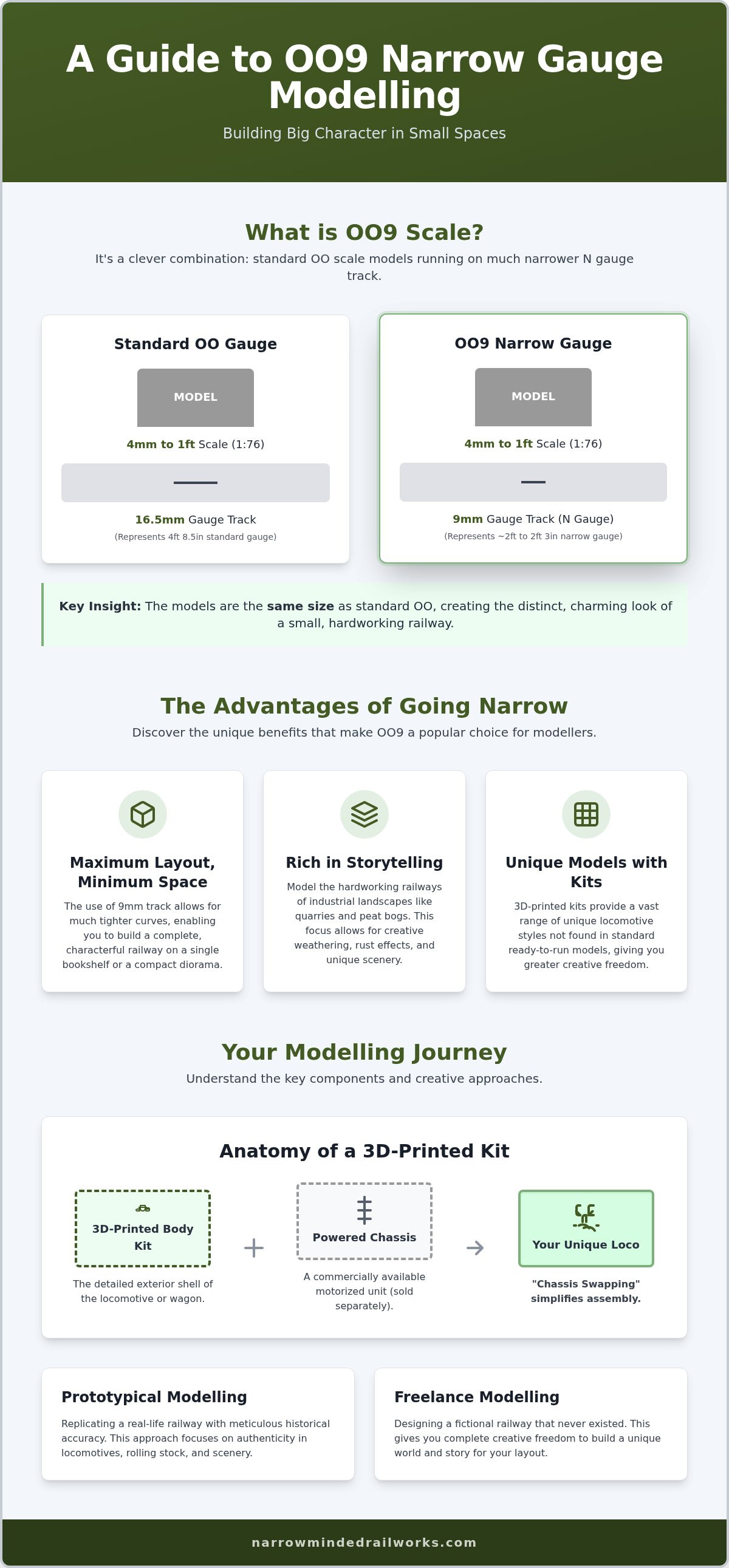
The term 9 oo refers to a specific modelling standard where the scale is 4mm to the foot (1:76), but the locomotives and rolling stock run on narrow 9mm gauge track. This combination allows you to maintain the same scale as standard OO gauge while representing the smaller, more agile railways that once dominated industrial and rural landscapes. Historically, narrow gauge railways served as the essential workhorses for remote environments. They hauled slate from Welsh quarries, transported peat from bogs, and moved goods across rugged terrain where standard mainline tracks were too expensive or bulky to build.
A frequent point of confusion for beginners is the physical size of the models. While the track is narrow, the models themselves are not "smaller" in scale than standard OO trains. A 4mm scale figure or building will look perfectly proportional next to an OO9 narrow gauge locomotive. The difference lies entirely in the width of the rails, which creates the distinct, charming aesthetic of a railway built for utility rather than high-speed travel.
The Relationship Between Scale and Gauge
In 9 oo modelling, the "9" represents the 9mm distance between the rails. This is the exact same track width used in N gauge modelling. By using N gauge track to represent 2-foot or 2-foot-3-inch narrow gauge lines, modellers benefit from high availability and lower costs. Standard OO gauge uses 16.5mm track to represent the 4 feet 8.5 inches of the UK mainline. Because 9mm track is so much narrower, you can fit much tighter curves and more complex track plans into a small footprint. This makes it a proactive solution for enthusiasts who want a functional layout but lack the space for a full-sized standard gauge project.
Common Terminology in Narrow Gauge Modelling
As you explore this hobby, you'll encounter specific terms that define how people build their collections. "Prototypical" modelling refers to replicating a real-life railway with historical accuracy. In contrast, "freelance" modelling gives you the creative freedom to design a fictional line that never existed. Understanding the components of a model is also vital. We specialize in 3D-printed body kits, which are the exterior shells of locomotives. These are designed for "chassis swapping," where you fit the detailed body onto a commercially available powered chassis. This approach removes the frustration of complex motor assembly, allowing you to focus on the creative aspects of painting and detailing your rolling stock.
- Body Kit: The 3D-printed shell of a locomotive or wagon.
- Chassis: The motorized unit that provides movement (sold separately by third parties).
- Freelance: A creative, non-historical approach to layout design.
Why Narrow Gauge Modelling Offers More Character in Less Space
Standard gauge railways often prioritize speed and efficiency. The world of 9 oo allows you to prioritize storytelling instead. Because narrow gauge lines historically served specific industries, every scene carries a distinct narrative. A small quarry engine isn't just a machine; it's a tool designed for a rugged, specialized environment. This focus on utility allows modellers to embrace weathering, rust, and the lived-in feel of a railway that works for its living. While standard hobby projects often require massive amounts of room, narrow gauge provides a high-detail alternative in a fraction of the footprint.
The Aesthetic of 9 OO Railways
Narrow gauge has a specific visual appeal that differs from the polished look of mainline steam. You might see small steam locomotives with oversized cabs or weathered wagons carrying raw timber. The integration of scenery is vital here. Because the tracks are narrow, the landscape often looms over the railway, creating a sense of scale and drama that is hard to replicate in larger scales. If you are new to the terminology, you can read our guide on What is a Narrow Gauge Railway? to understand the history behind these fascinating lines. Capturing this unique aesthetic can be difficult when relying on standard ready-to-run models. To address this, our OO9 Locomotive & Wagon Kits provide a proactive solution for modellers seeking variety and character.
Space-Saving Benefits for Modern Modellers
Space is a common constraint for many enthusiasts. While a standard OO layout might require a dedicated spare room, a 9 oo project can thrive on a single bookshelf or a small diorama. The tighter radius curves allow for a full circuit in a footprint that would be impossible for mainline models. This portability means you can work on your project at a desk and store it away easily when finished. You don't have to sacrifice complexity just because you're building small. A narrow gauge layout can feature intricate trackwork, specialized industries, and detailed scenery within a space no larger than two feet by four feet. This accessibility makes it a proactive choice for modellers who want to finish a project rather than spending years on a massive layout that may never reach completion.
Choosing Between Ready-to-Run Models and Custom Kits
Ready-to-run (RTR) models offer an immediate entry point into the hobby. Major manufacturers produce high-quality locomotives that function reliably from the moment they are unpacked. While these models provide convenience, they are often restricted to a small selection of well-known prototypes. This limitation can make it difficult to build a truly unique or historically specific layout. If you want your railway to stand out, relying solely on mass-produced models can be a constraint.
Kits provide a proactive solution for modellers who want to expand beyond high-street offerings. The kit-building community supports a vast range of industrial and rural prototypes that major brands do not produce. By choosing kits, you can populate your 9 oo railway with specialized rolling stock that reflects a specific era or industry, such as a localized timber line or a small-scale quarry operation. This variety allows you to tell a much richer story within your chosen setting.
The Advantages of Building from Kits
Building your own models provides a level of satisfaction that buying off-the-shelf cannot match. Kits allow you to customize every detail, from the placement of handrails to the specific shade of paint used for weathering. This creative control ensures your collection is entirely unique. Additionally, kits are a cost-effective way to grow your roster. By purchasing a 3D-printed body kit and fitting it to a commercially available chassis, you can own a high-detail locomotive for a fraction of the cost of a premium RTR model. This approach prioritizes value without sacrificing the visual quality of your layout.
Overcoming the Fear of Kit Assembly
A common misconception is that kit building is reserved for master craftsmen. While some older brass kits require advanced soldering skills, modern 3D-printed kits are designed with the beginner in mind. These parts fit together with high precision, reducing the need for extensive filing or adjustment. If you feel hesitant, a proactive step is to start with simple wagon kits before moving on to locomotives. This builds your confidence with basic tools and painting techniques. For those ready to take the next step, our guide on selecting Your First OO9 Loco Kit offers practical advice on finding the right project for your skill level. You don't need years of experience to produce a professional-looking result; you just need the right starting point.
Essential Steps for Planning Your First 9 OO Layout
Planning a 9 oo layout requires a shift in perspective. Unlike standard gauge projects that often demand long mainlines, narrow gauge excels in concentrated detail. While building a massive network is a common ambition, starting with a small, manageable scene is a proactive solution to avoid project fatigue. Focusing on a single diorama or a modest bookshelf layout allows you to master the techniques of narrow gauge modelling without becoming overwhelmed by the scale of the task.
Selecting the Right Theme and Era
Your chosen theme dictates every aspect of your project, from the type of rolling stock to the style of the buildings. A quarry setting requires heavy, weathered wagons and sturdy locomotives, while a peat bog or estate railway might feature lighter, more specialized equipment. Common carriers offer the most variety, often mixing passenger services with industrial freight. If you find strict historical prototypes too restrictive, freelance modelling provides a proactive solution. This creative path allows you to design a fictional railway that utilizes your favorite elements from real-world lines. Looking at preserved railways in Wales or the industrial history of your local area can provide excellent inspiration for your track plans and scenery.
Technical Considerations for Track and Power
Track selection is a vital part of the planning process. You can use standard commercial N gauge track, which is highly accessible and cost-effective. However, dedicated OO9 track features sleeper spacing that more accurately reflects the look of a narrow gauge line. While using N gauge track is a technical constraint, it allows you to begin construction immediately. You should also consider whether to use set-track for ease of assembly or flexible track for more realistic, flowing curves that suit the character of 9 oo railways.
Power requirements are usually simple, as standard analog controllers provide sufficient control for most small layouts. When choosing points, you'll need to decide between dead-frog and live-frog designs. Dead-frog points feature an insulated plastic frog that simplifies wiring, whereas live-frog points use a metal frog to ensure consistent power delivery for small locomotives with short wheelbases. Before you commit to a specific project, you must identify the chassis you will use. Because we design our kits to fit commercially available motorized units, knowing your chassis dimensions ensures a seamless assembly process. To start your project with the right components, browse our selection of OO9 Locomotive & Wagon Kits today.
How Narrow Minded Railworks Simplifies Your Modelling Journey
Starting a 9 oo layout can be daunting due to the limited variety of specialized rolling stock found in standard retail shops. While we don't sell ready-to-run models, we provide a proactive solution through our specialized range of 3D-printed locomotive bodies and wagon kits. Our design philosophy centers on making narrow gauge accessible; we prioritize high external detail while ensuring our models fit seamlessly onto commercially available chassis. This approach allows you to achieve a professional result without needing advanced engineering skills or specialized tools.
The Benefits of 3D Printed Locomotive Bodies
While traditional kit materials like brass often require complex soldering, our high-quality resin prints provide a more accessible entry point for modellers. 3D printing allows us to capture the intricate, compact shapes of iconic engines like the Quarry Hunslet with a level of precision that older methods struggle to match. These resin components offer a smooth surface that's easy to prime and finish. If you're unsure about the best techniques for your project, our guide on Painting 3D Printed Models offers a proactive path to achieving a flawless appearance.
Global Support for Narrow Gauge Enthusiasts
We recognize that narrow gauge enthusiasts are located globally, which can sometimes make sourcing high-quality kits feel like a logistical challenge. To address this, we offer worldwide shipping and use professional packaging to ensure your items arrive safely. Our team provides proactive customer support for modellers at all levels, ensuring you have the guidance needed to complete your project. Beyond locomotive bodies, we also provide diorama tools and scenery designed to bring your 9 oo scenes to life. We encourage you to browse our shop and explore the latest releases tailored for unique narrow gauge layouts.
Start Your Narrow Gauge Adventure Today
Building a 9 oo layout offers a unique creative outlet that fits perfectly into modern living spaces. You now understand how to navigate the technical relationship between scale and gauge; you've also seen that kit building isn't a task reserved only for experts. By starting with a manageable theme and utilizing modern 3D-printed components, you can bypass the limited variety found in standard retail shops. These specialized designs provide a proactive solution for modellers who prioritize character and historical detail in their projects.
We are specialists in 3D-printed designs for narrow gauge enthusiasts who want to create something truly unique. We provide worldwide shipping on all model kits to support your hobby regardless of your location. Narrow gauge modelling is about capturing the charm of industrial history in a compact space. With the right tools and a proactive plan, your first miniature railway is well within reach. Browse our range of OO9 Locomotive and Wagon Kits to find the perfect starting point for your next project.
Frequently Asked Questions
What track does 9 OO (OO9) use?
9 OO models run on 9mm gauge track, which is the same width used in N gauge modelling. While standard N gauge track is functional, dedicated OO9 track features sleepers that are spaced more realistically for a narrow gauge appearance. This is a common technical hurdle for beginners, but using N gauge track is a proactive way to start building immediately. It remains fully compatible with almost all narrow gauge locomotives and rolling stock.
Is 9 OO the same as N gauge?
No, 9 oo refers only to the track width, not the scale of the models. N gauge is 2mm to the foot, whereas OO9 is 4mm to the foot. This means your trains will be physically larger than N gauge models despite running on the same rails. It's a proactive solution for modellers who want the high detail of OO scale but need the space-saving benefits of narrower 9mm track.
Can I use a standard OO gauge controller for 9 OO trains?
Yes, you can use a standard analog DC controller to power your layout. Most narrow gauge locomotives operate on 12V DC power, which is the same requirement as standard OO gauge systems. Although we don't sell DCC systems or controllers, these units are widely available from other retailers. Using a standard controller is a proactive way to keep your setup simple and reliable while focusing on the creative aspects of your railway.
How difficult is it to build a 3D printed locomotive kit?
Modern 3D-printed kits are designed for straightforward assembly and are much easier to handle than traditional brass kits. While older metal kits require soldering, our resin-printed bodies usually only need basic cleaning and painting. This removes the barrier of specialized metalworking skills. We recommend starting with a simple wagon before moving to a locomotive. This approach builds your confidence with the material and ensures a professional finish.
Do I need a specific chassis for Narrow Minded Railworks kits?
Yes, our kits are designed to fit specific motorized units from other manufacturers. Because we don't sell chassis or motors, we ensure our 3D-printed bodies are compatible with common, reliable chassis available on the market. You should check the product description for the recommended motorized unit before purchasing. This approach provides a proactive solution for modellers who want unique locomotive bodies without the technical difficulty of building a custom motor unit.
Where can I find 9 OO scenery and accessories?
You can find a dedicated range of 9 oo scenery and accessories directly through our shop. Finding scale-appropriate details for narrow gauge can be a constraint, but we offer diorama tools and scenery items like figures and industrial structures. These are specifically designed to match the 4mm scale of your railway. We ship these items worldwide, providing a proactive way to add character and realism to your compact industrial or rural layout.