

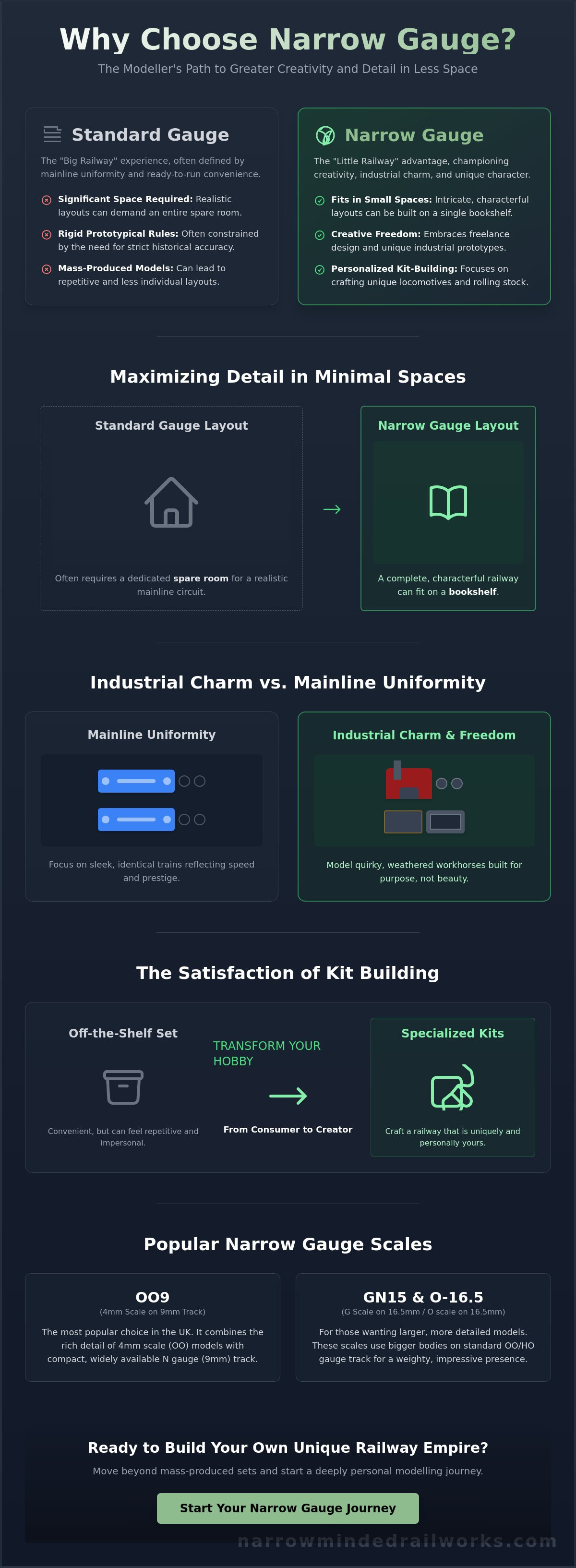
What if you could fit a complete, character-filled railway empire onto a single bookshelf instead of losing your entire spare room to a rigid mainline layout? Many hobbyists find themselves asking why choose narrow gauge model railways when the local shop is packed with standard gauge, ready-to-run sets. While standard gauge offers convenience, it often comes at the cost of significant space and individual expression.
It's common to feel that your hobby is limited by the dimensions of your home or the repetitive nature of mass-produced models. We acknowledge that the strict, by the book approach to mainline modelling can sometimes stifle the very creativity that drew you to the rails. This guide will show you how narrow gauge modelling provides a proactive solution to these constraints, offering a path to build something truly unique through specialized kits and imaginative designs.
You'll discover how focusing on smaller footprints and the art of kit-building can transform your modelling experience into a deeply personal project. We'll explore the charm of industrial prototypes and the immense satisfaction of crafting a layout that reflects your own vision rather than a manufacturer's catalogue.
Key Takeaways
- While standard layouts often demand significant space, narrow gauge scales like OO9 provide a proactive solution by fitting intricate designs onto small bookshelves.
- Understand why choose narrow gauge model railways to move beyond rigid mainline rules and embrace the freedom of freelance, industrial modelling.
- Although off-the-shelf models can feel repetitive, kit-building offers a direct way to create quirky locomotives and weathered rolling stock that reflect your personal style.
- Transition from mass-produced sets to specialized GN15 or O-16.5 kits to experience the professional satisfaction of hand-crafting a truly unique railway empire.
What is Narrow Gauge Modelling and Why is it Growing?
In the world of model railways, the standard gauge prototype measures exactly 4 feet 8.5 inches between the rails. Narrow gauge refers to any railway with a prototype gauge narrower than this standard. Modellers often find that standard mainline layouts require extensive room to look realistic. Narrow gauge modelling provides a proactive solution to this space constraint by using a specific scale-gauge combination. For example, OO9 scale uses 4mm scale (1:76) bodies on 9mm track, which is the same width as N gauge.
Many enthusiasts now ask why choose narrow gauge model railways when standard gauge models are so prevalent. The answer often lies in the shift toward character-heavy, industrial prototypes. Instead of the uniform look of mainline expresses, narrow gauge focuses on the quirky, weathered charm of lines like the Ffestiniog Railway in Wales. These railways weren't built for speed or prestige; they were built for purpose.
To better understand how these proportions translate into a model environment, watch this helpful video of a detailed OO9 layout:
The Philosophy of the "Little" Railways
Narrow gauge lines were historically the workhorses of difficult terrain. They carried slate from Welsh mountains or moved materials across busy factory floors where standard trains couldn't fit. While mainline railways often focused on polished prestige, narrow gauge was about grit and ingenuity. This historical context is vital for understanding what is a narrow gauge railway and how its utilitarian nature translates into a creative modelling hobby. By choosing these "little" railways, you embrace a history of industrial problem-solving that allows for more freedom in your layout design.
A Brief Overview of Popular Scales
The most popular choice in the UK is OO9, which represents narrow gauge prototypes on 9mm track. It's a perfect entry point because it utilizes widely available track components while offering the detail of 4mm scale. For those who prefer a larger presence, GN15 uses G scale proportions on 16.5mm track. These combinations are excellent for creating massive detail in tiny footprints, such as a micro-diorama or a bookshelf layout. You can find a comprehensive overview of the different scales to see which specific ratio fits your available space. Understanding these scales is key when deciding why choose narrow gauge model railways for your next project.
Industrial Charm vs. Mainline Uniformity
Mainline railways often emphasize prestige and high-speed efficiency, which leads to a fairly uniform visual experience. If you feel that modern liveries and streamlined designs lack individuality, narrow gauge modelling offers a proactive solution. It trades the polished look of the "big railway" for the rugged, weathered charm of industrial workhorses. Instead of identical trains running on a loop, you focus on the unique mechanical diversity of engines designed for specific, often difficult, tasks.
This niche focuses on "Industrial Archaeology" in miniature. You might choose to model a remote slate quarry, a timber line, or a factory floor tramway. These settings allow for quirky locomotives and rolling stock that were built for utility rather than beauty. The Narrow Gauge Railway Society supports this passion by documenting the fascinating history of these diverse lines, providing endless inspiration for your own projects. By focusing on these smaller, specialized operations, you create a layout that feels like a living piece of history.
The Freedom to Freelance
Many modellers struggle with the rigid expectations of prototype accuracy found in mainline circles. If the "prototype police" make you feel restricted, narrow gauge removes these constraints. It provides the freedom to freelance, allowing you to invent your own railway company with its own unique history and livery. You don't have to worry about whether a specific locomotive ever ran on a specific line because you are the one setting the rules. This sense of creative ownership is a compelling reason why choose narrow gauge model railways. Your layout becomes a personal story rather than just a replica of someone else's work.
Weathering and Realism
Texture is everything in this scale. A locomotive covered in rust and grime tells a much more interesting story than one that looks like it just left the factory. Because narrow gauge engines worked in harsh environments, heavy weathering is expected rather than optional. Mastering techniques like painting 3D printed models helps you bring out the fine details of rivets, rust patches, and panel lines. You can truly lean into the grime of a working environment, using overgrown trackbeds and dilapidated sheds to enhance the realism. Exploring a collection of specialist narrow gauge kits is the first step toward building a layout with genuine character.
Maximising Detail in Minimal Spaces
Standard gauge layouts often demand more space than a typical modern home can provide. If you've found that a traditional mainline circuit won't fit in your spare room, narrow gauge modelling offers a proactive solution. Because narrow gauge prototypes were built to navigate sharp bends in quarries and mountains, they allow for significantly tighter curves in miniature. You can model an entire industrial complex, complete with sidings and workshops, in the same footprint a standard gauge station would occupy. This spatial efficiency is a major reason why choose narrow gauge model railways; it makes the hobby accessible regardless of your floor plan.
Micro-layouts serve as an excellent gateway into the hobby. These small, focused projects allow you to complete a high-quality scene quickly without the overwhelming commitment of a room-sized installation. By focusing on a specific scene, you can elevate the level of detail beyond what is possible on a sprawling mainline layout. Understanding the historical context of these lines helps explain their compact nature, as they were the lifeblood of remote industries where standard trains simply couldn't operate.
- Tight Radii: Narrow gauge locomotives can handle curves that would cause standard gauge stock to derail.
- Vertical Interest: Smaller footprints encourage building upwards with cliffs, bridges, and multi-level tracks.
- Industrial Density: Pack more operational interest into every square inch of your baseboard.
Why OO9 is the King of the Spare Room
OO9 is often considered the king of the spare room for good reason. By utilizing N-gauge track components, you save a significant amount of floor space while maintaining the familiar 4mm scale for buildings and figures. This combination is highly efficient for those who want a detailed railway without losing their living space. You can find specialized OO9 locomotive kits that are designed to fit directly onto reliable N-gauge chassis. A single 4x2 foot board can easily hold a complete, self-contained narrow gauge world with multiple levels and intricate operations.
Large Scale in Small Spaces: The GN15 Revolution
If you prefer the presence of larger models but don't have a garden, GN15 is a revolutionary option. This scale places 1:22.5 scale bodies on 16.5mm track, which is the same width as standard OO gauge. It allows for incredible figure and scenery detail that is often lost in smaller scales. When getting started in GN15 scale, you'll find that you can create high-impact dioramas on a simple bookshelf. You don't need a massive room to enjoy the satisfaction of large-scale modelling; you just need the right creative approach to your layout design.
The Creative Satisfaction of Kit Building
The most frequent objection raised by those considering the hobby is the perceived lack of ready-to-run models. While standard gauge retailers offer shelves full of pre-assembled trains, the narrow gauge market operates differently. We acknowledge that this can feel like a disadvantage if you're used to buying a train and running it immediately. However, this constraint serves as a proactive solution to the problem of uniformity. This is a key reason why choose narrow gauge model railways; it ensures your layout won't look like an identical copy of every other display at a model show.
Modern technology has fundamentally changed the building experience. In the past, enthusiasts struggled with heavy white metal kits that required soldering and extensive filing. Today, 3D-printed resin kits offer a lightweight, highly detailed alternative that is far more accessible to beginners. A common hybrid strategy involves pairing a reliable, mass-produced chassis with a custom-designed kit body. This approach gives you the mechanical reliability of a modern motor with the individual character of a specialized industrial locomotive.
Overcoming the Fear of the Build
Many hobbyists hesitate to start because kit building seems technically daunting. While older methods were indeed complex, modern 3D prints provide a proactive solution by arriving with crisp details and minimal cleanup required. You don't need a workshop full of specialized tools to achieve a professional finish. Narrow Minded Railworks kits are designed to fit standard, easy-to-find chassis, which simplifies the process significantly. By breaking the assembly into manageable steps, you'll find that building your first locomotive is a straightforward and rewarding task.
Personalising Your Rolling Stock
The ability to modify and adapt your models is a major draw for many enthusiasts. 3D-printed wagons and locomotives are exceptionally easy to customize with extra details, unique liveries, or specific weathering effects. There is a profound level of pride in being able to say "I built that" when presenting your railway to friends or fellow club members. Beyond the trains themselves, you can integrate specialized scenery and figures to create a cohesive, living world. To begin your journey into custom modelling, explore our collection of narrow gauge kits and diorama tools designed for every skill level.
Starting Your Narrow Gauge Journey with Narrow Minded Railworks
Transitioning from standard mainline modelling to a specialized niche can feel like a significant leap. If you've spent years with off-the-shelf sets, the prospect of building your own rolling stock might seem daunting. Narrow Minded Railworks acts as a proactive partner in this transition, providing the high-quality components needed to move beyond the limitations of standard gauge. We specialize in OO9, GN15, and O-16.5 / 7mm scale kits, offering a direct path for modellers who prioritize character and individual creativity. This focus on unique, industrial prototypes is a primary reason why choose narrow gauge model railways for your next layout.
Our professional 3D-printed kits are designed to make the hobby accessible to everyone. While traditional kit building often required complex metalwork, our resin bodies offer crisp detail with very little preparation required. We've successfully shipped these kits to over 40 countries, supporting a global community of enthusiasts who want something different from the status quo. Whether you're building a tiny bookshelf diorama or a larger industrial scene, our range provides a helpful starting point for your creative vision.
Our Approach to Kit Design
We understand that mechanical reliability is just as important as visual detail. A common frustration in the hobby is spending hours on a model only for it to run poorly. To solve this, we provide the highly detailed body kits while you provide the power. Our designs are engineered to fit specific, reliable commercial chassis from brands like Kato or Tenshodo; this ensures a smooth run every time by combining our unique aesthetics with proven motor technology. Beyond locomotives, we offer specialized scenery items like vintage petrol pumps and diorama tools to help you build a complete, immersive world.
Your Next Steps
If you're new to the process, we recommend starting with a simple wagon kit. This allows you to practice basic assembly and painting techniques before moving on to a more complex locomotive project. Building your confidence in small steps is the best way to ensure long-term satisfaction with your railway. When you're ready to begin, you can browse our current collection of OO9 and GN15 kits to find the prototype that sparks your imagination. This variety is another reason why choose narrow gauge model railways; there is always something new and unusual to discover.
Ready to build something unique? Explore our range today and start crafting a railway that truly reflects your own style and creativity.
Build Your Unique Railway Empire Today
Standard mainline layouts often demand more space and uniformity than many hobbyists prefer. Narrow gauge modelling offers a proactive alternative, combining compact footprints with the creative freedom to build industrial workhorses that tell a story. Understanding why choose narrow gauge model railways allows you to move beyond the repetitive nature of mass-produced sets and embrace the satisfaction of kit building. Whether you're working on a tiny bookshelf diorama or a larger industrial scene, the shift toward these characterful railways provides a path to a more personal and rewarding hobby.
We provide a direct solution for your next project through our specialist 3D-printed designs for OO9 and GN15. Our kits are engineered to fit reliable commercial chassis, giving you the perfect balance of unique aesthetics and mechanical performance. With worldwide shipping available, we're ready to help you start your journey regardless of where your workshop is located. Browse our range of OO9 and GN15 narrow gauge kits today to find the perfect starting point for your next build. It's time to create a railway that's truly yours.
Frequently Asked Questions
Is narrow gauge the same as N gauge?
Narrow gauge isn't the same as N gauge, although they share the same 9mm track width in scales like OO9. While N gauge models are built to a 1:148 scale, OO9 narrow gauge uses the larger 1:76 scale for the locomotive and wagon bodies. This allows for significantly more detail and character while still utilizing a compact track footprint.
Do I need special track for OO9 model railways?
You don't strictly need special track, as OO9 runs perfectly on standard 9mm N gauge track. However, many modellers choose dedicated narrow gauge track because the sleeper spacing is wider. This wider spacing correctly represents the rugged look of industrial or rural lines rather than the polished appearance of high-speed mainlines.
Are narrow gauge kits difficult for beginners to build?
Modern 3D-printed kits are not difficult for beginners and offer a proactive solution to the lack of off-the-shelf models. Unlike old metal kits, these resin bodies require very little cleanup and fit directly onto commercial chassis. Starting with a simple wagon kit is an excellent way to build your confidence before tackling a locomotive.
What is the most popular narrow gauge scale in the UK?
OO9 is the most popular narrow gauge scale in the UK because it utilizes readily available 9mm track components. It allows modellers to build detailed layouts in small spaces, such as bookshelves or spare rooms. This popularity makes it easy to find community support and a wide variety of specialized kits for your projects.
Can I run narrow gauge trains on my existing OO gauge track?
You can run narrow gauge trains on OO gauge track if you choose specific scales like GN15 or O-16.5. These scales use 16.5mm track to represent larger prototypes in a narrow gauge context. It's a great way to reuse existing track while exploring why choose narrow gauge model railways for their unique industrial aesthetic.
Where can I find a chassis for a narrow gauge locomotive kit?
You can find suitable chassis from major manufacturers like Kato, Graham Farish, or Bachmann. Most OO9 kits are designed to fit specific N gauge locomotive chassis that are widely available from model shops or online retailers. We recommend checking the specific kit instructions for the exact model needed to ensure a perfect fit.
Why are there so few ready-to-run narrow gauge models?
The diversity of narrow gauge prototypes makes it difficult for large manufacturers to produce mass-market ready-to-run versions. Because these railways were often unique to a single quarry or mine, kit building is the most effective way to capture their individual character. This lack of uniformity is exactly why choose narrow gauge model railways if you want a layout that stands out.
What tools do I need to start building 3D printed railway kits?
You only need basic hobby tools to start building 3D-printed kits. A sharp hobby knife, fine-grit sandpaper, and cyanoacrylate (super glue) are the essential items for assembly. For finishing, a good quality primer and acrylic paints will help you achieve a professional, weathered look on your industrial models.