

The days of wrestling with a soldering iron just to add a niche narrow gauge locomotive to your layout are officially over. You've likely felt the frustration of wanting a specific prototype only to find it's either an expensive white metal kit or simply doesn't exist in a ready-to-run format. It's a common hurdle that often leaves modellers with layouts that look just like everyone else's. While traditional metal kits offer durability, they often require specialized tools and years of practice to master. 3D printing provides a proactive solution by delivering high-resolution, one-piece bodies that eliminate complex construction.
This guide explores the primary advantages of 3d printed model railway kits, showing you how 14K resin technology now delivers incredible detail without the technical headaches of traditional casting. You'll discover how these modern kits make high-detail narrow gauge models more accessible and significantly easier to build than ever before. We'll look at how these kits simplify the assembly process, reduce the entry cost for specialized prototypes, and provide a smooth surface that's easy to finish with confidence. Whether you're modelling in OO9, GN15, or O-16.5, it's time to see how technology is making the hobby more creative and inclusive.
Key Takeaways
- Learn how 14K SLA resin technology captures intricate details like rivet heads and cab interiors that were previously reserved for master-level brass modelling.
- Understand the primary advantages of 3d printed model railway kits, specifically how they provide a cost-effective route to owning niche prototypes in OO9 and GN15 scales.
- Discover the streamlined "box to track" assembly process that eliminates the need for complex soldering while maintaining the high-quality finish of a professional model.
- Explore how one-piece resin bodies offer superior kit-bashing potential, allowing you to customize locomotives and wagons to fit your specific layout requirements.
- Identify the best material choices for durability and detail to ensure your unique narrow gauge models stand the test of time on your layout.
The Shift in Narrow Gauge Modelling: Why 3D Printing is the Future
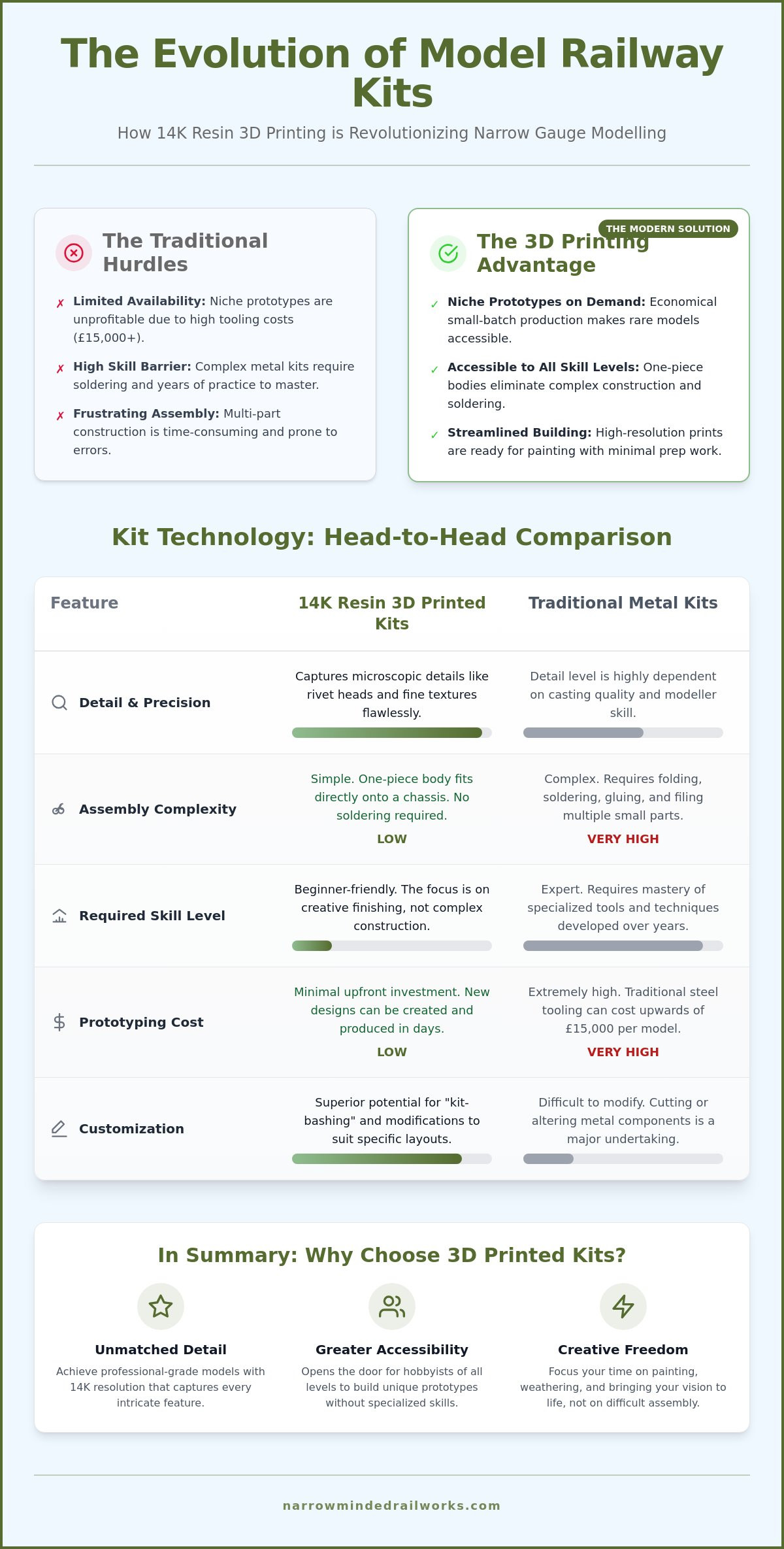
The model railway hobby has traditionally relied on mass-market production, which often overlooks the unique needs of narrow gauge enthusiasts. For decades, modellers were limited by what large manufacturers deemed profitable. Because traditional steel tooling costs can reach £15,000 or more, niche prototypes were rarely produced. This constraint forced hobbyists to choose between generic models or difficult scratch-building projects. 3D printing technology provides a proactive solution by enabling the creation of high-precision resin bodies designed to fit onto existing, reliable chassis. These kits offer a level of detail that rivals or exceeds traditional manufacturing without the need for massive production runs.
It's a shift that prioritizes the modeller's vision over manufacturing limitations. The transition to 3D printing is driven by several key factors:
- Minimal upfront costs for new prototype designs.
- One-piece construction that reduces assembly time.
- High-resolution 14K surface finishes that require less sanding.
- Perfect compatibility with proven, modern chassis.
To better understand this concept, watch this helpful video:
Solving the Availability Crisis in OO9 and GN15
Niche scales like OO9 and GN15 have faced a persistent availability crisis for years. If you wanted a specific locomotive from a small Welsh slate quarry or a regional industrial line, the options were almost non-existent. One of the primary advantages of 3d printed model railway kits is the democratization of design. In 2026, high-resolution 14K printers allow designers to produce small, economical batches of rare prototypes that would never be commercially viable otherwise. This rapid production cycle means that new models can go from digital design to your workbench in a matter of days. If you're looking to begin your journey, this beginner guide to OO9 loco kits explains how to select your first project.
The End of the Soldering Iron?
Traditional kits made from etched brass or white metal often require a level of craftsmanship that takes years to develop. Many modellers find the "soldering barrier" too high, leading to unfinished projects and frustration. While metal kits are durable, they demand specialized tools, ventilation, and a high tolerance for error. 3D printed resin kits serve as a cleaner, more accessible alternative for the modern modeller. By delivering the locomotive as a single, highly detailed piece, these kits eliminate the need for complex assembly. You won't need to master soldering to achieve a professional-grade model; instead, you can focus your energy on the creative aspects of painting and weathering. This accessibility allows newcomers to build confidence quickly while producing unique, high-quality results for their layouts.
Precision Engineering: The Technical Benefits of SLA Resin Kits
Achieving fine detail on a narrow gauge locomotive used to require hours of delicate hand-filing or expensive brass etchings. Modern modellers often struggle with the limitations of traditional casting, where fine rivets or thin cab walls can easily be lost during production. Stereolithography (SLA) resin printing provides a proactive solution by using a high-resolution light source to cure liquid resin into solid, precise shapes. This technology is part of a broader revolution in manufacturing that allows for levels of complexity previously unattainable at the hobbyist level. By utilizing these advanced methods, we can now produce locomotive bodies with integrated cab interiors and crisp panel lines that remain sharp even under a coat of primer.
One of the primary advantages of 3d printed model railway kits is the sheer accuracy of the final product. In 2026, high-resolution 14K printers have become the industry standard, effectively eliminating the visible layer lines or "stepping" that plagued earlier generations of 3D prints. These machines produce surfaces so smooth they often require less preparation than a traditional white metal casting. If you are ready to see these details firsthand, you can explore our range of OO9 and GN15 kits designed specifically for high-precision results.
SLA vs. FDM: Why Resin is the Standard
While Fused Deposition Modeling (FDM) uses a plastic filament to build objects, it lacks the resolution required for small-scale railway modelling. Filament printers often leave noticeable ridges that obscure fine details like boiler bands or door handles. SLA resin printing is the essential choice for locomotives because it captures minute features at a microscopic level. Modern 14K resin technology ensures that every surface is glass-smooth, providing a perfect canvas for professional-grade painting and weathering without the need for heavy sanding.
Digital Precision Meets Physical Modelling
Computer-Aided Design (CAD) ensures that every locomotive body is perfectly symmetrical and scaled with absolute consistency. Traditional hand-mastered kits can sometimes suffer from slight variances or "mould slip," but digital files produce identical results every time. This precision allows designers to integrate complex internal structures, such as dedicated mounting points for a Kato 11-109 chassis, ensuring a perfect fit without the need for extensive hacking or filing. Furthermore, the ability to design hollow resin bodies gives you more control over weight distribution. You can easily add lead shot or weights into specific cavities to lower the center of gravity, improving the pulling power and stability of your narrow gauge fleet on uneven trackwork.
The same principles of digital precision that allow for such detailed models are also transforming the business landscape. For those interested in how data-driven strategies can optimize performance, you can explore Data Science & Advanced Analytics to see how Nodal Marketing uses AI-powered technology to achieve superior results.
Material Comparison: 3D Resin vs. White Metal and Brass Kits
Traditional kits made from white metal or etched brass have long been considered the standard for high-end modelling. However, these materials come with significant constraints, including high retail prices and the need for advanced soldering skills. A traditional white metal kit typically retails between £60 and £85, which can be a steep investment for a single locomotive. 3D printing provides a proactive solution by offering comparable detail at a more accessible price point. One of the clear advantages of 3d printed model railway kits is their cost-effectiveness. In 2026, a high-quality 3D printed locomotive shell often costs between £35 and £50, allowing you to expand your fleet without exceeding your budget.
Durability is another area where modern resin excels. While old white metal models can occasionally suffer from "zinc pest" or lead rot over several decades, 2026 engineering-grade resins are chemically stable and designed for longevity. It's true that standard resin is roughly 25% more brittle than traditional cast polyurethane. We address this by utilizing "tough" resin blends that withstand the rigors of layout operation. While resin is lighter than metal, you can easily restore the necessary "heft" for traction by adding lead shot or liquid gravity into the hollow cavities of the printed body.
The Practicality of Assembly
The assembly process for a multi-part metal kit can take dozens of hours and requires specialized jigs. Modern 3D printed kits shift the focus from "constructing" a complex body to "finishing" a pre-formed model. Most of our kits arrive as a single-piece locomotive body, which removes the risk of misaligned parts or messy glue seams. This streamlined approach significantly lowers the learning curve for those getting started in GN15 scale or other narrow gauge variants. You spend less time struggling with assembly and more time on the creative aspects of the hobby.
Surface Finish and Paint Adhesion
A common myth suggests that paint struggles to bond with 3D printed surfaces. While older prints sometimes had oily residues, modern SLA resins provide an excellent surface for both acrylic and enamel paints. The key is proper preparation. Unlike cast resin kits, 3D prints don't require the removal of greasy mold release agents. A simple wash in isopropyl alcohol is usually enough to prepare the surface. For a step-by-step walkthrough on achieving a professional look, refer to our guide on painting 3D printed models. The resulting finish is often smoother than traditional sand-casting, providing a perfect foundation for fine lining and decals.
Simplified Assembly: How 3D Printing Streamlines the Modelling Process
Building a narrow gauge locomotive shouldn't feel like an endurance test. While traditional kits often arrive as a box of dozens of individual components, 3D printed alternatives offer a streamlined "Box to Track" workflow. One of the major advantages of 3d printed model railway kits is the drastic reduction in total part count. Instead of spending hours aligning a boiler, cab, and footplate from separate white metal castings, you receive a single, integrated body shell. This ensures perfect alignment from the moment you open the box. It removes the common frustration of a "wonky" locomotive that often occurs with multi-part builds.
Most modellers struggle with the technical challenge of fitting a custom body shell to a power unit. We provide a proactive solution by designing our kits to "drop fit" directly onto proven commercial chassis, such as the Kato 11-109. The digital precision of the design ensures that mounting points are located exactly where they belong. You won't need to perform invasive surgery on the chassis or the body to achieve a smooth-running model. This compatibility allows you to focus on the aesthetics of your layout rather than mechanical troubleshooting.
Preparing Your 3D Printed Kit
Before you begin painting, you'll need to perform some basic preparation. While 3D prints don't have the greasy mold release agents found on cast resin, a warm soapy wash is still recommended to remove any residual dust from the printing process. You might find small "pips" where support structures were attached during production. These are easily removed using fine-grit abrasives or a sharp hobby knife. When it's time to join parts, Cyanoacrylate (Super Glue) is the essential adhesive for resin. It creates a strong, permanent bond that allows you to move quickly through the assembly phase without the need for a soldering iron.
Detailing and Customisation
A simplified assembly doesn't mean a lack of detail. Once the main body is ready, you can add personal touches like handrails, whistles, and lamps to make the locomotive your own. These kits provide an excellent base for kit-bashing, allowing you to create unique regional prototypes that aren't available anywhere else. Because the resin is easy to drill and file, you can perform era-specific modifications, such as adding different chimney styles or cab configurations, without the risk of damaging the model. You can also enhance the realism of your cab by adding 3D printed figures and interior controls. If you're ready to experience a more efficient way to build, explore our latest range of OO9 and GN15 locomotive kits to start your next project today.
Finding Your Scale: Why Narrow Minded Railworks Kits are the Enthusiast Choice
Choosing a kit can be a challenge when you're faced with digital renders that don't always translate well to a physical workbench. This visualization gap is common across design fields; for instance, kitchen contractors use ArchKit Design to see how plans fit a physical space before building. Similarly, we provide a proactive solution by ensuring every design is created and tested by modellers who actually build them. Our catalog features a diverse range of OO9, GN15, and O-16.5 kits, ensuring the advantages of 3d printed model railway kits are accessible to everyone, regardless of their technical background.
A common concern for international hobbyists is the availability of niche prototypes in their local area. We've simplified this by offering worldwide shipping, connecting the global narrow gauge community with high-quality resin bodies. Our design philosophy centers on a "drop-in" fit for popular donor chassis, removing the need for complex mechanical modifications. This approach allows you to spend more time detailing your fleet and less time troubleshooting basic assembly issues.
Designed for the Modeller, Not Just the Printer
We focus on "buildability" because we know that a kit is only as good as its final assembly. Many designers prioritize looking good on a computer screen, but we subject every locomotive body to a rigorous testing process before release. We check for wall thickness, detail clarity, and chassis compatibility to ensure your build is successful. If you're tackling your first 3D printed project, we offer proactive support to help you navigate the process with confidence. We don't just sell kits; we provide the tools for you to succeed in your modelling journey.
Expanding Your Narrow Gauge World
A great locomotive needs a world to live in, which is why we offer more than just engine bodies. Creating a cohesive narrow gauge railway requires matching wagon kits and scenery items that share the same level of detail. Our range includes O-16.5 and GN15 scenery kits that help you build a unique environment that stands out from standard gauge sets. Using 3D printed parts allows you to maintain a consistent aesthetic across your entire layout, from the rolling stock to the trackside details. Explore our latest range of 3D printed locomotive bodies today! and discover how easy it is to bring a unique prototype to life on your own tracks.
Transform Your Narrow Gauge Layout Today
The traditional constraints of narrow gauge modelling often forced enthusiasts to choose between high costs or complex assembly. We've seen how modern technology provides a proactive solution by delivering incredible detail without the technical barriers of the past. By leveraging the advantages of 3d printed model railway kits, you can now access niche prototypes in OO9 and GN15 that were previously impossible to find. These kits simplify the build process with one-piece bodies while maintaining the professional standards required for exhibition-quality layouts.
Our specialist designs are created by enthusiasts who understand the practical needs of the hobby. We ensure that every kit is ready for your workbench and offer worldwide shipping to support modellers everywhere. If you're ready to expand your fleet with unique, high-detail locomotives and wagons, browse our full collection of 3D printed narrow gauge kits to find your next project. It's time to build the layout you've always envisioned with confidence and ease.
Frequently Asked Questions
Are 3D printed model railway kits as durable as metal ones?
Standard 3D printed resin is roughly 25% more brittle than traditional cast resin or white metal. While a metal locomotive might dent if dropped, a resin model is 80% more likely to shatter if it falls from a height of one meter. We provide a proactive solution by using high-quality resins that balance fine detail with operational strength. One of the key advantages of 3d printed model railway kits is that they are very easy to repair with super glue if an accident occurs.
Do I need special tools to build a 3D printed locomotive kit?
You don't need a workshop full of specialized equipment to finish these kits. Unlike metal kits that require soldering irons and fluxes, resin kits only need a sharp hobby knife, fine-grit abrasives, and tweezers. This reduction in tool requirements makes the hobby much more accessible for beginners. You can achieve professional results on a standard desk without the need for high-heat tools, specialized jigs, or heavy-duty clamps.
What is the best glue to use for 3D printed resin kits?
Cyanoacrylate, commonly known as super glue, is the best adhesive for resin kits. It creates a rapid, permanent bond that is much stronger than PVA or plastic cement. Since resin doesn't melt like styrene, traditional solvent glues will not work. We recommend using a gap-filling medium-viscosity super glue for the main body and a thin-viscosity version for small detail parts like handrails or whistles to ensure a clean finish.
How do I remove the visible support marks on my 3D printed model?
You can easily remove support marks using a sharp hobby knife followed by fine-grit sandpaper. We suggest starting with 400-grit to level the surface and finishing with 600 or 800-grit for a glass-smooth result. It's helpful to sand resin under a small amount of water to keep the dust down and prevent the paper from clogging. This ensures the high-resolution 14K detail remains crisp and clear before you begin the painting process.
Can I use standard model railway paints on 3D printed resin?
Yes, standard acrylic and enamel model railway paints bond perfectly to 3D printed resin. You don't need to worry about the greasy mold release agents found in traditional cast kits. A quick wash in warm, soapy water is all it takes to prepare the surface for the brush or airbrush. Once dry, apply a high-quality plastic primer to ensure an even finish. This allows you to use your favorite paint brands with total confidence.
Which chassis do I need for Narrow Minded Railworks locomotive kits?
Many of our OO9 scale kits are designed specifically to drop-fit onto the Kato 11-109 chassis, which is a reliable and affordable power unit. However, requirements change depending on the specific locomotive or scale you're building. We always list the recommended donor chassis in the product description to ensure you get the right fit. It's a proactive design choice that makes getting your locomotive onto the tracks much faster and more reliable.
Is 3D printing better for OO9 or O-16.5 scale models?
3D printing is equally effective for both scales, though it serves different needs. In OO9, the technology captures microscopic details that are hard to achieve in traditional castings. For O-16.5 and 7mm scales, it allows for complex, hollow structures that would be too heavy or expensive if made from white metal. One of the main advantages of 3d printed model railway kits is this versatility across different narrow gauge standards and scales.
Why choose a 3D printed kit over a ready-to-run model?
3D printed kits offer access to unique, regional prototypes that major manufacturers simply don't produce as ready-to-run models. While mass-produced models are convenient, they often lack the character of a niche narrow gauge locomotive. Building a kit allows you to customize the era, livery, and weathering to match your specific layout. It's a proactive way to ensure your railway stands out from standard, off-the-shelf sets while developing your modelling skills.