

What if you could add a highly detailed, unique narrow gauge locomotive to your layout for less than half the price of a ready-to-run model, all without touching a soldering iron? Many modellers find the transition to narrow gauge frustrating because they struggle to find unique prototypes or fear the complex assembly of traditional metal oo9 locomotive kits. While traditional white metal kits present significant technical hurdles for many hobbyists, we utilize high-resolution 3D resin printing to provide a straightforward assembly process that doesn't compromise on fine detail.
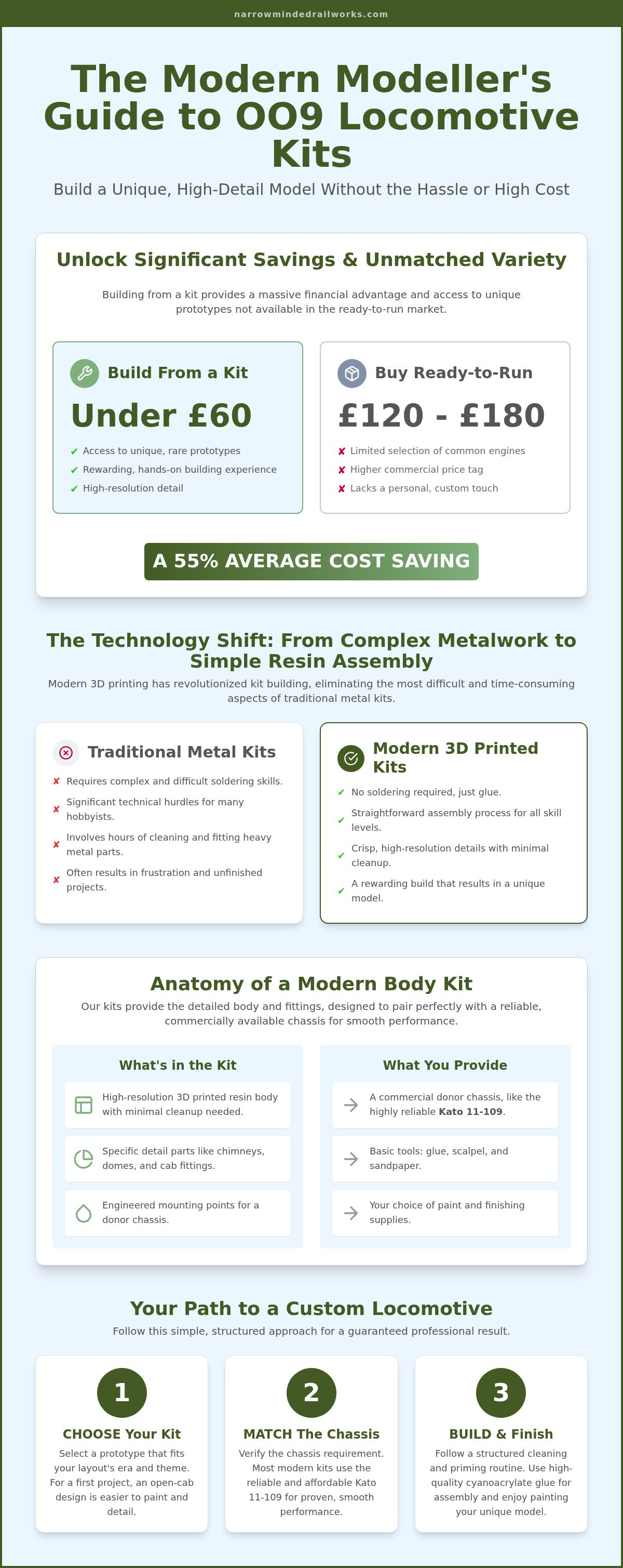
In this guide, you'll discover how to choose, build, and finish the perfect locomotive to bring your narrow gauge layout to life. We'll explore the best kits for 2026, explain how to match them with reliable commercial chassis like the Kato 11-109, and provide a clear path to achieving a professional finish. You'll learn how to navigate the assembly process with confidence, ensuring you end up with a unique, high-quality loco that stands out from standard commercial offerings. By following this structured approach, you can achieve a 55% cost saving compared to typical ready-to-run models while enjoying a rewarding building experience.
Key Takeaways
- While standard layouts require significant space, OO9 modelling provides a compact solution that maintains high levels of character and detail.
- Traditional metal kits often demand complex soldering, yet modern oo9 locomotive kits utilize 3D printed resin to simplify the assembly process.
- Although sourcing separate parts can be confusing, matching your kit to a Kato 11-109 chassis ensures reliable performance through a proven donor mechanism.
- Resin models may require specific preparation, but following a structured cleaning and priming routine leads to a professional finish every time.
- Finding niche prototypes can be difficult, but specialized 3D printed kits offer access to unique locomotives not available from major manufacturers.
Understanding OO9 Locomotive Kits and the Narrow Gauge Appeal
OO9 modelling captures the charm of narrow gauge railways by combining a 4mm scale with 9mm track. This combination allows for highly detailed models that run on N gauge track, providing a compact footprint for those with limited space. While many hobbyists start with standard gauge, the character of narrow gauge prototypes often draws them toward this specialized scale. For a technical deep dive into the origins of the scale, this OO9 scale overview explains the standards used by modellers worldwide.
The current surge in popularity stems from the ability to create expansive landscapes in small areas. You can fit a complete industrial scene or a winding mountain railway on a single bookshelf. Modern oo9 locomotive kits have transformed the hobby by replacing difficult metal soldering with high-resolution 3D resin printing. While traditional kits required hours of cleaning and fitting, modern resin bodies offer crisp details and smooth surfaces right out of the box.
Why Build a Kit Instead of Buying Ready-to-Run?
Ready-to-run models from major manufacturers are widely available, yet they often feature the same limited selection of engines found on every other layout. Building from a kit allows you to access unique prototypes such as the iconic Quarry Hunslets or robust WG Bagnall locomotives. Beyond the visual variety, there is a significant financial advantage. Research indicates that building a high-quality locomotive from a kit in 2026 can be achieved for under £60. This represents a 55% saving compared to ready-to-run models that typically retail between £120 and £180. You gain a bespoke model and the satisfaction of craftsmanship without the high commercial price tag.
The Anatomy of a Modern OO9 Body Kit
A modern oo9 locomotive kits package focuses on the upper portion of the engine. While we don't supply the internal electronics or motors, our kits are engineered to integrate seamlessly with reliable donor mechanisms. A standard body kit typically includes:
- A high-resolution 3D printed resin body designed for minimal cleanup.
- Specific detail parts like chimneys, domes, and cab fittings to match the prototype.
- Mounting points for a commercial donor chassis, such as the Kato 11-109.
The donor chassis provides the heart of the locomotive. By using a mass-produced mechanism from a manufacturer like Kato, you ensure your model runs smoothly and reliably from day one. This approach acknowledges the difficulty of building tiny gearboxes from scratch and provides a proactive solution for consistent, high-quality performance.
How to Choose Your First OO9 Locomotive Kit
Selecting your first model requires a balance between personal interest and technical feasibility. Many modellers feel overwhelmed by the sheer variety of oo9 locomotive kits on the market. To simplify the process, start by identifying your preferred era. Whether you're drawn to the slate quarries of North Wales or a generic industrial setting, your choice will dictate the specific locomotives you need. A clear vision of your layout's theme prevents you from purchasing models that don't fit your narrative.
Once you've settled on a prototype, verify the chassis requirement. Most modern kits are designed for the Kato 11-109, which has become the industry standard because it's reliable and affordable. While older kits might require complex motor assembly, choosing a design built for a "drop-in" commercial mechanism removes the stress of electrical engineering. These donor chassis typically cost between $26.99 and $35.00 USD, providing a cost-effective heart for your engine. We also suggest evaluating the material. Modern resin 3D prints offer crisp detail without the weight or soldering requirements of traditional white metal.
Pay attention to the cab style for your first project. Open cabs are significantly easier to detail and paint, which makes them ideal for beginners. Finally, check that you have the basic tools ready: a sharp scalpel, fine-grit sandpaper, and high-quality cyanoacrylate glue. If you're looking for a reliable starting point, you can browse our selection of beginner-friendly kits designed for rapid assembly.
Prototype vs Freelance Designs
Modellers often choose between recreating a specific narrow gauge railway or building a freelance industrial line. Prototypes like the Quarry Hunslets from the Penrhyn or Dinorwic quarries provide a direct link to history. You can find extensive inspiration and technical drawings for these in Railway Modeller Magazine. Conversely, freelance designs offer creative freedom. They allow you to build a unique fleet that fits your specific layout narrative without the strict constraints of historical accuracy.
Skill Level Assessment
It's helpful to categorize kits by the time and effort required for a successful build. Beginner kits typically feature one-piece resin bodies designed for a direct fit onto a Kato chassis. They require minimal cleanup and no complex sub-assemblies. Intermediate kits include separate detail parts like chimneys, domes, or handrails, allowing for a more customized appearance. Advanced kits involve complex weathering, interior cab detailing, and potentially light modifications to the donor chassis to achieve a perfect scale look.
Matching Kits to Chassis: The Key to a Reliable Runner
The heart of a successful narrow gauge build lies in its movement. While traditional kits often include bespoke gearboxes that are difficult to tune, the modern approach utilizes a "donor chassis" from reliable N gauge manufacturers. This strategy ensures that your oo9 locomotive kits benefit from mass-produced precision and smooth electrical pickup from the start. By choosing a pre-built mechanism, you bypass the frustration of complex gear alignment and focus your energy on the aesthetic finish of the model.
Reliability is the primary benefit of this method. Commercial chassis offer a level of consistency that DIY gearboxes rarely match. Because these mechanisms are designed for the global N gauge market, they undergo rigorous testing for long-term durability. If a component fails, finding a replacement is straightforward. You don't have to hunt for obscure brass gears; instead, you can purchase standard spare parts from major retailers. This accessibility provides a proactive solution for keeping your narrow gauge fleet operational for years without the need for specialized engineering skills.
Popular Donor Chassis for OO9 Kits
Different locomotives require specific wheelbases to look correct. The Kato 11-109 has emerged as the most versatile option for small steam and diesel engines. It is a renewed version of the older 11-103 and currently retails between $26.99 and $35.00 USD. For more specialized prototypes, the Kato 11-103 and 11-105 offer alternative wheel spacing to suit different boiler lengths. If you are building tiny industrial "critters," micro-chassis from brands like Tsugawa Yokou provide the ultra-compact footprint needed for the smallest oo9 locomotive kits available today.
Fitting the Body to the Chassis
Securing the printed resin body to the mechanism requires careful attention to detail. While some modellers prefer a simple friction fit for easy maintenance, using small screws provides a more permanent and secure mounting. You must ensure there is sufficient clearance for moving rods and that the coupling height matches the industry-standard Peco GR-102 stirrup coupling. Adding internal weight is another critical step. Because 3D printed resin is inherently lightweight, placing lead or tungsten putty inside the boiler or side tanks improves traction and ensures the wheels maintain constant contact with the rails for better electrical pickup.
Building and Finishing 3D Printed OO9 Kits
Transitioning from the mechanical assembly to the aesthetic finish is where your locomotive truly develops its character. Modern oo9 locomotive kits produced via 3D resin printing offer a distinct advantage over traditional materials, yet they require a specific preparation workflow. While raw resin is exceptionally detailed, the printing process can leave microscopic support marks or residual oils on the surface. We suggest washing the body in warm, soapy water and using a soft toothbrush to ensure the surface is chemically clean before you proceed with any paintwork.
Achieving a professional finish starts with the primer. Resin is a non-porous material, which means standard hobby paints may struggle to bond without a dedicated primer coat. A light, grey plastic primer reveals any remaining support "nubs" that need further attention while providing the necessary "tooth" for your topcoat. For the main livery, an airbrush provides the smoothest results on these small 4mm scale models. If you don't own an airbrush, high-quality acrylic paints applied in several thin, diluted layers will prevent the loss of fine rivet and bolt head detail.
Weathering is the final step that transforms a plastic model into a realistic piece of machinery. Narrow gauge engines were often hard-worked and rarely pristine. Applying a subtle wash of dark pigment into the recesses of the boiler and cab area highlights the depth of the 3D print. You can then use dry-brushing techniques to simulate coal dust, rust, or oil spills. This process doesn't just add realism; it masks any minor imperfections from the building stage, resulting in a model that looks like a functional part of your railway.
Essential Tools for 3D Printed Kits
Working with resin requires a slightly different toolkit than standard plastic or metal kits. You'll need fine-grit sandpaper (400 to 1000 grit) and a set of needle files to smooth out any remaining print artifacts. Because resin doesn't react to standard plastic cement, you must use cyanoacrylate (super glue) for all assembly. We recommend a gel-based formula for better control when attaching small detail parts. For a deeper look at the specific brands and chemicals that work best with our materials, read our comprehensive guide on painting 3D printed models.
Adding the Final Details
The smallest additions often make the biggest impact on the final look of your engine. Installing brass handrails or wire lamp irons adds a level of structural realism that 3D printing alone cannot achieve. We also recommend adding a painted driver figure to the cab to provide a sense of scale and purpose. Finally, you must choose a coupling system that matches your rolling stock. Whether you utilize the standard quarry hunslet coupler or the Peco GR-102 stirrup, ensuring they're mounted at a consistent height is vital for reliable operation. If you're ready to start your project, you can explore our range of high-detail kits to find your next build.
Why Narrow Minded Railworks Kits are the Modern Modeller’s Choice
Narrow Minded Railworks bridges the gap between ready-to-run convenience and the deep customization of kit building. Traditional white metal oo9 locomotive kits often intimidate hobbyists who aren't ready to master complex soldering. We provide a proactive solution by offering high-resolution 3D printed bodies that integrate seamlessly with reliable, off-the-shelf commercial chassis. This approach allows you to focus on the creative aspects of the hobby without the technical frustration of traditional metalwork.
Our kits are designed by modellers who understand the specific requirements of the narrow gauge community. We utilize 3D printing technology that achieves crisp, sharp details while maintaining the structural integrity needed for a working model. This process ensures that rivets, panel lines, and cab details are clearly defined right out of the box. Because our designs are tailored for specific Kato mechanisms, you won't have to worry about whether your body kit will fit your donor chassis. We've done the engineering work to ensure a smooth assembly experience every time.
While major manufacturers often focus on a small selection of famous engines, we provide an extensive range of unique prototypes. Our collection features characterful designs like the Atkinson-Walker and Baguley Drewry locomotives, which are rarely seen in ready-to-run form. These models allow you to create a layout that feels historically authentic and distinct from standard commercial offerings. We don't just sell kits; we support the community with detailed guides and helpful customer service to ensure every builder succeeds.
The Narrow Minded Railworks Advantage
Getting Started Today
Starting your next project is a straightforward process. You can begin by browsing our OO9 locomotive kits collection to find a prototype that fits your layout's era. We also invite you to join our community of builders, where you can find tips, share your progress, and gain inspiration from others. If you're ready to bring your narrow gauge layout to life with a unique, high-quality engine, explore our full range of OO9 kits and start your next build today.
Bringing Your Narrow Gauge Vision to Life
Building a custom fleet shouldn't be limited by complex soldering or the high price of ready-to-run models. While traditional metalwork presents technical hurdles, modern oo9 locomotive kits provide a proactive solution through high-resolution resin printing and reliable donor mechanisms. You now have the knowledge to select a unique prototype, match it with a proven Kato chassis, and apply a professional finish that adds character to your layout. Our UK-designed kits ensure that you achieve a high-quality result without the stress of traditional assembly methods.
The transition from a box of parts to a running locomotive is a rewarding experience that transforms your modelling skills. We're here to support that journey with designs that prioritize ease of fitment and exceptional detail. If you're ready to expand your railway with characterful engines that you've built yourself, browse our collection of 3D printed OO9 locomotive kits today. We look forward to seeing your narrow gauge layout grow with models that truly reflect your creative vision.
Frequently Asked Questions
Do OO9 locomotive kits come with a motor?
Body kits typically don't include a motor or chassis. We focus on providing high-quality resin shells for oo9 locomotive kits, which allows you to source a reliable donor mechanism like the Kato 11-109 separately. This approach ensures your engine has a proven, professional motor without the technical complexity of building a tiny gearbox from scratch.
Which chassis is best for a beginner OO9 kit?
The Kato 11-109 is the best chassis for those starting with their first kit. It's affordable, widely available, and fits a variety of small steam and diesel prototypes. We've designed many of our models specifically to drop onto this mechanism to provide a stress-free assembly experience for new builders.
What is the difference between OO9 and N gauge?
OO9 and N gauge share the same 9mm track width, but they utilize different scales. OO9 is 4mm to the foot (1:76), making the models physically larger than N gauge models, which use 2mm to the foot (1:148). This allows modellers to build characterful narrow gauge engines that run on compact, easily available track.
How do I remove support marks from a 3D printed loco kit?
You can remove support marks by using fine-grit sandpaper or small needle files. While high-resolution prints are very detailed, microscopic artifacts from the printing process are normal. Sanding with 400 to 600 grit paper provides a smooth surface that's ready for priming and painting without damaging the underlying detail.
Can I run OO9 locomotives on standard N gauge track?
You can run OO9 locomotives on standard N gauge track without any electrical issues. While the technical standards are identical, the visual appearance isn't ideal because N gauge sleepers are positioned too close together for narrow gauge. For a better aesthetic, we suggest using dedicated OO9 track with wider sleeper spacing.
What glue should I use for resin model kits?
You must use cyanoacrylate, commonly known as super glue, for all resin assembly. Standard plastic solvent won't work because it doesn't melt the resin material. A gel-based super glue is particularly helpful for attaching small details as it provides a few seconds of adjustment time before the bond sets.
Do I need to solder anything when building a 3D printed kit?
You don't need to solder anything when building our 3D printed oo9 locomotive kits. Traditional metal kits require a soldering iron for construction, but our resin bodies are designed for glue-only assembly. This makes the building process much more accessible for modellers who want to avoid the complexity of metalwork.
Are 3D printed kits as durable as metal ones?
Modern 3D printed resins in 2026 are exceptionally durable and match the impact resistance of traditional ABS plastics. With a tensile strength of approximately 55 MPa, these models are robust enough for regular layout operation and handling. They aren't as brittle as early 3D prints and provide a long-lasting solution for your railway fleet.