

What if your limited spare room wasn't a barrier, but actually the secret to building your most realistic model railway yet? Many hobbyists feel restricted by small footprints. You might worry that a compact design inevitably leads to a boring loop of track that loses its appeal after five minutes. It's also common to feel overwhelmed when deciding whether OO9 or GN15 is the right fit for a tiny shelf or a 2x2 foot micro-layout.
While space is a genuine constraint, it serves as a proactive catalyst for creativity. This guide demonstrates how narrow gauge track plans for small layouts offer more operational depth and detailing opportunities than many sprawling standard gauge systems. You'll discover how to design a railway that feels purposeful and immersive, even when it occupies less than four square feet. Small layouts are not a compromise; they are a superior canvas for high-intensity detailing and purposeful operation.
We'll provide clear blueprints for functional micro-layouts and explain which scales maximize your available area. You will also learn how to select the right locomotive and wagon kits to ensure your project is both a visual masterpiece and a joy to operate. By the end of this article, you'll have the confidence to start building a highly detailed, rewarding railway in the smallest of spaces.
Key Takeaways
- Narrow gauge allows for sharper curves and a reduced footprint compared to standard gauge, making it the most efficient way to model in confined areas.
- Utilize specific narrow gauge track plans for small layouts, such as industrial shelf designs or circular micro-layouts, to maintain high operational interest.
- Apply design techniques like vertical scenery and strategic view blockers to create an immersive world that feels significantly larger than its physical dimensions.
- Choose locomotive and wagon kits specifically designed for tight radii to ensure smooth performance and characterful detail on a small-scale railway.
- Shift your focus from track length to high-intensity detailing to transform a compact space into a professional-grade diorama.
Why Narrow Gauge is the Secret to Modelling in Small Spaces
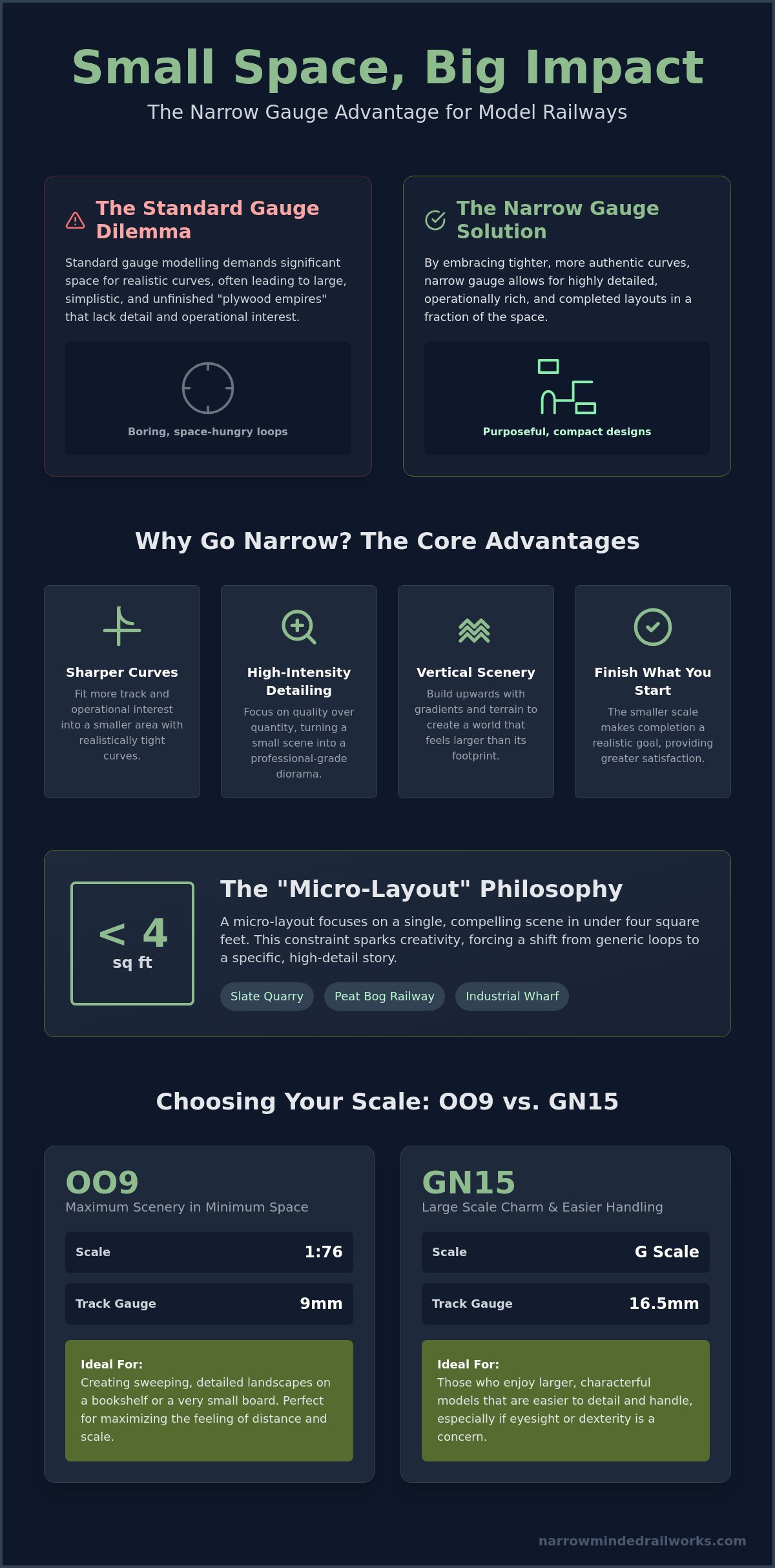
Standard gauge modelling often demands significant space to accommodate realistic track radii, which can be a major hurdle in smaller homes. However, choosing a narrow gauge prototype provides a proactive solution by allowing for tighter curves that still look authentic. When exploring narrow gauge track plans for small layouts, the first thing you'll notice is the footprint advantage. What is a narrow-gauge railway? By definition, these lines were built to navigate difficult terrain using narrower track and smaller rolling stock. Because real narrow gauge trains were designed for sharp bends in quarries or mountain passes, your model can do the same without breaking the illusion of realism.
To visualize how a compact footprint can still offer a complete modelling experience, watch this helpful video:
Small footprints allow you to focus on quality over quantity. Many modellers start massive projects only to leave them as unfinished "plywood empires." By utilizing narrow gauge track plans for small layouts, you're more likely to reach the finish line. There's a unique emotional satisfaction in completing a highly detailed diorama where every square inch has been carefully considered. You can achieve a level of scenic density that is simply impossible on a layout that spans an entire garage. This approach prioritizes the "finished" look, giving you a sense of accomplishment much sooner than traditional builds.
The "Micro Layout" Philosophy
Finding a theme for a tiny layout can be difficult, but the micro layout philosophy solves this by focusing on high-detail narratives. A micro layout is generally defined as a project occupying less than four square feet. Much like the architectural ingenuity seen in the designs of Tiny House Cottages, this constraint forces you to move away from generic loops and focus on a specific story. Whether it's a peat bog railway, a slate quarry, or a small industrial wharf, narrow gauge prototypes naturally fit these tiny footprints. You aren't compromising on the story; you're just telling a more concentrated one. These designs often focus on a single scene or a specific industrial operation, making the project manageable and rewarding.
Choosing Your Scale: OO9 vs. GN15
Deciding on a scale is often a compromise between size and detail, but selecting OO9 or GN15 allows you to tailor the project to your specific needs. OO9 models use 9mm track to represent narrow gauge in 1:76 scale, allowing for maximum scenery in a tiny area. It’s perfect if you want a sweeping landscape in a bookshelf space. Conversely, GN15 uses 16.5mm track to represent 15-inch gauge in G scale. This is ideal for those who prefer larger models that are easier to handle and detail. If your eyesight or dexterity makes smaller components a challenge, GN15 offers large-scale charm without needing a garden-sized room. Both scales offer unique advantages, and your choice determines the final character of your miniature world.
Design Principles for Maximum Impact in Minimum Footprint
Small layouts often feel restricted by their physical boundaries. However, you can overcome these limitations by applying specific design principles that prioritize depth and purpose. When reviewing narrow gauge track plans for small layouts, focus on verticality. Real narrow gauge lines often tackled steep gradients and mountainous terrain. By building upwards rather than outwards, you create a sense of scale that flat layouts lack. Every inch of track should serve a functional purpose, whether it's a coal stage or a passing loop, to ensure the scene feels authentic rather than cluttered.
One critical detail often missed in generic planning is the specific 'swing' of rolling stock. While ready-to-run models follow strict standards, specialized kits often have unique overhangs or larger cylinders that require wider clearances. You should account for these physical dimensions early in your design to prevent collisions with scenery. For historical accuracy on how these tight spaces functioned in reality, the Narrow Gauge Railway Society offers invaluable resources for researchers. Planning with these specific constraints in mind allows you to build a layout that is both compact and operationally reliable.
The Art of the View Blocker
A common fear is that a small layout will reveal its secrets at a single glance. You can solve this by utilizing view blockers to divide the scene and hide sharp curves. Large trees, industrial buildings, or stone bridges act as natural scene breaks. These elements create 'letterbox' views, forcing the observer to focus on specific details rather than the entire footprint at once. Using 3D printed structures as effective scene dividers is a proactive way to hide the entry and exit points of your track. This technique makes a four-foot shelf feel like a journey through a much larger landscape.
Operational Interest: The Shunting Puzzle
Watching a train go in circles can quickly become monotonous. You can maintain long-term engagement by designing for 'purposeful operation' through shunting puzzles. The Inglenook Sidings concept is a classic example that fits perfectly into narrow gauge themes. A simple three-turnout plan can provide hours of entertainment as you sort wagons into a specific order for an outgoing train. Integrating a small 'off-stage' fiddleyard allows you to swap stock and simulate traffic arriving from a distant terminus. Selecting high-quality locomotive and wagon kits ensures your stock performs reliably during these slow-speed shunting movements.
3 Proven Narrow Gauge Track Plans for Small Spaces
Selecting a layout design often feels like a series of compromises between your available space and your operational goals. You want variety, but you might only have a single shelf or a desk corner to work with. A proactive approach involves matching your specific footprint to a proven prototype. According to the National Model Railroad Association, the appeal of narrow gauge lies in its "quaint, grass roots feel," which naturally supports these smaller, character-driven themes. When you use narrow gauge track plans for small layouts, you're embracing a tradition of making the most of every square inch.
To ensure reliable running on these compact designs, track quality is paramount. For OO9 scales, Peco remains the industry standard, offering components like the SL-E496 Left Hand Turnout that handle the tight geometry required for micro-layouts. If you're building in GN15, standard 16.5mm track works perfectly, but you must be mindful of the minimum radius your stock can handle. Planning your trackwork with these specific tolerances in mind prevents stalling and derailments during operation.
Plan 1: The Industrial Shelf (4ft x 1ft)
The industrial shelf is a classic choice when selecting narrow gauge track plans for small layouts. This point-to-point design is ideal for OO9 quarry or timber mill themes. The plan features a loading dock at one end, a central run-round loop to allow the locomotive to change ends, and a hidden fiddle yard. The operational flow focuses on the purposeful movement of raw materials. You'll spend your time shunting wagons between the processing plant and the interchange, providing a high level of engagement without needing a massive room.
Plan 2: The GN15 Micro Circular (2ft x 2ft)
If you prefer a "pizza" style layout for continuous running, a 2ft x 2ft GN15 design is an excellent solution. This plan is perfect for an estate railway or a charming garden theme. Because GN15 uses a larger scale on narrow track, you can create a highly detailed world in a tiny space. Handling the tight 6-inch radius curves requires short-wheelbase locomotives. You can maximize the visual impact by utilizing GN15 scenery kits to fill the central area, creating a dense, immersive diorama that looks impressive from every angle.
Plan 3: The "T" Layout for Corner Desks
Dead space in a room corner is often overlooked, but a "T" shaped layout turns this constraint into an advantage. This design integrates a small station with a single industrial siding, allowing for both passenger and freight traffic. It works exceptionally well for O-16.5 / 7mm Scale Kits, as the larger scale fills the deeper corner area effectively. By placing the station on the main leg and the industry on the perpendicular wing, you create a natural sense of distance and destination within a very restricted footprint.
Bringing the Plan to Life: Rolling Stock and Scenery
Once you've selected one of the narrow gauge track plans for small layouts mentioned earlier, the focus shifts to the rolling stock and scenery that define the scene. Ready-to-run models often follow a "one size fits all" approach, which can feel out of place on a highly customized micro-layout. Building from kits is a proactive way to ensure your locomotives and wagons match the unique character of your railway. Kits allow for greater personalization, which is essential when every piece of stock is under close inspection on a small footprint. You can find a wide range of specialized narrow gauge locomotive and wagon kits designed specifically to handle the tight geometry of industrial and estate railways.
On a compact layout, your locomotives must perform exceptionally well at low speeds. Slow-speed shunting is the heart of purposeful operation, so selecting the right power is critical. Every wagon on a micro-layout is a "character" wagon; because you have fewer of them, each one should be detailed and weathered to tell a part of the story. Whether it's a rusted slate wagon or a pristine timber bolster, these models carry the narrative of your industrial scene.
Selecting Your Locomotive Kits
Short-wheelbase engines are the best choice for navigating the sharp curves found in compact designs. These smaller locomotives don't just fit the track; they also fit the narrative of a quarry or rural branch line. Utilizing 3D printed locomotive bodies gives you the freedom to create a unique fleet that isn't available in mass-produced ranges. When you match your locomotive to the specific era and industry of your plan, the entire scene feels more cohesive. A weathered diesel shunter looks right at home in a 1960s timber yard, while a small steam tank engine suits a Victorian-era slate quarry. This attention to detail ensures your rolling stock feels like a natural part of the environment rather than an afterthought.
Detailing the Environment
When working with narrow gauge track plans for small layouts, a helpful rule is that "less is more" for track, but "more is more" for scenery. Because the track plan is simple, you have more room to invest in high-intensity detailing. Integrating unique accessories like vintage phone boxes, petrol pumps, or 3D printed figures adds a layer of life to what might otherwise be a static diorama. These small details provide context and tell a story about the railway's location.
A single figure leaning against a shed can suggest a narrative of a quiet afternoon at a sleepy terminus. Creating realistic ground cover with varied textures of static grass and fine ballast helps to ground the models in their environment. This level of detail transforms a simple track plan into a convincing miniature world that rewards long-term observation and provides a sense of place that larger, less detailed layouts often miss.
The Narrow Minded Approach: Kits for Your Small Layout
Building a miniature world in a restricted space presents unique challenges, particularly when searching for rolling stock that fits specific narrow gauge track plans for small layouts. While mass-produced models are often too large or lack character, our commitment to designing specialized kits provides a proactive solution. We focus on creating models that thrive on small footprints, ensuring that your locomotives and wagons look proportional to the compact scenes you've created. This approach allows you to maintain a high level of detail without overcrowding your shelf or diorama.
The advantage of utilizing 3D printing technology is that it allows us to produce highly detailed, characterful models that traditional manufacturing often overlooks. This blend of engineering and art is a key part of the modern maker movement; for those looking to build their technical skills, Maker & Coder offers a specialized STEM ecosystem that encourages creative hardware projects. These kits are designed to complement the OO9 and GN15 track plans discussed earlier, from industrial shelf designs to micro-circular estate railways. Every model is engineered to navigate the tight radii common in space-saving designs. Whether you are located in the UK or abroad, we provide worldwide shipping to support modellers with big ambitions who are working within small spaces.
Start Your Small Layout Journey
If you're ready to move from planning to construction, selecting your first project is the next step. You can browse our range of OO9 locomotive kits to find an engine that matches your chosen industry. For those who prefer the larger presence of GN15, we offer various options tailored for micro-modelling. Completing a scene requires more than just track and trains. Don't forget to include the figures and scenery needed to finish the scene and provide a sense of scale. These final touches turn a simple track plan into a living piece of history.
Expert Support for Your Project
We understand that kit building can feel daunting if you're new to the format. While we don't sell chassis or motors, we are happy to provide advice on chassis compatibility to ensure your chosen kit runs smoothly on your layout. Joining the community of narrow gauge kit builders is an excellent way to share tips and find inspiration for your narrow gauge track plans for small layouts. If you have questions about which kit best suits your specific footprint, you can contact us for direct assistance. You can view all our Narrow Gauge Kits online to find the perfect addition to your miniature world.
Build Your Perfect Narrow Gauge World
A lack of floor space often feels like a barrier to the hobby, but narrow gauge modelling offers a proactive way to build without compromise. By utilizing narrow gauge track plans for small layouts, you can create a dense, operationally interesting scene that fits on a single shelf or desk corner. You've seen how vertical scenery and purposeful shunting puzzles turn these compact footprints into immersive environments that reward high-intensity detailing.
Achieving this level of realism requires rolling stock and scenery with true character. We are specialists in 3D-printed narrow gauge kits, designed by modellers for modellers to ensure every piece fits your unique vision. Whether you're building in OO9 or GN15, our range provides the quality you need to bring your track plan to life. We offer worldwide shipping from the UK to help you start your project regardless of your location. Our kits ensure that your limited space is never an obstacle to professional results.
Explore our range of OO9 and GN15 kits perfect for your small layout and take the first step toward a finished diorama. Don't let a small room stop your big ambitions; your ideal railway is just a kit away.
Frequently Asked Questions
What is the smallest space I need for a narrow gauge layout?
You can build a functional layout in as little as one square foot for a circular design or a 4-foot by 1-foot shelf. These compact dimensions are ideal for narrow gauge track plans for small layouts because the prototypes often operated in confined industrial spaces. While standard gauge requires large rooms, narrow gauge thrives on a bookshelf or a desk corner.
Can I use N gauge track for an OO9 narrow gauge layout?
You can use standard N gauge track for an OO9 layout because both systems utilize a 9mm gauge. However, choosing dedicated narrow gauge track with wider sleeper spacing is a proactive way to ensure visual accuracy. Standard N gauge components might save time, but purpose-made track better reflects the rugged, unkempt appearance of real narrow gauge lines.
Is GN15 too big for a shelf layout?
GN15 is not too large for a shelf layout; it's actually one of the most popular scales for micro-modelling. Although the models are larger, they run on 16.5mm track and can navigate very tight curves. This allows you to build a highly detailed industrial or estate scene on a shelf that's only 12 to 18 inches deep, providing a larger scale presence in a restricted footprint.
What is a "fiddle yard" and do I need one for a small plan?
A fiddle yard is an off-stage area where you can manually swap locomotives and rolling stock to simulate a larger railway network. While not strictly mandatory, including one is a proactive solution for increasing operational variety. It allows you to introduce new traffic to your visible scene without needing a massive amount of storage track on the layout itself.
How do I make a small layout look more realistic?
Achieving realism on a small footprint requires high-intensity detailing and the strategic use of view blockers. By hiding the ends of the track with buildings or trees, you prevent the observer from seeing the entire layout at once. Adding vertical elements like embankments or tall structures also creates a sense of scale that flat narrow gauge track plans for small layouts often lack.
Are narrow gauge kits difficult for beginners to build?
Many narrow gauge kits are designed specifically with beginners in mind, though some complex brass versions require more experience. Starting with 3D-printed locomotive bodies is a helpful way to learn because they require minimal assembly before painting. These kits provide a manageable entry point into the hobby while allowing you to create a unique piece of rolling stock for your first project.
What radius curves can OO9 locomotives handle?
Most OO9 locomotives can comfortably handle a 9-inch radius curve, and many short-wheelbase industrial engines can manage even tighter turns. It's important to check the specific requirements of your chosen chassis, as some longer models may struggle with extreme curves. Planning for a slightly wider radius where possible ensures more reliable running and reduces the risk of derailments during shunting.
Do I need a special controller for a micro layout?
You don't need a special controller for a micro layout; a standard DC analogue controller is perfectly adequate for most small designs. Since these layouts typically feature only one or two locomotives in operation at a time, complex control systems are often unnecessary. A basic controller with good slow-speed sensitivity is the best choice for achieving smooth industrial shunting in a confined space.