

What if the most characterful layout in your home didn't require a second mortgage or a dedicated spare room? Many hobbyists looking at the scale often ask, is oo9 expensive to get into, especially when they see the rising price tags on the latest ready-to-run models. You're right to be cautious. With some premium steam locomotives now retailing for over £185, it's easy to assume this niche is reserved for those with deep pockets and a lot of spare cash.
However, the reality of narrow gauge modelling in 2026 is far more accessible than the shop windows suggest. This guide will prove that OO9 is actually one of the most budget-friendly ways to enjoy the hobby. You'll discover how kit-building on reliable Kato or Peco chassis can slash your initial investment by 40% compared to buying brand new shelf-stock. We'll break down a realistic starter budget, compare the hidden value in kits, and provide a clear roadmap for your first £150 purchase to ensure you don't waste a single penny on the wrong gear.
Key Takeaways
- Discover whether is oo9 expensive to get into by comparing the 40% savings found in kit-building against the premium price of low-volume ready-to-run models.
- Learn how the "Micro-Layout" philosophy slashes your initial spend on timber and scenery by focusing on high-detail scenes in a fraction of the space.
- Uncover the financial benefits of kit-building, where a £60 investment can provide more "enjoyment per Pound" than a £180 off-the-shelf locomotive.
- Master strategic budgeting with the "£150 Challenge" to ensure your first narrow gauge layout remains affordable without sacrificing essential quality.
- Explore how 3D printed resin bodies from Narrow Minded Railworks offer a high-quality, low-cost entry point for beginners transitioning from standard scales.
The Real Cost of OO9 Modelling in 2026
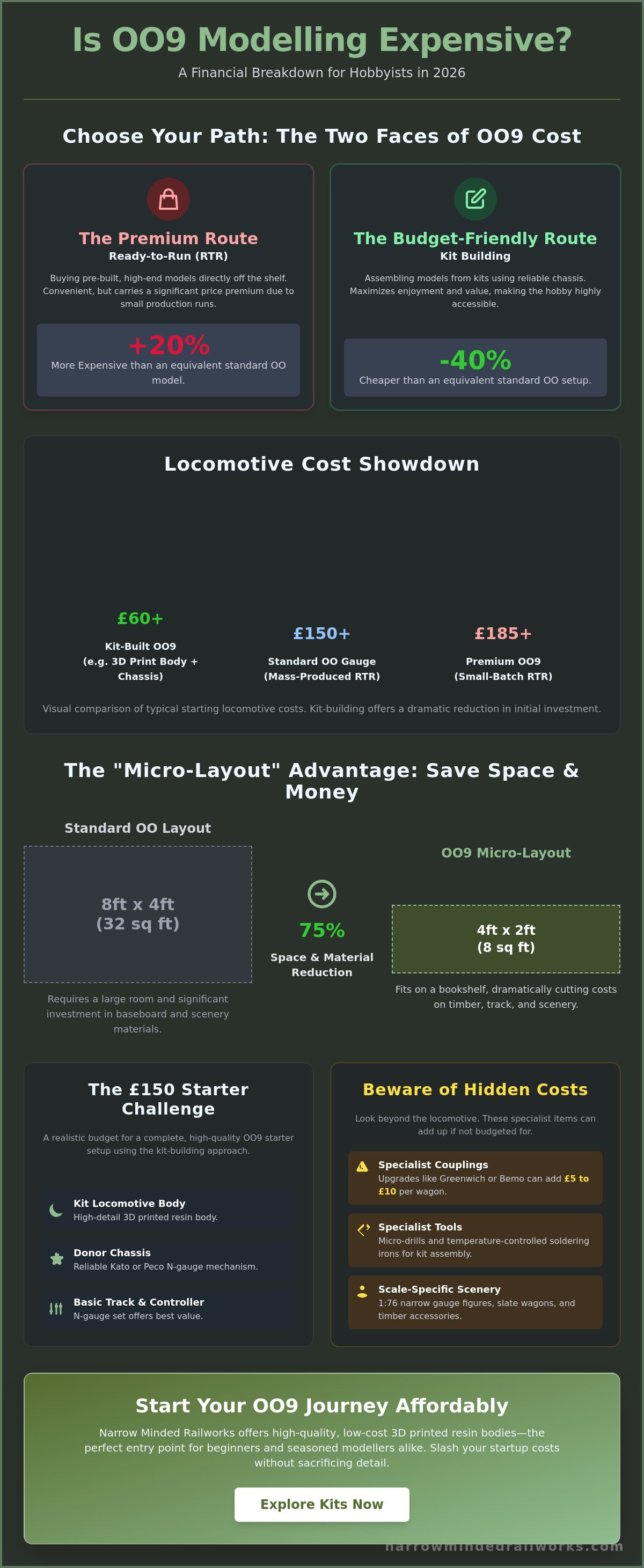
Many hobbyists ask if oo9 expensive to get into before they commit to a narrow gauge layout. The answer depends entirely on your approach to the hobby. By 2026, the market has split into two distinct paths. If you choose to build from kits and source second-hand components, OO9 can be roughly 40% cheaper than standard OO gauge. However, if you rely solely on high-end Ready-to-Run (RTR) models, you can expect to pay a 20% premium over standard gauge equivalents. To better understand how to manage your budget and find affordable alternatives, watch this helpful video:Is OO9 More Expensive Than Standard OO Scale?
The technical definition of the OO9 model railway scale is OO scale on N gauge track, which creates a unique pricing dynamic. While a mass-produced OO gauge locomotive might retail for £150, a small-batch OO9 locomotive often reaches £180 or more. This price gap is frequently called the "Narrow Gauge Tax." It exists because manufacturers like Bachmann or Peco produce smaller production runs compared to mainstream OO gauge. They cannot spread their development and tooling costs across as many units, which keeps the unit price higher. While track costs are largely comparable to N gauge, the lack of a massive second-hand market means beginners often pay full retail price for their first locomotive.The Hidden Costs: What Beginners Often Overlook
When calculating whether oo9 expensive to get into, you must look beyond the locomotive. Specialist couplings are a significant hidden expense. Standard loop couplings are functional, but many modellers upgrade to Greenwich or Bemo styles, which can add £5 to £10 per wagon to your fleet budget. There are also specific tool requirements. Kit-building is a core part of the narrow gauge community, and you might need to invest in:- Micro-drill sets (0.3mm to 1.0mm) for fine detailing.
- Temperature-controlled soldering irons for white metal kits.
- Specific 1:76 scale narrow gauge figures and slate or timber scenic accessories.
Why Space-Saving Makes OO9 More Affordable
The idea that model railroading requires a spare room or a massive garage is a significant hurdle for many newcomers. When people ask is oo9 expensive to get into, they often forget that physical space is a hidden cost. A traditional OO gauge layout usually demands a minimum 8ft x 4ft baseboard to allow for realistic curves and loops. In contrast, a 4ft x 2ft OO9 layout provides a massive 75% reduction in timber and baseboard materials. You don't just save money on the plywood; you save on every layer of the build from the cork underlay to the ballast.
Recent reports from 2024 highlight a downturn in the model railway industry due to rising costs and limited housing space for younger enthusiasts. OO9 solves both problems simultaneously. By adopting a "micro-layout" philosophy, you can build a complete, operational world on a standard bookshelf or inside a kitchen cupboard. This smaller footprint means your budget for scenery isn't spread thin across a vast, empty landscape. You can afford high-end detailing because you're only covering a fraction of the area compared to standard gauges.
Total Project Budgeting: Scenery and Infrastructure
Infrastructure costs drop significantly when you model in 1:76 scale narrow gauge. You can often use standard N gauge track components for hidden staging or even main lines if you're working on a tight budget. Scenery is where the savings really add up. Since narrow gauge lines usually run through rural environments, you can rely on "natural" scenery like static grass, rocks, and foam trees. These materials are far cheaper than purchasing dozens of resin-cast urban buildings or industrial warehouses. Modern 3D printing also allows you to download and print detail parts for pennies, rather than paying £10 or £15 per pack at a retail shop.
Space-to-Cost Ratio: A New Way to Measure Value
Think about your layout in terms of "cost per square inch." A sparse, 32-square-foot OO gauge loop might cost £500 to fill with basic scenery, resulting in a low-detail finish that feels empty. Spend that same £500 on an OO9 diorama of just 4 square feet, and you'll have a museum-quality masterpiece. When assessing if is oo9 expensive to get into, the space-to-cost ratio is your best friend. Understanding what is a narrow gauge railway helps you appreciate that the charm lies in the character and tight curves, not the length of the train. If you're ready to start small, you can browse affordable OO9 kits to begin your journey without breaking the bank. It's a more satisfying way to model because you reach the "finished" stage much faster.
Kit Building vs. Ready-to-Run: A Financial Breakdown
When asking is oo9 expensive to get into, the answer depends on whether you prefer spending money or spending time. In 2026, a brand-new, factory-finished steam locomotive from major manufacturers like Heljan or Bachmann typically retails between £180 and £230. For many, this is a significant barrier. However, the kit-building route offers a starkly different financial profile. You can often source a 3D-printed locomotive body for £25 and pair it with a reliable Japanese chassis for £35. This £60 total represents a 66% saving over the ready-to-run (RTR) equivalent.
Think of kit building as an investment in "hours of enjoyment per Pound." An RTR model provides instant gratification but zero hours of construction. A kit might take 15 hours to clean, prime, paint, and assemble. At a £60 entry point, your hobby costs drop to just £4 per hour of entertainment before the engine even turns a wheel. While factory models look pristine, kit-built locos using Kato or Tramway chassis often prove more durable. These power units are designed for high-intensity use, whereas some cheaper RTR mechanisms can be finicky to repair. Regarding resale, a professionally finished kit can hold its value, but a poorly built one will struggle. If you want to maximize your budget, joining The 009 Society is a smart move to find second-hand kits and expert advice on avoiding costly mistakes.
The "Budget Hack": Using Kato and Peco Chassis
The Kato 11-103 and 11-109 chassis remain the undisputed kings of budget modelling. These N gauge power units are incredibly smooth and cost approximately £30 to £40. They provide the perfect foundation for 3D printed bodies, which have largely replaced expensive white metal or brass kits in the 2026 market. You can find affordable donor chassis on the second-hand market for as little as £20 if you're willing to hunt through trade stands at local exhibitions. This approach makes the hobby accessible to those who find the triple-digit price tags of modern RTR locos daunting.
Ready-to-Run: When is the Premium Worth It?
There are times when the premium for an RTR model is justified. For the "time-poor" modeller, paying £190 for a Bachmann Quarry Hunslet saves weeks of work. These models now come with factory-fitted DCC and sound as standard, features that are difficult and expensive to retro-fit into tiny kit-built shells. If you're unsure which path fits your budget, read our guide on Your First OO9 Loco Kit to see if you're ready to make the jump from buyer to builder. Ultimately, is oo9 expensive to get into? Not if you're willing to build your way to a lower price point.
Strategic Budgeting for Your First OO9 Layout
Many newcomers ask is oo9 expensive to get into when they first see the intricate detail of narrow gauge models. While high-end ready-to-run locomotives can command premium prices, you can start the hobby with the "£150 Challenge." This budget allows for a reliable second-hand locomotive, a basic circle or point-to-point track setup, and a couple of wagon kits. Success in OO9 comes from spending your money on the infrastructure first. A locomotive that costs £200 will still stall on poorly laid, cheap track. Invest in quality nickel silver rails and a steady power supply before eyeing up the latest locomotive releases.
You should always build a wagon kit before you attempt to assemble or modify a locomotive. Wagon kits from manufacturers like Peco or Dundas Models are affordable, often costing between £10 and £20. They teach you the essential skills of weighting, wheel alignment, and painting without the risk of ruining an expensive motor. Avoid the "Collector Trap" where you buy every new release that looks interesting. Narrow gauge railways are usually small and specific. If you decide to model a Welsh slate quarry, you don't need a Lynton & Barnstaple Baldwin locomotive, no matter how good it looks in the display case.
Phase 1: The Essential Starter Kit
A minimum viable track plan for OO9 doesn't require much space. A 3ft by 1ft shelf layout provides enough room for a small station and a siding, offering plenty of shunting potential. For power, a basic DC analogue controller is often sufficient for small layouts because you'll rarely run more than one engine at a time. In the 2026 market, a standard OO9 starter track pack costs approximately £58 and provides enough geometry for a functional micro-layout.
Phase 2: Expanding Your Rolling Stock
Operate your layout using the "One Loco, Five Wagons" rule to keep costs down. This creates a realistic train length for narrow gauge prototypes while preventing overspending. You can supplement your fleet by scratch-building structures and wagon bodies from scrap materials like cereal boxes, coffee stirrers, and plastic offcuts. If you own a 3D printer, websites like Thingiverse or Cults3D offer free or low-cost STL files for skips, slate wagons, and scenic details. These digital assets allow you to mass-produce rolling stock for the price of a few grams of resin.
Low-Cost Entry Points with Narrow Minded Railworks
If you are still asking is oo9 expensive to get into, the answer depends entirely on your sourcing strategy. While mainstream ready-to-run (RTR) locomotives often carry price tags exceeding £150, Narrow Minded Railworks provides a vital middle ground for budget-conscious hobbyists. By utilizing high-quality 3D printed resin bodies designed to fit onto standard, mass-produced N-gauge chassis, the cost of entry drops significantly. You don't have to choose between a massive financial layout and the frustration of complex metal kits.
Supporting independent UK designers also keeps your money within the local hobby ecosystem. When you buy from UK-based creators, you avoid the £20 to £35 import fees and international shipping surcharges that often plague orders from overseas. These savings can be reinvested into track, scenery, or additional rolling stock. The resin bodies produced today offer incredible detail that rivals injection-moulded plastic, ensuring your layout looks professional even on a modest budget. Ultimately, the cost of OO9 is a choice you make based on how much of the work you're willing to do yourself.
Why 3D Printed Kits are the Budget Modeller’s Best Friend
The primary barrier for many beginners is the time and skill required for assembly. Traditional white metal or etched brass kits can take dozens of hours to master, often requiring expensive soldering stations. 3D printed kits from Narrow Minded Railworks drastically reduce this assembly time. Most bodies arrive as a single piece or a few simple components that fit together with basic adhesive. You can achieve a high-end look without investing £100 in a professional airbrush setup. Simple spray primers and acrylic paints work wonders on resin surfaces. For those concerned about the finishing process, this Painting 3D Printed Models guide provides a clear path to a perfect result.
Getting Started Today
The best way to keep costs down is to start small and scale gradually. Narrow gauge modelling is about character and charm, not the length of your trains. You can browse the beginner-friendly OO9 range today to find a locomotive body that fits your vision. Whether you are based in the UK or taking advantage of worldwide shipping for a global project, these kits offer the most accessible path into the scale. The OO9 community is known for its helpfulness, and you'll find plenty of support on forums and social media groups as you build your first kit. Don't let the price of premium models stop you from enjoying this creative hobby. With the right kits, a stunning narrow gauge railway is well within your reach.
Start Your OO9 Journey Without Breaking the Bank
Narrow gauge modelling offers a unique blend of character and creativity that doesn't have to drain your savings. By 2026, the shift toward space-saving 4ft by 2ft layouts means you'll spend significantly less on timber and scenery than traditional OO gauge projects. While ready-to-run models are available, the real financial win comes from kit building. You can achieve high-quality results by pairing 3D printed bodies with reliable mechanical parts. When asking is oo9 expensive to get into, the answer depends on your approach. Choosing modular designs and DIY builds keeps your initial investment manageable while providing a more rewarding creative experience.
At Narrow Minded Railworks, we simplify the process with locomotive kits designed specifically for affordable Kato chassis. These 3D printed kits are designed by modellers, for modellers, ensuring every detail fits perfectly for a smooth build. We offer worldwide shipping on all our kits, helping you build your dream narrow gauge railway regardless of your location. Explore our range of affordable OO9 kits and start your journey today! You've got the space and the vision; it's time to start building your miniature empire.
Frequently Asked Questions
Is OO9 more expensive than N gauge?
OO9 is typically more expensive than N gauge because it occupies a niche market with lower production volumes. A standard Bachmann Scamp locomotive currently retails for approximately £115, while a basic N gauge diesel often costs under £90. You'll find that N gauge benefits from mass-market manufacturing that brings unit costs down across track and rolling stock. This makes the entry point for narrow gauge slightly higher for newcomers.
Can I use standard N gauge track for OO9 to save money?
You can use standard N gauge track for OO9 because both use a 9mm rail width. This is a common way to reduce initial costs, as a 914mm length of Peco Setrack costs roughly £4.50 compared to £7.00 for dedicated OO9 Crazy Track. Just remember that N gauge sleepers are spaced closer together. This doesn't accurately represent the chunky, irregular look of a narrow gauge railway.
How much does a basic OO9 locomotive kit cost?
A basic OO9 locomotive body kit typically costs between £35 and £65 from manufacturers like Dundas Models or Mosskito. You must factor in the cost of a powered chassis, such as the Kato 11-103, which adds another £25 to your total. Totaling these components means a complete kit-built engine usually requires a minimum investment of £60 before you add paint and detailing. It's a cost-effective alternative to premium models.
Are OO9 ready-to-run models worth the high price tag?
Ready-to-run models are worth the investment for most hobbyists because they offer reliable performance straight from the box. When asking is oo9 expensive to get into, consider that a £160 Bachmann Quarry Hunslet includes a factory-fitted motor and fine detailing that's difficult to replicate by hand. These models hold 85% of their resale value on secondary markets like eBay, making them a safe long-term purchase for collectors.
What is the cheapest way to get a working OO9 locomotive?
The cheapest way to obtain a working locomotive is to fit a 3D printed body onto a Kato 109 or 11-103 chassis. You can find these Japanese N gauge chassis for £22 at UK retailers. Adding a basic resin body from a 3D printing service for £15 brings your total engine cost to just £37. This method saves you over £100 compared to buying premium ready-to-run steam locomotives from major brands.
Do I need a special controller for OO9 narrow gauge trains?
You don't need a special controller for OO9 as these trains run on standard 12V DC or DCC systems used by N and OO gauge layouts. A basic Gaugemaster Combi controller costs roughly £45 and provides excellent low-speed control for narrow gauge shunting. If you're transitioning from another scale, your existing power supply will work perfectly fine without any additional modifications or expensive equipment upgrades.
Is it cheaper to 3D print my own OO9 models?
3D printing is significantly cheaper if you already own a resin printer like the Anycubic Photon. A single wagon body uses about £0.40 worth of resin, whereas a plastic kit from a shop costs £8.00 or more. Even when adding £5.00 for metal wheelsets, your total cost per wagon stays under £6.00. This represents a 25% saving compared to buying traditional kits or ready-to-run rolling stock.
Can I model OO9 on a budget of under £100?
Modeling OO9 on a £100 budget is possible if you focus on a micro-layout or "pizza" style circuit. You'll spend £37 on a chassis and 3D printed body, £15 on a 1-meter length of track, and £45 on a basic controller. This leaves £3 for basic scenery materials like flock and PVA glue. While is oo9 expensive to get into is a common concern, starting small allows you to build a functional railway for exactly £100.