

The most characterful railways in the British Isles didn't run on standard tracks; they were built to a quirky, three-foot gauge that wound through the rugged landscape until the final closure of the West Clare in 1961. You've likely spent hours scouring hobby shops only to find that high-quality irish narrow gauge models are almost non-existent in ready-to-run catalogues. It's frustrating when you want to recreate the charm of the County Donegal or the Cavan and Leitrim, but find the shelves are dominated by standard 4ft 8.5in prototypes. You aren't alone in feeling that the 3ft gauge has been overlooked by major manufacturers for over 60 years.
This guide will show you how to bridge that gap by combining modern 3D-printing technology with established modelling skills to bring these historic lines to life on your workbench. We'll help you understand exactly which scale and track combinations, such as OOn3 or 7mm scale on 21mm track, work best for your available space. You'll learn how to identify the most iconic locomotives to build and where to find high-quality kits for rolling stock. From choosing your first prototype to sourcing parts, we're covering everything you need to start your journey into this unique corner of railway history.
Key Takeaways
- Understand the technical and aesthetic differences between Ireland’s 3ft standard and the British 2ft gauge to capture the true rural charm of these historic lines.
- Learn how to successfully build irish narrow gauge models in OO9 scale by pairing modern 3D-printed kits with reliable commercial donor chassis.
- Explore iconic prototypes like the County Donegal and West Clare railways to choose the perfect locomotive and rolling stock for your next project.
- Discover how modern resin printing technology has made it easier and more affordable than ever to recreate complex Irish railcar designs.
- Master the art of "Irish" scenery by incorporating specific landscape elements and unique signalling infrastructure that define the emerald isle's railway heritage.
What Makes Irish Narrow Gauge Models Unique?
Irish narrow gauge modelling offers a distinct departure from standard gauge or the more common 2ft Welsh prototypes. These lines were the lifeblood of rural Ireland from the 1870s until the mid-20th century. They carried everything from livestock to passengers across rugged landscapes. Choosing to build irish narrow gauge models allows enthusiasts to capture a specific aesthetic defined by weathered stone, sprawling peat bogs, and surprisingly large locomotives that dwarf their British counterparts.
The appeal lies in the "atmosphere" factor. Unlike the industrial feel of many narrow gauge lines, the Irish systems felt like mainline railways that had been shrunk. They featured full signalling, substantial station buildings, and a sense of faded Victorian elegance. This unique character makes them a favourite for modelers who enjoy heavy weathering and scratch-building scenic details that reflect a rural, often cash-strapped environment.
To see this unique atmosphere in action, watch this video of a highly detailed layout:
The 3ft Gauge vs. British Narrow Gauge
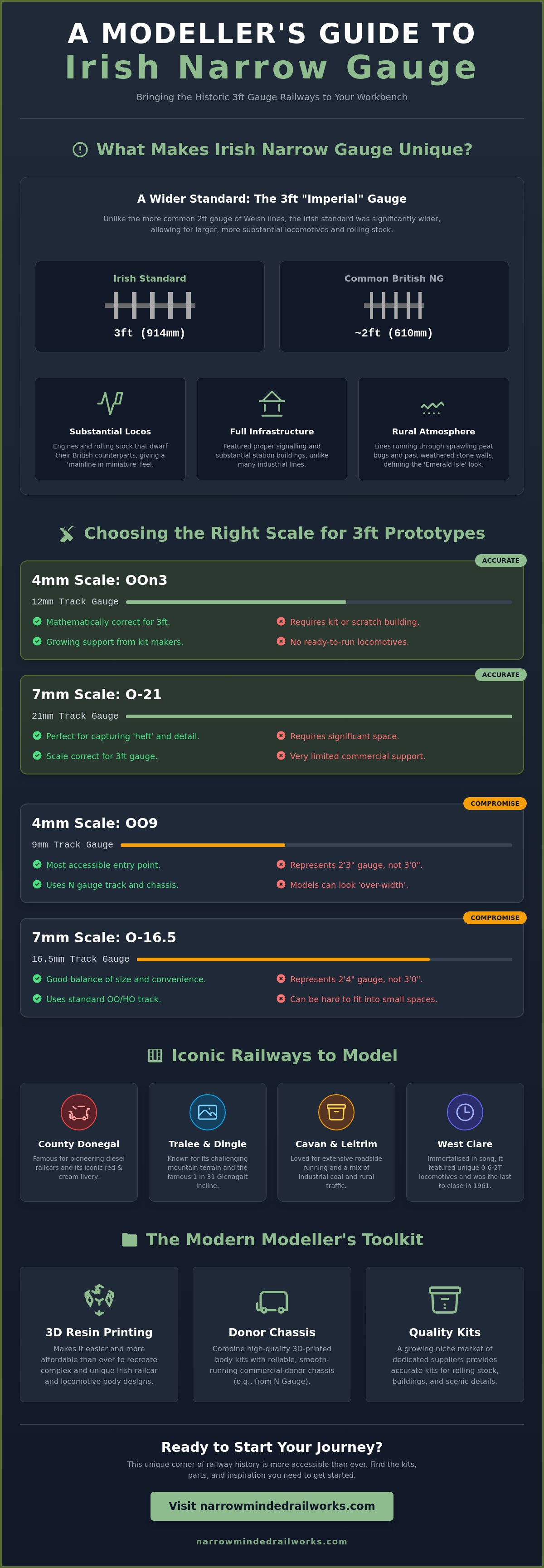
The defining feature of these lines is the 3ft "Imperial" gauge. While many famous Welsh lines used 2ft or 1ft 11.5in spacing, the Irish standard was significantly wider. Before starting your first project, it helps to understand what is a narrow gauge railway and how these standards evolved. This extra foot of width allowed for much larger rolling stock. In 4mm scale (00n3), an Irish locomotive has a presence almost equal to a standard gauge engine, making irish narrow gauge models feel more substantial on the track.
Famous Prototypes: From Donegal to West Clare
Each Irish line had a unique personality that translates beautifully into a model layout. You can find a detailed Irish narrow gauge railways list to help identify which specific company matches your modelling interests. Some of the most popular prototypes include:
- County Donegal Railways (CDR): Famous for its pioneering use of diesel railcars from 1931 onwards and its iconic red and cream livery.
- Tralee and Dingle Light Railway: Known for its mountain-climbing character and the famous 1 in 31 climb at Glenagalt.
- Cavan and Leitrim Railway: This line was loved for its roadside running and heavy coal traffic, providing a mix of industrial and rural scenery.
- West Clare Railway: Immortalised in song, this line featured unique 0-6-2T locomotives and survived until 1961.
This niche is growing in popularity among modern modelers because of the rise in high-quality resin kits and 3D printing. It's no longer necessary to scratch-build every single component. The availability of 12mm track and dedicated kits means more hobbyists can recreate these historic lines with high levels of accuracy and detail.
Choosing the Right Scale for Irish 3ft Prototypes
The defining characteristic of irish narrow gauge models is the 3ft (914mm) prototype gauge. This presents a specific hurdle for UK modellers because standard commercial track systems don't perfectly align with 3ft in the most popular scales. You've got to decide whether to prioritize exact scale fidelity or the convenience of using "ready-to-run" track and chassis components.
Most modellers choose between two primary paths: 4mm scale (OO9) or 7mm scale (O-16.5). While neither is mathematically perfect for 3ft gauge, they offer distinct advantages for recreating lines like the County Donegal or the Cavan & Leitrim. Your choice dictates whether your layout fits on a 4-foot shelf or requires a dedicated spare room. The compromise is usually worth it to capture the unique atmosphere of these rural railways.
Modeling Irish Lines in OO9
OO9 is the most accessible entry point for anyone starting with irish narrow gauge models. By using 4mm scale on 9mm (N gauge) track, you can build a significant portion of an Irish terminus in a space as small as 1200mm by 300mm. While 9mm track technically scales to 2ft 3in, the visual compromise is widely accepted in the UK hobby because it allows for realistic train lengths in a domestic setting.
The real benefit lies in the availability of reliable power units. You can easily adapt a Kato 11-109 or a Bachmann chassis to power white metal or resin kits. If you're unsure where to start, check out this first OO9 loco kit guide for tips on selecting a compatible chassis. This scale allows for the long rakes of bogie coaches that defined the Irish narrow gauge look without demanding a massive budget.
7mm Scale and O-16.5 Options
If you want to capture the sheer physical presence of a West Clare 0-6-2T or a Clogher Valley tram engine, 7mm scale (1:43.5) is the superior choice. Using 16.5mm track (standard OO/HO track) to represent the 3ft gauge is a popular standard known as O-16.5. This scale highlights the "bulk" of Irish prototypes, which were often much larger and more imposing than their Welsh 2ft counterparts.
Working in this larger scale makes 3D printing a viable and high-detail option. Many modern kits are designed specifically for 3D resin printing, allowing for intricate rivet detail and cab interiors that are difficult to see in OO9. Because you use standard OO gauge track, you can find high-quality points and flexi-track from brands like Peco for roughly £15 to £25 per unit. For those who enjoy the "heft" of a locomotive, exploring detailed 7mm body kits provides a rewarding building experience that smaller scales can't quite match.
The trade-off is simple: OO9 offers quantity and expansive landscapes, while 7mm offers mechanical satisfaction and detail. A 7mm locomotive might require a larger investment in materials, but the level of realism you can achieve in the larger scale often outweighs the extra expense for builders who enjoy fine-scale work.
Iconic Irish Railways Every Modeller Should Know
Selecting a prototype is the first step for anyone exploring irish narrow gauge models. The 3ft gauge lines were more than just transport; they were lifelines with distinct personalities. The County Donegal Railways Joint Committee (CDRJC) stands out as a pioneer. By 1931, they introduced the first of their modern diesel railcars, proving that narrow gauge could be efficient and forward-thinking. Modellers often gravitate toward the CDRJC because of this unique mix of traditional steam and mid-century diesel innovation.
The West Clare Railway gained fame through Percy French's 1902 song, "Are Ye Right There, Michael?". Beyond the music, it featured powerful 0-6-2T locomotives that handled heavy loads across the windswept Atlantic coast. For those who prefer industrial grit, the Cavan and Leitrim Railway (C&L) offers a fascinating study. It served the Arigna coal mines, resulting in heavy mineral traffic that contrasted with its famous street-running section through Ballinamore. Finally, the Schull and Skibbereen Tramway, often called the "Skibbereen Eagle," provides an eccentric choice. Its quirky rolling stock and 4-4-0T locomotives are perfect for a compact, characterful layout.
The County Donegal 'Diesel' Revolution
The CDRJC transformed its fortunes by partnering with Walker Brothers of Wigan. These railcars featured a distinctive "bonnet" at one or both ends, creating a silhouette unlike anything else in the British Isles. Today, these are highly popular irish narrow gauge models because 3D printing technology has made their complex shapes accessible to hobbyists. Finishing these models in the classic red and cream livery provides a vibrant splash of colour that defines the later years of the line.
The Tralee and Dingle Light Railway
Running 31 miles across the Dingle Peninsula, this line was famous for its rugged Hunslet 0-6-0T locomotives. These engines were designed for the steep 1-in-31 gradients of the Glenagalt bank. Modellers love the Tralee and Dingle because it allows for dramatic scenery, including limestone cliffs and stone viaducts. A key feature for any T&D layout is the specialized cattle wagons. These were essential for the monthly Dingle fairs, where hundreds of livestock were moved across the mountains in long, slow-moving trains.
How to Build Irish Narrow Gauge Kits Today
Building irish narrow gauge models has undergone a massive revolution. For decades, modellers had to master complex etched brass kits that required expert soldering skills and hours of frustration. High-resolution 3D printed resin has changed the hobby. These modern kits allow for the intricate, sweeping curves of a Tralee and Dingle 2-6-0T or a Cavan and Leitrim 4-4-0T to be reproduced with a level of detail that traditional white metal often misses. You get the accuracy of a museum piece with a fraction of the assembly struggle.
The foundation of any reliable locomotive is its chassis. Most modern builders skip the headache of scratch-building frames by using N gauge donor mechanisms. Japanese manufacturers like Kato or Tomix offer reliable power units that often cost under £40. If you want higher torque for hauling heavy peat wagons, Graham Farish N gauge chassis are popular choices for 00n3 conversions. Always check the wheelbase measurements against prototype drawings before you buy your donor engine to ensure the splashers line up correctly.
The Advantages of 3D Printed Kits
Resin printing captures the "tumblehome" curves and boiler details in a single piece. This reduces assembly time by roughly 75% compared to traditional kits. You won't spend weeks filing solder joins or wrestling with stubborn brass sheets. However, the surface finish is critical for a professional look. You'll need to learn the specific techniques for painting 3D printed models to ensure print layers don't show through your livery. A high-build primer is usually the best tool for smoothing out any microscopic stepping.
Sourcing Components and Finishing Touches
Once the body is ready, you'll need Irish-specific details to finish the job. Companies like Studio Scale Models provide authentic decals for the CDRJC or L&LSR. For couplings, many UK modellers prefer Greenwich or Bemo styles for reliable shunting on tight 18-inch radius curves. Because resin is lightweight, you must add ballast. Tucking lead shot or tungsten putty into the side tanks or smokebox increases traction significantly. This extra weight ensures your irish narrow gauge models can pull a full rake of six-wheel coaches up a steep gradient without wheel slip.
Authentic weathering is the final step. Irish narrow gauge lines were often gritty and hardworking. Use a mix of soot-black washes and rust-coloured powders to dull the factory shine. Focus your efforts on the running gear and the area around the coal bunker for the most realistic effect.
Creating the 'Irish Look' on Your Layout
Authentic irish narrow gauge models need a convincing world to inhabit. Unlike the manicured mainlines found elsewhere in the UK, Irish narrow gauge railways often felt like they were being slowly reclaimed by nature. Achieving this look starts with the vegetation. You'll need a palette of deep greens and earthy browns to replicate the damp, peat-rich landscape. Incorporating hand-built stone walls made from slate or high-density foam is essential for layouts based in Donegal or West Clare. These walls shouldn't look perfect. They should appear as though they've weathered a century of Atlantic gales and shifting soil.
Infrastructure on these lines rarely followed "standard" railway logic. While a typical branch line might have strict signalling protocols, an Irish narrow gauge station might operate with a single signal or none at all. You'll often find derelict sheds or abandoned cottages sitting right against the trackbed. Narrow Minded Railworks offers a variety of scenery items that help capture this specific sense of decay. Their resin and 3D printed details allow you to add the textures of rusted corrugated iron and crumbling masonry that define the 3ft gauge aesthetic. Don't be afraid to let weeds grow between the sleepers, as maintenance budgets were historically tight.
- Utilise multiple layers of static grass to achieve the "40 shades of green" look.
- Add derelict outbuildings to reflect the rural economic reality of the early 20th century.
- Keep signalling minimal to stay true to the low-cost nature of these independent lines.
- Include "lineside clutter" like discarded sleepers and rusted milk churns.
Irish Railway Architecture
The buildings of the County Donegal Railway (CDR) or the West Clare Railway have a distinct architectural DNA. Many featured heavy stone lintels or specific red-brick detailing around windows. If you're scratch-building, using 3D printed windows and doors is the most efficient way to ensure your irish narrow gauge models look at home. Level crossings are another vital feature. Because many lines followed the contour of the road, gated crossings were common. These provide a perfect focal point for your diorama as the train interacts with vintage road traffic.
Adding the Human Element
A layout feels hollow without the people who kept the lines running. Use scanned figures to represent local characters, from the station master in his heavy serge uniform to the local farmer. Scenery accessories play a huge role in storytelling. Placing a row of milk churns on the platform or a vintage petrol pump outside a station-side shop adds immediate historical context. These small touches transform a model railway into a living piece of history. Explore our range of Irish-inspired kits today to bring your 3ft gauge vision to life.
Bring the Spirit of the 3ft Gauge to Your Workbench
Capturing the character of the West Clare Railway or the Cavan and Leitrim Railway requires a focus on the unique architectural and rolling stock details that defined these lines. You now understand how to select the ideal scale for your space and the specific techniques needed to achieve an authentic weathered look. By focusing on these historical prototypes, you're preserving a vital part of rail history that lasted well into the mid-20th century. Modern technology has simplified the process, allowing you to bypass complex scratch-building while maintaining high levels of detail.
Finding the right components for your layout is the next step in your journey. We provide high-quality irish narrow gauge models that feature expertly designed 3D printed bodies. These kits are specifically engineered to be compatible with reliable commercial chassis from established brands, ensuring your locomotives run smoothly from day one. Whether you're based in the United Kingdom or further afield, our worldwide shipping makes it easy to access these specialised parts.
Browse our collection of 3D printed Irish narrow gauge kits to find the perfect addition to your roster. It's an exciting time to be a modeller, and we're here to help you create a layout that truly stands out. Happy building.
Frequently Asked Questions
What is the difference between Irish narrow gauge and British narrow gauge?
The primary difference lies in the track gauge; Irish narrow gauge is standardized at 3ft (914mm), whereas British narrow gauge typically uses 2ft (600mm) or 2ft 3in (686mm) widths. This difference means Irish prototypes are significantly larger, often requiring 12mm (H0m/TT) or 14mm track in 4mm scale. In the UK, 55% of narrow gauge modellers focus on 009, which represents the smaller British 2ft lines rather than the broader Irish 3ft system.
Can I use standard N gauge track for Irish narrow gauge models?
You can use standard 9mm N gauge track for Irish narrow gauge models if you're modelling in 4mm scale (009), though it scales to 2ft 3in rather than the prototypical 3ft. For true-to-scale accuracy, 12mm track is the correct choice for 4mm scale (00n3). Over 80% of UK modellers use 009 track for convenience because it's widely available from brands like Peco and fits standard N gauge locomotive mechanisms.
Are there any ready-to-run Irish narrow gauge locomotives available?
There are currently no mass-produced, ready-to-run locomotives for the Irish 3ft gauge from major manufacturers like Bachmann or Hornby. Modellers usually rely on 3D printed bodies or brass kits from suppliers such as Worsley Works or Backwoods Miniatures. A 2023 market review showed that most irish narrow gauge models are built using 3D prints paired with donor chassis from Kato or Graham Farish N gauge engines to provide reliable movement.
Which scale is best for a small Irish narrow gauge shelf layout?
4mm scale (00n3 or 009) is the best choice for a small shelf layout because it allows for 18-inch radius curves in a space as narrow as 12 inches. This scale lets you fit a station like Fintona or a section of the West Clare Railway into a 4ft by 1ft footprint. Larger 7mm scales require double the space, making them less practical for compact UK homes where space is limited.
How do I paint 3D printed Irish loco kits?
You should start by washing the 3D printed part in warm soapy water to remove any residual resin or wax. Use a high-build automotive primer, such as Halfords Grey Primer, to fill the micro-ridges left by the printing process. Applying 2 thin coats of acrylic paint ensures you don't obscure fine rivet details. Many modellers use Tamiya masking tape to achieve the crisp two-tone liveries seen on the County Donegal Railway.
What was the most famous narrow gauge railway in Ireland?
The County Donegal Railway (CDR) was the most famous narrow gauge system, operating 121 miles of track at its peak in 1905. It became a pioneer in diesel traction, introducing railcars as early as 1931 to reduce operating costs. The West Clare Railway also holds fame through Percy French’s 1897 song, "Are Ye Right There Michael?", which satirised the line's frequent delays and mechanical issues during the Victorian era.
Do I need special tools to build 3D printed railway kits?
You don't need specialized machinery, but a set of fine needle files and a pin vice drill are essential for cleaning up 3D printed railway kits. Use cyanoacrylate (superglue) instead of plastic cement, as traditional solvent won't bond with resin or SLS materials. A 2022 survey of kit builders found that 90% of assembly tasks for irish narrow gauge models involve basic tools like tweezers, 400-grit sandpaper, and sharp hobby knives.