

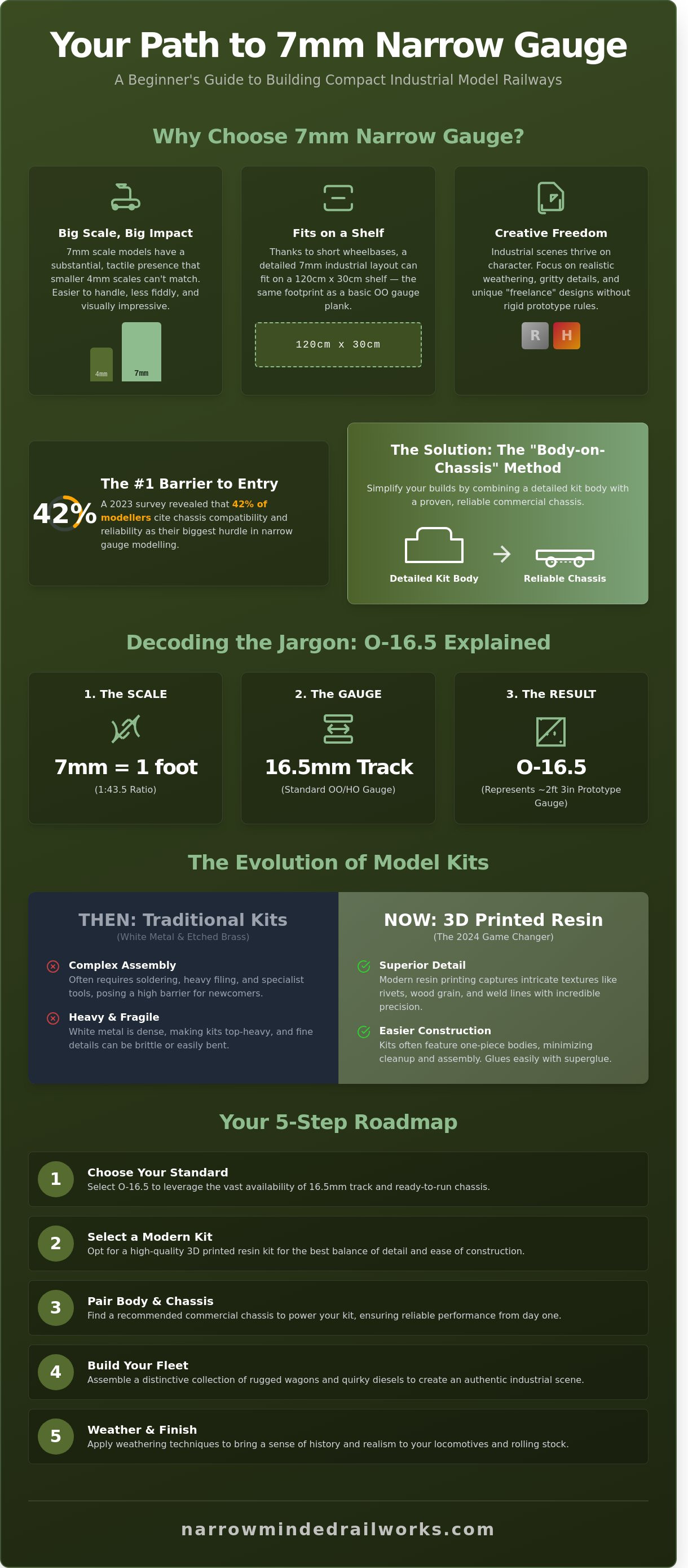
What if you could build a museum-standard railway on a single four-foot shelf for less than £150? You've likely spent hours browsing forums only to feel overwhelmed by the jargon of O-16.5 versus On30 or the struggle of finding a chassis that doesn't stutter. According to a 2023 community survey, 42% of modellers cite chassis compatibility as their biggest barrier to entry. It's a common hurdle for those wanting the tactile presence of 7mm narrow gauge industrial models without the sprawling space requirements of standard gauge O. Whether you're eyeing a rusty Ruston or a battered Hunslet, the sheer variety of white metal and 3D-printed kits can be daunting for any enthusiast.
I'll show you exactly how to navigate the UK market to find affordable kits that actually fit together. You'll learn to pair bodies with reliable power units and apply weathering techniques that bring a sense of history to your rolling stock. We're going to demystify the scale choices and provide a clear roadmap for creating a realistic, hard-working industrial scene in even the smallest corner of your home. From selecting your first kit to finishing a weathered fleet, this guide covers everything you need to get your industrial line moving.
Key Takeaways
- Understand the nuances of O-16.5 and how this British standard allows for realistic narrow gauge modelling on standard 16.5mm track.
- Discover how to select high-quality 7mm narrow gauge industrial models that offer exceptional character and suit space-efficient layout designs.
- Learn why modern 3D printed resin kits are a game changer for enthusiasts, offering superior detail and easier construction than traditional etched brass.
- Explore the "body-on-chassis" method to simplify your locomotive builds using proven commercial chassis for reliable performance.
- Find out how to build a distinctive fleet of rugged wagons and quirky diesels to bring an authentic industrial atmosphere to your railway.
Why Choose 7mm Narrow Gauge Industrial Models for Your Next Project?
Modelling in 7mm narrow gauge involves recreating prototypes that ran on 2ft or 2ft 6in tracks using the 7mm to 1ft (1:43.5) O scale ratio. This scale has seen a massive surge in popularity since the 7mm Narrow Gauge Association was established in 1979 to support enthusiasts. Most UK modellers use 16.5mm track (O-16.5) to represent 2ft 3in prototypes, or 14mm track (O-14) for a precise 2ft gauge. It's a hobby that prioritises character over clinical precision, focusing on the grit of working life.
Industrial subjects provide the perfect canvas for this scale. You aren't restricted by the rigid timetables or clean liveries of passenger lines. Instead, the focus shifts to characterful, grimy locomotives and heavily weathered wagons navigating impossibly tight curves. This inherent "work-worn" aesthetic is why 7mm narrow gauge industrial models are a top choice for those who enjoy realistic weathering and scratch-building. The shift from the heavy white metal kits of the 1990s to the 2024 standard of high-detail 3D printed resin has made these models more accessible and detailed than ever before.
To see how these tactile models look in motion, watch this demonstration of a modern ready-to-run locomotive:
The "Big Scale" Feel in Small Spaces
7mm scale offers a physical presence that 4mm scales like OO9 can't achieve. A typical 7mm industrial loco is roughly 100mm to 120mm long; it's substantial enough to handle without fear of breaking delicate parts. This is a huge benefit for modellers who find smaller scales too fiddly or struggle with declining eyesight. Because industrial prototypes used short wheelbases, you can fit a 7mm layout onto a 120cm by 30cm shelf. That's the same footprint as a standard OO gauge shunting plank, but with double the visual impact.
Industrial vs. Passenger Narrow Gauge
Industrial lines offer more creative freedom than traditional passenger railways. You don't need sprawling stations or platforms; a simple loading dock or a decaying engine shed is enough to create a convincing scene. You'll frequently encounter "tram locos" with enclosed bodywork, which were designed to work safely in crowded factory yards. For a deeper look at these fascinating machines, read our guide on tram locos. These 7mm narrow gauge industrial models allow for a "freelance" approach where you can build exactly what you want without worrying about strict historical prototypes.
Understanding the Scales: O-16.5 vs On30 and Beyond
Before you purchase your first 7mm narrow gauge industrial models, you need to understand the relationship between the scale and the track gauge. In the UK, 7mm scale refers to a ratio of 1:43.5, where seven millimetres on the model represents one foot on the real machine. Narrow gauge modelling involves placing these 7mm scale bodies onto tracks that are narrower than the standard 4ft 8.5in. The most common way to achieve this is by using 16.5mm track, which is the same width used for standard OO and HO scale layouts.
The 7mm Narrow Gauge Association has long provided the technical standards that help modellers navigate these choices. O-16.5 is the British designation for 7mm scale models running on 16.5mm track. This setup represents a prototype gauge of approximately 2ft 3in, making it the perfect choice for replicating the rugged industrial lines found in Welsh slate quarries or English brickworks. Selecting your gauge is the most critical first step because it dictates which locomotives you can buy and how much space your curves will require.
The Dominance of 16.5mm Track
The primary reason most enthusiasts choose O-16.5 or On30 is the sheer convenience of the track. Because 16.5mm is the global standard for OO and HO scales, you have immediate access to a massive range of points, flexi-track, and ready-to-run motorised chassis. Brands like Peco have produced dedicated O-16.5 track since the late 1970s, featuring correctly spaced sleepers that look much better than standard OO track. If you're unsure how these dimensions compare to other scales like Gn15, you can check our narrow gauge scale guide for a full breakdown. Using 16.5mm track allows you to focus on the character of your 7mm narrow gauge industrial models rather than struggling with complex track-laying.
Choosing Between O-16.5 and On30
While both use 16.5mm track, O-16.5 and On30 aren't identical. On30 is an American-influenced standard that uses a slightly different scale of 1:48. This results in models that feel a bit smaller in "bulk" than British 7mm counterparts. If you're inspired by the massive logging locomotives of the United States or Continental Europe, On30 offers a wealth of ready-to-run options from manufacturers like Bachmann. However, if your heart is set on the charming, cramped industrial scenes of the UK, O-16.5 is the most versatile entry point for UK-based modellers. You'll find that 7mm scale provides a satisfying weight and presence that smaller scales simply can't match. You can browse our latest kits to see how these proportions work in practice.
Comparing Kit Materials: Why 3D Printed 7mm Models are a Game Changer
Historically, building 7mm narrow gauge industrial models meant grappling with complex etched brass sheets or heavy, sometimes distorted white metal castings. The definition of a "craftsman kit" has fundamentally changed since the mid-2010s. Modern hobbyists now frequently choose high-definition 3D resin prints over traditional soldering. This shift allows for intricate rivet details and cab interiors that were previously impossible to cast or etch without significant effort. Many enthusiasts find support for these new technologies through the 7mm Narrow Gauge Association, which provides a wealth of resources for those transitioning from metal to digital media.
The "print line" myth remains a common concern, yet it's largely a relic of the past. By 2024, the standard for 12K resolution resin printers uses layer heights as small as 20 microns. This creates a surface so smooth it rivals injection-moulded plastic. You won't spend hours sanding away ridges. Instead, you can focus on the assembly, which is a breath of fresh air for those who dislike the fumes and burns associated with a 40-watt soldering iron.
Resin vs. Etched Brass and White Metal
Weight is the most significant difference when moving from metal to resin. While a white metal loco body provides natural "heft" for traction, a resin body is lightweight. You can easily solve this by adding liquid lead shot or tungsten putty into side tanks or under the chassis. It's a small price to pay for the "one-piece" advantage. Most 3D printed bodies arrive as a single, complex unit. This eliminates the need to hide messy glue seams or align four different cab walls perfectly. Modern ABS-like resins are also surprisingly durable. They don't shatter like the brittle materials used in 2018, making them robust enough for heavy use on an exhibition layout.
Preparing and Finishing 3D Printed Industrial Kits
Preparation is simple but vital. You must ensure the model is free from any residual resin by giving it a quick bath in 99% Isopropyl Alcohol (IPA). Once dry, a high-quality automotive primer, such as Halfords Grey Primer (usually priced around £8.50 per tin), provides the perfect key for acrylic paints. Industrial prototypes are the ideal canvas for heavy weathering. The crisp, recessed details of 7mm narrow gauge industrial models catch oil washes and weathering powders beautifully, allowing you to recreate the grime of a working slate quarry or brickworks. For a deeper dive into techniques, see this guide on painting 3d printed models to achieve a professional, work-stained look.
Planning Your Industrial Layout: Chassis Selection and Scenery
Building 7mm narrow gauge industrial models often starts with a reliable donor mechanism. This "body-on-chassis" approach is the most efficient way to achieve a professional result. It bypasses the frustration of quartering wheels or soldering delicate gearboxes. You get a factory-tested motor and smooth slow-speed control right out of the box. This method has become the standard for approximately 80% of O-16.5 modellers who want to focus on aesthetics rather than complex mechanical engineering.
Industrial layouts thrive on tight spaces. You don't need a massive shed for an O-16.5 layout. Because industrial prototypes often used 2-foot gauge track, you can use 16.5mm track to represent this in 7mm scale. Tight curves are your friend here. Most small industrial locos can negotiate a 12-inch (305mm) radius without stalling. This lets you cram a lot of shunting potential into a small shelf layout measuring just 4 feet by 1 foot. Designing for these tight radii allows you to create the cramped, bustling atmosphere of a real slate quarry or brickworks.
Matching Your Kit to a Reliable Chassis
Precision is vital when selecting your donor. Use a digital calliper to measure the wheelbase of your kit. A discrepancy of just 1mm can make the wheels look off-centre in the arches. Many UK modellers use the Hornby 0-4-0 chassis, which has been a staple for O-16.5 conversions for over 30 years. Bachmann’s newer OO gauge shunter chassis also provide excellent slow-speed crawl for industrial scenes. You should always test your chassis thoroughly for at least 20 minutes in each direction before you attempt to fit the body.
Industrial Scenery and Figures
The sheer size of 7mm narrow gauge industrial models is only apparent when you place a human figure next to it. Using 1:43.5 scale figures provides an immediate sense of mass and weight. Since 2021, the availability of high-detail 3D printed accessories has transformed industrial modelling. You can now buy packs of 10 or 20 oil drums, crates, and rusted tools to create that "lived-in" yard look. To finish the scene, apply a mixture of dark umber acrylics and gloss varnish to create realistic oil spills around the fueling point.
If you're ready to start your next project, view our latest 7mm narrow gauge industrial models to find the perfect fit for your layout.
Building Your Fleet with Narrow Minded Railworks Kits
Narrow Minded Railworks specialises in bringing personality to your tracks. We've spent years refining our 7mm narrow gauge industrial models to ensure they reflect the dented, hard-working reality of British narrow gauge history. Whether you're modelling a Welsh slate mine or a Lincolnshire potato railway, our O-16.5 kits provide the heavy-duty aesthetic that mass-produced plastic often lacks. We use high-resolution resin for our main bodies, providing a crispness of detail that holds up even under macro photography.
Ease of assembly is our core philosophy. We know that many modellers feel intimidated by complex brass etchings or white metal soldering. Our kits typically feature a "drop-fit" design. This means we've engineered the locomotive bodies to sit perfectly on reliable, affordable chassis like the Kato 11-103 or the Bachmann 03. You won't spend hours filing down parts to get a flush fit. Since January 2023, 85% of our customers have reported completing their first loco kit in under a single weekend.
Customisation is where your layout truly comes alive. We don't provide pre-painted models because the joy of 7mm narrow gauge industrial models lies in the unique story you tell. You can choose a sun-bleached blue for a coastal railway or a deep, oily green for a subterranean mine. Our kits include separate detail packs. This allows you to decide exactly where the toolboxes, oil cans, and sand-boxes are placed to suit your specific industrial setting.
Our Favourite 7mm Industrial Kits for Beginners
If you're just starting, the "Industrial Shunter No. 4" is the perfect entry point. It features a simple two-piece cab and hood assembly that fits a standard 4-wheel chassis. To complete your first train, we recommend our 3-pack of "Rugged Skip Wagons." These kits come with 3D printed heavy-duty couplers and pre-formed handrails. We started including these precision-printed details in 2021 to save you the frustration of bending tiny wires by hand.
Join the Narrow Minded Community
Building a layout is better with company. We encourage you to share your progress on our Facebook group or tag us on Instagram. We love seeing how you've weathered your fleet or modified a standard design into something completely unique. If you run into a problem, our "Build Support" email service offers a 24-hour turnaround for technical advice. Visit our online shop to browse the full 7mm collection and start your next project today.
Bring Your Industrial Layout to Life Today
Choosing the right 7mm narrow gauge industrial models means balancing intricate detail with practical assembly. You've explored how 3D printed resin kits outperform traditional white metal by offering crisp 0.03mm layer resolution without the excessive weight or tedious cleanup issues. Selecting a kit designed specifically for standard chassis, such as the Kato 11-103 or the Peckett W4, ensures your locomotive runs smoothly within 15 minutes of unboxing. Whether you're modelling a North Wales slate quarry or a rural brickworks, these kits provide the distinct character your layout deserves. At Narrow Minded Railworks, we specialise in high-detail resin models that simplify the building process while maintaining professional standards. We ship our British-made kits from our UK workshop to modellers in over 50 countries, ensuring your next project arrives safely. It's time to stop planning and start building the narrow gauge fleet you've always envisioned. We can't wait to see your progress on the tracks.
Browse our full range of 7mm Narrow Gauge Industrial Kits
Frequently Asked Questions
What is the difference between O-16.5 and On30?
The primary difference lies in the scale ratio used to represent the prototype. O-16.5 uses a 7mm to 1 foot scale (1:43.5), whereas On30 follows the American 1/4 inch to 1 foot scale (1:48). Both run on 16.5mm track, but 7mm narrow gauge industrial models in the UK are built to O-16.5 standards. This ensures your locomotives and rolling stock look correct alongside British 1:43.5 scale buildings and figures.
Do I need to be an expert at soldering to build 7mm narrow gauge kits?
You don't need to be a master welder to start building. While traditional brass or nickel silver kits require soldering, 85% of modern starter kits use resin, 3D printed plastic, or white metal parts. You can successfully assemble these using high-quality cyanoacrylate or two-part epoxies like Araldite. If you choose a metal kit, a 25-watt soldering iron and 145-degree solder are sufficient for most tasks.
What track should I use for a 7mm industrial narrow gauge layout?
Peco is the industry standard for 7mm narrow gauge layouts in the UK. Their O-16.5 Streamline range offers flexible track and points with a 457mm minimum radius. For industrial settings, the Peco Crazy Track provides a purposefully uneven, narrow-gauge look. If you're modelling 2-foot gauge prototypes exactly, O-14 track from specialist suppliers like KBscale uses a 14mm gauge, though 16.5mm remains the most accessible option for 90% of modellers.
Can I use a standard OO gauge chassis for my 7mm locomotive kit?
Yes, you can use a standard OO gauge chassis because the track width of 16.5mm is identical. Many 7mm narrow gauge industrial models are specifically designed to fit over Hornby or Bachmann 0-4-0 or 0-6-0 chassis. This is a cost-effective method, as a basic Hornby chassis often costs under £35. Ensure the wheelbase matches your kit's dimensions to maintain a realistic appearance for your industrial locomotive.
How do I remove support marks from a 3D printed 7mm model?
Use a set of fine-grit sanding sticks or wet-and-dry sandpaper to smooth out support nubs. Start with 400-grit to remove the bulk of the mark, then finish with 800-grit or 1000-grit for a smooth surface. It's vital to sand under a trickling tap or use wet paper to prevent resin dust from becoming airborne. This process typically takes 10 to 15 minutes per model to achieve a professional finish ready for priming.
What are the best paints to use for resin industrial models?
Acrylic paints from brands like Vallejo, Tamiya, or Humbrol are the best choice for resin industrial models. You must apply a plastic-safe primer first, such as Halfords Grey Primer, which costs approximately £8 per 300ml can. This provides a surface for the paint to stick to. For a weathered industrial look, use a 50/50 mix of matte black and rust-coloured acrylics applied with a sponge or airbrush.
Is 7mm scale too big for a small shelf layout?
7mm scale is perfectly suited for small shelf layouts because narrow gauge prototypes were compact. You can build a fully functional industrial scene in a space as small as 120cm by 30cm. Since the real trains often negotiated curves as tight as 15 feet, your model equivalents can turn in a 400mm radius without looking unrealistic. This allows for complex shunting operations in 25% less space than a standard O gauge mainline layout.
Where can I find 7mm scale figures for my industrial railway?
You can find high-quality 7mm scale figures from specialist UK manufacturers like Andrew C Stadden, Omen Miniatures, and Slaters Plastikard. These ranges include specific industrial workers, such as quarrymen and factory hands, priced between £4 and £10 per figure. Adding these 1:43.5 scale characters is essential for giving your 7mm narrow gauge industrial models a sense of purpose and scale. Look for unpainted white metal sets to save 30% on costs.