

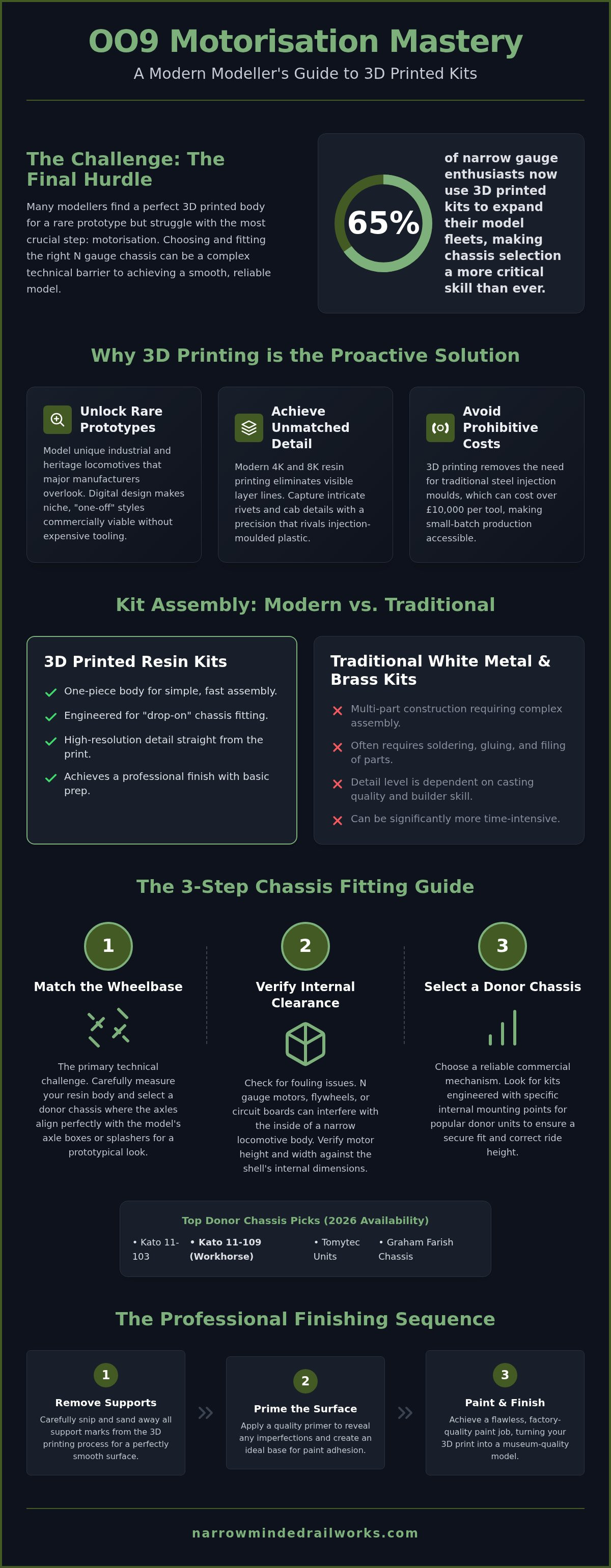
Approximately 65% of narrow gauge enthusiasts now use 3D printed kits to expand their model fleets, yet many still struggle with the final, most crucial step: motorisation. It's often frustrating when you find a rare prototype you love, but the technical hurdle of choosing a chassis for oo9 kits feels insurmountable. You want a model that runs as smoothly as it looks, without the visible layer lines or clunky movement associated with low-quality prints and mismatched parts.
We understand that while high-resolution 3D printing provides the body, the mechanism remains a separate technical challenge. This guide offers a proactive solution by teaching you how to select and fit the perfect N gauge chassis to your locomotive kits. You'll learn to achieve a professional finish that rivals injection-moulded plastic while ensuring your rare narrow gauge prototypes perform reliably on your layout. We'll explore the latest 2026 availability for Kato and Tomytec units, provide precise fitting techniques, and help you navigate the current market to ensure your next project is a mechanical success.
Key Takeaways
- Discover how high-resolution 3D printing offers a proactive solution for modelling rare narrow gauge prototypes that are unavailable in ready-to-run formats.
- Master the essential technical steps for choosing a chassis for oo9 kits, ensuring your donor mechanism perfectly matches the wheelbase of your resin body.
- Compare the assembly benefits of one-piece 3D printed kits against traditional white metal and brass alternatives to save time without sacrificing detail.
- Learn the professional finishing sequence required to remove support marks and prepare your locomotive for a flawless, factory-quality paint job.
- Evaluate the 2026 availability of Kato and Tomytec N gauge chassis to select the most reliable motorisation for your next narrow gauge project.
Why OO9 Modellers are Switching to 3D Printed Kits
3D printed OO9 kits represent a significant shift in how we approach OO9 scale model railways. Historically, enthusiasts were limited to a handful of ready-to-run models or complex white metal kits. Today, high-resolution resin shells provide a proactive solution for those seeking prototype-accurate narrow gauge designs. These kits aren't mass-produced in the traditional sense; they're digital-first creations that ensure perfect symmetry and scale accuracy even in the smallest dimensions. By removing the prohibitive costs of traditional steel injection moulds, which can often exceed £10,000 per tool, 3D printing makes niche prototypes commercially viable for the first time.
The transition to resin-based modelling doesn't just lower the entry cost. It changes the workflow for the hobbyist. While the body provides the visual detail, choosing a chassis for oo9 kits remains the foundation of a successful build. This combination of a high-detail shell and a reliable commercial mechanism offers the best of both worlds: museum-quality aesthetics and dependable running. To better understand how these kits come together, watch this helpful video:
The Freedom to Model Rare Narrow Gauge Prototypes
Major manufacturers often ignore 2ft gauge prototypes because the production volumes don't justify the investment. This creates a gap for modellers who want to replicate specific industrial or heritage lines. 3D design allows for rapid iteration, meaning we can produce "one-off" locomotive styles that reflect the unique character of British narrow gauge history. Whether it's a specific quarry engine or a unique preservation-era modification, digital design brings these rare machines to life without the need for scratch-building skills. It's a direct way to connect your hobby to real-world railway preservation.
Detail Levels: Breaking the Layer Line Myth
A common concern with 3D printing involves visible texture, but the technology has evolved rapidly. There's a critical difference between FDM (filament) printing, which often leaves visible steps, and SLA (resin) printing. In 2026, 4K and 8K resin printing have become the industry standard for model railways because they capture intricate rivets and cab details with extreme precision. High-resolution resin printing is the key to achieving invisible layer lines. This professional-grade finish ensures that once primed, your kit looks identical to an injection-moulded product but with the added benefit of being a rare, prototypical model.
Technical Guide: Choosing a Chassis for OO9 Kits
The success of a narrow gauge project relies on the marriage between a high-detail resin shell and a reliable N gauge mechanism. Modern 3D printed bodies are engineered as "drop-on" solutions, designed to fit over commercially available donor units. When you're choosing a chassis for oo9 kits, the primary technical challenge is matching the wheelbase and wheel diameter of the donor to your chosen prototype. While some modellers prioritize a generic fit for ease of use, achieving a prototypical look requires careful measurement to ensure the axles align perfectly with the locomotive's axle boxes or splashers.
Internal clearance is another critical factor that often goes overlooked until assembly begins. Modern N gauge motors frequently feature large flywheels or high-set circuit boards that can foul the inside of a narrow locomotive boiler. We acknowledge that fitting a standard mechanism into a niche body can be tight; however, we provide a proactive solution by engineering specific internal mounting points into our kit designs. These points ensure the body sits at the correct height and remains secure during operation. Before purchasing a donor unit, always verify the motor height and width against the internal dimensions of the resin shell to avoid costly compatibility issues.
Common Donor Chassis for OO9 Projects
The Kato 11-103 and 11-109 remain the undisputed workhorses of the OO9 world. These Japanese imports are favoured for their smooth slow-speed running and compact dimensions. In 2026, the Kato 11-109 continues to be readily available, though enthusiasts should note the price increases announced in May 2026. For larger narrow gauge prototypes, Graham Farish or Tomytec N gauge locomotive chassis offer more substantial power. The Tomytec TM-22, currently priced around £41.45 for 2026 releases, is an excellent choice for longer wheelbases. It's important to remember that Narrow Minded Railworks does not sell these motor units; the modeller must source the chassis separately from specialist N gauge retailers.
Measuring and Modifying for a Perfect Fit
Resin offers a distinct advantage over traditional white metal or brass because it's significantly easier to modify. If a chassis requires a fraction more room, you can use fine-grit sanding sticks or needle files to thin the internal walls of the shell without risking the structural integrity of the model. Organizations like The Model Railway Club often showcase how these small adjustments lead to superior running qualities on exhibition layouts. You should also pay close attention to electrical pick-ups; ensure they aren't compressed by the resin body, as this will lead to stalling on points.
If the ride height looks too high for a narrow gauge engine, you can use 3D-printed spacers or plasticard shims to lower the body onto the mechanism. This proactive approach allows you to hide the N gauge origins of the chassis, keeping the focus on the prototypical detail of the locomotive. To find a model that suits your available donor unit, you can browse our full range of OO9 locomotive kits today.
3D Printed Kits vs. Traditional White Metal and Brass
Modellers often debate the merits of traditional materials versus modern resin. White metal and etched brass have been the hobby standard for decades, prized for their weight and sharp edges. However, 3D printing offers a proactive solution for those who find complex soldering or multi-part metal assemblies daunting. A traditional brass kit might require hours of precise folding and heat-joining; in contrast, a high-resolution 3D printed shell arrives as a single, cohesive unit. This "one-piece" body advantage significantly reduces assembly time and eliminates the risk of misaligned panels or visible solder seams.
Surface finish is another area where the technologies diverge. Etched brass provides unmatched crispness for flat-sided wagons or industrial diesels with sharp corners. Resin excels at capturing the organic curves of steam locomotive boilers, domes, and flared chimneys. These shapes are notoriously difficult to replicate in metal without specialist rolling tools. When you're choosing a chassis for oo9 kits, the resin body provides a stable, symmetrical platform that simplifies the motorisation process. For beginners, the learning curve is much shallower. You can focus on painting and detailing rather than mastering a soldering iron.
Weight and Ballasting Strategies
One constraint of resin is its low density compared to white metal. A lightweight locomotive won't provide the traction needed to pull long trains up steep gradients. To solve this, you must strategically add lead ballast inside the hollow spaces of the boiler or side tanks. Placing weight directly over the driving wheels ensures maximum grip and electrical pick-up reliability. If you're just starting your journey, you might find our guide on Your First OO9 Loco Kit: A Beginner’s Guide to Choosing and Buying helpful for understanding these fundamental assembly steps.
Durability in the Layout Environment
Early hobbyist prints earned a reputation for being brittle, but modern engineering resins are far more resilient. These materials are designed to handle the temperature fluctuations of a typical UK spare room or loft layout without warping. While resin is more fragile than brass if dropped, it's perfectly durable for active layout use when handled with care. A proactive approach to storage, such as using foam-lined boxes, protects delicate details like handrails and lamp irons. Choosing a chassis for oo9 kits that runs smoothly also reduces the need for handling, as a reliable mechanism won't require constant "finger-poking" to start on dirty track.
How to Prepare and Finish Your OO9 Locomotive Body
After you've completed the technical task of choosing a chassis for oo9 kits, your attention must shift to the aesthetic finish of the locomotive. High-resolution resin provides a fantastic canvas, but it requires specific preparation to ensure a professional result. You can't simply apply paint directly to a fresh print. The resin often carries a microscopic layer of residue from the printing process that will repel paint if it isn't removed. A simple wash in lukewarm soapy water is non-negotiable. Use a soft toothbrush to gently scrub the surfaces, then allow the body to air-dry completely before moving to the next stage.
Your essential toolkit for this phase should include fine-grit sanding sticks (400 to 1000 grit), needle files, and a high-quality automotive or hobby primer. While our kits are engineered to minimise post-processing, some minor cleanup is always necessary. Choosing a high-build primer helps fill any remaining micro-lines, creating a glass-smooth surface that mirrors the look of injection-moulded plastic. This proactive preparation ensures that your hard work on the mechanism isn't let down by a poor surface finish.
Removing Support Marks and Post-Processing
The first step in finishing is identifying the difference between "support pips" and actual prototypical model detail. Support pips are the small bumps left where the 3D printer's scaffolding once touched the model. You should use a sharp hobby knife to remove the bulk of the pip, then follow up with wet-sanding. Wet-sanding prevents the resin dust from becoming airborne and keeps your sanding sticks from clogging. For a deeper dive into these techniques, read our guide on Painting 3D Printed Models: A Beginner’s Guide to a Perfect Finish.
Painting and Weathering for Realism
Acrylic paints are the preferred choice for 3D printed resin surfaces because they offer excellent opacity without the risk of damaging the material. Once your base coats are dry, you can use thin washes and weathering powders to highlight the 3D-printed rivets and panel lines. These details are often what set a narrow gauge engine apart from standard gauge counterparts. A final coat of matte varnish protects the resin from UV degradation and seals your weathering work. If you're ready to start your next build, you can explore our latest OO9 locomotive and wagon kits to find your perfect project.
Choosing Your Next Project from Narrow Minded Railworks
Selecting your next build is an exciting step once you've mastered the basics of preparation and finishing. Our 2026 catalogue is organised to simplify the process of choosing a chassis for oo9 kits by clearly identifying which commercial mechanism fits each resin body. We recognise that the variety of N gauge donor units can be overwhelming for those new to the hobby. To provide a proactive solution, every locomotive kit in our range is engineered around specific, readily available chassis like the Kato 11-109 or Tomytec units, ensuring you don't have to guess about compatibility or internal clearances.
Beyond the locomotives, a complete narrow gauge scene requires a cohesive fleet of rolling stock and authentic surroundings. Our categories for 2026 include a diverse range of wagons and accessories designed to complement our primary locomotive kits. Whether you are building a Welsh slate quarry, a Sussex brickworks, or a rural Irish line, the right combination of stock defines the character of your layout. By focusing on professional-grade resin, we ensure that every wagon and accessory maintains the same high level of detail as your motive power.
From Locomotives to Rolling Stock
Our range of OO9 wagons is designed specifically for industrial, quarry, and rural layouts. We offer everything from rugged slate wagons to versatile open goods stock, allowing you to build prototypical trains that match your layout's specific era. Choosing a locomotive body that fits your geographical style is only the start; integrating our 3D printed figures adds essential life and scale to your scenes. These figures are scaled precisely for OO9, providing a proactive way to hide empty cabs or populate a busy station platform without the clunky appearance of over-scale standard gauge alternatives.
The Narrow Minded Railworks Advantage
We believe that the best kits are designed by modellers who understand the technical needs of the hobby. Every Narrow Minded Railworks kit is a result of extensive prototyping to ensure the marriage between resin and mechanism is as seamless as possible. While we don't sell the motors ourselves, we provide the ongoing modeller support and technical guidance needed to help you succeed. We offer global shipping for our entire range, ensuring that enthusiasts across the United Kingdom and beyond can access unique narrow gauge prototypes. If you are ready to begin your next motorisation project, you can explore the full OO9 collection at Narrow Minded Railworks today.
Ready to Build Your Next Narrow Gauge Masterpiece?
Mastering the technical nuances of choosing a chassis for oo9 kits represents the final hurdle in creating a truly unique locomotive. By combining high-resolution resin bodies with reliable N gauge mechanisms, you can bypass the limitations of mass-produced models and bring rare prototypes to your layout. We recognise that sourcing your own motor units adds a step to the process; however, our kits provide a proactive solution by featuring internal mounting points engineered for a precise fit. This ensures your project moves from the workbench to the track with minimal frustration and maximum performance.
Every kit we produce uses professional-grade resin to capture museum-quality detail while minimising layer lines. From our UK workshop, we offer worldwide shipping to support modellers everywhere in their pursuit of narrow gauge excellence. Whether you're finishing a quarry engine or a rural goods wagon, the combination of digital precision and traditional finishing techniques yields a professional result. If you're ready to expand your fleet with prototype-accurate designs, you can Browse our full range of 3D Printed OO9 Kits today. We're excited to help you bring your narrow gauge vision to life.
Frequently Asked Questions
Do 3D printed OO9 kits come with a chassis?
No, our kits consist of high-resolution resin shells and do not include the motor units. We specialise in producing accurate locomotive and wagon bodies, while the modeller is responsible for sourcing the donor mechanism separately. This allows you to select a specific brand, such as Kato or Tomytec, based on your performance preferences. We provide the detailed body; you provide the functional mechanism to bring the model to life.
What is the best glue for 3D printed resin model kits?
Cyanoacrylate, commonly known as super glue, is the most effective adhesive for bonding resin components. Unlike standard plastic cement, which works by melting polystyrene, super glue creates a strong mechanical bond on cured resin surfaces. For larger structural parts, a two-part epoxy resin offers a proactive solution for added durability. Always ensure the bonding areas are free from dust and grease to prevent the joint from failing during layout operation.
How do I remove the visible layer lines on a 3D printed loco?
You can achieve a glass-smooth finish by using a combination of wet-sanding and high-build primers. While we utilise professional-grade 8K printers to minimise texture, a light pass with 1000-grit sandpaper followed by a dedicated filler primer is a proactive way to hide any remaining micro-lines. This process fills the microscopic gaps between layers, ensuring the surface is perfectly prepared for your final livery and prototypical weathering without any visible printing marks.
Can I use standard model railway paints on 3D printed resin?
Yes, standard acrylic and enamel paints are perfectly compatible with our resin materials. It's vital to degrease the model in lukewarm soapy water before painting to remove any microscopic residue from the printing process. Once the shell is dry, applying a high-quality primer ensures that your chosen colours adhere permanently. Acrylics are often favoured by modellers for their fast drying times and excellent coverage on the intricate details found in narrow gauge prototypes.
Are 3D printed narrow gauge kits suitable for beginners?
These kits are an ideal entry point because they bypass the steep learning curve associated with soldering white metal or brass. While choosing a chassis for oo9 kits requires some initial research into wheelbases, the assembly of the resin body is straightforward. We design our shells as cohesive, one-piece units where possible, which significantly reduces the assembly time and eliminates the risk of misaligned parts often encountered in traditional kit building.
How do I add weight to a 3D printed locomotive body?
You can improve traction and electrical pick-up by placing lead shot or liquid gravity inside the hollow cavities of the boiler and side tanks. Because resin is naturally lighter than white metal, adding internal weight is a proactive solution for ensuring your locomotive can pull prototypical loads. Always secure these weights with PVA glue or epoxy to prevent them from shifting and fouling the internal moving parts of your N gauge chassis during operation.
Are these kits compatible with Peco OO9 track?
Every kit in our range is fully compatible with Peco OO9 track and pointwork. Since the running gauge is determined by the N gauge chassis you select, the model will operate perfectly on standard 9mm narrow gauge rails. We engineer our locomotive and wagon bodies to maintain the correct ride height and clearance for Peco couplings, ensuring that your completed models perform reliably across the most common track systems used in the United Kingdom.
What happens if a 3D printed part arrives broken?
We utilise robust packaging to protect our kits, but we recognise that resin can be fragile during transit. If a component arrives damaged, our professional support team is here to help. Simply contact us with a photograph of the broken part, and we will provide a replacement as part of our commitment to quality. This proactive service ensures you can proceed with your project without the frustration of dealing with compromised or missing details.