

The era of settling for smooth, characterless plastic on your narrow gauge layout is over because 3D printing has finally mastered the rugged texture of riven slate and weathered timber. While traditional injection molding often struggles with the intricate lattice work of a Welsh slate wagon, modern 3d printed slate wagon kits oo9 now deliver a level of prototypical detail that was once the sole domain of master scratch-builders. You might worry that these high-fidelity prints come with the headache of prominent layer lines or brittle components. We recognize that these technical hurdles can be a barrier to achieving a realistic finish, so we have gathered the best methods to overcome them.
It is true that working with resin requires a different approach than standard plastic kits, but the trade-off in visual accuracy is well worth the adjustment. This guide promises to show you how to build authentic, high-detail slate trains that look like they have spent decades in the Welsh mountains. We will walk through the essential preparation steps to eliminate print artifacts, discuss how to handle delicate parts safely, and preview the best kits currently available for the OO9 standard. You will gain the practical knowledge needed to expand your fleet with confidence and precision.
Key Takeaways
- Understand the historical significance of Welsh narrow gauge slate wagons and why OO9 is the most effective scale for replicating these iconic operations.
- Learn how modern SLA printing captures fine ironwork and textures that traditional methods miss, making 3d printed slate wagon kits oo9 the superior choice for high-detail modelling.
- Differentiate between 2-bar and 3-bar wagon designs to ensure your rolling stock accurately reflects the specific prototype and story of your layout's quarry.
- Master the essential assembly techniques for resin kits, including professional cleaning methods and precise chassis fitting to ensure smooth operation.
- Discover the advantages of building wagons in consistent rakes to maintain a uniform, prototypical appearance across your entire train.
The Role of Slate Wagons in OO9 Narrow Gauge Modelling
Slate wagons are the unmistakable symbol of Welsh narrow gauge history. These rugged vehicles formed the lifeblood of legendary lines such as the Ffestiniog, Talyllyn, and Dinorwic. They spent decades transporting millions of tons of slate from high mountain quarries down to coastal shipping ports. In the specialized world of OO9 narrow gauge modelling, these wagons are more than just simple rolling stock; they define the entire purpose and atmosphere of a layout. While older kits frequently relied on heavy white metal or complex brass etchings, modern 3d printed slate wagon kits oo9 provide the extreme precision required to replicate the delicate iron strapping and weathered wood grain of the original prototypes.
We recognize that traditional casting methods often struggled with the thin-walled nature of these industrial wagons. Thick plastic walls can ruin the illusion of a 1:76 scale model. To solve this, high-resolution resin printing allows for wagon sides that look appropriately scaled while remaining remarkably rigid. A long rake of these wagons immediately transforms a simple loop of track into a busy industrial scene with a clear historical narrative.
To see these models in action and understand their impact on a layout, watch this helpful video:
A Brief History of the Slate Run
The journey of a slate wagon began at the quarry face, often involving dramatic gravity runs. During these operations, loaded wagons descended steep inclines controlled only by manual brakes and the skill of the brakesmen. Because these vehicles were built for brutal, repetitive industrial use, their designs remained remarkably primitive for over a century. Most were simple iron or wooden cages, yet they possessed a distinct functional elegance. Replicating this history requires a model that captures the "lived-in" look of industrial heritage. 3D printing excels here by reproducing the subtle riven textures of slate loads and the worn edges of timber frames that flat injection-molded plastic simply cannot match.
Why OO9 Modellers Prioritise Slate Rolling Stock
Choosing to model in OO9 means you can enjoy the detail of the 4mm scale while benefiting from the space-saving nature of 9mm track gauge. This unique combination allows you to fit an entire Welsh valley scene into a spare room or even a small shelf diorama. Slate rolling stock is a top priority for enthusiasts because it enables the creation of "the long slate train." This sight was iconic in North Wales but is nearly impossible to replicate on standard gauge layouts due to space constraints. These wagons are also the perfect companions for popular narrow gauge locomotives like the Quarry Hunslet or the Baldwin 4-6-0, creating a cohesive and historically accurate scene that feels grounded in reality.
Why 3D Printing is the Best Choice for Slate Wagon Kits
Traditional kit building in OO9 often requires mastering difficult soldering techniques or managing heavy, inconsistent white metal castings. While these materials have served the hobby for years, they often present barriers to entry for those who want high detail without a steep learning curve. Modern 3d printed slate wagon kits oo9 provide a proactive solution by using light-cured resin to produce complex industrial shapes in a single, highly detailed piece. This technology removes the need for tedious cleanup and allows you to focus on the creative aspects of painting and weathering.
While traditional injection molding relies on expensive steel molds that can limit the sharpness of fine details, 3D printing uses digital files to guide a laser with surgical precision. This allows for the replication of crisp ironwork and microscopic bolt heads that usually disappear in standard plastic kits. You don't have to spend hours filing away large casting gates or straightening warped metal parts because the resin cures in its final, intended shape. This precision ensures that every wagon in your rake meets the same high standard of prototypical accuracy.
The ability to produce these kits on demand also solves the issue of availability for those looking to build large, prototypical rakes. Instead of waiting for a major manufacturer to run a new batch of plastic models, 3D printing allows for a consistent supply of identical wagons. This consistency is vital when you want your train to look like a uniform industrial unit rather than a collection of mismatched parts. If you want to start your own rake, you can explore our range of OO9 wagon kits to see these details firsthand.
Resin vs. Plastic: The Modeller's Verdict
Unlike mass-produced plastic, resin captures riven slate and wood grain at the micron level. You won't find the unsightly "flash" or mold lines that are common in traditional kits, which means your preparation time is significantly reduced. Modern engineering-grade resins are also surprisingly durable. While early resins were known for being brittle, today's materials offer the perfect balance of rigidity and impact resistance, ensuring your rolling stock can handle the rigors of exhibition use or regular home operation.
Answering the Layer Line Concern
While early 3D prints suffered from visible stepping, modern high-resolution machines have virtually eliminated this issue through better software and hardware. The orientation of the model during the printing process ensures that the most visible wagon sides remain perfectly flat and smooth. A layer height of 0.03mm is significantly smaller than the human eye can typically resolve at a normal viewing distance, making the finish appear perfectly smooth on your layout. This high resolution means you can apply thin coats of paint without worrying about hiding the very details you bought the kit for.
Selecting Your OO9 Slate Wagon: Prototypes and Designs
Selecting the correct rolling stock for a narrow gauge layout often feels like a daunting task due to the sheer variety of historical prototypes. While the differences between wagon types might seem subtle at first glance, they define the specific era and location you are trying to replicate. Choosing the right 3d printed slate wagon kits oo9 allows you to build a fleet that feels historically grounded rather than a random collection of vehicles. We understand that identifying these nuances can be difficult, so we provide detailed prototypical options to ensure your quarry's story remains consistent.
The most common distinction modellers face is the choice between 2-bar and 3-bar slate wagons. 2-bar wagons were the workhorses of the Ffestiniog Railway, designed for carrying standard slate slabs with a lower center of gravity. In contrast, 3-bar wagons featured an extra horizontal rail to provide additional security for larger loads or different slate sizes. Your choice between iron-framed and wooden-framed models also impacts the visual timeline of your layout. Iron frames represent a more modern industrial approach from the late 19th century, whereas wooden frames evoke the earlier, more primitive days of the Welsh slate industry.
While we focus on providing high-detail resin bodies, these kits are designed with practical assembly in mind. A common constraint for modellers is finding a reliable running gear that fits a custom body. To solve this, our kits are specifically engineered to be compatible with industry-standard Peco or Dundas chassis components. This ensures that your wagons don't just look the part on a shelf but perform reliably during operation on your layout.
Common Slate Wagon Variants
The Ffestiniog Railway "Standard" slate wagon is perhaps the most ubiquitous design in the hobby. Its simple, open-cage construction is instantly recognizable. However, many quarries used narrower "Quarry" wagons for internal transport within the mines where clearances were tight. For those looking to add operational interest, specialist wagons like incline "tubs" or braked variants provide a functional contrast to the standard rakes. These tubs were often shorter and more rugged to survive the stresses of steep gravity inclines.
Matching Your Rolling Stock to Your Loco
Creating a cohesive scene requires pairing your wagons with the right power. Many modellers choose to run their slate rakes behind Quarry Hunslets, as these small but powerful locomotives were the backbone of the Welsh quarrying system. To maintain a professional finish, you should ensure consistent coupling heights across your 3D printed fleet. While a perfectly uniform train looks impressive, building a "mixed" rake of various 2-bar and 3-bar designs often results in a more realistic, lived-in appearance that reflects the haphazard nature of real-world industrial railways.
Building and Finishing Your 3D Printed Slate Wagon Kits
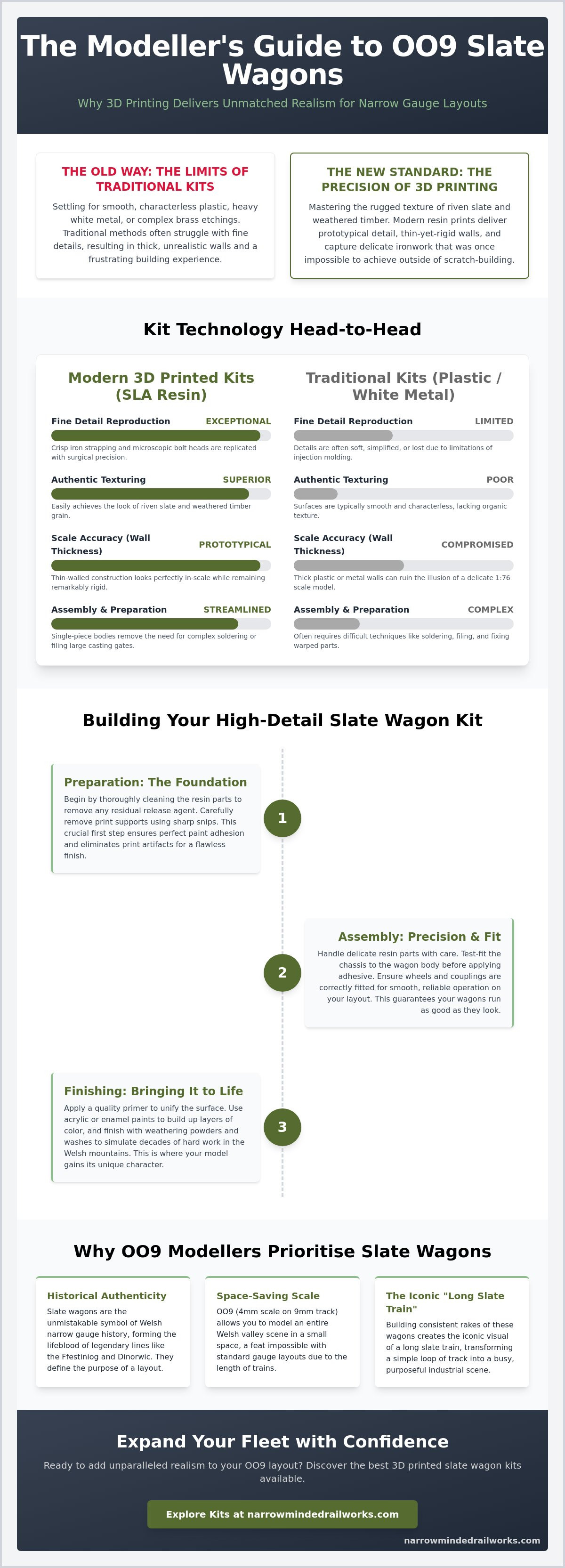
Assembling 3d printed slate wagon kits oo9 requires a slight departure from the techniques used for traditional plastic models. While the resin material provides exceptional detail, it lacks the porosity of styrene, which can make paint adhesion a challenge. We recognize that achieving a durable, professional finish on resin can be frustrating, so we recommend a systematic approach to preparation and priming. By following a structured workflow, you can ensure that your fine industrial details remain crisp and your paintwork stays intact for years of layout operation.
Preparation and Safety
Safety is a priority when you are sanding or filing 3D printed parts. While the cured resin in your kit is stable, the fine dust produced during cleanup can be a respiratory irritant. To solve this, always wear a dust mask and consider wet-sanding to keep particles out of the air. Removing support marks requires a sharp hobby knife and a light touch to avoid gouging the wagon sides. Once you have smoothed the surface, follow the "wash and dry" rule. Use warm, soapy water to remove any residual oils or dust, then allow the parts to air-dry completely. This step is vital for ensuring your primer bonds correctly to the surface.
Painting for Prototypical Accuracy
Prototypical slate wagons rarely looked perfectly clean or uniform. When you choose your base colors, avoid using a flat black for the ironwork, as this can look toy-like in 4mm scale. Instead, use a very dark charcoal or a custom "Slate Grey" to create visual depth. This base allows you to use dry-brushing techniques to highlight bolt heads and iron strapping with lighter shades. For those looking to master advanced airbrushing and shading tips, refer to our guide on painting 3D printed models. Finish the look with weathering powders to replicate the distinctive grey dust found in Welsh quarries.
Adding Weight and Rolling Qualities
A frequent constraint with lightweight resin wagons is their tendency to derail on complex pointwork. To solve this, you must add weight without ruining the open-caged appearance of the model. You can hide small lead or tungsten weights under a realistic slate load in the bottom of the wagon. This extra mass improves tracking and ensures smooth operation during gravity-defying runs. Take the time to "bed in" the chassis to the body, ensuring the axles are perfectly parallel. If you are ready to put these techniques into practice, you can find your next project in our collection of OO9 wagon kits.
Creating a Realistic Slate Train with Narrow Minded Railworks
Building a full slate train often feels like an endless task when you are sourcing individual, mismatched kits from various sellers. To solve this, our 3d printed slate wagon kits oo9 are produced using standardized digital masters, ensuring that your tenth wagon is as precise and uniform as your first. This consistency is vital for modellers who want to move beyond single-car projects and create a convincing, prototypical fleet. When your rolling stock shares the same design DNA, the entire train carries a sense of industrial purpose that is difficult to achieve with a fragmented collection.
We believe that buying in "rakes" is the most effective way to maintain a uniform look across your layout. It's often jarring to see a train composed of wagons with vastly different wall thicknesses or conflicting detail levels. By utilizing our consistent manufacturing process, you can build a long slate run that looks like it emerged from the same quarry workshop. If you're looking for guidance on how to manage a larger fleet build, you can explore our top tips for successfully building OO9 wagon kits to streamline your assembly line.
Our brand philosophy centers on transparency regarding the 3D printing process. We acknowledge that resin printing involves specific physical constraints, such as support placement and material shrinkage. To solve this, we design our kits specifically for the medium, ensuring that every 3d printed slate wagon kits oo9 body is optimized for the best possible print quality. This proactive design approach means you spend less time fixing print artifacts and more time integrating your new rolling stock into your existing scenery.
The Narrow Minded Railworks Difference
Choosing our kits means you aren't just buying a resin body; you're gaining access to direct-from-designer support for your kit-building journey. We select our high-quality resins specifically for their durability and their ability to retain fine details under multiple layers of paint. Whether you are modelling a small quarry siding or a sprawling mountain railway, our worldwide shipping ensures that narrow gauge enthusiasts everywhere can access professional-grade models. We prioritize clarity and set realistic expectations for every kit we produce, so you always know exactly what to expect when you open the box.
Ready to Start Your Slate Run?
You can browse our current range of 3D printed slate wagon bodies to find the specific prototypes that fit your layout's era. To create a truly immersive environment, don't forget to check our scenery and accessories to complete your quarry scene with realistic details. Once your wagons are on the track and weathered to perfection, we invite you to share your finished builds with our community on social media.
Building Your Prototypical Slate Fleet
We've explored how 3d printed slate wagon kits oo9 have redefined what is possible for narrow gauge enthusiasts. By moving beyond the limitations of traditional materials, you can now replicate the rugged textures of the Welsh slate industry with microscopic precision. We recognize that the shift to resin can feel daunting due to different preparation requirements, but following a structured cleaning and priming workflow provides a reliable solution for any modeller. Whether you are building a single 2-bar wagon or a massive rake for a gravity run, the consistency of modern 3D printing ensures your rolling stock remains uniform and historically accurate.
You can now put these techniques into practice by browsing our collection of professional 3D resin prints. Every kit we offer is expertly designed for prototypical accuracy to ensure your rake looks consistent from the locomotive to the final brake van. We also provide worldwide shipping available for modellers across the globe. Explore our range of high-detail OO9 Slate Wagon Kits today and start transforming your layout. It's time to bring the authentic character of the Welsh mountains to your own railway diorama.
Frequently Asked Questions
Do 3D printed slate wagon kits come with wheels and axles?
Our kits generally consist of the 3D printed body and chassis frame, but they don't include wheels or axles. We recognize that sourcing these parts separately can be an extra step, so we design our kits to be compatible with industry-standard 9mm wheelsets from brands like Peco or Dundas. This allows you to choose the specific wheel profile and material that best suits your layout's operation and your personal budget.
What glue is best for assembling 3D printed resin wagon kits?
You should use Cyanoacrylate (CA) glue, commonly known as superglue, for assembling resin kits. Standard plastic cement does not create a chemical bond with 3D printed resin because it's a non-porous material. If you need a stronger bond for structural components, a two-part epoxy resin provides a proactive solution. We recommend using a medium-viscosity CA glue to allow for a few seconds of adjustment before the bond sets permanently.
Can I use standard N gauge track for my OO9 slate wagons?
Yes, you can run your OO9 slate wagons on standard N gauge track because both use a 9mm gauge. While the track width is identical, we recognize that the sleeper spacing on N gauge track is designed for 2mm scale models. To achieve a more prototypical look for your 3d printed slate wagon kits oo9, we suggest using dedicated OO9 track. This track features wider-spaced sleepers that better represent narrow gauge railway construction.
How do I remove the 'stepping' or layer lines from a 3D print?
High-resolution resin prints have minimal layer lines, but you can remove any remaining stepping with fine-grit sandpaper or a sanding stick. We recommend starting with 400-grit paper and finishing with 800-grit or higher for a smooth surface. It's vital to wet-sand the parts to prevent resin dust from becoming airborne. Applying a high-quality automotive primer will also help fill microscopic gaps and reveal any areas that require additional smoothing before painting.
Are these kits suitable for beginners in the model railway hobby?
These kits are excellent for beginners who want to move beyond ready-to-run models and explore kit building. While resin requires different handling than plastic, the one-piece nature of many 3D prints simplifies the assembly process. We provide detailed instructions to help you navigate the preparation and finishing stages. Starting with a simple slate wagon allows you to practice essential skills like painting and weathering without the complexity of a powered locomotive kit.
What is the best way to weight an empty 3D printed slate wagon?
The best way to weight an empty wagon is to hide lead or tungsten putty inside the floor area under a cosmetic slate load. Because 3D printed resin is lightweight, adding mass is a proactive solution to prevent derailments on uneven track. You should aim for a total weight that matches other rolling stock in your fleet. This extra weight ensures that the 3d printed slate wagon kits oo9 track reliably during long runs.
Do I need to prime 3D printed resin before painting?
You must always apply a primer to 3D printed resin before you begin the final painting process. Resin is a non-porous material, so standard hobby paints don't adhere well to the bare surface and can easily flake off. Using a dedicated plastic or automotive primer creates a stable surface for acrylics or enamels to bond with. This step also acts as a quality check, highlighting any support marks or imperfections that need further sanding.
How do I fix a warped 3D printed wagon body?
If you discover a warped component, you can gently reshape it by submerging the part in warm water for about thirty seconds. Once the resin becomes slightly pliable, carefully bend it back into the correct position and hold it while it cools under a cold tap. We recognize that resin can sometimes retain internal stresses from the curing process, so this thermal treatment provides a simple and effective fix. Avoid using boiling water to prevent permanent damage.