


You don’t need complete confidence before starting a kit. Getting over the fear of starting a kit is less about eliminating uncertainty and more about making the first step manageable. It’s understandable to worry about mistakes or not knowing what comes next, but those concerns don’t have to stop you from beginning.
This article shows how to approach uncertainty more calmly, consider what you might gain from trying something new, and focus on what you can control. You’ll find practical ways to ease in, from choosing a small first task to building confidence through steady progress. Starting at your own pace gives you room to learn as you go, without expecting yourself to have every answer in advance.
Key Takeaways
- Treat uncertainty as not knowing what will happen, rather than proof that something will go wrong.
- Picture what you could enjoy or learn from trying a new activity, not only what feels intimidating.
- Build confidence by focusing on choices within your control, such as when to begin and what to do first.
- Break the first steps into manageable tasks and repeat each one until it feels more comfortable.
1. Changing your perspective on uncertainty
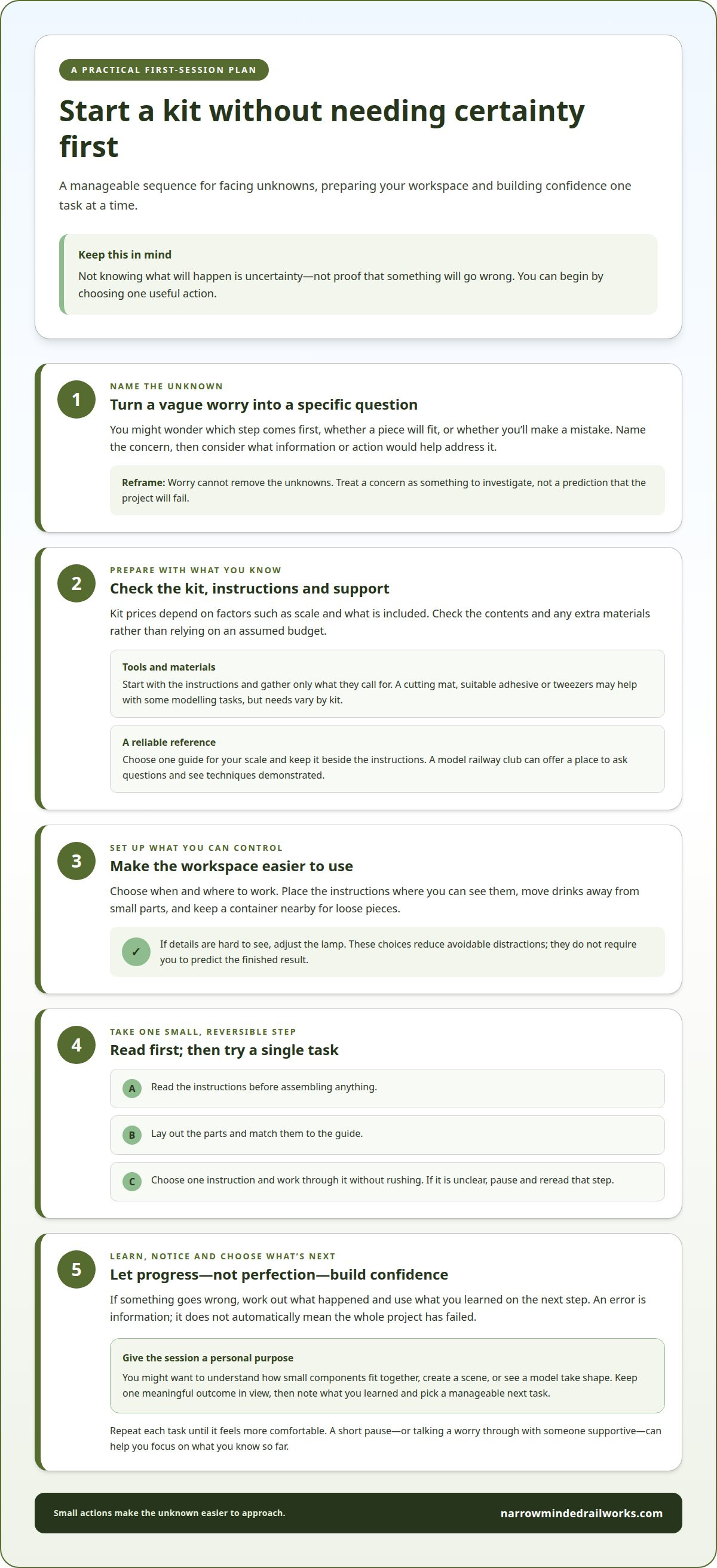
Starting a kit means facing some unknowns. You may wonder which step comes first or whether a piece will fit. Those questions reflect uncertainty, not proof that something will go wrong. Worry can’t remove the unknowns, and it can make starting feel harder. Instead, name the specific concern, such as making a mistake with an early part. Then decide what information or action would help address it.
How much does a beginner kit typically cost in the UK? There’s no single useful figure for every kit. Price depends on factors such as scale and what’s included, so consider the kit’s contents and any extra materials before choosing. That keeps the decision grounded in your project rather than an assumed budget.
To reduce the fear of mistakes, make the first task small and reversible. Read the instructions before assembling anything, then choose one step to try without rushing. For example, lay out the parts and match them to the guide. If anything is unclear, pause and reread that step. Treat an error as information: work out what happened, then apply what you learned to the next step.
What tools and materials do you need to start a beginner kit? Begin with the instructions, then gather only the tools and materials they call for. A cutting mat, suitable adhesive or tweezers may help with some modelling tasks, but requirements vary by kit. Diorama Tools & Scenery can support scenery work if it’s part of your project.
For beginner-friendly guidance and support in the UK, look for model railway clubs near you and guides for your chosen scale. A club can offer a practical setting for asking questions and seeing modelling techniques demonstrated. Before beginning, choose one reliable guide and keep it beside the instructions. That gives you a clear reference point when uncertainty returns.
Focus on the task in front of you, not every possible outcome. Set out the parts, read one instruction and complete that step. A short pause can help you recognise what you know so far. If worry keeps interrupting, talk it through with someone supportive. Small, specific actions make the unknown easier to approach without demanding certainty first.
2. Focusing on the benefits of trying something new
Fear can alert you to genuine danger, but it can also discourage worthwhile activities. A new kit may feel unfamiliar because you haven’t assembled one before. That uncertainty doesn’t tell you whether the experience will be rewarding. Separate practical risks from imagined outcomes. A misplaced part, for example, may need careful correction, but it doesn’t automatically mean the whole project has failed.
Make the possible benefits specific. You might enjoy learning how small components fit together, creating a scene or seeing a model take shape. Choose one outcome that matters to you. Write it beside your workspace, such as, “I want to understand how the wagon parts assemble.” This gives your first session a purpose beyond finishing the whole kit.
Imagining a positive outcome can make a new activity easier to approach. Picture a realistic moment, not a perfect result: opening the instructions, identifying the first parts and completing one clear task. Include likely challenges, too. If a step confuses you, you can pause and reread it. The aim is to picture yourself responding, rather than expecting everything to go smoothly.
Before you begin, make a simple list of benefits and concerns. Name one concern, then pair it with a possible gain. For instance, “I may need to redo a join” can sit beside “I’ll learn how the pieces fit.” This doesn’t dismiss the concern; it puts it alongside your reason for choosing the activity. Keep the benefit personal and practical, rather than measuring success only by a finished model.
After your first session, note what you learned. You may discover that sorting parts felt satisfying or that a particular instruction needs another look. That observation helps you choose the next task with clearer expectations. Trying something new doesn’t require certainty about the final outcome. It means testing one manageable step and noticing what the experience offers. A small beginning can help you decide whether you want to continue.
3. Focusing on what you can control
A kit project involves choices you can make and outcomes you can’t predict. You can choose when to work, where to set up and which instruction to follow, but you can’t know every result in advance. Separate these on paper: list your decisions on one side and unknown outcomes on the other. This makes preparation more concrete. Getting over the fear of starting a kit can begin by recognising which concerns have practical answers.
Choose one action to make your workspace easier to use. Move drinks away from small parts, place the instructions where you can see them and keep a container nearby for loose pieces. If the lighting makes details hard to see, adjust the lamp before you continue. These choices can’t control the finished result, but they can reduce avoidable distractions.
Practising a challenging activity in a familiar setting can help you prepare. For a public-speaking talk, you might practise in front of friends or family. With a kit, try describing an assembly step aloud to someone supportive. Explaining how two pieces connect can show which instructions make sense and which need another careful read.
Creators can also set boundaries around feedback. Nat Eliason suggests starting privately within an existing social network before sharing work with a wider audience. If you post your progress, choose what to share and whose comments you want to see. You can mute or hide comments from people who upset you, then focus more on supportive responses. Other people’s reactions are outside your control; your boundaries aren’t.
At the end of a session, write down one helpful decision, such as adjusting the light or rereading a diagram. Use that note to plan a practical change for next time. Getting over the fear of starting a kit doesn’t mean controlling every detail. It means choosing useful actions, setting reasonable boundaries and responding to the task in front of you.
4. Taking small steps towards a new activity
A large project can feel daunting before it begins. Break it into small actions, such as reading one instruction, sorting parts or preparing your workspace. Each action gives you a clear starting point. You don’t need to complete the whole kit in one sitting. Before you begin, choose a stopping point, such as finishing one manageable task.
A graded-exposure approach starts with the easiest situation and repeats it until anxiety has improved by at least 50%, according to NHS. For a kit, the easiest step might be opening the instructions or arranging parts without assembling them. Repeat that step if it feels uncomfortable. Then move to a slightly more demanding task, such as joining two pieces.
How can beginners choose an easy first kit in the UK? Look for clear instructions and a project whose complexity feels manageable to you. Consider the time and concentration you can give it, rather than choosing only for its finished appearance. A straightforward first task can make it easier to begin.
Follow a simple progression: read the guide, identify the parts, prepare your workspace, then try one assembly step. If anxiety rises, return to the previous task and practise it again. Don’t treat a pause as failure. It gives you time to understand the instructions and decide what comes next.
How can you stay motivated and finish a kit project? Keep a brief record of completed steps, such as “parts sorted” or “first section assembled.” Seeing your progress makes the next task more specific. Set a realistic goal for each session, then stop when you reach it. If you miss a session, restart with the next small action instead of judging the delay.
Keep the instructions beside your work and mark your current step. That way, each session has a clear restart point. For a new project, explore a manageable kit project and choose a first task you can approach at your own pace.
Learning about a sport first can help someone ease into it; the NHS says gradual exposure starts with the easiest step. Nat Eliason says creators get used to the fear of creating by making things.
Narrow Minded Railworks
Narrow Minded Railworks gives you model railway kits and scenery items to consider as a practical starting point. If you’re unsure which kind of project feels manageable, begin by choosing a scale or subject that interests you. The range includes OO9 Locomotive & Wagon Kits, GN15 Locomotive & Scenery Kits, O-16.5 / 7mm Scale Kits, and Diorama Tools & Scenery. Each offers a different way to approach a modelling project, from railway components to scenic details.
You don’t need certainty about every step before choosing a direction. Start with a project that matches your interests, then use its instructions to plan a first task. If you’d like help choosing a kit or scenery option for your project, explore Narrow Minded Railworks’ narrow gauge kits and scenery.
Make your first session your own
Confidence doesn’t have to come before you begin. Let it develop through the experience. Choose a time when you can give the project your attention, and decide what a satisfying first session would look like. It might simply mean getting familiar with the parts and instructions. That’s still a genuine beginning.
Getting over the fear of starting a kit can take practice, so adjust your approach as you learn. You may find that a different workspace, a clearer project goal or a slower pace makes the activity more comfortable. Treat those discoveries as useful feedback, not signs that you’ve chosen the wrong hobby. Make room for curiosity alongside uncertainty.
If you’re ready to choose a model railway project that suits your interests, contact Narrow Minded Railworks. You can take the next step at your own pace, one considered choice at a time.
Frequently Asked Questions
What are the first steps for starting a kit without feeling overwhelmed?
Start by checking the kit’s contents against its parts list, then read the instructions through once before handling the pieces. Note unfamiliar terms or symbols so you can understand them before assembly. Keep small parts in their original packaging or in separate, labelled containers. This preparation reduces the chance of losing pieces and helps you understand the project’s sequence before making decisions.
How can you break a kit project into manageable tasks?
Divide the work into stages, such as preparation, main assembly, finishing and scenery, then list the actions within each stage. Give each action a clear endpoint, such as “assemble the body” rather than “work on the kit.” Follow the order required by the instructions, and leave optional details until the main build is complete. This keeps extra choices from crowding out essential work.