


The track gauge matters as much as the model’s scale: an OO9 railcar kit is made for a 1:76 narrow-gauge railway running on 9 mm track. At this scale, that track represents a prototype gauge of about 2 ft 3 in, while OO9 is also commonly used to model British narrow-gauge lines around 2 ft to 2 ft 6 in.
Choosing a railcar is only one part of planning a convincing layout. Its relationship to locomotives, wagons and coaches, along with the track beneath them, helps determine whether the finished railway feels consistent.
This guide explains how OO9 kits fit into a narrow-gauge model railway, what to consider when matching railcars with other rolling stock, and how track compatibility works. It also covers the distinction between kits and ready-to-run models, plus the role different manufacturers play, so you can make informed choices for your layout.
Key Takeaways
- Learn how to build a coherent narrow-gauge train by considering how railcars relate to locomotives and other rolling stock.
- Understand the track-gauge compromise behind OO9 modelling and how it affects layout planning.
- See what to consider when adding coaches and carriages to a railcar-led service.
- Compare the different roles manufacturers play, then explore kits and scenery that suit your modelling scale.
Locomotive and rolling stock kits
A railcar carries passengers or goods under its own power, unlike a wagon hauled behind a locomotive. That difference shapes its place in an OO9 train: it can operate alone, while a locomotive usually needs suitable rolling stock to form a complete working scene. An OO9 railcar kit therefore suits modellers planning a self-propelled vehicle rather than another wagon for an existing locomotive.
Diesel and steam locomotives create different visual and operational themes. A diesel can suggest a compact industrial railway, while a steam outline may suit a heritage-inspired scene. Choose motive power to match the setting, then decide whether the railcar belongs in the same service or represents a different period. Consistent vehicle styles and purposes make even a short train look intentional.
Rolling stock includes wagons and passenger vehicles, each with a different role. A locomotive can haul a mixed train, such as a passenger coach alongside a goods wagon, if that combination suits the scene. A railcar, by contrast, may need only its own passenger space or a trailer to suggest a larger service. Check the kit instructions and the models’ coupling arrangements before planning which vehicles to pair.
- Start with the service: decide whether the scene shows passengers, freight or both.
- Select motive power: choose diesel or steam to suit the railway’s visual character.
- Build the consist: pair a locomotive with relevant wagons or coaches, or give a railcar a focused role.
- Review the kit instructions: identify assembly requirements and how the vehicle connects to other stock.
These choices matter on a compact layout, where every vehicle contributes to the scene. A single railcar can become the focal point, while a locomotive and wagon can tell a freight story. Decide each vehicle’s role before assembly so the finished train has a clear purpose.
OO9 scale and track compatibility
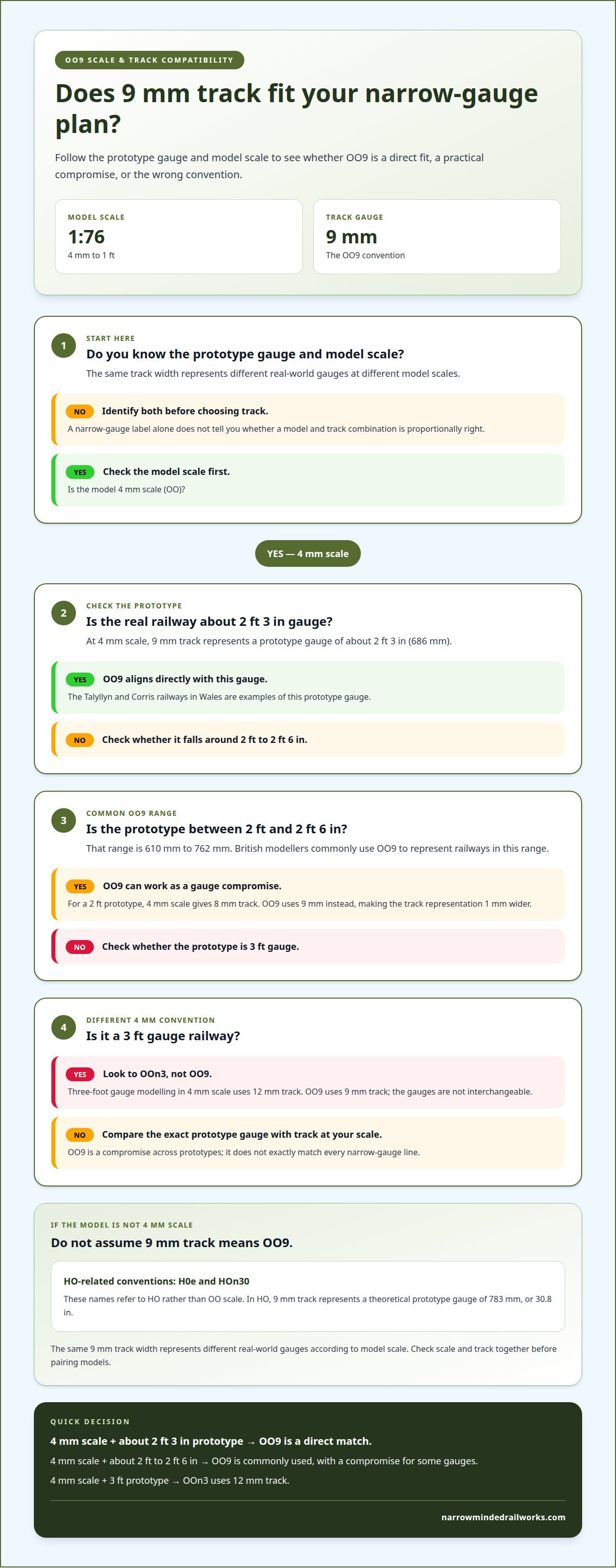
OO9 combines 1:76 scale models with 9 mm track. At 4 mm to 1 ft scale, that gauge represents a prototype track width of 2 ft 3 in, or 686 mm. The Talyllyn and Corris railways in Wales use this prototype gauge, making them natural reference points for OO9 layouts.
British modellers also use OO9 to represent railways around 2 ft to 2 ft 6 in gauge. That range spans 610 mm to 762 mm. A 9 mm track gauge is therefore a modelling compromise across different prototypes, rather than an exact match for every line.
For a 2 ft prototype, the track gauge at 4 mm scale would be 8 mm. OO9 modellers generally accept 9 mm instead, which can simplify layout planning while slightly widening the track representation. The choice matters when a model’s appearance must closely reflect a specific railway. A 2 ft 3 in prototype, for example, aligns directly with the OO9 convention; a 2 ft line involves the 1 mm difference.
H0e and HOn30 are related narrow-gauge modelling conventions, but their names refer to HO rather than OO scale. In HO, 9 mm track represents a theoretical prototype gauge of 783 mm, or 30.8 in. The same track width therefore represents different real-world gauges according to model scale. Don’t assume that a vehicle designed for one convention will look proportionally right beside another.
Three-foot gauge modelling in 4 mm scale uses 12 mm track, a combination known as OOn3. This differs from OO9, which uses 9 mm track. Keep the distinction clear when planning a track layout or selecting models: a similar narrow-gauge subject doesn’t mean the track gauges are interchangeable.
- Identify the prototype: note its gauge and railway before choosing a modelling convention.
- Match scale and track: compare the model’s scale with the track gauge, not just the narrow-gauge label.
- Consider the compromise: OO9 uses 9 mm track, including for some prototypes narrower than its exact representation.
If your project uses a different modelling scale, explore broader narrow-gauge scale options before settling on a track plan.
OO9 coaches and carriages
Coaches give a narrow-gauge passenger train a different character from a goods consist. Behind a locomotive, an enclosed carriage can suggest a regular passenger service; an open-sided design can create an informal excursion scene. A railcar already carries its own passengers, so adding a coach makes it feel like part of a larger service. Choose the arrangement that fits your layout’s story.
Before assembling a coach, consider how it fits the railway’s setting. An industrial line might call for plain, practical carriages, while a visitor railway could suit more decorative passenger stock. These are visual choices, not fixed rules. Aim for consistency: a highly detailed coach may look out of place beside a deliberately simple locomotive, even if both are the same scale.
Window arrangement, doors, roof shape and finish all help define a carriage’s character. An enclosed coach with regular windows, for example, looks distinct from an open-sided carriage, even in a short train. Use paint and small details to support the scene rather than adding features without a clear purpose. A restrained finish can help the locomotive, coach and scenery feel connected.
Plan the train as a complete unit before final assembly. Place the locomotive or railcar beside the intended coach and compare their lengths, shapes and finishes. Follow the kit instructions for assembly and connection, and check the coupling arrangements, particularly when a carriage will run behind a locomotive or powered railcar. If the models use different arrangements, you may need to adapt the planned consist before adding final details.
- Define the service: choose passenger, excursion or industrial character for the scene.
- Match the appearance: coordinate coach details and finish with the motive vehicle.
- Plan connections: consider how each carriage joins the locomotive or railcar.
- Build with purpose: add visible details that support the railway’s setting.
A well-chosen carriage adds context, not just length. Whether it follows a locomotive or accompanies a railcar, its design and connection should support the same railway story.
OO9 manufacturers
OO9 manufacturers differ in what their kits include, so compare the model’s scope before choosing. One kit may focus on a vehicle body, while another may provide a broader set of parts. The word “kit” alone doesn’t tell you what assembly involves. Read the product description and instructions to understand what the modeller builds and what the finished model represents.
Next, compare each manufacturer’s intended scale and track context. OO9 uses 1:76 scale models on 9 mm track, so those details should align with your layout. A maker’s description should help identify the model’s scale and subject. For example, a narrow-gauge railcar designed for OO9 serves a different purpose from a model intended for another scale.
Manufacturer information also helps you plan how a model will fit your railway. Look for the vehicle type, prototype inspiration, assembly guidance and any stated requirements. A railcar kit and a locomotive kit can both suit an OO9 layout, but they create different operating scenes. Choose according to the role you want the model to play, rather than appearance alone.
For UK modellers, the 009 Society provides a useful point of reference for the hobby. Its monthly newsletter, 009 News, keeps narrow-gauge modelling in view. Use publications and modelling discussions to learn the terms makers use, then apply those terms when comparing a kit’s scale, subject and construction details. This helps you make a considered choice without treating every manufacturer’s range as identical.
- Confirm the scale: match the stated scale and track gauge to your layout.
- Identify the contents: distinguish a vehicle body from a more complete kit.
- Review assembly details: use the instructions to understand the build.
- Choose by role: decide whether the model supports passenger, freight or scenic operation.
Once you know which details matter, browse narrow-gauge model options with your layout’s scale and intended scene in mind. A clear match between model, track and railway setting makes the manufacturer comparison more useful.
Narrow Minded Railworks
Narrow Minded Railworks offers model railway kits and scenery for modellers choosing a narrow-gauge direction. Its range includes OO9 Locomotive & Wagon Kits, alongside GN15 Locomotive & Scenery Kits and O-16.5 / 7mm Scale Kits. Diorama Tools & Scenery can support the setting around a railway, helping connect rolling stock with its surrounding scene.
If you’re planning an OO9 railcar layout, these options provide a useful starting point for considering scale, motive power, wagons and scenery together. The right choice depends on the railway you want to represent and the role each model will play. Browse the relevant kit categories to find options that fit your modelling plans, then contact Narrow Minded Railworks to discuss your project.
Shape your next narrow-gauge project
Choose a scene before settling on the final vehicle. A working passenger service, a quiet rural stop and an industrial siding each call for a different balance of models and scenery. That decision can help you move from browsing an OO9 railcar kit to planning a railway with a clear identity.
Narrow Minded Railworks brings together options across narrow-gauge modelling, including OO9 Locomotive & Wagon Kits, GN15 Locomotive & Scenery Kits, and O-16.5 / 7mm Scale Kits. Consider which scale and project direction best match your layout, then use that choice to guide your next build.
If you’re ready to develop the idea, contact Narrow Minded Railworks to discuss your modelling plans. A well-chosen starting point can turn your railway concept into a rewarding project.
Frequently Asked Questions
What is an OO9 railcar kit?
An OO9 railcar kit is a model kit for a self-propelled narrow-gauge vehicle. Narrow Minded Railworks lists a Commer FC spacevan railcar kit designed for a trimmed KATO 109 chassis; the chassis isn’t included. Its resin parts arrive unpainted and unprimed, with supports removed. Resin can be fragile, particularly around thin sections, so handle the parts carefully during assembly.
Which manufacturers make OO9 railcar kits?
Narrow Minded Railworks is a UK manufacturer offering OO9 railcar and locomotive kits. Its Commer FC spacevan is one example, alongside locomotive bodies and wagon kits. Product ranges differ in subject and intended chassis, so compare each model’s details rather than assuming every maker supplies the same parts or assembly requirements. That distinction matters when planning a powered model.
How much do OO9 railcar kits cost in the UK?
The price depends on the specific model, so the price of one railcar or body does not tell you what another kit costs. The KATO chassis required for the Commer model is not included and must be purchased separately.
Where can I buy OO9 railcar kits in the UK?
You can buy an OO9 railcar kit directly from Narrow Minded Railworks through its online shop. Product listings identify the model and its stated contents, helping you distinguish a vehicle body kit from a complete working model. These kits require assembly and, where specified, the buyer’s own suitable chassis. Review the product details to match the model to your planned build.
Are OO9 railcar kits compatible with standard OO9 track and couplings?
Track and coupling compatibility are separate considerations. OO9 uses 9 mm track, but coupling fit depends on the chassis and coupling fitted to the assembled model. For example, the Commer FC spacevan kit is designed for a trimmed KATO 109 chassis, which isn’t included. Use the stated chassis match as your starting point rather than assuming every OO9 coupling arrangement is interchangeable.
How do you assemble and paint an OO9 railcar kit?
Follow the kit instructions for assembly and check how the railcar connects to other stock. Choose a paint finish that suits the railway’s setting and works with the rest of the train and scenery.