

The largest model isn’t automatically the best fit for a narrow-gauge layout. In Britain, choosing the right narrow gauge scale means matching the model’s scale and track gauge to the railway you want to represent: OO9 uses 4 mm scale on 9 mm track for 2 ft prototypes, while 16 mm modelling pairs 16 mm scale with 32 mm track for 2 ft gauge. O-16.5 is another option, using 7 mm scale on 16.5 mm track for narrow-gauge prototypes.
It’s easy to focus on the track first, especially when a familiar gauge seems convenient. But scale affects how large models look, how much detail they show and how much space a layout needs. The scale and track gauge therefore matter as much as the track itself.
This guide explains common narrow-gauge scale and track combinations, how to read their names and which options suit British railway subjects. Layout space, prototype gauge and the kind of modelling you enjoy can all help narrow your choice.
Key Takeaways
- Separate model scale from track gauge so you can assess what a combination represents, rather than relying on its name alone.
- Balance model size and visible detail against the space available and the curves your layout needs.
- Compare British prototype gauges before settling on a modelling combination, especially when your subject isn’t a 2 ft railway.
- Use the scale and subject you’ve chosen to guide your next step, from selecting suitable kits to planning a focused scene.
16Mm narrow-gauge modelling
16mm modelling pairs a large, detailed model with narrow track. The choice also depends on your prototype and the space your model railway can use.
Distinguishing Scale from Track Gauge
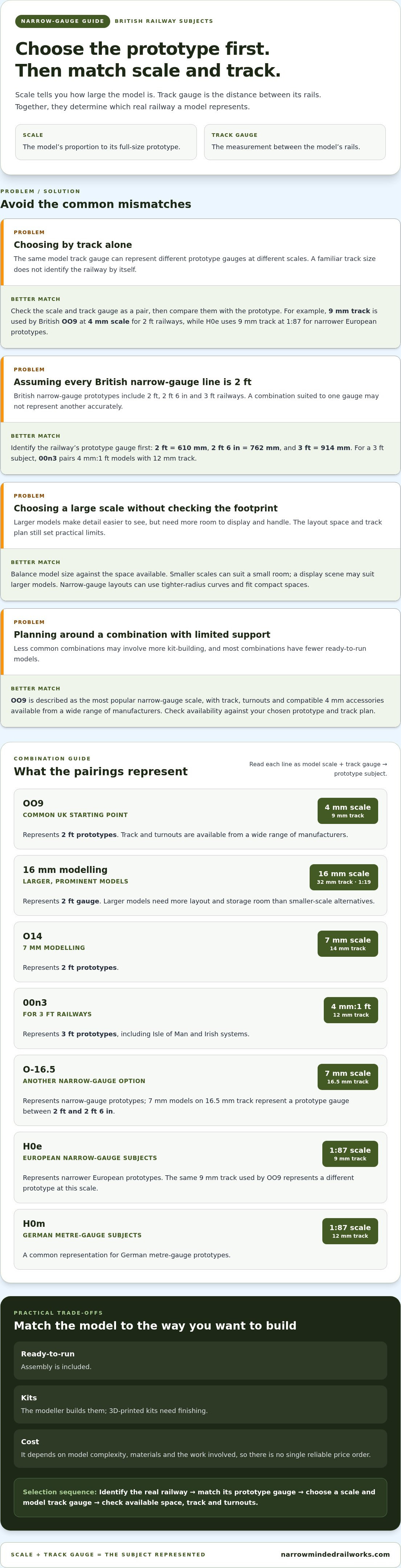
Scale is the model’s proportion to its full-size prototype; track gauge is the measurement between the rails. The distinction matters because one track gauge can represent different prototype gauges at different scales. For example, 16mm models on 32mm track represent 2ft railways at 1:19, while 7mm models on 16.5mm track represent narrow-gauge prototypes.
Choosing for Available Space
Choosing a scale and gauge for your available space means balancing model size against the track plan you can accommodate. Larger models make details easier to see, but require more room to display and handle. Narrow-gauge layouts can use tighter-radius curves and fit into compact spaces, so consider your available footprint as well as the prototype. A small room may suit a smaller scale, while a display scene may work well with larger models.
Beginner Scale Choices in the UK
For a beginner in the UK, OO9 is a practical starting point: it uses 4mm scale and 9mm track to represent 2ft prototypes. It’s described as the most popular narrow-gauge scale, with track, turnouts and compatible 4mm accessories available across the hobby. That can make it easier to plan a first layout than a less common combination.
At 16mm scale, 32mm track represents 2ft gauge at 1:19. This creates larger, prominent models, but the layout and storage need more room than smaller-scale alternatives.
00n3 uses 4mm:1ft models on 12mm track for 3ft railways, including the Isle of Man and Irish systems. German metre-gauge subjects use other scale-and-track pairings, so identify the prototype before choosing.
Ready-to-run models include assembly; kits require the modeller to build them, while 3D-printed kits need finishing. Their costs depend on model complexity, materials and the work involved, so there’s no single reliable price order.
Smaller scales can save layout space, while larger scales make detail easier to see. The trade-off is that larger models need more room for display and handling.
Narrow-gauge scale and track combinations
Each combination pairs model size with track gauge to represent a particular railway. In the UK, OO9 locomotives and rolling stock are modelled on 9 mm track, with track and turnouts available from a wide range of manufacturers.
How Scale and Track Gauge Work Together
Scale sets the model’s size relative to its prototype, while track gauge measures the distance between its rails. Together, these measurements determine which real railway the model represents. For example, British OO9 uses 4 mm scale and 9 mm gauge track to represent 2 ft gauge railways. The same 9 mm track in H0e represents narrower European prototypes at 1:87 scale.
Matching Track to Prototype Gauge
Matching track gauge to prototype gauge means scaling the real distance between rails to the model’s chosen scale. This keeps the locomotive and rolling stock proportionate to their track. For 7 mm modelling, 16.5 mm track represents a prototype gauge between 2 ft and 2 ft 6 in. By contrast, O14 uses 7 mm scale with 14 mm track for 2 ft prototypes. Choose the prototype first, then compare the model gauge combinations that represent it correctly.
Track and Turnout Availability
Track and turnout availability affects how easily you can build the layout you’ve planned. OO9 has track and turnouts from a wide range of manufacturers, while less common combinations may involve more kit-building. UK modellers can find narrow-gauge locomotive and wagon kits alongside track options; most combinations have fewer ready-to-run models. Smaller industrial subjects may suit compact scenes, while a live steam layout needs track planning that accommodates its models and operation.
German metre-gauge prototypes are commonly represented by H0m, using 12 mm track at 1:87 scale. For a focused scene, compare the available track and turnouts against the prototype and the curves your plan requires. You can also explore narrow-gauge modelling options once you’ve settled on a suitable combination.
British narrow-gauge railway gauges
In the UK, narrow gauge means track narrower than 4 ft 8½ in, the standard gauge used by most real railways. British narrow-gauge subjects span several prototype gauges, so identify the railway before selecting a model scale. The Ffestiniog Railway and Lynton and Barnstaple Railway are 2 ft examples; the Leek and Manifold Valley Light Railway represents 2 ft 6 in.
The most common surviving narrow gauge in Britain is 2 ft, equivalent to 610 mm. British railways have also used 2 ft 6 in, or 762 mm, and 3 ft, or 914 mm. These distinctions matter: a model built for 2 ft track won’t accurately represent a 3 ft prototype unless its scale and model track gauge are matched accordingly.
Garden railway modelling offers another way to choose a subject and scale. G-scale garden railways use 45 mm track, with narrow-gauge models spanning scales from 1:20 to 1:29. The original G-scale convention is 1:22.5, based mainly on continental metre-gauge trains. That combination can represent metre gauge, but the same 45 mm track can represent different prototype gauges when the model scale changes.
Gauge 1 is also used for garden railway modelling, but the label alone doesn’t identify a narrow-gauge prototype. Consider the model’s scale and track gauge together, then compare them with the real railway. Garden layouts may give larger models room to be seen, while the available space and track plan still shape the choice.
British garden railway scales range from 4 mm to the foot to 7/8 in to the foot. The difference is particularly visible in the model’s size, the material required and the space needed for scenery. A 2 ft Welsh railway and a 3 ft Isle of Man subject need different gauge combinations, even if both are considered narrow gauge. Choose the prototype first; then select a model scale and track gauge that represent it consistently.
British narrow-gauge combinations
British narrow-gauge notation combines model scale with track gauge, so read both parts before choosing a layout. Scale determines model size, while track gauge represents the width of the prototype. When choosing the right narrow gauge scale, start with the real railway you want to portray, then compare its gauge with suitable model combinations.
OO9 uses 4 mm scale and 9 mm track for prototypes from 2 ft to 2 ft 6 in. O14 pairs 7 mm scale with 14 mm track to represent 2 ft prototypes. OO12 uses 4 mm scale and 12 mm track for 3 ft railways. These combinations differ in model size and track width, even where their prototype subjects overlap.
Nn3 is smaller, using N scale at 1:160 with 6.5 mm track to represent 3 ft gauge. Compared with OO9, its models take less space, while O14 models are larger and show more visible detail. Track and turnout availability also varies: OO9 components are available from a wide range of manufacturers, while fewer ready-to-run models exist across narrow-gauge combinations generally.
For an accurate comparison, use the real railway as your reference and check both model measurements. Imperial labels such as 2 ft and 3 ft describe prototype track widths, not model size. The same model scale can represent different prototypes when paired with another track gauge. Choosing the right narrow gauge scale therefore involves matching all three elements: prototype, model scale and track gauge.
British 5.5 mm scale kits for Welsh slate railways were launched in 1963 using readily available TT gauge parts. This example shows how an existing track system can support a narrow-gauge subject. European conventions such as H0m use 1:87 scale and 12 mm track for metre-gauge prototypes, so notation must be read in its modelling context.
Before committing to a plan, check that track and turnouts are available for your chosen combination, then compare their requirements with the curves and scene you want to build. This practical check helps keep the model’s scale, track and prototype aligned.
Narrow Minded Railworks: OO9 Locomotive & Wagon Kits
Narrow Minded Railworks offers OO9 Locomotive & Wagon Kits for modellers building narrow-gauge layouts around OO9 subjects. Once you’ve matched a prototype to its scale and track gauge, these kits give you a way to develop the railway with locomotive and wagon models.
For other modelling approaches, the range also includes GN15 Locomotive & Scenery Kits, O-16.5 / 7mm Scale Kits, and Diorama Tools & Scenery. Choose according to the scale and subject you’ve settled on: a railway scene, a specific narrow-gauge combination or a diorama. The products are 3D-printed, including locomotive bodies, wagons and scenery items.
If a kit-based approach suits your layout plans, contact Narrow Minded Railworks to discuss your modelling interests.
Make Your Next Modelling Choice
Your next step is to turn your scale decision into a clear modelling plan. Decide what you want to build first: a working railway, a detailed scene or a compact display. That purpose can guide your choice of subject, level of detail and project footprint. Choosing the right narrow gauge scale is not just about matching rails to a prototype; it’s also about choosing a project that holds your interest.
Narrow Minded Railworks offers OO9 Locomotive & Wagon Kits, GN15 Locomotive & Scenery Kits, and O-16.5 / 7mm Scale Kits. These provide kit-based options for different narrow-gauge modelling directions. Explore the offerings and take the next step towards your layout by contacting Narrow Minded Railworks. A well-chosen subject gives your project a practical starting point and room to develop in your own way.
Frequently Asked Questions
What are the different types of scales?
Model railway scales describe how large a model is compared with its full-size prototype. British examples include OO at 1:76, N at 1:148 and 7 mm scale, which represents seven millimetres for each prototype foot. Narrow-gauge modelling pairs these scales with track gauges selected for the railway being represented. The same scale can therefore support different narrow-gauge subjects.
What are the main narrow gauge model railway scales and track gauges?
Common UK combinations include OO9, O14, O-16.5 and 16 mm narrow gauge. OO9 pairs 4 mm scale with 9 mm track; O14 uses 7 mm scale and 14 mm track. O-16.5 uses 7 mm scale on 16.5 mm track, while 16 mm narrow-gauge models use 32 mm track for 2 ft prototypes. Each pairing suits different subjects and model sizes.
How do layout space and minimum curve radius affect narrow gauge scale choice?
A larger scale takes more room for models and scenery, while a tight curve can restrict which locomotives and wagons run convincingly. Allow space for the longest vehicle to travel around bends without overhang or interference. G-scale set track has a smallest radius of 600 mm in the examples covered here, so use the actual track plan and rolling stock dimensions to judge fit.
What are the UK scale-to-gauge standards for 009 and other narrow gauge modelling?
These are modelling conventions rather than one scale-to-gauge rule for every British prototype. In 009, 4 mm scale on 9 mm track represents prototypes from 2 ft to 2 ft 6 in. O14 uses 7 mm scale on 14 mm track for 2 ft prototypes. For other combinations, compare the model’s scale and track gauge with the railway’s real gauge.
How should I choose a narrow gauge scale for a specific prototype or railway?
Start with the railway you want to model, then establish its prototype gauge and the scale you want to work in. For example, a 3 ft subject needs a different track pairing from a 2 ft line. Next consider the layout footprint, the curves your chosen vehicles need, and whether suitable track and modelling components fit your plans. This makes the prototype, rather than a convenient track gauge, the starting point.