


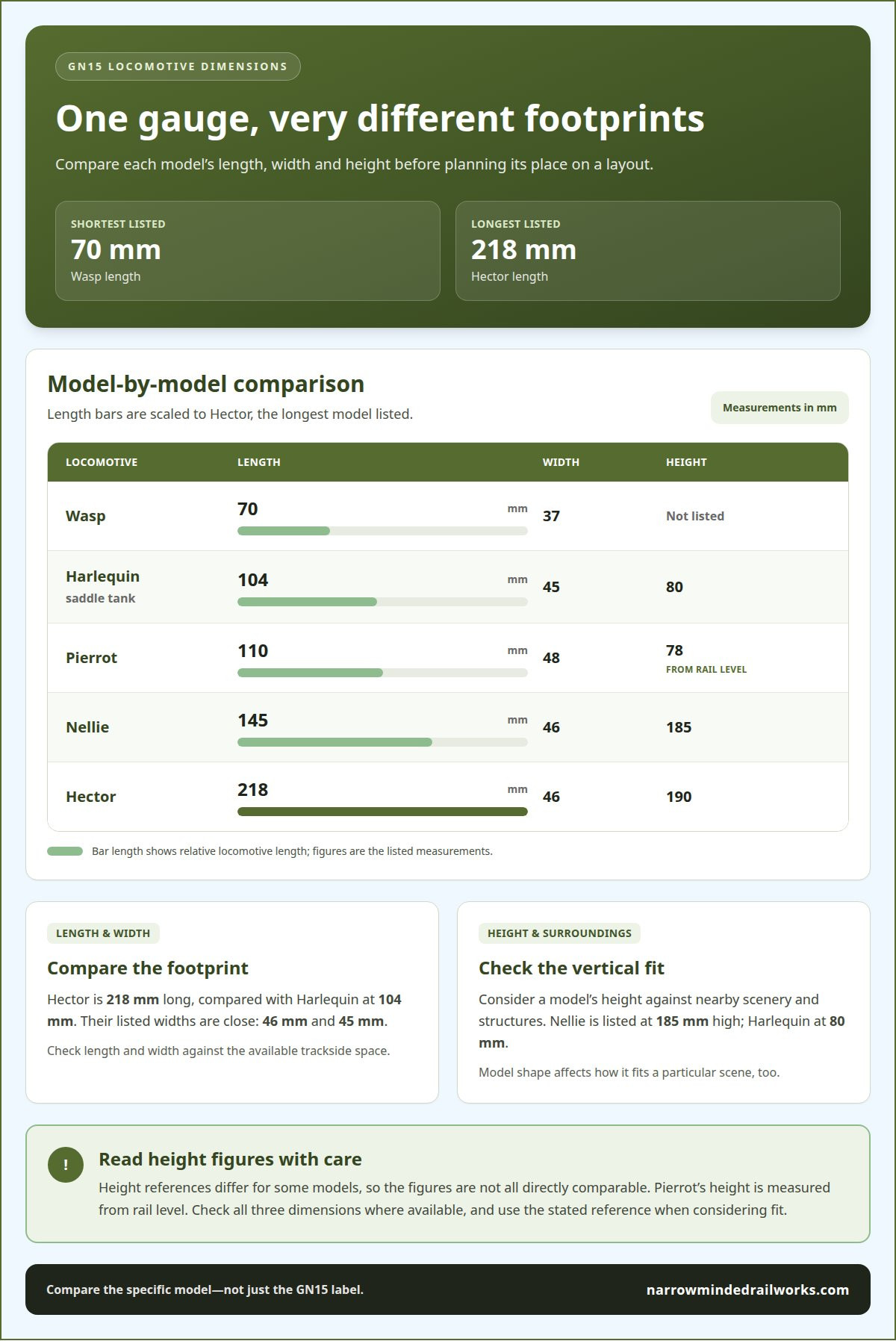
A GN15 locomotive can be 70 mm long or 218 mm long, depending on the model. For GN15 locos, dimensions also vary in width and height: examples include the Pierrot at 110 mm long, 48 mm wide and 78 mm high, and the Hector at 218 mm long, 46 mm wide and 190 mm high.
That range matters when planning a layout or deciding how much space a model needs. Kit costs vary by model, so compare both the type of kit and its listed price rather than assuming all locomotive kits are alike.
This guide compares the available locomotive dimensions and explains how to assess kit costs in the UK. It also outlines the differences between body kits, tender locomotives and railcar kits, helping you choose a model that suits your layout.
Key Takeaways
- Compare locomotive length, width and height to judge how each model will fit your layout.
- Learn why kit prices vary by locomotive type and what to consider when comparing options.
- Understand how GN15 relates to On30 and 16mm scale before choosing a modelling approach.
- Find out what to consider when matching track, power and control systems to your locomotive.
Loco dimensions
GN15 locomotives vary considerably in length, width and height, so one model’s measurements won’t represent the whole range. The Wasp measures 70 mm long and 37 mm wide, while the Hector measures 218 mm long, 46 mm wide and 190 mm high. These examples show why checking the dimensions of the specific kit matters before planning its position on a layout.
Several other models sit between those extremes. The Harlequin saddle tank measures 104 mm long, 45 mm wide and 80 mm high. Pierrot measures 110 mm long and 48 mm wide, with a height of 78 mm from rail level. Nellie measures 145 mm long, 46 mm wide and 185 mm high. That height makes it notably taller than Pierrot, despite its shorter length than Hector.
Compare the dimensions of each named locomotive to judge the space it occupies, rather than relying on length alone. Harlequin, for example, is shorter than Nellie, but its listed height is much lower. Pierrot’s height is measured from rail level, which helps show how the model sits above the track. The figures use different height references for some models, so they are not directly comparable.
Before choosing a locomotive, compare its length and width with the available trackside space, then consider its height against nearby scenery or structures. A 218 mm Hector needs more length than a 104 mm Harlequin, while their listed widths are close. For a compact scene, the Wasp’s 70 mm length offers a different footprint from Nellie’s 145 mm body. These dimensions help narrow the choice, but the model’s shape also affects how it fits a particular scene. Check all three dimensions where available, and use rail level as the reference for Pierrot’s height.
Locomotive kit prices
GN15 kit prices depend on the model and the type of kit, so compare like with like. The named options include body kits, a tender locomotive kit, and an Emett steam railcar body kit. Their different formats make a simple price comparison less useful unless you first identify what kind of model you want.
For example, Coppelia, Pierrot, Hattie and Nellie are listed as locomotive body kits. Hector is a tender locomotive kit, while Excelsior is an Emett steam railcar body kit. These names describe distinct model formats, so use the kit description alongside its listed price. That helps keep comparisons focused on similar types rather than treating every GN15 listing as equivalent.
First, decide which format suits your project, then compare the relevant listings and consider each model’s role in your layout. A body kit, tender locomotive and railcar body kit are different starting points for a build. The listing name and description identify the category, while the price helps you compare options within it.
- Body kits: Compare Coppelia, Pierrot, Hattie and Nellie as the same broad kit type.
- Tender locomotive: Hector gives you a distinct format to assess separately.
- Steam railcar: Excelsior is described as a body kit, making it a different comparison.
Keep the intended model type at the centre of your decision. A lower listed cost alone doesn’t show whether a kit matches your plan; the format matters too. If you’re considering GN15 locomotive kits, browse the GN15 range to compare the available model descriptions and choose a suitable direction for your build.
How do GN15 locomotives compare with On30 and 16mm scale?
Compare scale and track gauge separately: they describe different aspects of a model railway. GN15 locomotives are designed around G-scale modelling at 1:22.5 or 1:24, and use 16.5 mm gauge track. The Pierrot locomotive is made in 1:24 scale. These details give you a concrete reference when considering GN15 alongside On30 or 16mm models.
Start with the scale ratio for the specific locomotive. A 1:24 model represents its subject at a different reduction from a 1:22.5 model. That affects how the locomotive’s body relates to figures, buildings and scenery. The Pierrot’s 1:24 scale therefore provides a useful GN15 example, but the label alone doesn’t establish that an On30 or 16mm model will look proportionate beside it.
Next, consider track gauge independently. GN15 uses 16.5 mm gauge track, but that number does not tell you the model’s scale by itself. For an On30 or 16mm locomotive, compare the stated scale and track requirements for that exact model. Don’t assume that a shared track measurement means two locomotives have the same proportions or will suit the same visual setting.
For a mixed collection, compare each locomotive’s scale, gauge and physical dimensions before planning a shared scene. The GN15 Pierrot at 1:24 gives you a reference point; an On30 or 16mm model needs its own stated specifications for a meaningful comparison. Then consider whether figures, buildings and other scenery appear consistent beside both models. If the aim is a single-scale layout, prioritise matching scale. If you’re bringing different modelling approaches together, plan how each locomotive will sit within the scene. This comparison helps distinguish track compatibility from visual compatibility, two separate decisions when selecting a model railway locomotive.
What track, power supply and control systems work with GN15 locomotives?
According to Wikimedia Foundation, GN15 uses 16.5 mm H0/00 gauge track. Gauge describes the distance between the rails; it doesn’t identify a locomotive’s power supply or control system. GN15 kits designed for G scale at 1:22.5 or 1:24 also run on 16.5 mm gauge track. Keep those details separate when planning track and selecting a model.
Track design still matters. The Wescott Mine and Mill Railway layout has a minimum track radius of about 7 inches. That is a layout-specific example, not a universal GN15 requirement. It shows why curve compatibility matters alongside gauge. A locomotive’s mechanism and dimensions influence how it suits a particular track plan, so consider both the intended model and the route.
Power and control depend on the mechanism fitted to the locomotive. For example, the Nellie body kit is designed to fit Hornby Bill or Ben chassis without modification, or a Smokey Joe chassis with minor modification. Hector is designed for the Smokey Joe mechanism. The Gnat Black Beetle version requires a Black Beetle power unit with a 34 mm wheelbase. These examples show that a body kit’s mechanism requirements can differ between models.
Stromboli is an additional track exception: its Emett locomotive body kit is designed to run on 00/H0 track. Don’t assume every GN15 locomotive follows that specification; check the individual model’s stated track and mechanism requirements. Those details are more useful for matching power and control than gauge alone. Confirm that the selected mechanism suits the planned control setup before building around it. To compare GN15 models and their descriptions, explore the GN15 locomotive kits.
Narrow Minded Railworks: GN15 Locomotive & Scenery Kits
Narrow Minded Railworks offers GN15 Locomotive & Scenery Kits for modellers planning a narrow-gauge layout or scene. After comparing dimensions, kit types and track requirements, this range is a natural next step for exploring models suited to your project.
The right choice depends on what you want to build. GN15 kits address locomotive and scenery interests, while OO9 Locomotive & Wagon Kits and O-16.5 / 7mm Scale Kits serve other narrow-gauge modelling plans. Diorama Tools & Scenery can also support scene-building alongside a locomotive project.
Use your layout’s intended scale, track and overall design to guide your selection. If you’re ready to discuss your modelling project, contact Narrow Minded Railworks.
Plan your next modelling step
The right choice supports the scene you want to create. Treat the locomotive, track and surrounding scenery as parts of one design, so each decision contributes to a coherent layout. Having a clear project direction also makes it easier to choose the kit category that fits your plans.
Narrow Minded Railworks offers GN15 Locomotive & Scenery Kits, OO9 Locomotive & Wagon Kits, and O-16.5 / 7mm Scale Kits. These options give modellers distinct starting points for different narrow-gauge projects. Choosing GN15 locos is not only about selecting a model; it is also an opportunity to develop the setting and character around it.
Once you have a project in mind, take the next step and contact Narrow Minded Railworks about the GN15 range. A considered choice now can help bring your planned scene together. Your next model railway project starts with that decision.
Frequently Asked Questions
What does GN15 mean in model railways?
GN15 describes a narrow-gauge modelling approach using G-scale proportions on narrow track. Models are made at 1:22.5 or 1:24, so dimensions can vary with the chosen scale. The term identifies the modelling format, but doesn’t by itself specify a locomotive’s exact size or mechanism. Check the individual kit details when planning how it will fit with figures, buildings and scenery.
Which locomotives are available in GN15 scale?
GN15 locos include examples such as the Harlequin saddle tank, Pierrot and Nellie body kits, Hector, and the Excelsior steam railcar body kit. These names represent different styles and kit formats. For a scene built around GN15 locos, first choose the locomotive type and appearance that suit your plan, then consider the mechanism requirements and the model’s intended position in the layout.
What are the dimensions and track gauge for GN15 locomotives?
The track gauge is 16.5 mm, while locomotive dimensions depend on the model. The Wasp, for example, measures 70 mm long and 37 mm wide; Nellie measures 145 mm long, 46 mm wide and 185 mm high. Compare the measurements for your chosen model with nearby structures and scenery, allowing its body shape to influence where it sits in the scene.
How much do GN15 locomotives cost in the UK?
GN15 kit prices vary by model and format. Listings include locomotive body kits, a tender locomotive kit and a steam railcar body kit, so compare prices for the type you’re considering. Also distinguish a kit from a complete locomotive: the kit format affects what you’re buying and what further components or finishing your build may involve.
Are GN15 locomotives available ready to run or only as kits?
Narrow Minded Railworks offers GN15 kits rather than ready-to-run locomotives. The kits arrive unprimed and unpainted, with supports removed; some fine sanding may be needed to remove faint support marks or layer lines. Resin can be quite delicate, so avoid dropping the parts. Handle components carefully during assembly to reduce the risk of breakage.
Where can I find GN15 locomotive models, plans and second-hand listings in the UK?
Narrow Minded Railworks offers GN15 locomotive kits. The material provides no information about plans or second-hand listings.