

The choice between freelance vs prototype modelling needn’t be either-or. A protolance approach combines both: it keeps a connection to real railways while letting you adapt track plans, operations and other details to suit your layout. You can create a distinctive railway without losing the sense of how a real one might work.
It’s understandable to feel that choosing one approach means giving up the strengths of the other. Prototype modelling takes its cues from a real railway, place and period; freelance modelling gives you more freedom to invent a setting and its story. Drawing on both can make a layout coherent, engaging and practical for your available space.
This article explains what distinguishes the approaches, when those differences matter and how selective changes can bring them together. You’ll learn how to preserve the details that make a railway believable while adapting others to fit your vision.
Key Takeaways
- Choose the details that anchor your railway, such as its setting, traffic and operating character, then decide where creative changes will make the layout work better.
- Judge a modelling approach by whether it supports your goals, not by strict labels; consistency matters more than following every convention.
- Use selective compression to adapt real-world geography and railway features to your available layout space while preserving their recognisable character.
- Prototype modelling is a useful reference for understanding how real railways work, even when your finished railway includes invented places, history or operations.
Prototype and freelance modelling as complementary approaches
Prototype modelling follows a real railway, while freelance modelling creates an imagined one. Protolancing combines the two: keep the character of a real railway, then adapt its track plan, operations or history. For example, you might base a fictional route on a real railway but give it different customers and destinations. The result can feel grounded without copying every real-world constraint.
This balance works well when available space or personal interests make exact replication impractical. Selective compression can shorten a yard or route while preserving its recognisable function. You might also add a fictional interchange, change operating procedures or imagine a line that was never built. Each alteration works best when it supports the setting rather than contradicting it.
The skills involved differ in emphasis, not in qualification. Prototype modelling rewards historical research using maps, photographs and timetables; freelance modelling relies more on planning a consistent setting, traffic and company story. Both approaches benefit from careful construction, painting and clear, understandable railway operations.
Common pitfalls include researching a prototype so extensively that the layout stalls, or adding freelance details that make the railway feel inconsistent. Career prospects depend on whether you sell models, build commissioned layouts or pursue the activity as a hobby. Each path involves different work and customers.
For paid work in the UK, a written contract can define the model or layout, scope, deadlines, payment terms, revisions and ownership. Tax treatment depends on how the work is organised and earned; insurance needs depend on the work, equipment and exposure to third-party claims.
There is no single UK earning figure or standard rate for this work. A commission’s fee depends on its scope, materials, time, level of detail and agreed deliverables. Whether modelling brings in income depends on whether you undertake paid work related to it.
Prototype modelling may involve track, rolling stock, cutting and assembly tools, paints, scenery materials and planning software. Start-up spending depends mainly on layout size, chosen scale, construction methods and the equipment you already have.
To find work, prepare clear photographs of completed models and explain each project’s scope and approach. Share your portfolio through model railway clubs, exhibitions and relevant online communities. For commissioned work, agree on deliverables and payment terms before starting.
Avoiding dogmatic prototype-versus-freelance debates
Arguments about whether a layout is “properly” prototypical or freelance often mistake labels for useful design decisions. A better test is whether each choice supports the railway’s setting and operation. Bill Darnaby’s freelanced Maumee appeared in Model Railroad Planning in 1995, showing that a fictional railway can still be developed as a considered modelling subject.
Start by separating the elements you want to preserve from those you want to change. A real railway might provide the landscape, traffic patterns or visual character, while an imagined history supplies different destinations. The Northern Pacific example, where an independent road becomes part of the system in 1900, shows how one changed historical event can create a coherent alternate setting.
Apply the same test to individual models. Seven-axle articulated coal hoppers might suit an intentionally imaginative railway, but could distract from a layout meant to closely represent a specific prototype. Neither choice is automatically better. Decide whether the equipment fits the story, operating plan and other trains in the scene.
John Signor’s Southern California Ry. combines elements of three prototypes and was featured in Great Model Railroads in 2004. It offers a useful example of combining influences without treating strict replication as the only measure of quality. For your own layout, record the borrowed features and explain how they fit together. That simple design note can expose contradictions before they spread into buildings, rolling stock and operations.
Keep decisions proportionate to their effect. A changed company history may shape the entire layout, while an altered station name may affect only one sign. Set a clear boundary for each departure, then apply it consistently. If you’re exploring a narrow-gauge setting, model railway inspiration can help connect a creative idea with practical modelling choices.
Blending prototype and freelance elements
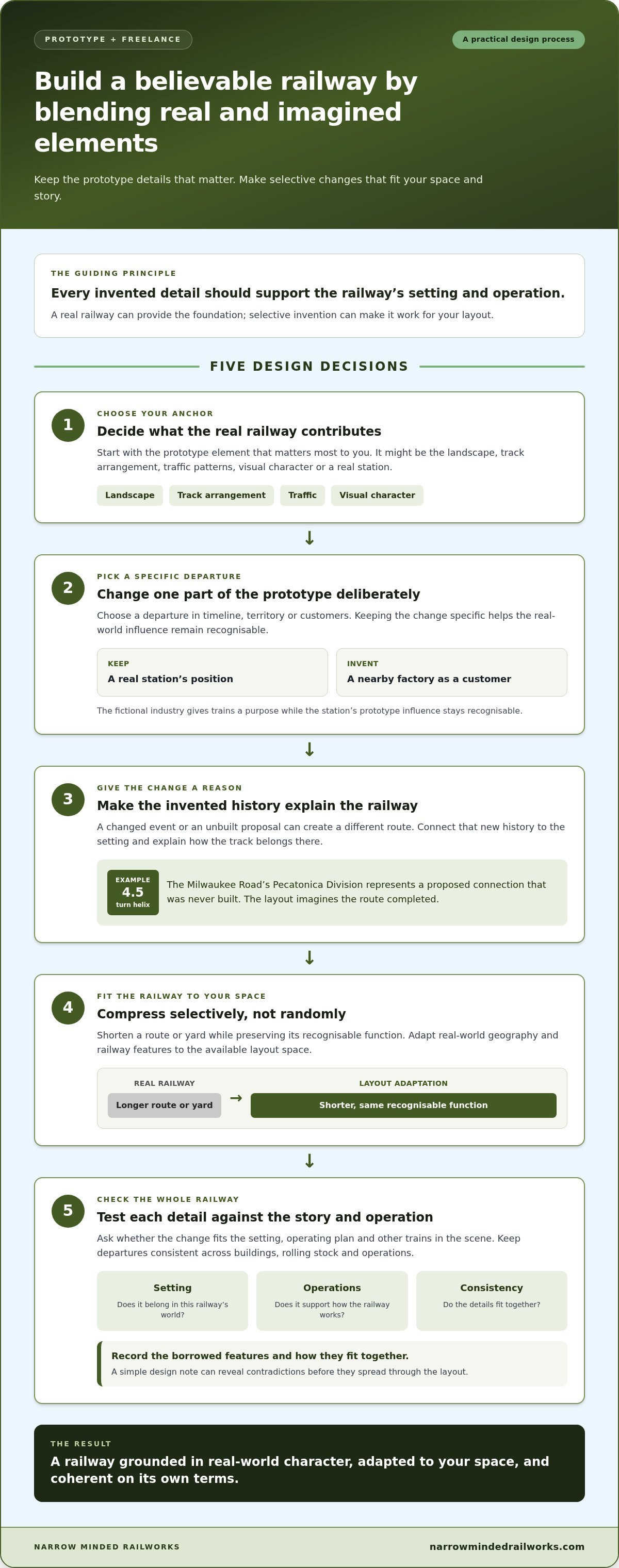
A railway becomes proto-freelance when its creator changes aspects of a prototype, such as its timeline, territory or customers. The distinction between freelance vs prototype modelling becomes less rigid when a real railway provides the basis for selective invention. The key is to make every change believable within the railway’s world. A real company can provide the visual and operational foundation, while an imagined event explains a different route.
The Milwaukee Road’s Pecatonica Division offers one way to approach this. Its layout represents a proposed connection that was never built, using a 4.5-turn helix. A modeller can take a documented proposal as a starting point, then imagine the route being completed. The invented history should explain the change and connect the new track to the setting.
Start with the prototype element that matters most to you, such as the landscape, track arrangement or traffic. Then choose a specific departure from it. For example, retain a real station’s position but invent a nearby factory as a customer. This fictional industry gives trains a purpose while keeping the station’s prototype influence recognisable.
Selective compression adapts a larger railway to the space available. Turn a long route into a shorter sequence of scenes, or reduce a large yard to its essential tracks and functions. Preserve the relationships that make the prototype legible, such as how trains enter the yard and reach its industries. Reduce features that don’t support those relationships.
Consider the consequences of every invented detail. A new customer affects freight movements; a changed junction can alter train meetings; a revised timeline can change the equipment. Record your decisions in a short layout brief, then compare buildings, rolling stock and operations against it. For a freelance vs prototype modelling project, revise any feature that conflicts with the brief or give it a stronger fictional explanation.
This method makes design choices purposeful without limiting creative freedom. Use a real railway to guide the structure, then make carefully chosen changes to give the layout its own identity.
What is prototype modelling, and what industries use it?
In model railways, prototype modelling aims to reproduce a real railway as accurately as practical. The modeller chooses a particular railway, location and period, then uses evidence to guide the layout. That evidence can include old maps, photographs and timetables. For example, Tony Koester models the Nickel Plate Road’s St. Louis Division as it appeared in 1954.
This approach suits layouts that aim to represent a recognisable railway and its operations. A chosen location helps determine track arrangements, buildings and surrounding scenery, while the period informs which trains and equipment belong. If you’re modelling a specific branch line, for instance, local maps can show how its stations and industries relate to the track.
Here, prototype modelling means model railways, not a particular UK employment sector. Its practical focus is research and representation: identify the real subject, gather relevant records, then decide which features define its character. Timetables can inform train movements, while photographs can guide building shapes, signs and scenery. Comparing sources helps keep details consistent with the same place and period.
Exact reproduction also has physical limits. A real railway’s route or yard may be too extensive for your layout space. Selective compression lets you shorten the subject by retaining its defining features and reducing less essential distances or structures. The aim is to preserve the railway’s recognisable arrangement, not reproduce every metre of track at full scale.
For a first project, choose a railway scene with records that answer practical design questions: where the line runs, what serves it, and how trains operate. Then use those details to guide track, structures and rolling stock. If your chosen scene involves narrow-gauge railways, explore narrow-gauge modelling options for related project ideas.
Prototype model railroading aims to replicate real-world railways as accurately as possible. The real railway is the reference for decisions about track, structures and equipment. When space is limited, choose the features that best preserve its identity.
Narrow Minded Railworks: OO9 Locomotive & Wagon Kits
Narrow Minded Railworks offers model railway kits and scenery for enthusiasts developing prototype-inspired or fictional layouts. Its OO9 Locomotive & Wagon Kits can help you add narrow-gauge railway subjects to a layout, while GN15 Locomotive & Scenery Kits provide another scale option for shaping a distinctive setting.
For other project requirements, the range also includes O-16.5 / 7mm Scale Kits and Diorama Tools & Scenery. These categories can support different layout approaches, from representing a real railway to building an imagined scene. Choose according to the scale and elements your project calls for.
Explore Narrow Minded Railworks’ model railway kits and scenery to find parts for your next layout.
Shape your next railway project
Start your next layout with one clear decision: which real-world details matter most, and where would creative freedom make the project more personal? Set that direction before choosing scenery, structures or rolling stock. It gives each later choice a purpose while leaving room to refine the plan as the railway develops.
Your approach to freelance vs prototype modelling can evolve over time. You might start with a real railway, then introduce an imagined customer or altered route when the layout needs a stronger story. Treat these changes as design choices, not as a test of whether your railway fits a label.
If you’re planning a narrow-gauge layout and want to discuss suitable kits, contact Narrow Minded Railworks. A focused conversation can help you consider how your project’s scale and direction connect with its available model railway kits. Choose the approach that keeps you curious, then take the next step at a pace that suits your build.
Frequently Asked Questions
How do freelance modelling and prototype modelling differ?
Prototype modelling uses a real railway as its reference, while freelance modelling lets you invent the railway’s identity and history. A prototype modeller might reproduce a real station’s track arrangement; a freelance modeller could design a fictional station around the trains and industries they want to feature. You can also combine the approaches, keeping some real-world details and inventing others.
What UK contracts, tax rules and insurance apply to freelance models and prototype modellers?
For paid work in the UK, a written contract can set out the model or layout, scope, deadlines, payment terms, revisions and ownership. Tax treatment depends on how the work is organised and earned; insurance needs depend on the work, equipment and exposure to third-party claims.