

For the dedicated narrow gauge modeller, the term 'complete kit' promises a streamlined path from box to track. Yet, the reality is often a frustrating search for separate wheels, bearings, and couplings. This guide redefines what a 'complete' OO9 wagon means in 2026, showing you how to combine a high-detail body kit with the right components to create truly exceptional rolling stock, eliminating the guesswork and getting you back to building what you love.
What Defines a 'Complete' OO9 Wagon Project?
In the world of specialist narrow gauge modelling, a "complete OO9 wagon kit with wheels" is often more of a project than a single product. While mainstream manufacturers might offer all-in-one plastic kits, the finest and most interesting prototypes come from specialist producers. These kits typically provide a high-fidelity body, leaving the choice of running gear to the modeller. This approach offers superior flexibility and quality. Let's break down the essential components you'll need to assemble for a genuinely 'complete' wagon.
A successful project must bring together the body, chassis, wheels, bearings, and couplings into a single, smooth-running vehicle. This guide focuses on turning a 'body kit' or 'scratch-aid' into a complete model that performs flawlessly on your layout. The OO9 scale, representing 4mm to the foot on 9mm track, is unforgiving of poor tolerances. Every component must be chosen with precision in mind to ensure your miniature trains run as well as they look.
The 'Everything You Need' Checklist
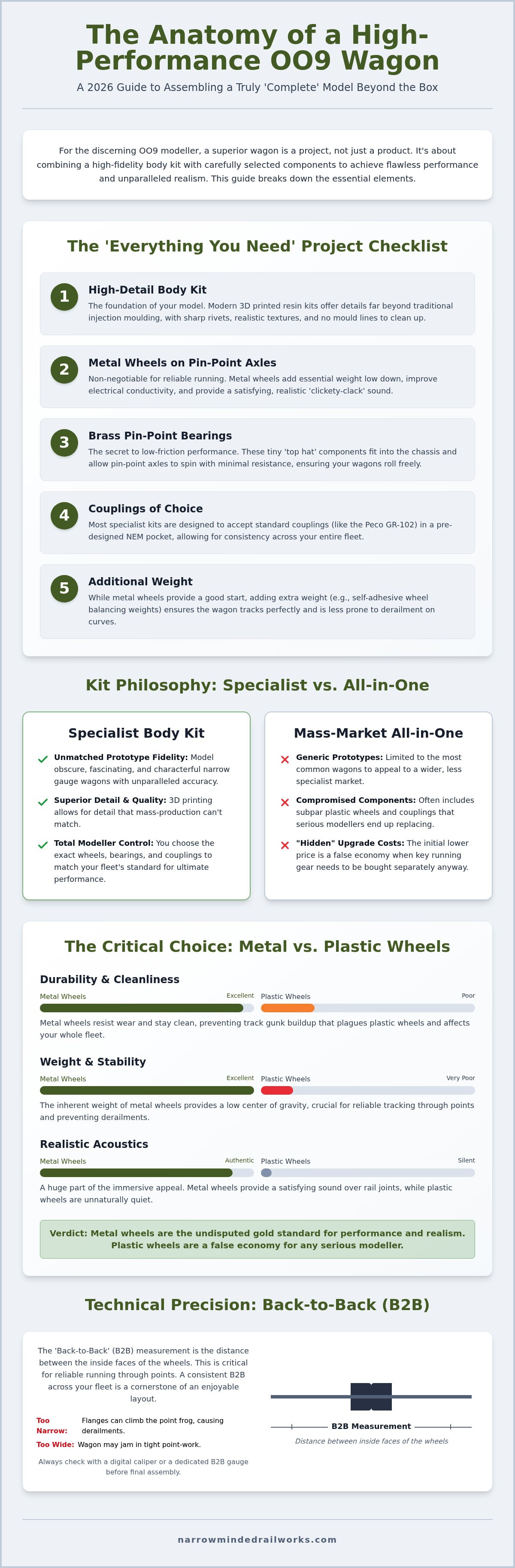
To begin your project, you will need to source several key items to complement your wagon body kit. Here is the definitive checklist for a superior, free-rolling wagon:
- A High-Detail Body Kit: This is your foundation. A modern 3D printed resin kit provides detail far beyond what traditional injection moulding can achieve, with sharp rivets, realistic wood grain, and no mould lines to clean up.
- Metal Wheels on Pin-Point Axles: This is non-negotiable for reliable running. Metal wheels add essential weight low down, improve electrical conductivity for track cleaning, and provide the satisfying 'clickety-clack' sound that brings a layout to life.
- Brass Pin-Point Bearings: These tiny 'top hat' shaped components are the secret to low-friction performance. They fit into the chassis or solebars and allow the pin-point axles of your wheelsets to spin with minimal resistance.
- Couplings of Choice: Most kits are designed to accept a standard coupling, such as the Peco GR-102, often fitting into a pre-designed NEM pocket. This allows for fleet consistency.
- Additional Weight: While metal wheels provide a good start, adding extra weight (like self-adhesive wheel balancing weights or liquid gravity) ensures the wagon tracks perfectly and is less prone to derailment.
Body Kits vs. All-in-One Solutions
Why would a modeller choose a body kit over a so-called 'complete' kit from a larger manufacturer? The answer lies in prototype fidelity and quality. Large companies must appeal to a mass market, often producing generic or highly popular wagons.
Specialist producers, using the flexibility of 3D printing, can create kits for obscure, fascinating, and characterful narrow gauge prototypes that would never be commercially viable for mass production. This allows you to model a specific Welsh slate quarry or a quirky industrial line with unparalleled accuracy.
While a body-only kit appears to have 'hidden costs', this approach gives you, the modeller, ultimate control. You can choose the exact wheel standard, bearing type, and coupling that matches the rest of your fleet. This prevents the costly exercise of replacing subpar plastic wheels and couplings included in a cheaper, all-in-one box, ensuring a higher standard of performance from the outset.
The Technical Heart: Wheels, Axles, and Smooth Running
The performance of any OO9 wagon is dictated entirely by its running gear. A beautifully detailed model is useless if it wobbles, sticks, or constantly derails. This is why selecting the right wheels, axles, and bearings is the most critical technical decision you will make when building your rolling stock.
For 2026, metal wheels are the undisputed gold standard. They add crucial low-slung weight, which is essential for stability, especially on the tight curves common to narrow gauge layouts. This weight helps prevent 'stringlining', where a light wagon in the middle of a long train is pulled sideways off the track on a curve. Furthermore, metal wheels are far easier to clean and help maintain better electrical contact for locomotives, even on DC layouts.
Metal vs. Plastic Wheels: The Final Verdict
While plastic wheels may lower the initial cost of a product, they are a false economy for any serious modeller. Here’s a direct comparison:
- Durability and Cleanliness: Plastic wheels are softer than metal and accumulate dirt and 'track gunk' at an alarming rate. This grime builds up, causing poor running and depositing itself back onto your track, creating problems for your entire fleet. Metal wheels stay cleaner for longer and are more resistant to wear.
- Weight and Stability: As mentioned, the inherent weight of metal wheels is a significant advantage. A wagon with metal wheels has a lower, more stable centre of gravity, making it track more reliably through complex point-work and uneven track.
- Acoustics: The sound of a model railway is a huge part of its immersive appeal. Plastic wheels are nearly silent, whereas metal wheels produce a satisfying and realistic sound as they move over rail joints, adding another layer of realism to your operating sessions.
Understanding Back-to-Back Measurements
The 'back-to-back' (B2B) measurement is the distance between the inside faces of the wheels on an axle. This dimension is critical for reliable running through points and crossings. If the B2B is too narrow, the wheel flanges can climb the point frog and derail. If it's too wide, the wagon may jam in the point-work.
Most commercially available OO9 wheelsets come pre-gauged to a standard that works well with Peco trackwork, the de facto standard for the scale. However, it is always best practice for the modeller to have a digital caliper or a dedicated back-to-back gauge. A quick check before final assembly can save hours of frustrating derailment-chasing later. Ensuring all your wagons have a consistent B2B measurement is a cornerstone of building a reliable and enjoyable layout.
3D Printed Resin vs. Injection Moulded Plastic Kits
A common concern among modellers unfamiliar with modern 3D printing is the perceived fragility of resin. The myth that resin kits are delicate "shelf queens" is firmly outdated. The engineering-grade resins used in 2026 are tough, slightly flexible, and more than capable of withstanding the rigours of regular layout use, including the occasional accidental drop.
The primary advantage of 3D printing is the staggering level of detail it can reproduce. Because the model is built up in microscopic layers, it's possible to create details like bolt heads, wood grain, and fine lettering that are far sharper and more delicate than what can be achieved with a traditional two-part steel mould. Furthermore, 3D printed kits do not suffer from issues like 'flash' (excess plastic leaking from the mould) or mould lines, which must be painstakingly scraped and sanded away on conventional plastic kits. For an in-depth look at the process, our guide on assembling 3D printed model railway kits provides a comprehensive overview.
The Evolution of 3D Printing in Modelling
Not long ago, 3D prints were plagued by visible layer lines that required significant sanding and filling to achieve a smooth finish. Today's technology, particularly with 8K and 12K resolution resin printers, has made this a problem of the past. The surface finish of a high-quality print is now virtually indistinguishable from injection-moulded plastic, providing a perfect canvas for painting and weathering.
Before painting, it is essential to prepare the resin surface. All 3D prints should be gently washed in warm, soapy water and scrubbed with a soft toothbrush to remove any residual mould-release agent or uncured resin. This simple step ensures that your primer and paint will adhere perfectly, giving you a professional and long-lasting finish.
Durability and 'Layout Longevity'
Modern photopolymer resins are designed for durability. While they can be drilled and sanded just like plastic, they are often stronger at points of detail. Many 3D printed kits are designed as one-piece bodies, which eliminates weak glue joints and creates a much more robust structure than a multi-part plastic kit. Modern resins also have excellent UV stability, meaning they will not become brittle or warp over time, even in a sunlit hobby room. When handled with reasonable care—the same care you would give any fine-scale model—a 3D printed wagon will provide a lifetime of service on your layout.
Choosing the Right Wagon for Your Narrow Gauge Era
Building a believable narrow gauge scene is about more than just smooth-running wagons; it's about telling a story. The type of rolling stock you choose is central to that narrative. Are you modelling a bustling Welsh slate quarry, a rural agricultural line, or a colonial sugar cane railway? Each has its own distinct and characterful wagons.
Rolling stock can be broadly divided into 'Common Carrier' wagons, which were used on lines that served the general public, and 'Internal' user wagons, which were specific to an industrial process like a quarry or mine. Mixing these types can create a wonderfully realistic and 'lived-in' feel for your railway. To explore different prototypes and settings, consider reading our complete beginner's guide to getting started with OO9 model railways.
Industrial vs. Passenger-Rated Wagons
The aesthetic of an industrial wagon is one of hard work and minimal maintenance. These were tools, and their appearance should reflect that. Modellers can take great joy in applying heavy weathering, rust effects, dents, and grime to create a fleet of unique and battered wagons. At the other end of the spectrum, any wagons used in passenger service, even on the smallest of lines, would have been kept in a much cleaner and more presentable condition.
Don't forget the humble brake van. Almost every train would require one for safety, and they provide a fantastic opportunity for adding specific detail and character to your train formations, known as 'consists'.
Coupling Standards and Compatibility
The 'industry standard' coupling for OO9 is the Peco GR-102, which represents the hook-and-loop couplings found on many British narrow gauge lines. Most specialist kits are designed with mounting points or NEM pockets compatible with this standard. However, it may not be suitable for all prototypes.
For example, many quarry railways used dumb buffers and simple chain couplings. Modellers seeking ultimate fidelity might opt for more discreet aftermarket couplings. Our guide to Quarry Hunslet couplers explores one such alternative. Whatever system you choose, the key is consistency. Ensuring all your couplings across your entire fleet are mounted at the same height is essential for reliable, hands-free operation.
Why Our Body Kits are the Perfect Foundation
While we acknowledge that our kits require the modeller to source wheels and couplings, we have taken this approach deliberately. Our philosophy is to provide the best possible starting point—a highly detailed, accurate, and robust wagon body—while giving you the freedom to finish it with the high-performance components of your choice.
We focus our expertise on what we do best: meticulous research, precision 3D design, and engineering prints that form the perfect foundation for your project. This prevents you from paying for subpar components that a seasoned modeller would likely replace anyway.
Designed by Modellers, for Modellers
Our background is in the hobby itself. This means we understand the small details that make a kit a pleasure to build. Our designs incorporate features to make assembly straightforward, such as pre-cleared holes for bearings, NEM pockets for easy coupling installation, and one-piece body designs for maximum strength. Every single kit undergoes a rigorous testing process on our own 'torture track' layouts to ensure it not only looks right but also performs correctly once assembled with standard components.
We believe in supporting your entire modelling journey. That’s why we create extensive guides and resources to help you with every stage of the build, from initial assembly to advanced weathering. For a broader look at the parts that make up the hobby, see our complete guide to narrow gauge parts and kits.
Global Shipping and Local Support
From our base in the UK, we ship our range of unique prototypes to the narrow gauge community around the world. We take great care in packaging to ensure your kits arrive safely, wherever your layout may be. Our commitment to customer service is absolute; in the unlikely event a part is missing or has been damaged in transit, we will replace it without question.
By choosing a Narrow Minded Railworks kit, you are not just buying a model; you are joining a community of passionate modellers who value precision, detail, and the unique charm of the world's narrow gauge railways.
Frequently Asked Questions (FAQs)
- Do your kits include wheels and couplings?
- Our kits do not include wheels or couplings. We provide the high-detail body and chassis, allowing modellers to use their preferred brand of wheels (we strongly recommend metal) and couplings to maintain consistency with their existing rolling stock.
- Do I need special glue for a 3D printed resin wagon kit?
- Standard superglue (cyanoacrylate) or a two-part epoxy resin works perfectly for assembling resin kits and attaching any separate details.
- Can I use these OO9 wagons on standard N gauge track?
- Yes. OO9 scale uses the same 9mm track gauge as N gauge, so they are perfectly compatible. Your OO9 rolling stock will run happily on any N gauge track from manufacturers like Peco or Kato.
- What tools are essential for building a complete OO9 wagon kit?
- You will need a basic modeller's toolkit, including a craft knife, fine tweezers, superglue, a set of small files or sanding sticks, and a pin vice drill for cleaning out any holes.
- How do I remove the support marks from a 3D printed wagon body?
- Support marks, which look like tiny nibs, can be carefully removed with a sharp craft knife blade or gently sanded with a fine-grit sanding stick until the surface is smooth.
- Will these wagons fit through tight R1 (first radius) curves?
- Most of our shorter wheelbase wagon kits are designed to navigate first radius curves without issue. Longer wagons or bogie vehicles may require a larger radius for reliable running, which will be noted on the product page.
- Do I need to add extra weight to the wagons for reliable running?
- While using metal wheels provides a good base weight, we highly recommend adding extra weight. Self-adhesive car wheel balancing weights, lead shot, or products like 'Liquid Gravity' secured inside the wagon body will significantly improve tracking and stability.