

A beautifully detailed GN15 locomotive kit is merely a static shelf ornament if it lacks a reliable heart to drive it. Many modellers encounter the frustration of investing in an expensive donor power unit only to discover the wheelbase fails to align with their 3D printed body shell. While the variety of scales used in this hobby can make choosing the right chassis for gn15 feel confusing, a systematic approach ensures your "critter" runs as smoothly as it looks. We understand that technical specifications across HO and On30 scales often conflict; however, identifying the correct donor is the most critical step in your build.
This guide provides a definitive selection of 2026 chassis options, including the Bachmann HO S4 and the reliable Tenshodo "spud" motor bogies. Although we focus on providing high-quality GN15 locomotive and scenery kits rather than the internal motors themselves, we're committed to helping you source the best external components for a successful build. You'll learn how to measure a kit with confidence and select a mechanism that eliminates stall-prone running at low speeds. By following this structured guide, you can transform a resin kit into a high-performing locomotive for your micro layout.
Key Takeaways
- Understand the unique geometry of GN15 modelling and why external donor chassis provide the most reliable power for niche scale kits.
- Master the critical measurement steps for choosing the right chassis for gn15 by aligning internal kit dimensions with donor wheelbase centers.
- Explore the performance characteristics of popular 2026 mechanisms, including the Hornby 0-4-0 and Bachmann On30 units, for various locomotive sizes.
- Evaluate essential technical factors like slow-speed gearing and wheel pickup reliability to ensure your industrial models operate as well as they look.
- Access specific chassis recommendations tailored for the Narrow Minded Railworks GN15 kit range to simplify your next build project.
The GN15 Chassis Dilemma: Why the Foundation Matters
GN15 is a unique niche that combines the impressive size of G scale (1:22.5) with the compact footprint of 16.5mm track. This specific GN15 model railroading scale allows modellers to create detailed industrial scenes in limited spaces. Because major manufacturers don't produce ready-to-run GN15 locomotives, hobbyists must rely on body kits designed for third-party power units. This limitation can feel daunting to newcomers; however, it actually provides the creative freedom to select a mechanism that fits both your budget and your desired performance profile.
To see how these components come together in a precision design, watch this demonstration:
Successfully choosing the right chassis for gn15 requires a "bottom-up" mindset. It's often tempting to purchase a stunning 3D printed body shell first. This approach often leads to compatibility issues where the motor or gears won't clear the internal resin walls. We recommend selecting your donor mechanism before even opening your kit box. This ensures you can adjust the body assembly to accommodate the specific dimensions of your motor, leading to a locomotive that runs reliably at the slow speeds required for narrow gauge operations.
Understanding the Scale-to-Gauge Relationship
The 16.5mm track gauge, typically used for OO and HO standard gauge models, represents roughly 15-inch narrow gauge in G scale. This relationship means you can repurpose widely available mechanisms from brands like Hornby or Bachmann. While these units are designed for smaller 1:76 or 1:87 scales, their robust motors are perfectly capable of moving the larger G scale bodies. The choice of chassis ultimately dictates the physical presence of your model. A short-wheelbase 0-4-0 mechanism creates a charming, agile industrial "critter." A longer diesel switcher unit provides the power needed for a heavy-haul estate railway engine.
Donor Chassis vs. Bespoke Power Bogies
Cost-effectiveness is a significant driver in 2026, making second-hand Hornby 0-4-0 models a popular starting point for entry-level builds. These mechanisms are simple to maintain and easy to fit into many industrial kits. For more specialized applications, such as small diesel shunters, you might consider self-contained power bogies like the Tenshodo "spud." These units offer a compact footprint that leaves more room for interior cab detail. While bespoke power units can be more expensive, they often provide the superior slow-speed gearing necessary for realistic shunting. Modellers should set realistic expectations. Kit-bashing requires patience and precision, but the result is a unique piece of rolling stock that standard manufacturing simply cannot match.
Essential Measurements for a Perfect Body-to-Chassis Fit
Precision is the difference between a smooth-running model and a frustrating workshop project. While many modellers focus on the exterior finish, the internal geometry determines the ultimate success of the build. When choosing the right chassis for gn15, you need to document the internal shell width, motor height, and wheelbase before committing to a donor unit. A mismatch of just a few millimeters can prevent the body from seating correctly or cause the gears to bind against the resin walls. Establishing these metrics early allows you to select a mechanism that provides both a perfect scale appearance and mechanical reliability.
The Internal Void: Measuring Your Resin Shell
Resin kits have fixed internal dimensions that cannot easily be altered without compromising the structural integrity of the model. You must find a mechanism that fits comfortably within these constraints. Use digital calipers to identify the narrowest point of the shell, usually near the center where the motor sits. Check the height from the track level to the underside of the cab roof to ensure the motor doesn't protrude into the viewing area. If you find a tight spot, a small amount of sanding can help, but it's better to choose a mechanism that fits naturally. Our GN15 locomotive range is designed for common donor units, but verifying the internal clearance remains a vital step for every builder.
Don't forget to account for 3D printing support remnants. These tiny resin nibs often hide in corners or along the ceiling of the shell. If you don't remove them with a sharp hobby knife or file, the chassis may sit at an angle. This leads to poor electrical contact and an uneven scale height. Measure the width of the chassis block itself, ensuring it's at least 0.5mm narrower than the internal shell walls to allow for natural expansion and motor vibration.
Wheelbase and Overhang Considerations
The distance between axle centers is your most vital metric for visual accuracy. It must match the cosmetic axle boxes or wheel arches on the body kit. If the wheels sit too far forward or back, the locomotive's weight distribution looks incorrect. Beyond aesthetics, the wheelbase affects how your locomotive handles trackwork and layout geometry. Consider these factors during your measurement phase:
- Curve Radius: Short wheelbases (under 30mm) navigate tight industrial curves and micro-layouts with ease.
- Stability: Longer wheelbases provide more stability and better electrical pickup but might require a larger minimum radius.
- Clearance: Check that the chassis ends don't interfere with the coupler mounting points or buffer beams on the kit.
Finally, verify the wheel diameter. G scale models are large, and using tiny wheels on a GN15 "critter" can make it sit too low to the ground. This can cause the buffer beams to catch on point frogs or uncoupling ramps. Aim for a wheel size that keeps the locomotive at a consistent scale height relative to your rolling stock, ensuring the entire train looks cohesive on the track.
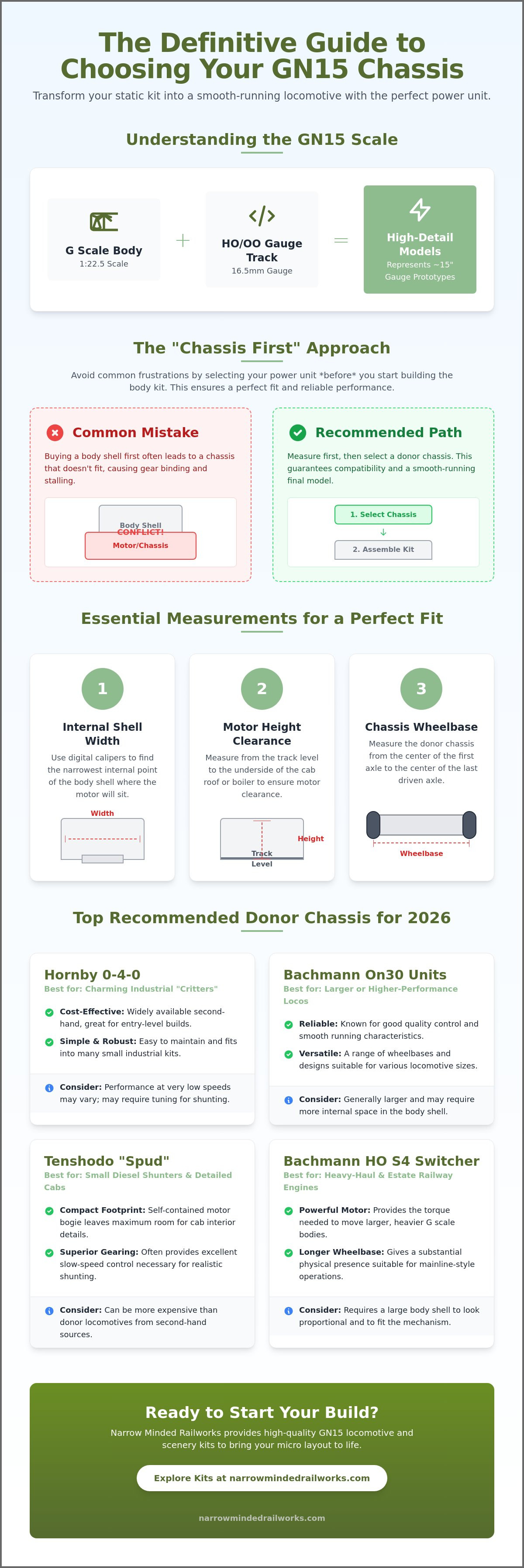
Top Recommended Donor Chassis for GN15 in 2026
Identifying a reliable power source is the most significant hurdle once you've established your build's dimensions. While the market has shifted toward specialized 3D printed components, several commercial mechanisms remain the preferred choice for their availability and proven track records. When choosing the right chassis for gn15, you must weigh the benefits of a brand-new unit against the affordability of pre-owned models. In 2026, many modellers find success by sourcing older OO gauge models through online marketplaces or hobby fairs, provided they inspect the motor brushes and wheel cleanliness before installation.
The 'Classic' OO Gauge Donors
The Hornby 0-4-0 mechanism, found in the "Smokey Joe" and Holden Tank models, is often the first recommendation for beginners. These units are robust and straightforward to maintain. Their simple design allows for easy modification of mounting lugs to fit inside a resin shell. However, they can be somewhat fast-geared, requiring a high-quality controller for smooth industrial shunting. The Bachmann Junior range offers a similar entry-level solution, though these are becoming harder to find as new stock. If you're building a larger locomotive, Bachmann On30 mechanisms provide a heavier alternative with superior pulling power, though their larger footprint requires a more spacious body shell.
Modern Small-Scale Mechanisms
For those building "minimum space" or micro-layouts, N-gauge power units offer a surprisingly effective solution. The Kato 11-103 and 11-109 power bogies have become favorites in 2026 for tiny industrial "critters." These units utilize modern coreless motors that provide exceptional slow-speed performance and near-silent operation. While they are lighter than OO gauge donors, you can improve their electrical pickup by adding lead or tungsten weight inside the locomotive body. This extra mass ensures the wheels stay in firm contact with the 16.5mm rails, even over uneven pointwork.
Beyond traditional ready-to-run donors, we're seeing a rise in specialized 3D-printed chassis frames designed to house standard 12v motors and gears. These allow for a bespoke fit that matches the exact wheelbase of our GN15 locomotive range. When choosing the right chassis for gn15, consider whether you prefer the "plug-and-play" nature of a commercial unit or the flexibility of a custom-built frame. Regardless of your choice, prioritizing a mechanism with reliable wheel pickups will save you hours of frustration during the running-in phase of your model.
- Hornby 0-4-0: Best for budget builds and beginners.
- Bachmann On30: Ideal for heavy-duty estate railway engines.
- Kato 11-103/109: The gold standard for slow-speed industrial shunters.
- Custom 3D Frames: Best for advanced modellers requiring specific wheelbases.
Performance Factors: Beyond the Physical Fit
A chassis that matches your body shell's internal dimensions is only half the battle. When choosing the right chassis for gn15, you must also evaluate how that mechanism behaves at crawling speeds. Industrial narrow gauge railways aren't known for high-speed transit; they rely on slow, deliberate movements for shunting heavy loads. If your donor chassis is geared for an express passenger train, it will likely ruin the scale effect of your model. We recognize that finding the perfect balance between power and pace can be difficult. However, selecting a unit with high reduction gearing solves this problem before you even start the assembly.
Gearing and Shunting Performance
Many OO gauge donor units are designed for standard gauge prototypes that travel at significant scale speeds. When these motors are placed under a G scale body, the "racing" effect becomes jarring. To achieve realistic movement, look for chassis with a high gear ratio. This allows the motor to spin at a high RPM while the wheels move slowly, providing the torque needed to haul a string of heavy wagons. If you've already purchased a fast-geared motor, you can often mitigate the issue by using a specialized low-voltage controller or adding resistors to the circuit. Starting with a dedicated slow-speed mechanism remains the most effective way to ensure your locomotive has the "soul" of an industrial workhorse.
Electrical Pickups and Reliability
Reliability on the track is non-negotiable, especially on micro-layouts with frequent pointwork. A four-wheel chassis is the standard for most GN15 builds, but it offers fewer points of electrical contact than a six-wheel unit. If you're building a smaller engine, we recommend carefully cleaning and adjusting the pickup wipers on your donor unit to maximize contact. For those struggling with stalling on dirty track, adding a "stay-alive" capacitor or a small flywheel can provide the necessary momentum to bridge dead spots. While we don't sell these specific electronic components, our GN15 Locomotive & Scenery Kits are designed with enough internal volume to house these performance-enhancing upgrades.
Space is often at a premium in 2026, yet the demand for sound and realistic control continues to grow. When measuring your shell, account for the volume required for a decoder and a small sugar-cube speaker. A well-chosen chassis should leave enough room in the internal void for these additions without obstructing the motor's cooling. By prioritizing electrical reliability and realistic gearing, you ensure your locomotive operates with the same level of detail that you've put into its exterior finish. This technical foundation is what transforms a static kit into a functional part of your layout's ecosystem.
Pairing Your Chassis with Narrow Minded Railworks Kits
Selecting the ideal mechanism is a significant milestone, but the final integration requires careful handling to ensure long-term durability. The Narrow Minded Railworks GN15 range is specifically designed to accommodate the most reliable donor units available in 2026. While resin shells offer exceptional detail, they require a thoughtful mounting strategy to prevent damage to either the body or the motor. By following a structured pairing process, you can ensure that choosing the right chassis for gn15 results in a professional-grade model that is easy to service.
Our Top Pairings for 2026
Our "Industrial Shunter" kit is optimized for the Hornby 0-4-0 wheelbase, providing a classic "critter" silhouette that handles tight curves with ease. If you're building one of our larger Tram Loco bodies, we recommend utilizing Bachmann On30 or HO diesel mechanisms for their superior weight and pulling power. We understand that some modellers may wish to use rarer or vintage donor units that don't perfectly align with standard mounting points. To solve this, we provide 3D printed mounting brackets that can be adjusted or shimmed to create a custom fit without the need for messy adhesives. This modular approach keeps the chassis removable, which is essential for lubricating gears or replacing motor brushes.
Securing the Body to the Chassis
Before committing to a permanent fix, use a small amount of Blu-Tack to temporarily hold the body in place. This allows you to test the balance of the locomotive on your track and ensure the wheels aren't catching on the internal wheel arches. Once you're satisfied with the position, we advocate for mechanical fastening using small self-tapping screws. While glue is a faster option, it makes future motor maintenance nearly impossible and can lead to resin cracking if the motor generates heat. If your chosen donor unit lacks screw holes, our mounting brackets can be bonded to the shell, allowing the chassis to "clip" into place securely.
After the mechanical fit is verified, the final step involves preparing the resin surface for its aesthetic transformation. Ensure all fingerprints and oils from the chassis fitting process are removed with a gentle wash in warm, soapy water. Once dry, you can move from the technical phase of the build to painting and finishing your model. This transition from a raw kit to a weathered, working locomotive is where your effort in choosing the right chassis for gn15 truly pays off, resulting in a unique piece of narrow gauge history for your layout.
Bringing Your Industrial Narrow Gauge Vision to Life
Building a successful GN15 locomotive depends on the harmony between a detailed body shell and a reliable mechanism. By prioritizing precise internal measurements and selecting a donor unit with appropriate slow-speed gearing, you ensure your model performs with industrial realism. We understand that technical specifications across different scales can be intimidating; however, starting with a proven mechanism simplifies the entire assembly process. Mastering the art of choosing the right chassis for gn15 is the final hurdle before you can enjoy the creative rewards of painting and weathering your unique "critter."
At Narrow Minded Railworks, we support your modelling journey with expertly designed 3D printed resin shells and detailed compatibility guides for every loco kit we produce. Whether you're building a tiny shunter or a heavy estate engine, our components provide a precise foundation for a high-quality build. We provide worldwide shipping for narrow gauge modellers, ensuring you have access to premium kits regardless of your location. Explore our range of GN15 kits designed for popular chassis and take the first step toward a smoother-running layout. Your next project is just a few measurements away from becoming a functional, reliable piece of your miniature world.
Frequently Asked Questions
Can I use an N gauge chassis for a GN15 locomotive?
You can use an N gauge power unit, but it typically requires regauging or a custom frame to fit 16.5mm track. While the motors are excellent for small industrial "critters," the wheel width is too narrow for standard GN15 rails. You can solve this by mounting the N gauge motor into a wider 16.5mm underframe. Most builders find it more efficient to start with an HO or OO mechanism that matches the track gauge natively.
What is the best donor chassis for a beginner in GN15?
The Hornby 0-4-0 mechanism is the most practical choice for beginners choosing the right chassis for gn15 due to its simplicity. These units are widely available and fit perfectly under many industrial body shells. You might find the gearing a bit fast for realistic slow-speed shunting, but using a high-quality controller helps manage the pace. It's a reliable way to learn kit-bashing basics without risking a complex or expensive mechanism.
How do I measure my kit to ensure a chassis will fit?
Measuring your kit requires digital calipers to verify the internal width and height of the resin shell. You must document the narrowest points around the motor area to ensure the chassis doesn't bind. Comparing these metrics against the donor motor's physical footprint prevents the body from sitting too high. Always measure from axle center to axle center to ensure the wheels align with the cosmetic axle boxes on your kit.
Is it hard to convert a DC chassis to DCC for GN15?
Converting a DC chassis to DCC is manageable if you have basic soldering skills and enough internal space. You'll need to isolate the motor from the chassis frame to prevent short circuits before installing the decoder. While we don't supply DCC components, our GN15 kits often include enough room in the cab for small decoders. Always ensure the motor's stall current doesn't exceed the decoder's capacity to avoid damaging the electronics.
Why is my GN15 locomotive stalling on points?
Stalling on points often results from a short wheelbase failing to bridge the non-conductive gaps in the trackwork. If your locomotive stops frequently, check for dirt accumulation on the wheels or oxidized rails. You can improve performance by adjusting the pickup wipers for firmer contact or adding weight to the chassis. Many modellers resolve this by installing stay-alive capacitors, which provide temporary power to move the engine across dead spots.
Where can I buy reliable donor chassis in 2026?
You can find reliable donor mechanisms through online marketplaces or specialized hobby shops that stock HO and OO scales. In 2026, the second-hand market remains a cost-effective source for Hornby and Bachmann units through private traders and hobby exhibitions. If you're looking for new power units, specialized manufacturers like Carroll Creek offer underframes designed specifically for GN15. Always check the seller's description for motor health to ensure your kit has a dependable heart.
Do I need to modify the chassis weights to fit the kit?
You'll often need to trim or relocate chassis weights when choosing the right chassis for gn15 to ensure the body sits correctly. Some donor mechanisms have large metal blocks that conflict with the internal details of a resin kit. While removing weight can reduce traction, you can solve this by adding smaller tungsten weights in empty spaces. This approach maintains the locomotive's pulling power while allowing the body to fit perfectly over the frame.