


The original Festiniog Railway toastracks became flat wagons as well as passenger vehicles. In 1923, the railway bought six open toastrack coaches from Robert Hudson Ltd; by the end of the 1920s, four had been converted to flat wagons, while two remained in use in the mid-1930s. A 7mm scale Hudson toast rack wagon can therefore represent a vehicle with a changing working life, not just its original passenger role.
The appeal lies in the railway history: the open-sided coach design and the later reuse of its underframe tell two connected stories. To get the conversion right, understand what changed, what could be retained, and how the model’s form reflects its purpose.
This article traces the Hudson toastracks on the Festiniog Railway, explains how some became flat wagons, and looks at the details that help bring either version to life in 7mm scale. It also sets the railway’s original coaches in context, so you can make an informed choice about which stage of their history to model.
Key Takeaways
- Place the original Festiniog Railway toastracks in context: six were purchased in 1923, and their story includes both passenger use and later conversion.
- Learn what changed when toastracks became flat wagons, and which parts of their underframes help explain the conversion.
- Use the prototype dimensions to guide your model’s proportions, while keeping model scale distinct from the railway’s track gauge.
- Separate the historical purchase price from present-day model costs, and use the original numbering to inform a historically grounded version.
Which 7mm scale manufacturers sell Hudson toast rack wagons in the UK?
Robert Hudson Ltd of Leeds built the original Festiniog Railway toastracks. The railway purchased six open coaches in 1923, so Hudson is the maker associated with the historical prototype. That name identifies the full-size vehicles, not necessarily a present-day model kit or ready-to-run model. Keep the distinction clear when interpreting a product description or a historical account.
The original vehicles also connect to another wagon type. Their underframes were identical to those of WD type D open wagons, apart from the vacuum-brake fittings and bogies. This is a useful prototype reference when assessing a model of a converted toastrack. A wagon based on that frame relationship can represent the later goods role while retaining its underlying Hudson connection.
The Festiniog Railway’s conversion history helps explain why descriptions can vary. By the end of the 1920s, four of the six original toastracks had become flat wagons. Two remained in use in the mid-1930s. A listing might therefore describe a passenger coach, a flat wagon, or a model inspired by one stage of the vehicles’ working lives.
For a UK purchase, use these distinctions to assess what a listing actually represents:
- Prototype maker: Robert Hudson Ltd built the original coaches in 1923.
- Vehicle form: Compare an open-sided toastrack with a flat wagon converted from one of the original six.
- Frame reference: The WD type D relationship concerns the underframe, with vacuum brake fittings and bogies as the stated exceptions.
Boston Lodge provides a separate railway-building reference, rather than a commercial model-kit maker. Two modern open-sided toastracks were built there in 1971, followed by a third in 1992. Those dates help distinguish later Festiniog Railway carriages from the six Hudson coaches. A product’s maker, prototype subject and current model format are separate details; identifying each makes it easier to judge whether it suits the version you want to represent.
What are the dimensions and gauge of a 7mm scale Hudson toast rack wagon?
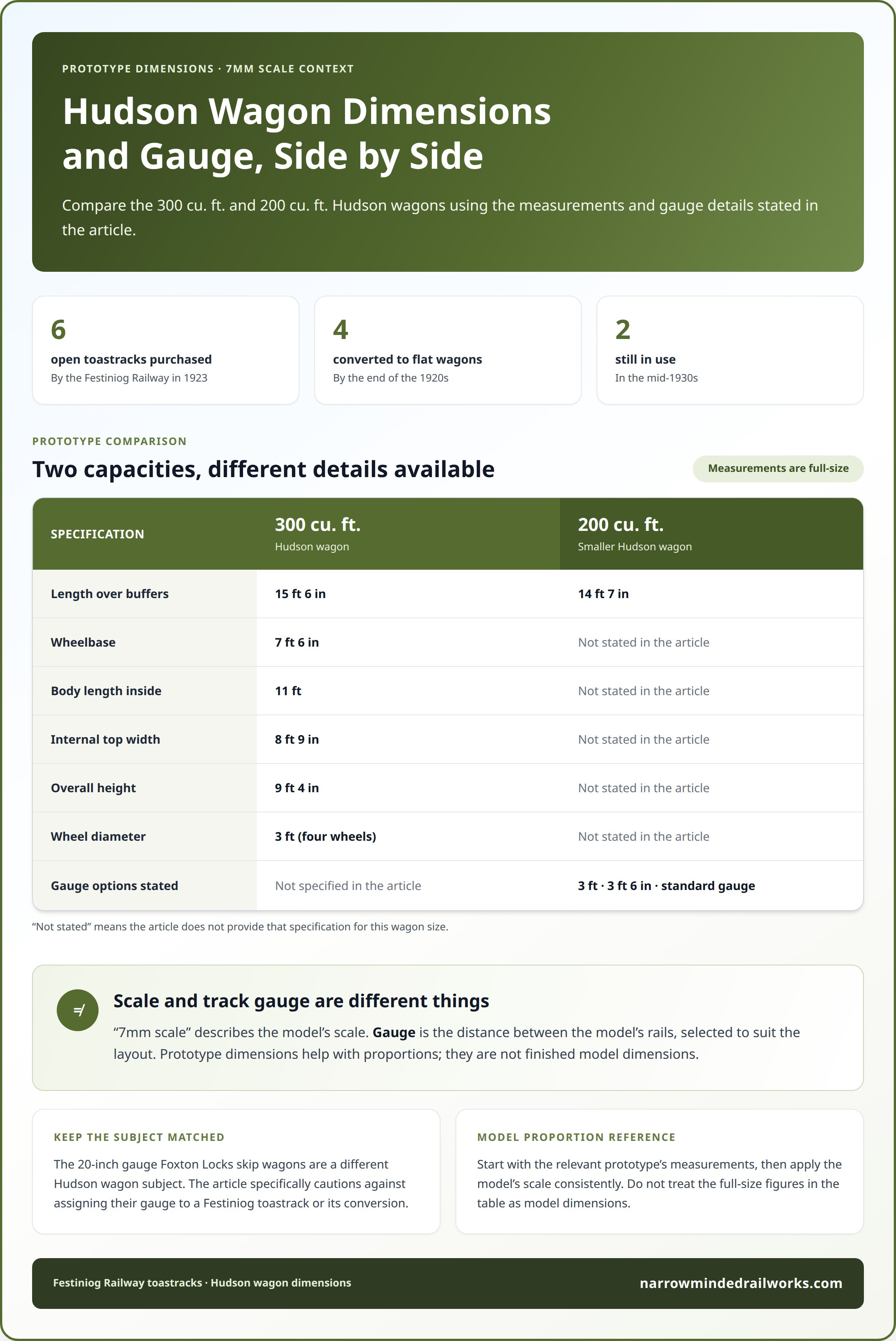
Prototype dimensions give a useful reference for proportions, but the gauge must be treated separately from the model’s scale. The 300 cu. ft. Hudson wagon had a 7 foot 6 inch wheelbase and measured 15 foot 6 inches over buffers. Its body was 11 foot long inside, with an internal top width of 8 foot 9 inches.
Height matters too. The 300 cu. ft. wagon stood 9 foot 4 inches overall, and its four wheels were each 3 foot in diameter. These measurements describe the prototype, not the finished model. Use them to compare the wagon’s relative length, width and height, rather than treating the full-size figures as model dimensions.
Hudson also offered a smaller 200 cu. ft. wagon. It measured 14 foot 7 inches over buffers and was available for 3 foot and 3 foot 6 inch gauges, as well as standard gauge. That range shows why “Hudson wagon” alone does not identify one track gauge. Match the intended prototype gauge to the particular vehicle being represented.
For a model, keep three measurements distinct:
- Scale: the model’s representation of full-size dimensions.
- Gauge: the distance between the model’s rails, chosen to suit its layout.
- Prototype size: measurements such as the 300 cu. ft. wagon’s wheelbase and body width.
The Foxton Locks skip wagons provide a useful caution: those Hudson wagons were 20-inch gauge, not two-foot gauge. They are a different wagon subject, so their gauge should not be assigned to a Festiniog toastrack or its conversion. For accurate proportions, start with the relevant prototype dimensions, then apply the model’s scale consistently. Explore model-building options for further 7mm-scale project inspiration.
How much does a 7mm scale Hudson toast rack wagon cost in the UK?
The historical price gives context, but it is not a present-day model price. That figure relates to full-size railway vehicles purchased by the railway, not a 7mm-scale model, kit or current UK retail price.
For a model purchase, the total depends on what the product includes and how it is supplied. A complete model, an assembly kit, and a project built from separate parts are different purchases. The description should make clear which format is offered. That distinction matters for a subject with two forms: an open-sided passenger toastrack and a flat wagon converted from one.
Before setting a budget, identify the version you want to represent. The Festiniog Railway bought six toastracks in 1923, and four had become flat wagons by the end of the 1920s. A kit or model depicting the passenger coach may differ from one representing the later wagon. Prototype details and the scope of the model affect which option suits your project.
Use this simple comparison when reviewing a UK listing:
- Subject: Is it an original-style toastrack or a converted flat wagon?
- Format: Does the purchase provide a kit for assembly or a finished model?
- Included parts: Which components are supplied, and which are separate?
- Historical fit: Does the represented version match the Festiniog Railway’s passenger or goods use?
These checks help distinguish a prototype’s historic value from a model’s retail cost. Compare like with like: a kit and a completed model may include different parts and require different amounts of work. Match those details to your planned build before deciding which option suits it.
Which liveries and numbering options are available for 7mm scale Hudson toast rack wagons
The six original Festiniog Railway Hudson toastracks provide a clear numbering basis: they carried numbers 37 to 42. That sequence gives six historically grounded identities for a model representing the original passenger coaches. Choose a number within that range, then keep it consistent with the vehicle’s role and period in your layout.
Numbering alone does not establish a livery. A number identifies a vehicle, while paint and lettering represent its appearance at a particular point in its working life. For a historically focused model, first decide whether it represents an open passenger toastrack or a later flat wagon. The Festiniog Railway’s records show both uses among the original vehicles.
Four toastracks had been converted to flat wagons by the end of the 1920s, while two remained in use in the mid-1930s. That change gives a practical guide to choosing a model’s presentation: a passenger coach and a goods wagon should not be treated as interchangeable simply because both relate to the original six. Avoid assigning a conversion to a specific number unless the history supports that pairing.
Use these steps to keep the model’s identity coherent:
- Select a vehicle: choose one number from the original range, 37 to 42.
- Set its role: decide whether it represents a toastrack coach or a converted flat wagon.
- Match the period: align the chosen role with the railway’s documented passenger and goods use.
- Apply the finish: use lettering and paint appropriate to the version being modelled, without treating the number as proof of a particular colour scheme.
This approach separates documented numbering from interpretation of appearance. A number such as 39 places the model within the original series, but the chosen body form still determines whether it depicts a coach or wagon. To develop a build around this railway subject, explore 7mm-scale modelling options.
Narrow Minded Railworks: OO9 Locomotive & Wagon Kits
Narrow Minded Railworks offers OO9 Locomotive & Wagon Kits and O-16.5 / 7mm Scale Kits for model railway projects. If the Festiniog Railway’s toastracks have inspired a build, these scale-focused offerings provide a relevant starting point for planning a narrow-gauge scene or wagon project.
The historical details in this guide can help shape your design decisions: choose whether to represent a passenger toastrack or a later flat wagon, then use the prototype’s dimensions and numbering as references. For a broader layout, GN15 Locomotive & Scenery Kits and Diorama Tools & Scenery can support related modelling work.
Contact Narrow Minded Railworks to discuss your model railway project.
Shape your next railway modelling project
A historically inspired build can become the starting point for a wider layout. Consider how a 7mm scale Hudson toast rack wagon would fit its setting: as a standalone model, part of a goods scene, or one element in a narrow-gauge railway. That choice can guide the surrounding scenery and help the finished project feel coherent.
If you’re planning a 7mm scale Hudson toast rack wagon project, Narrow Minded Railworks offers O-16.5 / 7mm Scale Kits, alongside OO9 Locomotive & Wagon Kits and GN15 Locomotive & Scenery Kits. These options can support related modelling interests while keeping your plans focused on narrow-gauge subjects.
Choose the part of the railway story you’d like to model next. Contact Narrow Minded Railworks to discuss your project and take the next step at a pace that suits your plans.
Frequently Asked Questions
What is a Hudson toast rack wagon in 7mm scale?
It is a model representing an open-sided Hudson railway vehicle, with its form shown at 7mm scale. The Festiniog Railway’s original toastracks were passenger coaches, although some underframes later served goods use. “Toastrack” describes the open-sided arrangement, while “Hudson” identifies the maker associated with the prototype. A model’s precise form depends on whether it depicts the passenger coach or a later wagon role.
Is the Hudson toast rack wagon available as a kit or ready-to-run model?
Narrow Minded Railworks sells model kits, not ready-to-run models. Its O-16.5 / 7mm Scale Kits are relevant to 7mm modelling, but a kit requires assembly and should not be mistaken for a finished model. The available business information doesn’t establish a specific Hudson toastrack kit, so distinguish the historical subject from the general scale-kit category when considering your project.
What railway companies and eras used the real Hudson toast rack wagon?
The original Hudson toastracks are associated with the Festiniog Railway, and surviving underframes also connect with later railway use. WHRL Coach No. 3 was built on a Hudson open-wagon chassis at Gelert’s Farm Works in 1980, then converted to a disabled coach in 2005. This example shows how a Hudson frame could continue in railway service beyond its original wagon configuration.
Where can I buy a 7mm scale Hudson toast rack wagon in the UK?
Narrow Minded Railworks sells O-16.5 / 7mm Scale Kits for UK model railway projects. This is the relevant range to explore for a 7mm-scale build, although a general scale-kit category should not be read as confirmation of a specific Hudson toastrack model. The key distinction is whether the item represents the prototype you want and whether it is supplied as a kit or a finished model.