


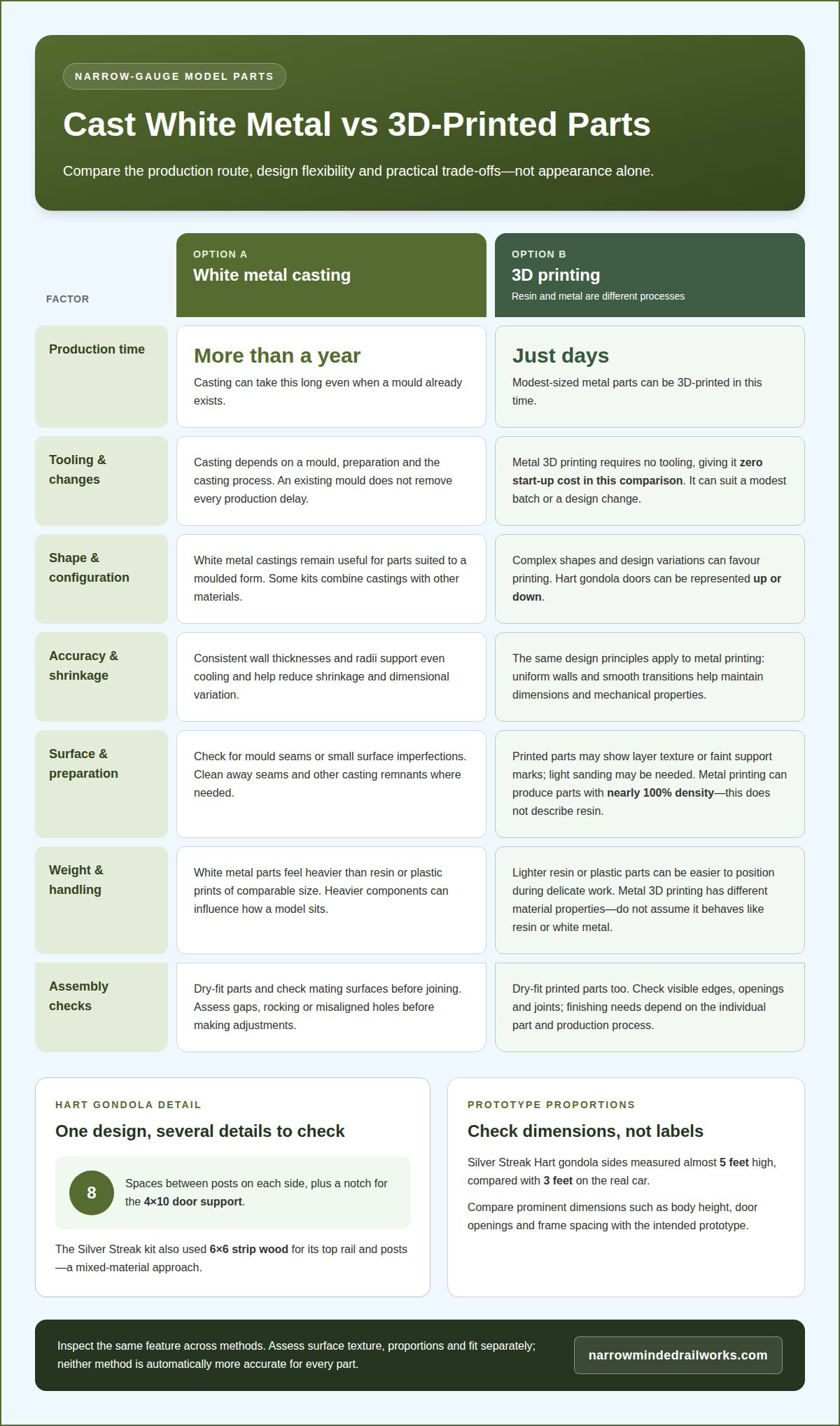
A white metal casting can take more than a year to produce, even when a mould already exists, while modest-sized metal parts can be 3D-printed in just days. That doesn't make one method automatically better: a comparison of 3D printed vs white metal kits depends on the part, the detail required and how it will be used.
It’s understandable to focus on appearance, since small differences in shape and fit can affect a narrow gauge model. But the manufacturing method also influences dimensional accuracy, shrinkage, material options and production time. A 3D printed vs white metal kits comparison should account for these practical differences, not appearance alone.
This guide explains where printed and cast parts suit different applications, what affects their accuracy and how shrinkage can be managed through design. It also compares lead times and material availability, so you can weigh the trade-offs before choosing a kit or planning a build.
Key Takeaways
- Match the manufacturing method to the part’s role: complex shapes and design variations can favour printing, while cast parts suit other build requirements.
- Assess accuracy at the design stage. Consistent wall thicknesses and radii help control cooling, shrinkage and fit.
- Production time can influence the choice, particularly when a part is needed promptly or casting depends on tooling.
- Compare material availability alongside detail and strength, since the practical choice depends on what the part must do in your model.
Applications for cast and printed parts
Part shape and intended use help determine whether a printed or cast part is the better fit. The Hart gondola, for example, shows how a design can combine structural details with alternative configurations.
Strength and Durability
Resin and white metal miniatures behave differently under handling, so consider exposed details and how the finished model will be used. Resin parts can preserve fine shapes, while metal 3D printing can produce parts with nearly 100% density. That figure describes printed metal, not resin. For narrow gauge structures, the Hart gondola has eight spaces between posts on each side, plus a notch for the 4x10 door support. Its doors can be represented up or down, showing how printing accommodates design variations.
White metal castings remain useful for parts suited to a moulded form. The Silver Streak Hart gondola kit used 6x6 strip wood for its top rail and posts, illustrating a mixed-material approach.
Assembly, Cleaning and Painting
Assembly effort depends on the number of separate parts and the preparation each needs. Printed pieces may require light sanding to remove support marks or layer lines; cast parts may need seams or other casting remnants cleaned away. Work carefully around fine details and dry-fit parts before joining them. For painting, clean the surfaces and use primer and paint suited to the material. Follow the product’s handling guidance and use appropriate eye and skin protection and ventilation during preparation. Resin and metal may require different precautions.
For UK buyers, restrictions on a purchase, sale or import depend on the product and transaction, not just the material. Kit prices also vary with scale, detail and included components, so there is no single figure that usefully compares every build.
Weight and Handling
White metal parts feel heavier than resin or plastic prints of comparable size, which affects how a model feels during assembly and display. Heavier components may also influence how a model sits, while lighter parts can be easier to position during delicate work. Metal 3D printing is a separate process from resin printing, so its material properties should not be assumed to match either resin or white metal. Choose by the part’s function, handling needs and place in the finished model.
Dimensional accuracy and shrinkage
Accuracy depends on the design as well as the manufacturing method. Casting and metal 3D printing both benefit from consistent wall thicknesses and radii, which support even cooling, reduce shrinkage and help preserve dimensions and mechanical properties.
To compare detail and surface quality, inspect the actual part rather than relying on its material label. White metal castings can show mould seams or small surface imperfections; printed parts may show layer texture or faint support marks. The result depends on the individual part and production process, so check edges, openings and other visible features before choosing.
The Silver Streak Hart gondola kit offers a useful reminder: its sides measured almost five feet high, compared with three feet on the real car. This illustrates why proportions matter. Check prominent dimensions, including body height, door openings and frame spacing, against the intended prototype.
For either casting or metal printing, uniform walls help the material cool more consistently. Sudden changes in thickness can create uneven cooling, increasing the risk of shrinkage and dimensional variation. Smooth transitions and consistent radii also help the design avoid abrupt changes around corners and joins. These decisions should be made in the part design, rather than treated solely as finishing work.
During assembly, test-fit mating surfaces and check for gaps, rocking or misaligned holes. A small discrepancy at a mounting face can affect how a body sits on its base, even if the exterior detail looks sharp. Assess the fit before altering the part, and remove material only where the design clearly calls for an adjustment.
For a fair comparison, examine the same feature across both methods, such as a narrow window, straight edge or mating joint. Assess surface texture, proportions and fit separately. This gives you a more useful basis for choosing than a blanket claim that printed or cast parts are always more accurate.
Manufacturing lead times
Production time can shape a narrow gauge project’s schedule. Casting metal parts can take more than a year, even when an existing mould is available. By contrast, modest-sized metal parts can be produced by 3D printing in just days. These are manufacturing timelines, not a promise about when a finished kit will arrive.
The difference reflects the production route. Casting depends on a mould, preparation and the casting process; an existing mould does not necessarily remove every production delay. Metal 3D printing requires no tooling, giving it zero start-up cost in this comparison. That can make printing useful for a modest batch or a part that needs a design change, since production does not depend on creating a new mould.
Plan the full build, not just the manufacturing stage. A printed component needs design preparation and production, then any necessary finishing and packing. A cast component also needs production and preparation before assembly. A Hart gondola, for example, may involve a body, doors and supporting details across several parts, so the production time for one component is not the schedule for the whole project.
For a deadline-led build, list the steps in order: finalise the design, choose the production method, allow for manufacturing, then plan finishing and assembly. Printing may suit a modest-sized metal part needed quickly, while casting can take much longer, even when a mould is ready. If the model needs a particular configuration, such as Hart gondola doors positioned up or down, settle that choice before production. Late changes can affect preparation whichever method you choose.
In short, compare production time with the remaining build stages. The contrast between just days for modest-sized printed metal parts and more than a year for casting shows why the method matters. The full schedule also depends on design readiness and post-production work.
Material availability
Material choice affects which production methods can make a narrow gauge part. White metal kits are cast, while 3D printing may use resin or metal. These materials are not interchangeable: the part’s purpose, required detail and assembly design all influence the suitable option. For example, a locomotive body and a small fitting may have different material needs.
Consider the material and process together. A resin print is not the same as a metal 3D print, and neither should be treated as equivalent to a white metal casting. Metal 3D printing can produce parts with nearly 100% density, but that fact does not describe resin prints or cast metal. The selected material determines the part’s properties, while the design determines how it is shaped and joined.
Availability depends on the particular part, not simply on whether a material is available. A detailed wagon body, thin rail or small door fitting may call for different production choices. A Hart gondola, for example, can have its doors positioned up or down. This design choice affects which material and production process will suit the required configuration.
For a practical comparison, list the parts in your build and assess each one separately:
- Body: Consider the shape, visible surface and how it joins the chassis.
- Fine details: Look at whether the material and process can represent the feature clearly.
- Moving or separate parts: Consider how each piece fits and handles during assembly.
- Finish: Account for cleaning, preparation and painting after production.
This part-by-part approach avoids choosing a kit solely by its material label. If you’re comparing narrow gauge models, explore available model kits and consider how their parts suit your planned build.
Narrow Minded Railworks
Narrow Minded Railworks offers narrow gauge kits and accessories for model builders weighing printed and cast components. Its range includes OO9 Locomotive & Wagon Kits, GN15 Locomotive & Scenery Kits, and O-16.5 / 7mm Scale Kits. These options help you choose a scale and project type before considering how individual parts suit your build.
The comparison matters most when you’re deciding between a particular model, its details and the work involved in assembly. Narrow Minded Railworks designs and sells 3D-printed products, including locomotive bodies, wagons and scenery items. Diorama Tools & Scenery can also support the surrounding layout. Consider the part’s function and preferred finish as you select a kit for your narrow gauge project.
For a straightforward next step, contact Narrow Minded Railworks to discuss your modelling requirements.
Make your next build decision with confidence
Choose your next kit by starting with the model you want to create, then consider which parts need fine detail, durable handling or a particular finish. A 3D-printed vs white metal kits comparison is most useful when grounded in a real project, rather than treated as a universal rule. Decide what matters most for your build, such as a component’s shape, assembly or the time available.
If you’re still weighing those priorities, narrow your decision to the scale and model you plan to build. Revisit the 3D-printed vs white metal kits choice against your layout and modelling approach to see which fits your project.
Contact Narrow Minded Railworks to discuss your modelling requirements and take the next step towards your build. Your next project can start with a choice that fits the way you want to model.
Frequently Asked Questions
What are 3D printed model kits and white metal kits?
3D-printed kits are formed from digital designs, while white metal kits use cast metal parts. Narrow Minded Railworks’ kits are supplied as model components, not ready-to-run models; they arrive unprimed and unpainted, with supports removed. Fine sanding may be needed for faint support marks or layer lines. Resin can be quite delicate; avoid dropping the parts. The seller cannot be held responsible for breakages once the item has arrived.
How much do 3D printed and white metal model kits cost in the UK?
Prices vary with scale, material, detail and included components, so there is no single useful figure for comparing kits.