

What if you could build a railway with more character and history than a standard layout, using only a fraction of the space? Many modelers feel held back by the perceived complexity of narrow gauge model train scales, often worrying that the "wrong" choice will lead to a dead end with no product support. It's common to feel overwhelmed by the technical overlap between scale and gauge, yet these constraints actually provide a creative opening for those who want something unique.
You deserve a clear path through the jargon so you can focus on the craft of modeling industrial and quarry prototypes. This guide will help you master the nuances of the most popular scales for 2026, ensuring you have the confidence to choose a project that fits your available space. We will explore how to identify the right track for your scale, how to leverage 3D-printed kits to bypass expensive brass models, and how to successfully adapt existing chassis for your next narrow gauge masterpiece. Whether you are looking at OO9, GN15, or O-16.5, the solution to a more detailed layout starts with understanding the standards.
Key Takeaways
- Technical jargon often complicates the hobby; however, defining the relationship between scale and gauge provides a clear foundation for your next project.
- Mainstream models rarely cover every prototype; therefore, exploring diverse narrow gauge model train scales helps you find the specific industrial character you desire.
- High-end brass models are often prohibitively expensive; fortunately, 3D-printed kits offer a detailed and accessible alternative for the modern modeler.
- Large layouts require significant room; nevertheless, choosing the right scale allows you to build a complete railway system within a compact footprint.
- Finding compatible motors can be a challenge; consequently, we design kits specifically to fit reliable, commercially available chassis.
Scale vs. Gauge: The Foundation of Narrow Gauge Modelling
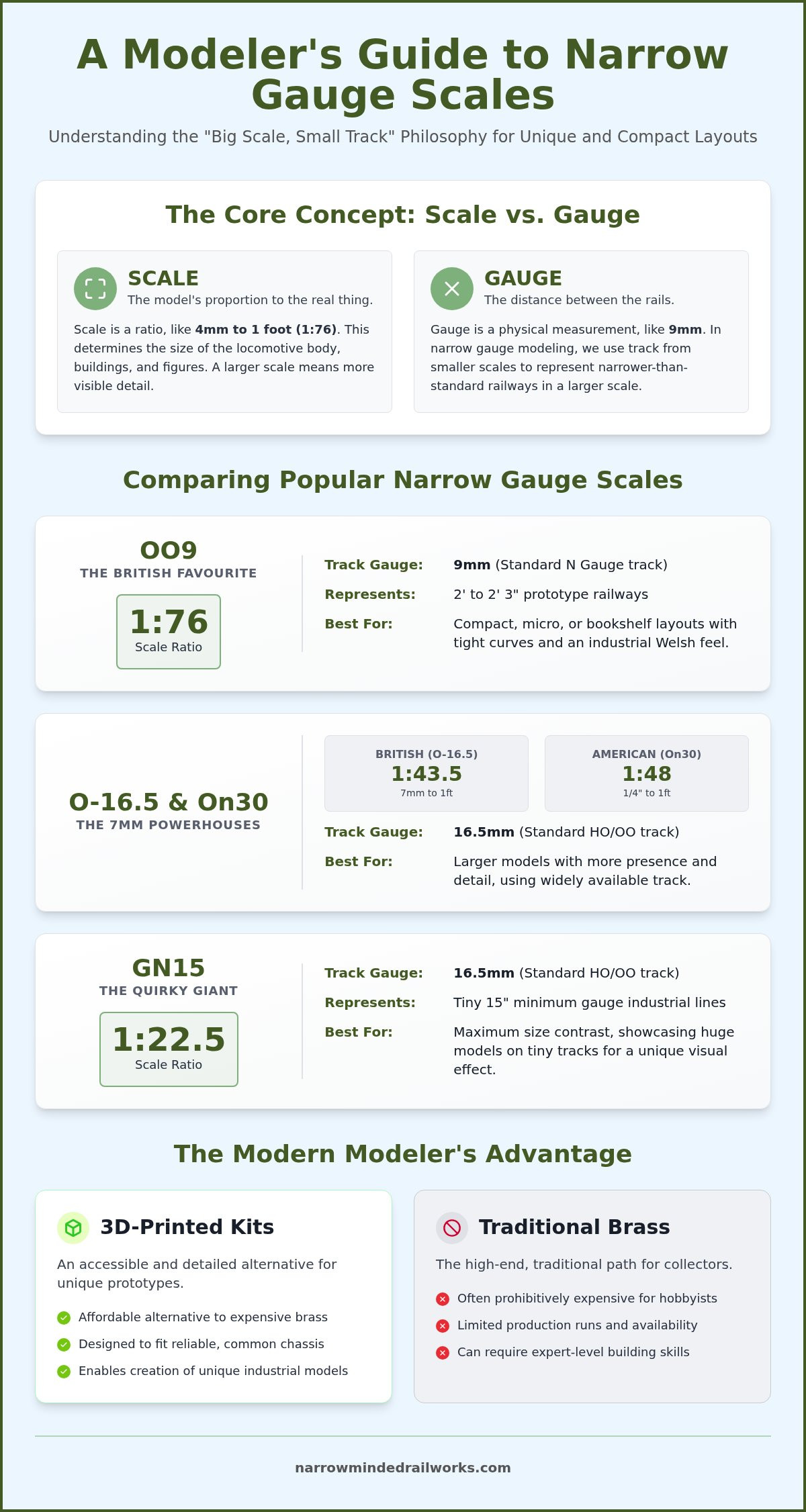
Confusion often arises when newcomers first look at narrow gauge model train scales. While standard gauge modeling follows a rigid set of rules, narrow gauge is essentially a creative hack of existing hobby standards. To understand the foundation, you must first separate two distinct concepts: scale and gauge. Scale refers to the proportion of the model compared to the real world, such as 4mm to 1 foot (1:76). Gauge refers strictly to the physical distance between the rails on your layout.
Narrow gauge modeling thrives on a "Big Scale, Small Track" philosophy. Instead of manufacturing entirely new track systems, modelers use track originally designed for smaller scales to represent narrow rails in a larger scale. For example, OO9 uses 9mm track, which is standard for N gauge, to represent 2-foot or 2-foot 3-inch tracks in 4mm scale. This approach saves space while allowing for the heavy, industrial aesthetic that defines the hobby. For those wanting to see every possible combination, this comprehensive list of narrow gauge scales illustrates how diverse these pairings can be.
British vs. American Naming Conventions
The terminology varies significantly depending on which side of the Atlantic you are on. British modelers typically use scale names followed by the track gauge, such as OO9 (OO scale on 9mm track) or O-16.5 (O scale on 16.5mm track). American conventions often use the scale followed by "n" and the prototype's track width. HOn3 means HO scale representing a 3-foot narrow gauge prototype. This distinction is vital when ordering parts from overseas suppliers. A 9mm part from a UK supplier might be intended for a very different prototype than a 3-foot part from the US, even if the physical track width is the same.
The Mathematical Mystery of Narrow Gauge
Calculating real-world equivalents can feel like a complex math test. A single track width, like 16.5mm, represents vastly different things depending on your chosen scale. In HO or OO, it's standard gauge. In O-16.5 (7mm scale), it represents a 2-foot 4-inch narrow gauge line. In GN15, it represents a tiny 15-inch minimum gauge line. In narrow gauge modelling, the gauge of the track is secondary to the scale of the locomotive body. At Narrow Minded Railworks, we design our 3D-printed kits to maintain these proportions accurately. While sourcing the right chassis can be difficult, our kits provide the detail you need to fit common commercial standards without the high cost of traditional brass.
The Most Popular Narrow Gauge Scales Explained
Choosing between narrow gauge model train scales can feel like a trade-off between detail and space. While standard gauge layouts often demand a dedicated room, narrow gauge scales provide a proactive solution for the space-constrained modeler. These scales prioritize character and industrial history over sheer size. The variety of narrow gauge model train scales available in 2026 allows for immense creativity, as each scale offers a distinct personality, from the rugged industrial feel of a quarry to the charm of a rural passenger line.
OO9: The British Favourite
The rugged charm of the Welsh slate railways has made OO9 the most popular choice in the UK. Many hobbyists find that standard OO gauge layouts take up too much floor space. OO9 solves this by using 9mm track, which allows for tight curves and expansive scenery in a micro-diorama or bookshelf layout. This scale captures the essence of the Ffestiniog or Talyllyn railways without requiring a massive footprint. If you are new to this niche, reading What is a Narrow Gauge Railway? will help you understand why these small lines were so vital to industry. For those who want more variety than ready-to-run models, our OO9 locomotive and wagon kits offer unique industrial prototypes that stand out from the crowd.
On30 and O-16.5: The 7mm Powerhouses
If you want the presence of a larger model without the complexity of hand-laid track, the 7mm scales are an excellent choice. On30 grew rapidly because it runs on standard 16.5mm track, which is the same gauge as standard HO or OO layouts. American On30 typically follows NMRA modeling standards at a 1:48 scale, while British O-16.5 uses 7mm-to-the-foot proportions. This difference can lead to confusion when sourcing parts from different regions. We provide a deeper look at these nuances in An Introduction to On30 Gauge. To help modelers bridge the gap between scales, our O-16.5 kits are designed to fit common chassis, giving you a straightforward path to a 7mm layout.
HOe, HOn3, and GN15
Precision is the priority for HOe and HOn3 enthusiasts. These scales represent European and American 3-foot lines with high accuracy, often requiring careful trackwork to maintain reliable running. For a different approach, GN15 uses 16.5mm track to represent 15-inch minimum gauge lines in a large G scale (1:22.5). This allows for highly detailed figures and machinery in a surprisingly small space. Finding unique models for these scales is often a challenge. To solve this, we specialize in GN15 locomotive and scenery kits that allow you to build a diverse roster without specialized engineering skills. These kits focus on the "ready-to-build" philosophy, turning a standard chassis into a high-detail industrial workhorse.
Choosing Your Scale: Space, Budget, and Detail
Selecting from the comprehensive list of narrow gauge scales requires a realistic assessment of your hobby goals. Many enthusiasts want the grandeur of a main line but lack the square footage for a traditional layout. Choosing the right narrow gauge model train scales provides a proactive solution to this spatial constraint. While standard gauge layouts often demand room-filling empires, narrow gauge thrives in compact environments. The cost of entry varies; however, utilizing existing track standards like 9mm or 16.5mm helps keep initial investments manageable since you don't need to purchase proprietary track systems.
Handling tiny components can be a challenge for beginners or those with limited dexterity. This "fiddle factor" is a significant consideration when browsing narrow gauge model train scales. While OO9 is incredibly compact, larger scales like O-16.5 offer more substantial parts that are easier to assemble and paint. Ready-to-run models are often expensive and limited to a few specific prototypes. To solve this, many modelers turn to kit-building, which offers a broader range of industrial and quarry prototypes at a more accessible price point. Standard gauge power systems work perfectly for most of these scales, which reduces the need for specialized electronics and allows you to focus your budget on high-quality kits and scenery.
The Space-Saving Magic of OO9
Limited space often forces modelers to compromise on their vision. OO9 provides a solution by offering 4mm scale detail on track that requires a much smaller footprint than standard OO. You can achieve minimum radius curves as tight as 9 inches, allowing for intricate track plans on a simple bookshelf. This scale is perfect for recreating the winding slate lines of North Wales where space was at a premium in the real world. Because OO9 is the most popular UK narrow gauge scale, there is a wealth of wagon kits available to complement your locomotives. If you are ready to begin, our guide on Your First OO9 Loco Kit walks you through the selection process for your initial project.
Large Scale in Small Spaces: The GN15 Appeal
Finding a scale that balances high detail with small space can be difficult. GN15 addresses this by placing 1:24 scale models on 16.5mm track. This combination is ideal for estate railways or small industrial scenes where character is more important than track length. Because the models are larger, you can incorporate high-detail scenery and diorama tools to create a convincing world in a tiny area. This scale allows you to build unique, often whimsical prototypes that would be lost in smaller scales. For a deeper dive into this unique niche, check out our guide on Getting Started in GN15 Scale.
The Kit-Builder Advantage in Narrow Gauge
Mainstream manufacturers often prioritize popular passenger locomotives; consequently, modelers looking for obscure industrial subjects must look elsewhere. While standard gauge modeling relies heavily on ready-to-run products, narrow gauge model train scales have long been the domain of the kit-builder. This shift from "Ready-to-Run" to "Ready-to-Build" isn't a hurdle, but a creative opening. Modern 3D printing has revolutionized this process by offering high detail without the high price of traditional etched brass. These 3D printed bodies make the hobby more accessible for beginners who want to avoid complex soldering. If you are ready to start your first project, explore our full range of narrow gauge kits and diorama tools to find your perfect prototype.
Using Donor Chassis for Fast Results
Sourcing high-quality motors and gearboxes is a common hurdle in scratch-building; however, the "Chassis-Swap" method provides a proactive solution. This technique involves placing a detailed narrow gauge body onto a reliable, commercially available chassis from a different scale. For OO9 projects, an N gauge chassis is the standard choice. For larger narrow gauge model train scales like O-16.5 or GN15, standard HO or OO chassis provide a robust foundation. This method ensures your model runs smoothly from day one. It allows you to focus on the aesthetic and character of the locomotive rather than complex mechanical engineering. Every modeler should keep a list of reliable donor models, as this approach is far more consistent than trying to build a power unit from individual parts.
Finishing and Painting Your Kits
Layer lines on 3D printed parts can distract from the model's detail; therefore, proper surface preparation is essential before applying color. A good primer helps identify areas that need light sanding, ensuring a professional finish. When it's time to choose a livery, you have the freedom to be as historically accurate or as creative as you like. Many narrow gauge lines were freelance operations that used whatever paint was available, which gives you license to create a unique identity for your railway. Whether you are replicating a specific quarry locomotive or a fictional estate engine, the finish is what brings the model to life. For detailed advice on achieving the best results, see our guide on Painting 3D Printed Models. This extra attention to detail transforms a simple kit into a centerpiece for your layout.
Starting Your Narrow Gauge Journey with Narrow Minded Railworks
Finding specialized models for narrow gauge model train scales can be a frustrating search through old catalogs and limited production runs. While mainstream brands prioritize high-volume standard gauge models, we provide a proactive solution by focusing on the unique industrial and quarry prototypes that define the narrow gauge world. Our kits for OO9, GN15, and O-16.5 scales are designed to bridge the gap between interest and execution. We utilize high-resolution 3D printing to deliver exceptional detail, ensuring you don't have to choose between a reasonable price and a professional look.
We understand that not every modeler is an expert engineer. Our "Beginner-Friendly" design philosophy addresses the fear of complex assembly by creating parts that fit together logically. Sourcing motors and gearboxes is often the hardest part of a project; however, we solve this by designing our locomotive bodies to fit onto reliable, commercially available chassis. This approach allows you to benefit from modern manufacturing while enjoying the creative freedom of kit-building. Whether you are building a micro-layout in a cupboard or a larger industrial scene, our kits provide the character and variety that ready-to-run models simply cannot match.
Our Signature OO9 and GN15 Kits
The distinctive silhouettes of industrial railways are at the heart of our collection. We specialize in locomotive bodies like the iconic Quarry Hunslet and various tram locos that were once the workhorses of British and global industry. These models often have complex shapes that are difficult to scratch-build; therefore, we use precision 3D printing to capture every rivet and panel line. For those interested in the history and variety of these enclosed engines, we recommend exploring A Modeller’s Guide to Tram Locos. By providing a stable, well-designed body, we allow you to focus on the fun aspects of modeling, such as painting, weathering, and detailing.
Beyond Locomotives: Wagons and Scenery
A locomotive alone does not make a railway; it needs a purpose and a place to run. Rolling stock is essential for telling the story of your layout, whether it's a slate quarry in Wales or a small estate line. Traditional plastic kits can sometimes lack the fine detail required for close-up diorama work; fortunately, our 3D printed wagons and scenery items offer a level of precision that sets your layout apart. We encourage you to browse our full shop for diorama tools and scenery that complement our locomotive kits. We are proud to support a global community of modelers with worldwide shipping, ensuring that no matter where you are, you can find the perfect fit for your next project using narrow gauge model train scales.
Build Your Unique Narrow Gauge Layout Today
Mastering the relationship between scale and gauge is the first step toward a successful layout. While technical jargon can feel restrictive, it's actually the framework for building a railway that fits your specific space and budget. 3D-printed kits offer a proactive solution to the high costs of traditional brass models, allowing you to achieve professional levels of detail without a massive investment. By choosing from the diverse narrow gauge model train scales available, you can focus on the unique industrial prototypes that bring a layout to life.
We design our locomotive bodies for easy assembly on reliable, standard chassis to ensure your project runs smoothly from the start. With worldwide shipping available, our expertly designed kits are accessible to enthusiasts everywhere. Browse our range of OO9 and GN15 kits today and start turning your model railway plans into a reality. Your journey into the creative world of narrow gauge is just beginning, and we're here to help you every step of the way.
Frequently Asked Questions
What is the most popular narrow gauge model scale?
In the United Kingdom, OO9 is the most popular choice for narrow gauge enthusiasts due to its compact size and rich history. In the United States, On30 holds the top spot because it utilizes standard HO gauge track. These narrow gauge model train scales allow modelers to create detailed scenes in limited spaces. While mainstream support for these scales is growing, most modelers still rely on specialized kits to find unique industrial prototypes.
Can I run OO9 trains on N gauge track?
Yes, OO9 trains are specifically designed to run on 9mm track, which is the standard for N gauge. This allows you to use widely available N gauge track and turnouts for your narrow gauge layout. However, standard N gauge track often has sleeper spacing that looks incorrect for narrow gauge. To solve this, you can use specialized narrow gauge track or disguise the standard sleepers with ballast and scenery to maintain a prototypical appearance.
What is the difference between HOn3 and On30?
The primary difference lies in the scale of the models themselves. HOn3 is HO scale (1:87) representing 3-foot narrow gauge on 10.5mm track, requiring specialized track and wheels. On30 is O scale (1:48) representing the same 3-foot gauge but running on standard 16.5mm track. While HOn3 offers precision for smaller spaces, On30 provides a larger, more tactile modeling experience while allowing you to repurpose standard OO or HO gauge track.
Is narrow gauge modelling more expensive than standard gauge?
Narrow gauge modeling can be more expensive if you only buy high-end, ready-to-run brass models. However, kit-building provides a cost-effective alternative that often results in more unique layouts. According to 2026 industry trends, using 3D-printed kits and repurposed chassis can cut costs by as much as half compared to premium standard gauge locomotives. This approach allows you to build a highly detailed industrial fleet without the financial burden of collector-grade models.
What scale is GN15?
GN15 is a unique combination that uses G scale (typically 1:22.5 or 1:24) models running on 16.5mm track. This represents minimum-gauge lines, such as the 15-inch estate railways found in the UK. It's a "character" scale that allows for extremely high levels of detail and large figures within a very small layout footprint. Because it uses standard track, it's an accessible entry point for those who want the presence of large-scale modeling.
Do I need special tools to build 3D printed narrow gauge kits?
Building 3D-printed kits doesn't require a heavy investment in specialized workshop equipment. You will need basic modeling tools like a fine-toothed saw, high-grit sandpaper, and cyanoacrylate (superglue), as traditional plastic cement won't work on resin. Surface preparation is the most important step for a professional finish. Using a high-quality primer will help reveal layer lines that need sanding, ensuring your narrow gauge model train scales look as realistic as possible once painted.
What is the smallest narrow gauge scale available?
The smallest commercially supported narrow gauge scale is Nn3, which is N scale (1:160) running on 6.5mm track (Z gauge). While this allows for massive landscapes in tiny areas, the parts are extremely small and can be difficult to handle. Most modelers find that OO9 offers the best balance between a small footprint and ease of assembly. If you're looking for a compact project, OO9 provides a wealth of kit options and a much lower "fiddle factor" than Nn3.
How do I choose a donor chassis for a loco body kit?
Selecting a donor chassis requires matching the wheelbase and wheel diameter of the prototype you wish to model. You don't need to build your own motor; instead, you can identify reliable, commercially available N or HO gauge models that fit the dimensions of your kit. We design our kits at Narrow Minded Railworks to fit specific, easy-to-find chassis. Always verify the physical clearance inside the body shell to ensure the motor and gears fit without obstruction.