

Why does a technically perfect layout sometimes feel like a collection of plastic toys rather than a living, breathing world? You've likely spent hours on a kit, yet the final scene feels "empty" or lacks that elusive spark of life. It's a common frustration to struggle with choosing figures and scenery that actually belong together, especially as the hobby shifts toward more compact, narrative-driven designs that fit into our modern lives.
I understand the desire to move past the basic building stage and create something that feels truly authentic. This guide will show you that building a model that tells a story is the secret to transforming a simple railway kit into a compelling diorama that captures a specific moment in time. You'll learn how to use the posture of a figure or the specific "work-wear" of a locomotive to create a genuine sense of history.
We'll provide a cohesive framework for choosing kits and scenery to ensure your next project feels like a real place. By following these steps, you'll find a deeper sense of satisfaction in your hobby and create a layout that truly earns attention at exhibitions.
Key Takeaways
- Understand the core principles of narrative realism to shift your focus from mere technical accuracy to emotional impact.
- Discover how selecting specific narrow gauge locomotive designs and rolling stock sets a clear tone and implies a unique industry for your layout.
- Learn the art of building a model that tells a story by using realistic figure placement and intentional "clutter" to imply a living, working environment.
- Master the logic of grime and rust to treat weathering as a visual record of your model's history rather than just adding random dirt.
- Explore how niche 3D-printed kits in scales like OO9 and GN15 provide the perfect raw materials for crafting your own unique miniature narratives.
What Does It Mean to Build a Model That Tells a Story?
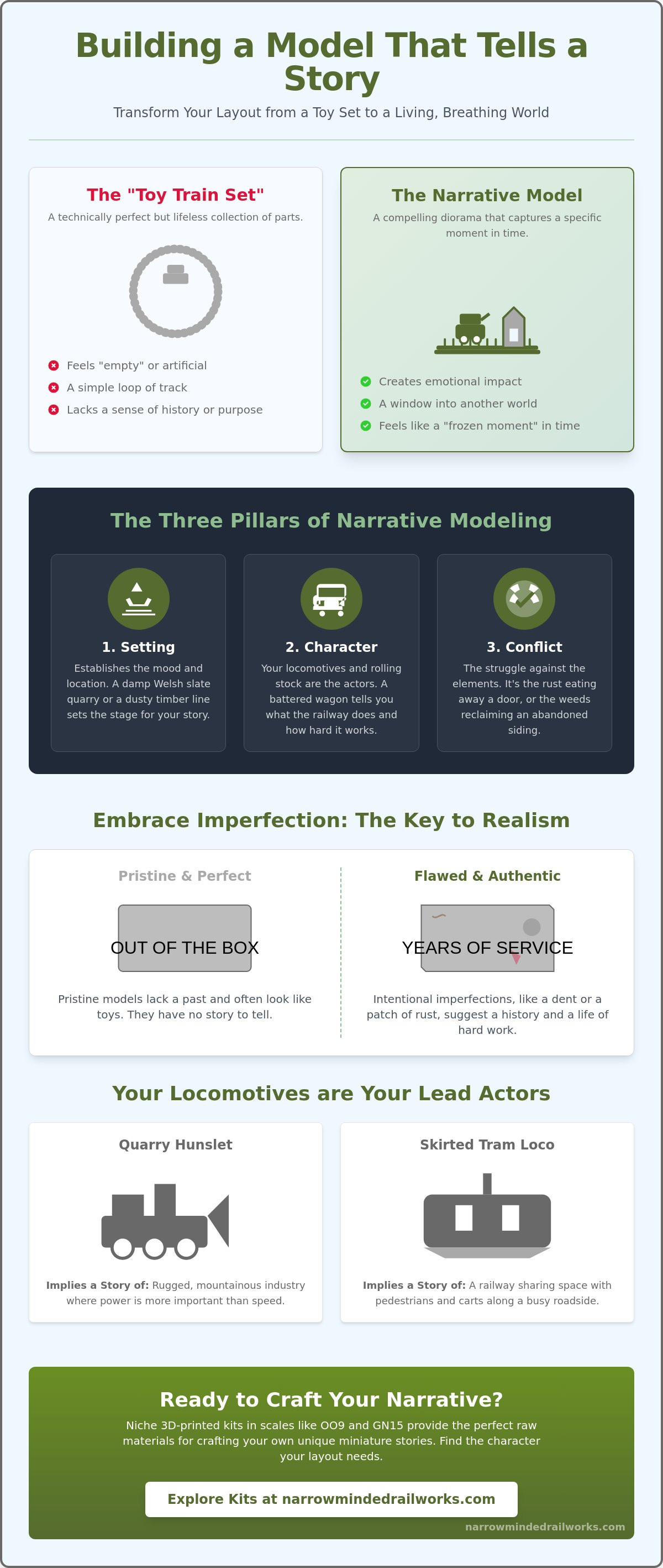
Narrative realism isn't just about technical accuracy; it's about creating a believable history for your layout. In the long history of model railroading, the shift from functional train sets to story-driven dioramas has redefined the hobby. A train set is a loop of track where things move. A model railway is a window into another world. When you're building a model that tells a story, you're looking for the "frozen moment." This is the feeling that a worker has just stepped out of the frame to grab a cup of tea or that a boiler has just hissed its last breath of steam.
To better understand how these narrative elements come together in a physical space, watch this process of creating a detailed scene:
Narrow gauge modeling, specifically in scales like OO9 or GN15, is the perfect medium for this type of work. These railways were often built on tight budgets for specific industrial tasks. They're inherently quirky, cramped, and full of character. Because they don't follow the rigid standards of main-line travel, there's more room for the human element to shine through.
The Three Pillars of Narrative Modeling
To succeed, you need three things. First is the Setting. This establishes the mood, whether it's a damp Welsh slate quarry or a dusty timber line. Next is Character. Your locomotives aren't just machines; they're the actors. A battered wagon tells you what the railway does and how hard it works. Finally, there's Conflict. This isn't a battle, but a struggle against the elements. It's the rust eating a door or the weeds reclaiming a siding.
Why 'Perfect' is the Enemy of a Good Story
Pristine models straight out of the box often look like toys because they lack a past. Real life is messy. If you want to master building a model that tells a story, you have to embrace intentional imperfections. A slightly crooked fence post or a patch of mismatched paint on a cab roof suggests a repair made in haste. If you're new to these smaller scales, check out our guide on what is a narrow gauge railway to understand the industrial roots that make these stories so compelling.
Choosing Your Protagonists: Locomotives and Rolling Stock with Character
If the layout is your stage, the locomotives and rolling stock are your lead actors. When building a model that tells a story, the design of your engine dictates the narrative. A sturdy Quarry Hunslet implies a rugged, mountainous industrial site where power is more important than speed. In contrast, a skirted tram loco suggests a railway that shares its space with pedestrians and horse-drawn carts along a busy roadside. The visual weight of these models informs the viewer about the world they inhabit before a single wheel turns.
Unlike mass-produced, ready-to-run models that often look identical, 3D printed kits allow for a higher degree of personality. You can choose a specific prototype that fits your story's era and industry perfectly. This level of environmental context is what museums have used for decades to educate and immerse visitors. By looking at The Evolution of Dioramas, we see that a subject only makes sense when its physical form matches its surroundings. A locomotive with a spark arrestor tells you it works in a timber yard; a loco with extra water tanks suggests long hauls through remote terrain.
Your rolling stock completes the picture. A line of slate wagons tells the viewer that there's a quarry nearby, even if it's off-scene. A mix of general goods wagons suggests a vital lifeline to a remote village. Consider the "life cycle" of these models as well. A wagon that has been in service for twenty years shouldn't look like one that just left the workshop. Scuffs on the floorboards or a dented corner plate show the model's "work life," giving the viewer clues about the daily grind of your miniature world.
OO9 vs GN15: Different Scales, Different Stories
The scale you choose changes how you tell your tale. OO9 is fantastic for showing the journey. It allows for expansive landscapes and long-distance industrial lines where the train is a small part of a big, sweeping world. GN15, however, is built for character studies. Because it's a larger scale on narrow track, it focuses on high-detail, small-space dioramas where every rivet and texture counts. If you're interested in the latter, our guide on Getting Started in GN15 Scale offers deeper insights into this unique scale.
The 'Hero' Loco: Making One Model the Focal Point
Every story needs a hero. You can make one locomotive stand out by adding unique, human details. A driver's lunchbox on the footplate or a set of oil cans tucked near the boiler makes the model feel inhabited. For example, a tram loco kit can imply a rich urban or roadside history where the engine had to be enclosed for safety. You can find more historical inspiration in A Modeller's Guide to Tram Locos. If you're ready to start your next project, consider exploring our range of narrow gauge kits to find your next protagonist.
Setting the Stage: Scenery and the 'Small Human' Details
If the locomotive is your lead actor, the scenery is the world that gives its journey meaning. Scenery shouldn't just be a backdrop. It's the context that makes the locomotive's presence believable. When you're building a model that tells a story, you're looking for ways to reward the viewer's curiosity. I use the "Third Glance" rule to achieve this. The first glance captures the train. The second takes in the buildings. The third glance, however, is where the magic happens. It's the moment someone notices a discarded oil drum leaking into the ballast or a pair of rusty pliers left on a workbench. These tiny details imply that someone was just there, making the scene feel alive rather than static.
Clutter is the narrator of industrial life. In narrow gauge environments, space was often limited. This led to a chaotic accumulation of tools, fuel cans, and spare parts. Overgrown weeds around a siding don't just look "natural"; they tell the viewer that this specific track hasn't seen a wagon in months. Architecture works the same way. A derelict shed with a sagging roof or a boarded-up window suggests a shift in economic fortunes. It tells a tale of a railway that has seen better days. These visual cues build a history without needing a single word of text.
Just as a station garden or a small allotment adds life to a miniature scene, real-world landscaping requires the same attention to detail. If you are looking to maintain your outdoor space with precision, you can visit Garden Watering for professional irrigation solutions that keep your garden thriving.
Figures as Narrative Anchors
Figures should never be placed at random. Give them a job and a relationship to their surroundings. A 3D scanned figure with a realistic pose carries more weight than a perfectly painted one with a stiff, "toy-like" stance. Realistic poses capture how humans actually lean, sit, or carry heavy loads. If two figures are talking, their eye-lines should meet. If a figure is leaning against a phone box, they're no longer just a plastic shape. They're a character waiting for a call or hiding from the rain. This interaction changes the entire scene's context from a simple display to a compelling story.
Scenery Items that Build the World
Small details like petrol pumps, post boxes, or specific signage act as chronological anchors. They date your story to a specific era. Using 3D printed scenery kits allows you to fill the "gaps" that mass-produced items often miss. You can find unique items that fit your specific industrial theme, whether it's a rural timber yard or a coastal slate quay. If you're just starting out, picking up your first OO9 loco kit is the perfect way to begin planning the characters that will inhabit your stage. Building a model that tells a story starts with these small, intentional choices that turn a kit into a world.
The Art of Weathering: Visualizing the Passage of Time
Weathering isn't just about making things dirty. It's the final, vital chapter in building a model that tells a story. Think of weathering as a physical record of your model's work life. Every streak of rust or patch of faded paint tells the viewer how long the locomotive has been in service and the harshness of the environment it faces. If you apply grime without a plan, you risk making your model look messy rather than realistic. You need to follow the "Logic of Grime" to ensure the wear makes sense for a narrow gauge setting.
On a narrow gauge wagon, rust doesn't appear at random. It starts where moisture gets trapped, such as around ironwork, hinges, and corner plates. For locomotives, soot accumulates on the roof and around the chimney, while oily residue builds up near the cylinders and motion. By placing these details logically, you lead the viewer's eye to the focal points of your story. A heavily weathered cab door suggests a driver who has climbed in and out thousands of times, adding a human touch to the machine. To get the best results, you'll need the right supplies, so browse our diorama tools and scenery to find the pigments and washes that bring these details to life.
A Step-by-Step Approach to Narrative Weathering
- Step 1: The Base Layer. Start with sun-bleaching and faded paint. Real equipment left outdoors loses its vibrant color over time.
- Step 2: Working Grime. Add the marks of daily labor. This includes coal dust on the tender, oil spills around the filler caps, and soot on the boiler.
- Step 3: Environmental Impact. Finish with rust streaks, mud on the chassis, and even a hint of moss if the vehicle has been sitting in a damp siding.
Micro Sol is an essential chemical solution that softens decals so they conform perfectly to rivets and textures, making them look painted on and aged rather than like a plastic sticker.
Finishing 3D Printed Kits for Realism
When you're working with 3D printed kits, the finish is everything. You must carefully remove support marks during the assembly phase to ensure the illusion of a "real" metal or wood machine isn't broken. A smooth surface allows your weathering washes to flow naturally into the recesses. The psychological difference between a "toy" and a "model" often comes down to the finish. A high-gloss shine looks like plastic, while a flat, matte finish absorbs light like real-world materials. For a deeper dive into these techniques, read our guide on painting 3D printed models. Mastering these finishing touches is the most effective way to succeed at building a model that tells a story that feels authentic and lived-in.
Implementing Your Story with Narrow Minded Railworks
Narrow Minded Railworks was founded on the idea that every layout should be unique. Our 3D printed kits aren't just plastic parts; they're the raw materials for your imagination. When you're building a model that tells a story, you need details that standard injection-molded kits often miss. Our technology allows us to capture the subtle texture of wood grain on a wagon or the distinct pattern of rivets on a locomotive boiler. These details provide the essential foundation for the narrative weathering and scenery we discussed earlier.
Niche scales like GN15 and O-16.5 offer a distinct advantage for those focusing on character-driven modeling. Because these scales often represent large equipment on narrow tracks, they're perfect for the growing trend of compact, high-detail layouts. This is particularly relevant as urbanization continues to shape our hobbies. With 68% of the world's population projected to live in urban areas by 2050, smaller, story-rich layouts are becoming the standard. Our kits for these scales are designed with a "narrative first" approach, focusing on the industrial quirks that make a model feel like it has a history.
From Kit to Character
A standard locomotive kit doesn't have to stay standard. You can customize our designs to create a one-of-a-kind narrator for your layout. Perhaps you'll add a specific tool rack or a custom cab modification that implies a particular repair history. This transformation from a kit to a character is what makes the hobby so rewarding. We encourage modelers to share these layout stories with our community. Seeing how different people interpret the same kit is a constant source of inspiration and helps everyone improve their craft.
Your Next Steps in Narrative Modeling
You don't need a massive room to begin building a model that tells a story. Start small by building a single "story plank" or a micro-layout that focuses on one specific scene. Choose one "hero" kit, such as our OO9/009 Pannier Steam Locomotive with Coal Bunker kit for £25.00, and build the world around it. Focus on the figures, the clutter, and the weathering until that single square foot of scenery feels completely real. Once you've mastered a small space, you can expand your narrative to larger, more complex scenes.
Browse our range of OO9 and GN15 kits to start your story today!
Bring Your Miniature World to Life
Transforming a collection of parts into a living history is the ultimate reward for any narrow gauge enthusiast. We've explored how narrative realism relies on more than just technical precision; it's about capturing that "frozen moment" through intentional clutter and logical weathering. Whether you're selecting a hero locomotive or placing a figure with a specific purpose, every choice you make contributes to building a model that tells a story that resonates with everyone who sees it.
At Narrow Minded Railworks, we provide the high-detail, 3D-printed kits you need to set the stage. Our models are designed for exceptional narrative detail and are engineered to fit standard, easy-to-find chassis, making the building process as smooth as possible. Plus, we offer worldwide shipping to over 40 countries, ensuring modellers everywhere can access these unique designs.
Start building your story with our unique Narrow Gauge kits today and watch your layout evolve from a simple track into a compelling industrial tale. We can't wait to see the worlds you create.
Frequently Asked Questions
What is narrative modeling in the railway hobby?
Narrative modeling is the practice of designing a railway layout around a specific history or sequence of events rather than just focusing on track geometry. Instead of only caring about where the trains go, you focus on why the railway exists in that specific spot. Every element, from the choice of locomotive to the placement of a discarded tool, serves to explain the environment's past and present to the viewer.
Do I need to be a professional artist to tell a story with my models?
No, you don't need professional art skills to create a compelling and realistic scene. Storytelling is more about careful observation and logic than fine art talent. By looking at real-world industrial sites and mimicking how things wear down or where workers naturally leave equipment, you can achieve a high level of realism. Focus on the human elements and "frozen moments" to guide your scenery placements.
How do figures contribute to a model's story?
Figures act as narrative anchors that give the viewer a sense of scale, era, and purpose. A figure isn't just a decoration; they're a character with a job to do. Their posture and eye-lines can suggest an ongoing conversation or a moment of hard labor. When you're building a model that tells a story, realistic 3D scanned poses are far more effective than stiff, generic figures for creating a sense of life.
Can 3D printed kits really look as good as ready-to-run models?
Modern 3D printed kits can actually surpass the detail found in mass-produced ready-to-run models. Because they're printed in high-resolution resin, they capture intricate textures like wood grain and individual rivets that standard injection molding often misses. While they require assembly and painting, this process allows for the unique customization and "personality" necessary for a truly one-of-a-kind narrative model that stands out at exhibitions.
What is the best scale for building a narrative diorama?
The best scale for a narrative diorama depends on your space, though narrow gauge scales like OO9 and GN15 are specifically designed for storytelling. OO9 allows for a sense of journey within a larger landscape, while GN15 is perfect for detailed character studies in very small spaces. These scales emphasize industrial charm and quirkiness, making them ideal for those interested in building a model that tells a story within a compact footprint.
How much weathering is 'too much' for a story-driven model?
Weathering becomes "too much" when it obscures the model's details or lacks a logical reason for its placement. Every bit of rust or grime should tell a specific part of the machine's history. if a wagon is in daily use, it will have working grime but shouldn't look like a total wreck unless your story is about a scrapyard. Balance is key to maintaining the illusion of a working world.
What tools do I need to start building narrative railway kits?
You'll need basic assembly tools like fine nippers, files, and cyanoacrylate glue for resin kits. For the narrative elements, weathering pigments, washes, and a matte varnish are essential for removing that "toy-like" shine. Specific solutions like Micro Sol help decals blend into the model's surface perfectly. These tools allow you to move beyond basic construction and into the realm of realistic, story-driven finishing that captures the viewer's imagination.
How do I choose a theme for my model railway story?
You can choose a theme by selecting a specific industry, such as a Welsh slate quarry or a timber yard, and researching its daily operations. Understanding the challenges workers faced in those environments provides a natural framework for your layout. This historical context helps you choose the right locomotives, wagons, and scenery items to make the scene believable. A well-chosen theme ensures every detail on your layout feels like it belongs.