

Stepping into the wonderful world of model railways is an exciting moment. You have a vision of miniature locomotives chuffing through scenic landscapes, but then you're hit with a wall of confusing terms: OO, HO, N gauge, scale... what does it all mean? If you've ever felt overwhelmed trying to figure out which track is compatible with which train, you're not alone. The vast array of track gauges for model trains can seem like a complex puzzle, and the fear of buying the wrong components is a common hurdle for every newcomer to the hobby here in the UK.
But don't let the jargon derail your dream layout! This complete beginner's guide is here to be your friendly signalman, clearing the line ahead. We will demystify the crucial difference between 'scale' and 'gauge' once and for all. By the time you've finished reading, you'll be able to confidently choose the perfect track for your project, understand which parts work together, and select a size that fits your available space and creative vision perfectly. Let's get you on the right track to building the model railway you've always imagined.
The #1 Confusion in Model Railways: Understanding Gauge vs. Scale
Welcome to the fascinating world of model railways! As you begin your journey, the first and most common hurdle is getting to grips with two critical terms: gauge and scale. Many newcomers use them interchangeably, but they refer to two very different, though related, concepts. Understanding this distinction is the single most important step to ensure the locomotives, rolling stock, and track you buy will all work together seamlessly.
Think of it like a real road network. The gauge is the width of the road, while the scale determines the size of the cars, lorries, and buses that use it. You need the right size vehicles for the road you've built. To see these different sizes in action, this video provides an excellent visual comparison:
What is Track Gauge? (The Simple Definition)
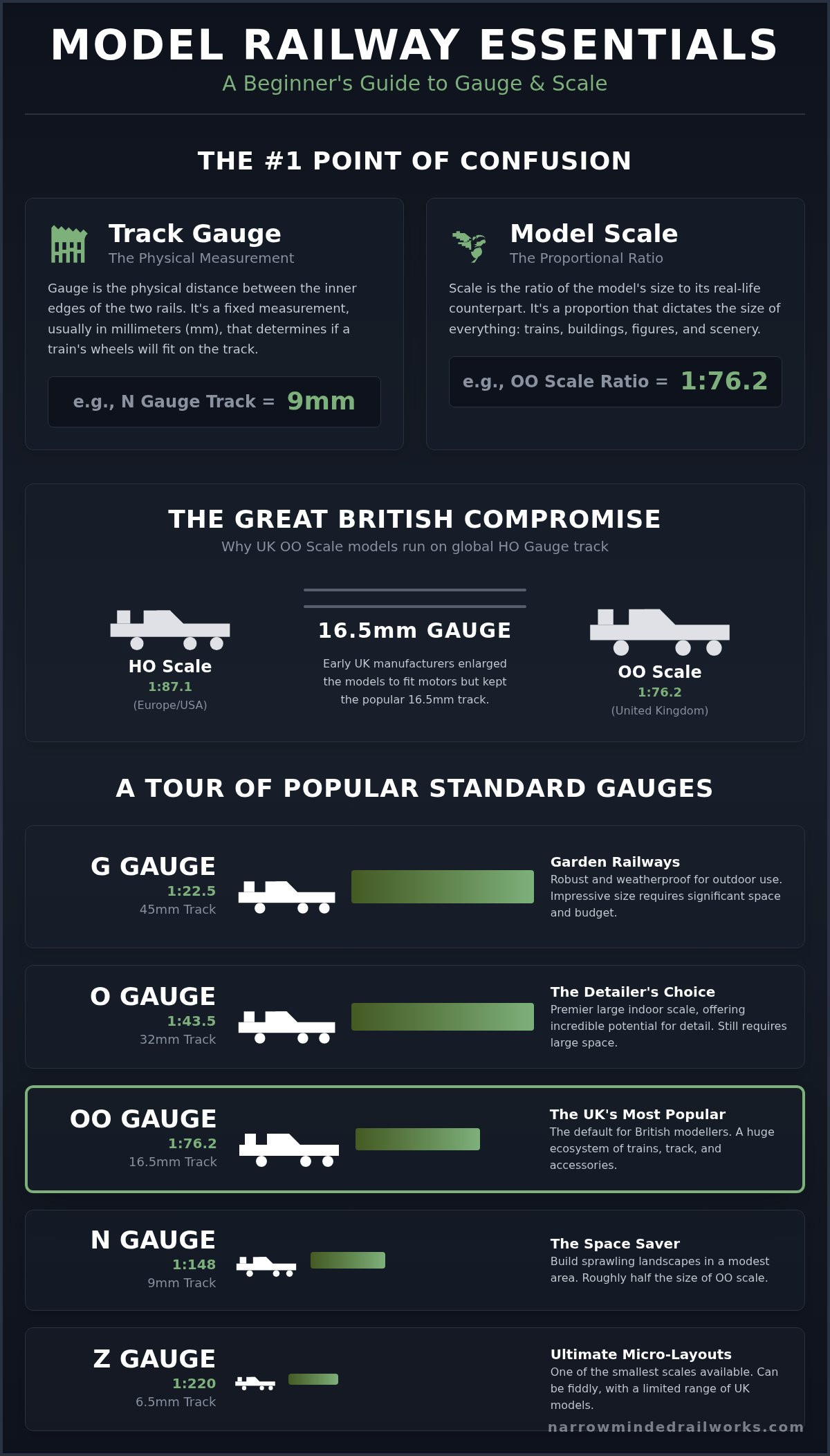
Track gauge is simply the distance between the inner edges of the two rails. It’s a fixed, physical measurement, almost always expressed in millimetres (mm). This measurement determines whether a model train's wheels will fit on the track. For example:
- HO and OO Gauge Track: 16.5mm
- N Gauge Track: 9mm
- O Gauge Track: 32mm
Using our road analogy, the gauge is the standardised width of the road lanes, ensuring all vehicles designed for it can travel safely.
What is Model Scale? (The Other Half of the Equation)
Model scale is the ratio of the model's size to its real-life counterpart. It's a proportion, not a fixed measurement. This ratio dictates the size of everything in your model world-not just the trains, but also the buildings, figures, and scenery. For a full breakdown of the various Rail transport modelling scales, you can find detailed charts and histories. Common examples include:
- OO Scale (UK): 1:76.2
- HO Scale (Europe/USA): 1:87.1
- N Scale: 1:148 (UK) or 1:160 (Europe/USA)
In our analogy, scale determines if you're modelling with small city cars (N scale) or massive articulated lorries (O scale).
Why the Confusion? The Unique Case of OO Gauge
The primary source of confusion, especially here in the UK, stems from the most popular choice: OO gauge. Historically, early British manufacturers found it too difficult to fit the motors of the day into a true-to-scale 1:87 model of the smaller UK train prototypes. Their solution was to keep the popular 16.5mm track gauge of HO scale but enlarge the model locomotives and rolling stock to a 1:76 scale. This means that OO scale models are slightly larger than their HO counterparts, but they run on the exact same track. This compromise is why understanding the difference between scale and the various track gauges for model trains is so crucial for British modellers.
A Tour of Standard Gauge Model Tracks: From Garden to Tabletop
Before exploring more specialist options, it’s essential to understand the world of standard gauge model railways. These scales represent the vast majority of real-world railways, from mainline expresses to local branch lines, which use a track gauge of 4 feet 8½ inches. Selecting from these common track gauges for model trains is the first major decision you'll make, dictating everything from the space you need to the cost of your hobby.
Large Scales: G and O Gauge
Often called 'Garden Railways', G Scale is the largest common scale, built with robust, weatherproof materials to withstand the elements outdoors. Its substantial size makes for an impressive spectacle. O Gauge is the premier large indoor scale, favoured by dedicated modellers for its incredible potential for detail. Both scales, however, require considerable space and a larger budget, with locomotives often costing several hundred pounds.
The World's Most Popular: OO and HO Gauge
This is where most British modellers live. While HO Gauge (1:87) is the world's most popular scale, the UK market is completely dominated by OO Gauge (1:76). Crucially, both scales run on the exact same 16.5mm gauge track. This means that while OO models are slightly larger than their continental and American HO counterparts, they share a vast ecosystem of track and accessories, making it the default choice for modelling British railways from brands like Hornby and Bachmann.
Space-Saving Scales: N and Z Gauge
If space is at a premium, N Gauge is the perfect solution. At roughly half the size of OO, it allows you to build sprawling landscapes and complex track plans in a modest area, like a spare room or on a simple baseboard. For the ultimate in micro-layouts, Z Gauge is one of the smallest commercially produced scales, though its tiny size can be fiddly for beginners and the range of available UK-outline models is more limited.
Standard Gauge Comparison Table
To help you visualise the differences between these popular track gauges for model trains, here is a quick reference table.
| Name | Scale Ratio (UK) | Track Gauge | Primary Use |
|---|---|---|---|
| G Gauge | 1:22.5 | 45 mm | Garden / Outdoor |
| O Gauge | 1:43.5 | 32 mm | Large, highly detailed indoor layouts |
| OO Gauge | 1:76.2 | 16.5 mm | UK's most popular standard |
| HO Gauge | 1:87.1 | 16.5 mm | World's most popular standard |
| TT Gauge | 1:120 | 12 mm | A 'mid-size' scale, growing in popularity |
| N Gauge | 1:148 | 9 mm | Excellent for small spaces |
| Z Gauge | 1:220 | 6.5 mm | Extremely small 'briefcase' layouts |
The World of Narrow Gauge: Modelling More in Less Space
While standard gauge railways dominate the main lines, a whole world of characterful, quirky, and industrious railways operated on tracks set closer together. This is the world of narrow gauge, and for modelers, it offers a fantastic way to build a detailed and captivating layout in a smaller footprint. Its unique charm and space-saving nature make it an incredibly popular choice.
What is Narrow Gauge in the Real World?
In reality, narrow gauge railways were often built for specific purposes where cost and terrain were major factors. Think of industrial lines serving quarries, mines, logging operations, and large country estates. By using rails spaced closer than the standard 4ft 8½in, engineers could build railways more cheaply and navigate much tighter curves. Famous UK examples, like the historic Ffestiniog Railway in Wales, showcase the beauty and utility of these lines.
How We Model Narrow Gauge: The 'Scale-on-Gauge' Method
The magic of modelling narrow gauge lies in a clever technique. Instead of manufacturing unique track for every combination, modelers use track from a smaller commercial scale to represent the narrow gauge track for a larger scale's models. This 'scale-on-gauge' principle is the heart of the hobby.
- Example 1: OO9 uses British OO scale models (1:76 scale) running on N gauge track (9mm wide). This combination perfectly represents a railway with a real-world gauge of around 2ft 3in.
- Example 2: GN15 uses large G scale figures and accessories (around 1:24 scale) with models designed to run on standard HO/OO track (16.5mm wide), representing a tiny 15-inch gauge estate railway.
Popular Narrow Gauge Combinations You Should Know
Understanding the different track gauges for model trains in this niche opens up a wealth of creative options. Some of the most popular combinations in the UK include:
- OO9: The most popular British narrow gauge, using 1:76 scale models on 9mm track. Narrow Minded Railworks offers an extensive collection for this scale.
- O-16.5: British O scale (1:43.5) models running on 16.5mm (HO/OO) track to represent a 2ft 4in gauge prototype.
- GN15: A charming and whimsical scale using 1:24/G scale elements with models on 16.5mm track, perfect for creating characterful micro-layouts.
Each of these combinations allows you to tell a different story, from a bustling slate quarry to a whimsical garden railway. Ready to start your narrow gauge journey? Explore our range of OO9 kits.
How to Choose the Right Track Gauge for Your Layout
Now that you understand the different scales and gauges, it’s time for the exciting part: choosing the right one for your project. This decision will shape your entire modelling journey. By asking yourself four key questions, you can confidently select from the available track gauges for model trains and start planning your perfect layout.
How Much Space Do You Have?
For most of us, available space is the single biggest deciding factor. The key concept to understand is minimum turning radius-the tightest curve your trains can handle. A mainline express train in OO gauge needs a wide, gentle curve, while a small N gauge shunter can navigate a much tighter space on a bookshelf. Before you buy a single piece of track, measure your area. Is it a small 8ft x 1ft shelf or an entire spare room?
What is Your Budget?
Your budget will also guide your choice. Generally, the larger the scale, the higher the cost. An O gauge locomotive can easily cost several hundred pounds, with rolling stock and buildings priced to match. In contrast, OO and N gauge offer a vast range of affordable starter sets and accessories. Narrow gauge can be a fantastic compromise, giving you large, detailed models in a small, cost-effective footprint that doesn't demand a huge investment in track.
What Do You Want to Model?
What kind of railway captures your imagination? Your choice of prototype-the real-world inspiration for your model-is crucial.
- Mainline Expresses: If you dream of modelling modern high-speed trains or the great steam expresses of the past, the wide product availability in OO and N gauge makes them the logical choice.
- Characterful Branch Lines: If you're drawn to the charm of industrial settings like quarries, slate mines, or rural tramways, then narrow gauge is where the real magic happens. These railways were often quirky and full of unique character.
Do You Prefer Kit Building or Ready-to-Run?
Finally, consider how you want to build your collection. Ready-to-Run (RTR) models come out of the box fully finished. The most popular track gauges for model trains, like OO, have an enormous RTR market. In contrast, more specialised gauges often have a thriving kit-building scene. Building from a kit is a deeply satisfying part of the hobby, allowing you to create unique locomotives and rolling stock with a personal touch. If this hands-on approach appeals, exploring the world of narrow gauge kits can open up a whole new level of satisfaction.
Your Journey Starts Here: Final Thoughts on Track Gauges
Navigating the world of model railways begins with a solid grasp of the fundamentals. We've demystified the crucial difference between scale and gauge, explored the vast landscape of standard gauge options, and delved into the creative potential of narrow gauge modelling. Choosing correctly from the many track gauges for model trains is the foundational decision that will shape your entire layout, defining its size, character, and operational possibilities.
If the idea of crafting a detailed, character-rich scene in a compact space has captured your imagination, the world of narrow gauge awaits. As UK-based specialists in 3D-printed narrow gauge kits, we offer a unique collection of models designed specifically for popular scales like OO9, GN15, and O-16.5. We proudly offer worldwide shipping to help enthusiasts bring their vision to life.
Find your next project in our collection of narrow gauge model kits. Whatever path you choose, the most important step is the first one. Happy modelling!
Frequently Asked Questions
What is the most popular model train gauge?
In the United Kingdom, OO gauge is by far the most popular choice. It offers the widest variety of ready-to-run locomotives, rolling stock, and accessories from leading brands like Hornby and Bachmann. Globally, HO gauge holds the top spot. For those just starting, the vast support and product availability for OO gauge make it an excellent entry point into the world of different track gauges for model trains, ensuring you can easily find everything you need.
Can I run HO gauge trains on OO gauge track?
Yes, you can. Both HO gauge (1:87 scale) and OO gauge (1:76 scale) use the same track gauge of 16.5mm between the rails. This means the wheels will fit perfectly. However, because OO scale models are slightly larger than their HO counterparts, mixing them on a layout can look visually inconsistent. You may also encounter clearance issues with OO trains on layouts built with tighter HO scale tunnels, bridges, or station platforms.
What does the '9' in OO9 or the '30' in On30 mean?
These terms describe narrow gauge models. The letters (OO, On) refer to the model's scale, while the number indicates the track gauge. For example, 'OO9' means OO scale (1:76) models running on 9mm wide track (the same as N gauge). 'On30' refers to O scale (1:48) models designed to run on track representing a 30-inch prototype gauge, which conveniently uses 16.5mm HO/OO gauge track. It's a way of modelling smaller trains within a larger scale.
Is narrow gauge modelling more difficult for beginners?
It can present different challenges, but not necessarily greater difficulty. While the range of ready-to-run narrow gauge models has grown, it is still much smaller than for OO gauge. This often leads enthusiasts towards kit-building, which can be a steeper learning curve for a complete novice. However, the primary benefit is that narrow gauge layouts allow for tighter curves and more scenery in a smaller space, which can be a huge advantage for many beginners.
What is the difference between set-track and flexible track?
Set-track consists of pre-formed straight and curved pieces with a fixed radius. It clips together easily, making it ideal for beginners, temporary layouts on the floor, or creating a simple oval in a train set. Flexible track, or 'flexi-track', comes in long, bendable lengths (typically one yard or metre). It allows you to create your own custom, flowing curves for a more realistic appearance but requires more skill to lay, cut, and shape correctly.
What does 'track code' (e.g., Code 100, Code 75) mean?
The 'code' of a track refers to the height of the metal rail, measured in thousandths of an inch. For instance, Code 100 rail is 0.100 inches high, while the finer Code 75 rail is 0.075 inches high. Code 100 is very robust and forgiving for older models with larger wheel flanges, making it a common choice for train sets. Code 75 is more to-scale and is preferred by many experienced modellers for its more realistic appearance.