

On a damp morning in 1863, the Festiniog Railway proved the world wrong by successfully introducing steam locomotives to its tiny tracks, sparking a revolution in transport efficiency. You likely appreciate the charm of these "Little Trains," yet finding a clear narrative through the 160 years of their existence often feels like an uphill climb through confusing technical jargon. It is frustrating when historical accounts focus solely on axle loads rather than the human stories and economic necessity that shaped the British landscape.
This article simplifies the history of narrow gauge railways uk, taking you from the slate quarries of North Wales to the modern preservation movement. We'll explore why engineers chose narrower tracks to save on construction costs and identify the specific lines that paved the way for today's heritage industry. You will also learn how these real-world engineering feats directly influence the precision and passion found in railway modelling today. From the 1832 Horse Tramroad to the 1951 rescue of the Talyllyn Railway, this is the cohesive timeline you've been looking for.
Key Takeaways
- Learn why narrow gauge tracks were the superior engineering solution for navigating the UK's rugged industrial terrain and tight budgets.
- Uncover the fascinating history of narrow gauge railways uk, from their peak as the "industrial lifeblood" of Victorian quarries to their 20th-century struggle for survival.
- Discover how the world-first preservation of the Talyllyn Railway sparked a global movement to save these iconic "Little Trains" from the scrapheap.
- Identify the key factors, including the impact of World War I and the rise of road haulage, that forced the evolution of Britain's secondary lines.
- Find out how to bring this heritage to life at home by exploring the unique creative freedom and flexibility offered by narrow gauge modelling.
The Origins of UK Narrow Gauge: Why Smaller was Smarter
In the context of British narrow-gauge railways, the term refers to any track with a width less than the standard 4ft 8.5in. While George Stephenson's standard gauge dominated the national mainlines by the mid-19th century, it wasn't a universal solution. Standard gauge required massive investment and heavy engineering. It couldn't reach the tight corners of the British Isles. The history of narrow gauge railways uk began as a pragmatic response to these limitations. These smaller lines filled vital niches where full-sized trains simply couldn't go.
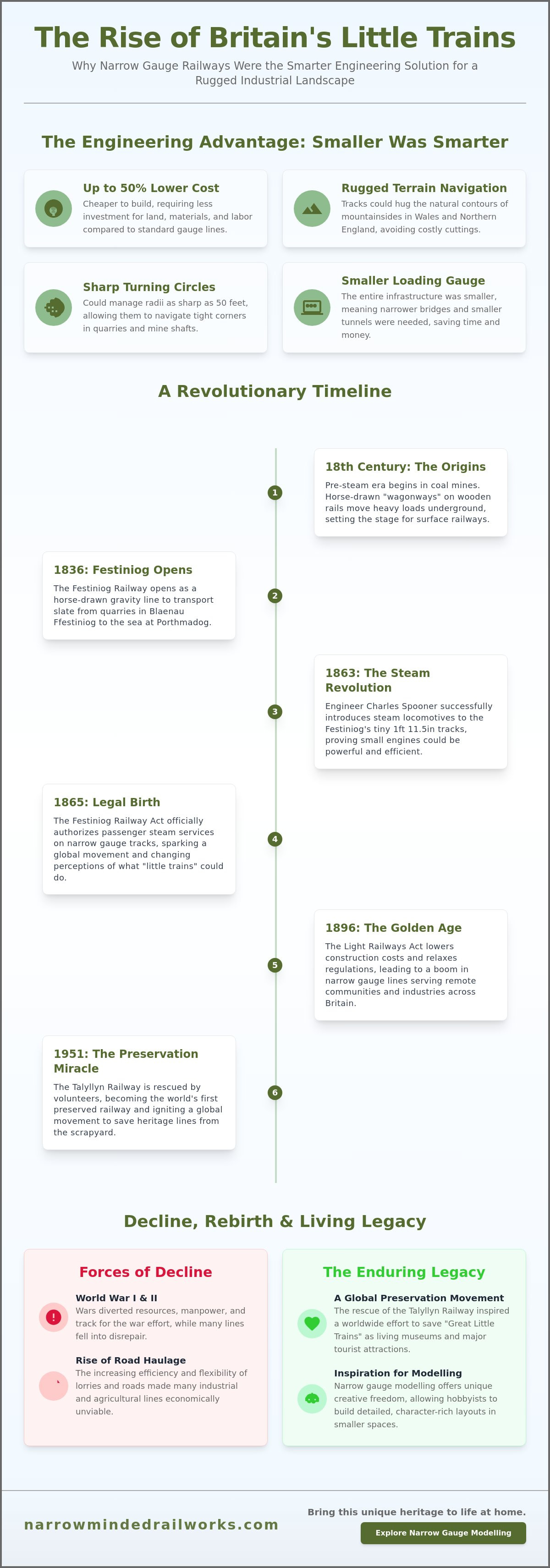
Geography dictated the need for a more flexible approach. In the rugged terrain of North Wales and Northern England, building a standard gauge line was often financially impossible. Narrow gauge tracks offered significant economic advantages. They were cheaper to build, sometimes costing 50% less than their larger counterparts. Because the tracks were closer together, the "loading gauge" was smaller. This meant engineers could dig smaller tunnels and build narrower bridges. They could also use tighter turning circles, with some lines managing radii as sharp as 50 feet. This allowed tracks to hug the natural contours of a mountainside rather than cutting through it.
The Pre-Steam Era: Wooden Tracks and Horse Power
The history of narrow gauge railways uk actually starts underground and in the dark. During the 18th century, coal mine owners used wooden "wagonways" to move heavy loads. These early systems didn't use engines. They relied on horse power to pull small wooden tubs along timber rails. The size of these tubs, often determined by the narrowness of the mine shafts, defined the initial loading gauges that would later influence surface railways. By 1767, the Coalbrookdale Company began replacing timber with cast-iron "plateways." These L-shaped iron plates kept flat-wheeled wagons on track and proved much more durable than wood. By the early 1800s, these industrial lines were common across the North of England, providing a blueprint for the steam revolution to follow.
The 1865 Turning Point: The Festiniog Railway Act
The Festiniog Railway in North Wales became the catalyst for the global narrow gauge movement. It opened in 1836 as a horse-drawn gravity line for the slate industry. However, by the 1860s, the demand for slate outpaced what horses could provide. In 1863, engineer Charles Spooner introduced steam power to the 1ft 11.5in tracks. Locomotives like The Princess and Mountaineer proved that small engines could be just as capable as their larger cousins. The Festiniog Railway Act of 1865 stands as the legal birth of modern narrow gauge by officially authorizing the use of passenger steam power on such narrow tracks. This success changed perceptions across the British Empire. It showed that narrow gauge wasn't just for mines; it was a viable system for public transport and heavy industry alike.
The Golden Age: Slate, Stone, and Industrial Expansion
The Victorian era transformed these diminutive tracks into the industrial lifeblood of Britain. While standard gauge lines linked major cities, narrow gauge systems penetrated deep into rugged landscapes where larger trains simply couldn't go. By the mid-1800s, the history of narrow gauge railways uk shifted from simple tramways to sophisticated networks. The 1896 Light Railways Act was a pivotal moment for this expansion. It lowered construction costs by relaxing strict safety regulations, allowing for cheaper "Common Carrier" lines that served remote farming communities and small-scale mines. These lines often carried everything from coal and timber to mail and livestock, acting as a vital social tether for isolated regions. This legislation meant that a village previously cut off from trade could suddenly export goods for a fraction of the previous cost.
The Great Welsh Slate Lines
Wales became the global epicentre for narrow gauge innovation. The Penrhyn and Dinorwic quarries developed internal networks of staggering complexity, often using gauges as narrow as 1ft 11.5in to navigate steep, narrow galleries. The Ffestiniog Railway, which opened in 1836, became the gold standard for transporting "blue gold" (slate) from Blaenau Ffestiniog to the coast at Porthmadog. In 1869, the introduction of the Fairlie double-boiler locomotive proved that these small lines could handle heavy loads on sharp curves. The Fairlie design was revolutionary because it provided twice the power without increasing the axle load, a necessity for the light rails of the era. Today, many of these routes are celebrated among Britain's top narrow-gauge railway journeys, preserving the engineering genius of the 19th century.
Industrial Diversity Beyond the Quarries
Expansion wasn't limited to the Welsh mountains. In Devon, the Lynton & Barnstaple Railway opened in 1898, showcasing a masterclass in narrow gauge engineering with its high viaducts and scenic coastal views. Meanwhile, estate railways like the Eaton Hall Railway, built for the Duke of Westminster in 1896, demonstrated how 15-inch gauge lines could manage large-scale agricultural transport and guest travel. The Isle of Man took a different path, opening a comprehensive 3ft gauge network in 1873 that remains a unique survival of a complete Victorian transit system. These lines weren't just for freight; they became essential links for passengers in areas where standard gauge was financially impossible. If you're looking to recreate these historic liveries on your own layout, you can find authentic parts at narrowmindedrailworks.com to bring that golden age detail to life.
War, Roads, and Decline: The 20th Century Struggle
The 20th century brought a brutal reality check for the history of narrow gauge railways uk. While these lines were once the backbone of slate and mineral transport, they struggled against a rapidly modernising world. The First World War provided a temporary boom in utility but ultimately accelerated their demise. By 1930, the public perception of these little railways shifted from efficient tools to quaint, slow-moving relics of a Victorian past. The 1921 Railways Act largely ignored them, leaving small companies to face the rise of the internal combustion engine alone.
As lorries became more reliable and affordable after 1918, the narrow gauge's biggest advantage, its ability to reach remote locations, vanished. Road haulage offered door-to-door delivery that tracks simply couldn't match. This competition created a downward spiral of deferred maintenance and reduced service. By the mid-1930s, many lines weren't just struggling financially; they were physically falling apart. The psychological shift was complete. The British public no longer saw these trains as symbols of progress but as antiquated curiosities that hindered modern traffic.
The Role of the War Department Light Railways (WDLR)
During the Great War, the War Department Light Railways (WDLR) adopted the 60cm gauge for the Western Front. Over 700 miles of track were laid by 1917 to supply the trenches. British manufacturers like Hunslet and American firms like Baldwin produced hundreds of locomotives for this effort. After the 1918 armistice, a massive surplus of this equipment returned to the UK. While this provided cheap motive power for industrial lines like the Leighton Buzzard Light Railway, it also saturated the market. The sheer volume of military-grade equipment meant that few new innovations were funded for decades, stalling the technological evolution of the history of narrow gauge railways uk.
The Post-War Collapse and the 1950 Deadline
As road haulage improved in the 1920s, the economic case for narrow gauge transport crumbled. The Lynton & Barnstaple Railway, a masterpiece of engineering, closed its doors on 29 September 1935. The Glyn Valley Tramway met a similar fate that same year. When the 1948 Transport Act nationalised the UK's rail network, narrow gauge lines were largely dismissed as insignificant. By 1950, the Talyllyn Railway was surviving on a shoestring budget with a single operational locomotive. The Ffestiniog Railway had already ceased passenger services in 1939 and remained derelict for years. These lines weren't just losing money; they were losing their place in a nation focused on motorways and high-speed travel.
The Preservation Miracle: From Scrap to "Great Little Trains"
The history of narrow gauge railways uk shifted dramatically in the post-war era. As heavy industry declined and road transport improved, these smaller lines lost their original purpose. By 1950, many faced total liquidation. However, a group of dedicated enthusiasts refused to let the tracks be lifted. They transformed these routes from industrial tools into global tourist attractions, creating a heritage model that is now emulated worldwide.
This transition wasn't just about nostalgia. It was a massive engineering undertaking. Volunteers spent thousands of hours clearing decades of overgrowth, repairing rotting sleepers, and overhauling steam locomotives that were often over 80 years old. Today, these lines contribute millions of pounds to the UK economy, proving that tourism is a viable "industrial" successor to slate and coal transport.
The Talyllyn and the Birth of Heritage Rail
The preservation movement began in central Wales. When the owner of the Talyllyn Railway died in 1950, author L.T.C. Rolt and a small band of volunteers stepped in to prevent the line from being sold for scrap. Their success in 1951 proved that a railway could be operated by a non-profit organisation driven by passion rather than purely commercial freight. The reopening of the Talyllyn Railway on 14 May 1951 stands as the most significant date in modern rail history. This event created a blueprint for historical conservation that saved dozens of other lines across the British Isles.
The Rebirth of the Welsh Highland Railway
While some lines were saved from closure, others required a complete resurrection. The Welsh Highland Railway (WHR) represents the pinnacle of this effort. After closing in 1937, the trackbed sat empty for decades. It took a 60-year legal and financial battle to begin the £28 million restoration project. This massive technical feat eventually connected Caernarfon to Porthmadog, creating a 25-mile continuous narrow gauge route through the heart of Snowdonia. If you are new to these unique systems, you might ask What is a Narrow Gauge Railway? to understand why their scale makes them so special for enthusiasts.
The survival of these lines led to the formation of the "Great Little Trains of Wales" marketing brand. This collective helps coordinate tourism for several key railways, including:
- The Ffestiniog Railway: The world's oldest independent railway company.
- The Vale of Rheidol: A former British Rail line that was the last to use steam in regular service.
- The Llanberis Lake Railway: Built on the tracks of the former Dinorwic Slate Quarry.
These organisations don't just run trains; they preserve the very history of narrow gauge railways uk through apprenticeship programmes and engineering workshops. They ensure that Victorian skills, like boiler making and vacuum brake maintenance, aren't lost to time. Whether you're a casual tourist or a dedicated modeller, the preservation movement ensures these "Great Little Trains" continue to climb the Welsh hillsides for generations to come.
Ready to bring the magic of heritage rail to your own home? Explore our range of narrow gauge models and start building your own miniature preservation project today.
Bringing History Home: Modelling the UK’s Narrow Gauge Legacy
Recreating the history of narrow gauge railways uk doesn't have to stop at visiting a preserved line. Modelling allows you to preserve specific moments in time that no longer exist in the physical world. You can build a scene from a 1920s slate quarry or a 1950s rural branch line right on your tabletop. It's a hands-on way to study the engineering and social history that shaped the British Isles. By building these models, you're keeping the memory of these unique transport systems alive for future generations.
One of the best things about this hobby is the choice between "prototype" and "freelance" modelling. Prototype modellers aim for total accuracy, where every sleeper and rivet matches a specific historical record. However, narrow gauge history is full of small, quirky lines that didn't always follow the rules. This makes "freelance" modelling very popular. You can create a fictional company that feels authentic to the period without being tied to a specific map. It gives you the creative freedom to imagine how a local industry might have thrived if its railway had survived past the 1940s.
Technology has lowered the barrier to entry for everyone. For decades, if you wanted a rare industrial locomotive, you usually had to scratch-build it from brass or white metal. 3D printing changed that forever. It allows for complex, accurate shapes to be produced in high-quality resin with incredible detail. This tech has made the hobby more inclusive for those who don't have a workshop full of heavy machinery but still want a professional finish.
Choosing a scale is your first big decision. OO9 is the most common choice in the UK, using 4mm to the foot scale on 9mm track. If you want something larger, O-16.5 uses 7mm scale on 16.5mm track. This larger scale offers more room for intricate detail and added weight, which helps with slow, realistic shunting. Both scales have vibrant communities and plenty of support for newcomers.
The Charm of OO9 Scale
OO9 is currently the powerhouse of the UK narrow gauge scene. Its popularity surged when major manufacturers began producing ready-to-run models, but the heart of the hobby remains in customisation. You can take a reliable, mass-produced N gauge chassis and fit a bespoke body on top. This blend of modern reliability and traditional kit-building makes it accessible for everyone. If you're ready to pick up the glue and paint, read Your First OO9 Loco Kit to see how to start your journey.
The Narrow Minded Approach to History
We focus on the locomotives that the history of narrow gauge railways uk often overlooks. While the famous heritage lines get plenty of attention, the small industrial workhorses of the 19th and 20th centuries are just as important to our national story. Our 3D printed kits capture the rugged, hardworking character of these steam and diesel engines. We help you bring these "forgotten" pieces of history back to life on your own layout. Explore our range of historical narrow gauge kits today!
Keeping the Narrow Gauge Legacy Alive on Your Workbench
The history of narrow gauge railways uk reflects a fascinating journey from the rugged slate quarries of North Wales to the volunteer-led preservation movement that saved the Talyllyn Railway in 1951. These 2-foot and 2-foot-3-inch gauge lines proved that smaller footprints could handle massive industrial output before the 1920s road boom threatened their existence. Today, these "Great Little Trains" represent a unique engineering heritage that continues to captivate enthusiasts across the country. They've transitioned from vital industrial tools to beloved cultural icons.
You don't have to visit a heritage line to experience this mechanical history. You can recreate these iconic scenes at home with our expertly designed 3D printed kits. We specialize in rare and historically significant prototypes available in OO9, GN15, and O-16.5 scales. Whether you're in the UK or building from abroad, we offer worldwide shipping to ensure every modeller can access high-quality wagons and locomotives. Browse our historical locomotive and wagon kits to start your next build. It's time to bring a piece of British industrial history to your layout.
Frequently Asked Questions
What was the first narrow gauge railway in the UK?
The Festiniog Railway, founded in 1832, is the oldest surviving narrow gauge railway company in the world. It originally carried slate from Blaenau Ffestiniog to Porthmadog using gravity and horses before introducing steam power in 1863. This line set the standard for the history of narrow gauge railways uk by proving that small locomotives could handle heavy loads on steep gradients. It successfully paved the way for hundreds of miles of similar tracks.
Why are many narrow gauge railways found in Wales?
Wales became the heart of narrow gauge travel because its mountainous terrain and narrow valleys made standard gauge construction too expensive. The slate industry in North Wales required efficient transport from remote quarries like Dinorwic and Penrhyn to coastal ports. Engineers chose narrow gauges to navigate tight curves that larger trains couldn't manage. By 1890, dozens of these lines operated across the Welsh hills to support local industry.
What is the difference between narrow gauge and standard gauge?
The primary difference is the distance between the rails, with standard gauge measuring 4 feet 8.5 inches and narrow gauge being anything smaller. Most UK narrow gauge lines use widths of 1 foot 11.5 inches or 2 feet 3 inches. These smaller dimensions allowed for sharper curves and smaller tunnels. It reduced construction costs by up to 50 percent compared to full sized mainline railways during the 19th century.
Are there still industrial narrow gauge railways operating in the UK?
Active industrial narrow gauge railways are rare in the 21st century, as most transitioned to heritage status or closed by 1970. A few specialized sites like the Fawley Hill Railway or private peat extraction sites still use them for moving materials. However, the majority of the 100 plus surviving lines now serve the tourism sector. They preserve the mechanical legacy of the industrial revolution for thousands of annual visitors.
What is the "Great Little Trains of Wales"?
The Great Little Trains of Wales is a marketing collective representing 12 historic narrow gauge railways across the country. Established in 1970, this group helps promote iconic lines like the Talyllyn and Snowdon Mountain Railway. It offers a "Wanderer" discount pass for tourists visiting multiple sites. These railways contribute millions of pounds to the Welsh economy each year while maintaining steam locomotives that are over 150 years old.
How fast could narrow gauge steam locomotives travel?
Narrow gauge steam locomotives typically travel at speeds between 15 and 25 miles per hour. The Light Railways Act 1896 officially capped speeds at 25 mph for safety reasons on these lighter tracks. While some modern diesel variants can go faster, heritage lines stick to these limits to protect the vintage infrastructure. This slower pace allows passengers to enjoy the scenic views of the British countryside without putting stress on the engines.
What is the most famous narrow gauge locomotive in Britain?
'Prince', built in 1863 for the Festiniog Railway, is widely considered the most famous narrow gauge locomotive in Britain. It's one of the oldest operational steam engines globally and represents a turning point in the history of narrow gauge railways uk. Another notable engine is 'Dolgoch' from the Talyllyn Railway. This specific locomotive inspired the 'Skarloey Railway' characters in the famous Thomas the Tank Engine stories written by Wilbert Awdry.