

Have you ever admired a breathtakingly detailed brass locomotive, wondering what justifies its premium price tag and what truly sets it apart from a standard plastic model? You're not alone. The world of high-fidelity model railways can seem shrouded in mystery, leaving many enthusiasts curious about whether these masterpieces are complex kits or ready-to-run treasures. For decades, one name has stood at the pinnacle of this craft: the Precision Scale Company. They are renowned for setting the standard, yet their vast and varied catalogue can be as intimidating as it is impressive for newcomers and seasoned modellers alike.
This guide is your all-access pass into their world. We will pull back the curtain on what makes brass models the ultimate collector's item and clarify exactly what Precision Scale Co. produces and imports. You'll learn how to navigate their extensive range of super-detailing parts to elevate your own projects from great to truly exceptional. Whether you're contemplating your first brass investment or searching for that one perfect casting to complete a custom build, consider this your definitive resource for understanding a true legend in model railroading.
Who is Precision Scale Company (PSC)? A Pillar of the Hobby
For serious model railway enthusiasts and collectors, the name Precision Scale Company (PSC) resonates with quality, historical accuracy, and unparalleled detail. Established over four decades ago, PSC has cemented its reputation as a cornerstone of the fine-scale modelling community. They are not a mass-market manufacturer; instead, they cater to discerning hobbyists who demand the highest fidelity in their locomotives, rolling stock, and scenic details. This focus has made them a go-to source for those aiming to create truly museum-quality layouts.
To see an example of the exquisite detail found in their models, take a look at this review of a PSC Mack Railbus:
A Brief History and Legacy
Founded to fill a gap in the market for high-end, accurate models, PSC quickly became a key importer of brass trains, primarily crafted by skilled builders in Korea. This allowed them to bring limited-run, highly detailed prototypes to the market that were not feasible for larger manufacturers. Alongside importing, the precision scale company developed an enormous catalogue of 'super-detailing' parts. This dedication to accuracy across various model railroad scales helped set a new standard in the hobby, pushing the boundaries of what was possible for realism.
Brass Models vs. Detail Parts: Understanding Their Business
PSC's business operates on two parallel tracks that serve slightly different, yet often overlapping, segments of the hobby. It's crucial to understand this duality to appreciate what they offer:
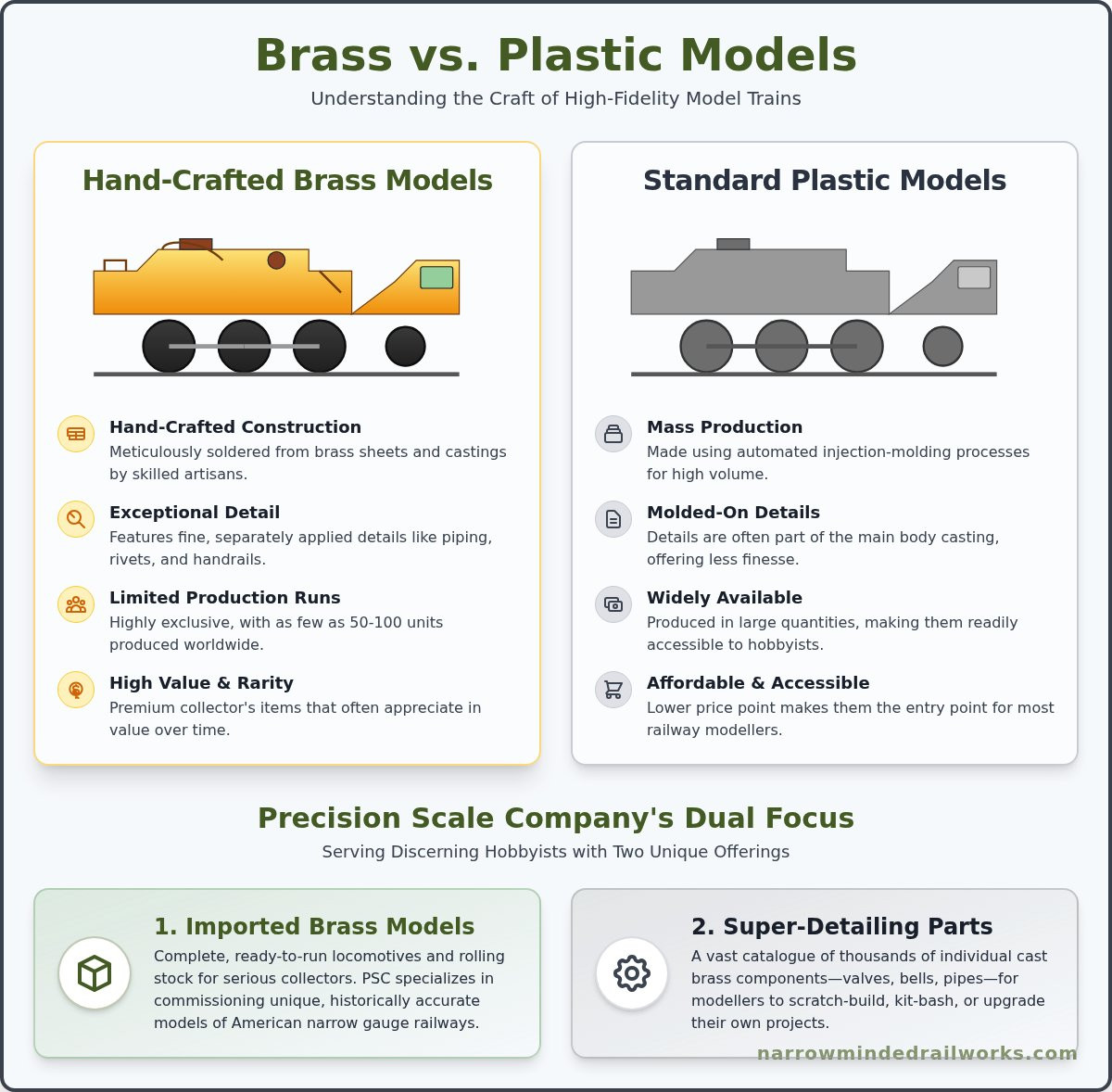
- Imported Brass Models: These are complete, ready-to-run (or easily made so) locomotives and rolling stock. Often pre-painted and exquisitely detailed, these are premium collector's items that can command prices of several hundred pounds or more. They represent a specific prototype with incredible accuracy.
- Super-Detailing Parts: This is the manufacturing side of the business. PSC produces thousands of individual components-from tiny brass valves and pipe fittings to intricate locomotive bell assemblies. These parts are for modellers who are scratch-building, kit-bashing, or upgrading existing models to a higher standard of detail.
This unique business model means they are not a traditional kit manufacturer. Instead, they provide either the finished masterpiece or the individual, high-quality components for you to create your own.
The World of Brass Model Trains: What Makes PSC Special?
For many enthusiasts, the pinnacle of model railway collecting isn't found in a high-street hobby shop. It lies in the world of brass models-exquisite, handcrafted replicas that represent the highest level of fidelity and craftsmanship. Unlike mass-produced plastic models, brass trains are considered functional art, built for the most discerning collectors. They offer a tangible connection to railway history through unparalleled detail and robust construction.
What Defines a Brass Model Train?
A brass model train is a far cry from its plastic counterpart. These models are defined by their unique construction and the artistry involved in their creation. Key characteristics include:
- Hand-Crafted Construction: Each model is built by hand from sheets and castings of brass, with components meticulously soldered together by skilled artisans.
- Exceptional Detail: This method allows for incredibly fine, separately applied details like piping, rivets, and handrails that are impossible to replicate with plastic injection moulding.
- Durability and Weight: The all-metal construction gives these models a satisfying weight and a durability that ensures they can be cherished for generations.
- Collector Status: Produced in very small quantities, brass models are often seen as investments that appreciate in value over time.
This dedication to artistry by skilled artisans is a hallmark of many specialist crafts. The meticulous soldering involved is a microcosm of industrial welding, where process management is just as critical as the physical skill. In fact, modern software platforms exist to handle this complexity; you can learn more about SOCWeld to see one such example. This principle of relying on specialists is also seen elsewhere; for instance, those looking to buy church vestments UK trust experts in their field, much like model railway enthusiasts rely on companies like PSC.
Why are Brass Models So Expensive?
The premium price of a brass model, which can range from several hundred to many thousands of pounds, is a direct reflection of its quality and rarity. The entire process is incredibly labour-intensive, with a single locomotive often requiring hundreds of hours of skilled work. Furthermore, they are produced in extremely limited runs-sometimes as few as 50 or 100 units worldwide. This exclusivity, combined with high material costs, import duties, and the builder's reputation, contributes to their value.
PSC's Role in the Brass Market
In this specialist market, importers play a crucial curatorial role, and this is where a precision scale company like PSC truly excels. While others focus on mainstream prototypes, PSC has built its legacy on serving a passionate niche: American narrow gauge railways. They are renowned for their focus on iconic lines like the Denver & Rio Grande Western (D&RGW) and the Rio Grande Southern (RGS). Their models are widely regarded as benchmarks for historical accuracy, adhering to the high standards promoted by organisations like the National Model Railroad Association (NMRA). By commissioning these specific models, the precision scale company provides collectors with access to unique pieces of railroad history that would otherwise never be produced.
Exploring the Precision Scale Co. Product Range
Precision Scale Co. has carved a distinguished niche in the model railway market by focusing on high-fidelity, ready-to-run brass models rather than kits. For the modeller who values exceptional detail and historical accuracy straight out of the box, their catalogue is a treasure trove. The collection primarily celebrates the golden age of American steam, with a significant emphasis on the country's iconic narrow gauge railways.
Iconic Locomotives in HO, HOn3, and O Scale
The heart of the product line lies in its stunningly detailed steam locomotives. While they produce models in standard HO and O scales, the precision scale company is arguably most famous for its HOn3 narrow gauge offerings. Enthusiasts will find legendary prototypes meticulously recreated, such as:
- Denver & Rio Grande Western K-class Mikados (K-27, K-36)
- Rio Grande Southern articulated locomotives
- Various Shay and Climax geared steam locomotives
Each model is a work of art, featuring complete backhead and cab interior detail, prototypical piping, and correctly scaled components. Many are offered professionally painted but unlettered, providing a perfect canvas for modellers to apply custom decals for their specific prototype or freelance railway.
Highly Detailed Freight and Passenger Cars
To complement their world-class locomotives, Precision Scale Co. offers an equally impressive range of rolling stock. These pieces are crafted to the same exacting standards, ensuring a consistent, museum-quality appearance across your entire train. The range includes historically accurate cabooses, a wide variety of freight cars like boxcars and gondolas, and elegant passenger coaches. These are not simple plastic kits; they are typically fully built brass models, a craft with a rich heritage. Understanding the history of brass model trains helps explain why these items are so highly prized by collectors. Each car is a faithful representation of a specific prototype from a particular era, making them essential for anyone building a historically precise layout.
PSC Detail Parts: The Secret to Super-Detailing Your Models
While Precision Scale Co. is renowned for its complete locomotive kits, the true heart of its offering for many modellers lies in its vast catalogue of over 16,000 individual detail parts. This extensive collection is the key to 'super-detailing'-the art of taking a standard model and elevating it to a museum-quality piece by adding or replacing finer, more accurate components.
The secret to their quality lies in the materials. PSC primarily uses exquisite lost-wax brass castings for components that demand strength and sharp detail, such as pipework and valve gear. This is complemented by high-fidelity, injection-moulded plastic parts for other items. The universal design of these components means they aren't exclusive to PSC kits; they are perfect for upgrading models from any manufacturer, breathing new life into older ready-to-run stock or adding that final touch to a complex kit build. For any modeller looking to achieve maximum realism, the precision scale company parts catalogue is an essential resource.
What Kind of Parts Do They Offer?
The sheer breadth of the PSC parts range is staggering, covering nearly every conceivable detail for your layout. Spanning scales from the diminutive N scale all the way up to large G scale for garden railways, you can find components for virtually any project. Key categories include:
- Locomotive Parts: Everything from bells, whistles, and smokestacks to intricate injectors, headlights, and cab detailing.
- Rolling Stock Parts: A complete selection of couplers, highly detailed bogies, brake wheels, grab irons, and underframe details.
- Right-of-Way Details: Enhance your trackside scenes with accurate switch stands, signal components, water columns, and other lineside structures.
How to Use PSC Parts on Your Own Projects
The versatility of these parts allows modellers to approach projects in several ways. You can take a mass-produced plastic locomotive from a brand like Hornby or Bachmann and systematically replace the moulded-on details with crisp brass castings for a dramatic increase in realism. Alternatively, when building a craftsman kit, you can substitute or add PSC components to further enhance the final model's accuracy.
For the truly ambitious, these parts are the building blocks for scratch-building a unique prototype. By combining components, a modeller can construct a locomotive or piece of rolling stock that has never been commercially produced. For instance, a highly detailed base model, such as one of our 3D printed kits, provides the perfect canvas for adding these exquisite PSC details to create a truly one-of-a-kind masterpiece.
Brass vs. Kits: Is Precision Scale Co. Right for You?
The world of narrow gauge railway modelling offers two distinct paths to owning a superb model: buying a finished masterpiece or building one from a kit. Understanding the difference in philosophy, cost, and required skills is key to choosing the right path for your hobby. This section compares the two approaches to help you decide if a precision scale company like PSC is your destination.
Cost and Value Proposition
The most immediate difference is financial. A ready-to-run PSC brass model is a significant investment, often costing several hundred pounds. However, its value is tangible; it's a high-fidelity, collectible piece that often holds or even appreciates in value over time. In contrast, a 3D printed kit has a very low entry cost. The value here isn't in resale potential, but in the personal satisfaction and experience of the build itself. Think of it as investing in a finished asset (brass) versus investing your time in a rewarding project (a kit).
Skillset and Enjoyment
Your enjoyment of the hobby is deeply tied to your preferred skillset. Do you get the most satisfaction from collecting and operating the finest, most accurate models straight out of the box? If so, the exquisite detail and craftsmanship of a brass model is likely your ideal choice. Conversely, if your passion lies at the workbench-the methodical process of assembly, the creative challenge of painting, and the pride of finishing a model with your own hands-then a kit is for you.
These two worlds are not mutually exclusive. Many skilled modellers use high-quality components from a precision scale company to super-detail their kits, blending the best of both approaches. There is no single "correct" way to enjoy the hobby, only the way that brings you the most joy.
Finding Your Path in Narrow Gauge
Precision Scale Co. offers the pinnacle of ready-made narrow gauge models, representing a benchmark for collectors. For those who wish to get more hands-on, brands like ours provide an accessible and affordable entry into building your own unique rolling stock. Both approaches are valid and vital ways to celebrate the rich history of these unique prototypes. If you're inspired to take the builder's path, we invite you to Explore our OO9 and GN15 kits and start your modelling journey today.
From Brass Heritage to Your Workbench
Precision Scale Co. has undeniably shaped the model railway landscape, offering both exquisite, ready-to-run brass locomotives and the tiny detail parts that bring any model to life. We've seen how their commitment to accuracy makes them a pillar of the hobby and how their components can elevate a standard kit into a museum-quality piece. Whether you are a collector of fine brass or a hands-on modeller, the legacy of the precision scale company provides a benchmark for quality that inspires us all.
If that inspiration has sparked your desire to create something truly your own, the next chapter of your modelling journey is waiting. As specialists in 3D printed OO9 and GN15 kits, we provide unique prototypes you simply won't find anywhere else, with worldwide shipping for modellers across the UK and beyond. Ready to build? Explore our unique range of 3D printed narrow gauge kits.
Whatever your next project, embrace the immense satisfaction of building and bring your unique vision to the rails. Happy modelling!
Frequently Asked Questions
Are Precision Scale Company models still being made?
While the original Precision Scale Company ceased manufacturing new models several years ago, its legacy is very much alive. The tooling and rights for many of their popular kits and parts were acquired by other manufacturers. Therefore, you won't find new models being released under the original brand name. However, these highly-detailed brass models remain extremely popular and are actively traded on the second-hand market, prized by collectors and serious modellers for their quality and historical accuracy.
Where is the best place to buy Precision Scale Co. models and parts?
For UK buyers, the best sources are typically on the secondary market. Online auction sites like eBay are a primary destination, but you must be diligent. Specialist UK-based model railway forums and dedicated second-hand brass model dealers often provide better-quality listings. Don't overlook major model railway exhibitions and swap meets, as these are excellent places to inspect models in person and find rare parts or complete, well-maintained locomotives from private sellers.
What is the difference between HOn3 and HO scale?
The key difference is the track gauge they represent. Both HOn3 and standard HO are built to the same 1:87 scale, meaning the locomotives and rolling stock are the same size. However, HO scale models standard gauge track (16.5mm between the rails), representing the real-world 4' 8.5" gauge. HOn3 models 3-foot narrow gauge prototypes, running on narrower 10.5mm track. This accurately reflects the smaller, often industrial or mountain railways they are based on.
Do brass models run on regular model railway track?
Yes, brass models run on the corresponding regular model railway track for their scale. An HO scale brass locomotive will run perfectly on standard HO gauge track, just like a plastic model. The material of the model doesn't dictate the track it requires; the scale and wheel standards do. However, be aware that some very old brass models may have oversized wheel flanges that can cause issues on modern, fine-scale track like Peco Code 75.
How do you maintain and care for a brass locomotive?
Proper care preserves your investment. For the body, gently dust with a soft brush and avoid abrasive polishes, which can damage factory paint or lacquer. To maintain performance, lubricate the mechanism sparingly. Use a high-quality, plastic-compatible model oil on a pinpoint oiler for gears and axle boxes. Avoid over-oiling. Storing the model in a dust-free display cabinet or its original box is the best way to keep it in pristine condition.
Are PSC models DCC ready?
Most Precision Scale Co. models were manufactured before DCC (Digital Command Control) became commonplace, so they are not 'DCC ready' out of the box. They are designed for traditional DC (analogue) operation. However, they can be converted to DCC. This typically involves electrically isolating the motor from the brass chassis and hard-wiring a suitable decoder. This conversion is a project best undertaken by an experienced modeller or a professional DCC installation service.