

What if you could enjoy the heavy, tactile presence of O scale modelling without sacrificing your entire spare room to a single standard gauge siding? Many modellers find themselves stuck in a frustrating middle ground. You might struggle with the microscopic parts of smaller scales, yet you don't have the footprint for a full-sized 7mm layout. Focusing on 7mm narrow gauge wagon kits is the proactive solution to this space constraint, allowing you to build a high-detail fleet on a compact HO-sized footprint.
This guide will help you master the art of narrow gauge modelling for O-16.5 and On30 layouts. You'll learn exactly how to choose, build, and finish high-detail models that look professional but remain accessible for any skill level. We'll show you how to bridge the gap between traditional techniques and modern technology to create a characterful industrial or freelance railway with confidence.
We'll break down the essential differences between O-16.5 and O-14 standards and explain why 3D-printed resin has become the preferred choice for modern builders. You'll gain a clear understanding of how to source the right components and assemble your first kit. From understanding gauge widths to planning your final rake, this is your complete roadmap for successful modelling in 2026.
Key Takeaways
- Understand the technical standards of O-16.5 and why 16.5mm track facilitates a high-detail 7mm scale layout within a compact footprint.
- Evaluate the advantages of 3D-printed resin when selecting 7mm narrow gauge wagon kits, focusing on surface detail and assembly efficiency.
- Identify the specific chassis and wheel standards required to avoid running issues, ensuring your rolling stock performs reliably on commercial track.
- Master the practical workflow for finishing 3D-printed components, from removing support marks to choosing the correct adhesives for resin assembly.
- Develop a strategy for building a characterful fleet by choosing wagon types, such as slate or timber bolsters, that suit your specific industrial operations.
What is 7mm Narrow Gauge? Scale, Gauge, and Standards
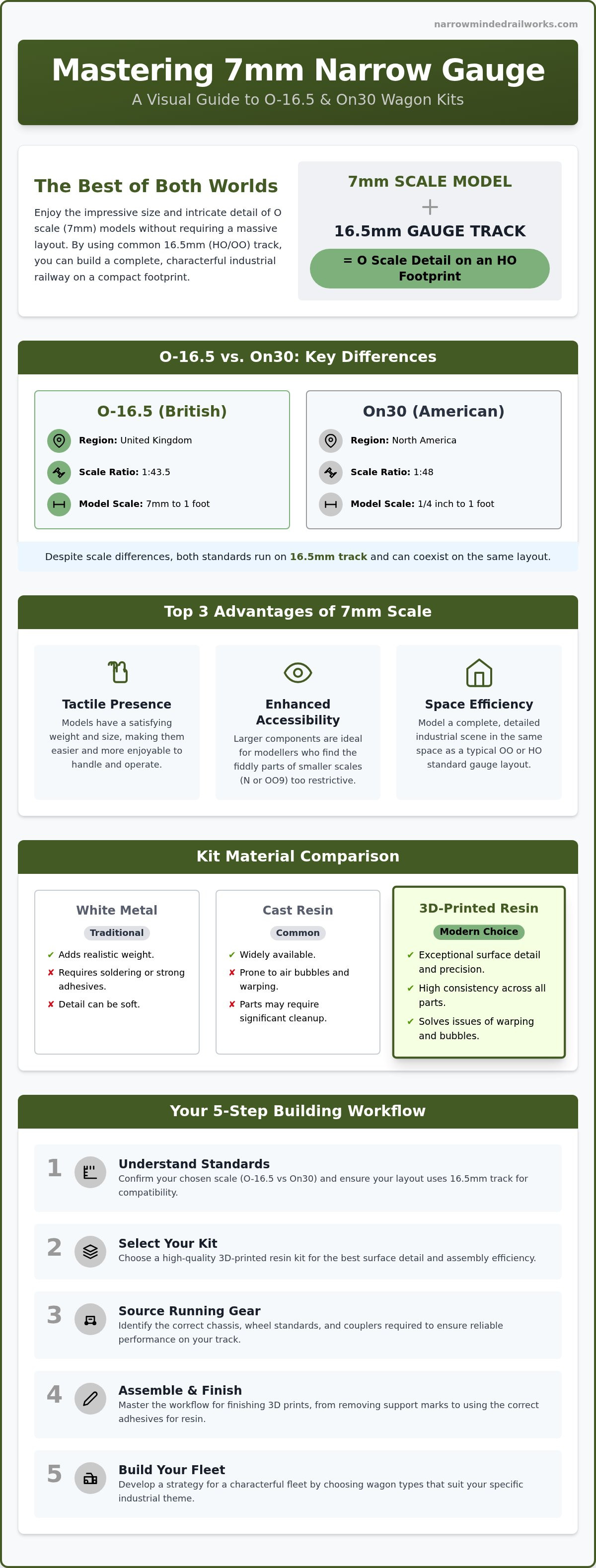
7mm narrow gauge is a unique creative space that prioritises character and detail. It uses a 1:43.5 ratio, meaning 7mm on the model represents one foot on the prototype. This is often called the "modeller's scale" because it's large enough to showcase incredible detail, from individual wood planks to heavy iron strapping, without requiring a massive layout. It's the proactive solution for those who want the detail of O scale but don't have the room for standard gauge track.
When you look at 7mm narrow gauge wagon kits, the visual difference from standard gauge is striking. Standard gauge wagons are often uniform and massive, but their narrow gauge counterparts are smaller, quirkier, and built for specific tasks like hauling slate or timber. By using 16.5mm track, which is standard for OO gauge in the UK, modellers represent narrow gauge lines that were originally 2ft or 2ft 6in wide. This clever use of common track makes the hobby accessible while maintaining the impressive 7mm scale.
O-16.5 vs. On30: The Technical Difference
There's often confusion between British and American standards. British O-16.5 uses a 1:43.5 ratio, while American On30 uses 1:48. While the difference seems small, it's noticeable when models are side-by-side. However, because both rely on 16.5mm track, they coexist comfortably on the same layout. O-16.5 is 7mm scale models running on 16.5mm gauge track. This standard is supported by the 7mm Narrow Gauge Association, which remains a vital resource for technical accuracy and historical prototype information.
Why Choose 7mm Scale for Your Next Layout?
Choosing this scale offers a level of presence that smaller scales can't match. The models have a tactile weight and a chunky feel that makes them satisfying to handle and run. If you find working with OO9 or N gauge parts too fiddly, 7mm provides a welcome relief. It's much easier to thread a coupling or apply a decal when the parts are large enough to hold comfortably. Consider these advantages:
- Tactile Presence: The models have a satisfying weight and size that makes them easier to handle.
- Accessibility: Larger components are better for modellers who find smaller scales too restrictive.
- Space Efficiency: You can model a complete industrial world in the same space as a standard OO gauge layout.
Space efficiency is the ultimate benefit for the O scale enthusiast. You get the high detail of a large scale without the need for a huge room. Because the prototypes were designed for tight curves, your layout can be much more compact than a standard gauge equivalent. Building a fleet of 7mm narrow gauge wagon kits allows you to create a busy industrial scene within a standard HO footprint, offering the best of both worlds.
Choosing Your 7mm Narrow Gauge Wagon Kits
Selecting the right 7mm narrow gauge wagon kits can feel daunting due to the sheer variety of prototypes available. Many modellers struggle to narrow down their fleet, but the proactive solution is to decide on a specific industrial or estate theme before purchasing. Whether you're interested in rugged slate wagons, timber bolsters, or general goods vans, your choice defines the atmosphere of your layout. For those looking at broader standards, you might find our An Introduction to On30 Gauge helpful for technical context.
Material choice is equally important for the building experience. While white metal kits offer weight, they often require complex soldering or heavy adhesives. Cast resin kits are common, but they can suffer from air bubbles or warped parts. Modern 3D-printed resin kits solve these issues by providing high precision and consistency across every part. For historical accuracy, researching the National Railway Museum collection provides excellent prototype references for those who want to replicate specific historical vehicles accurately.
Industrial vs. Estate Railway Prototypes
Industrial layouts usually demand a rugged, functional aesthetic. You might focus on quarry or mining wagons that look heavily used and weathered. If you prefer a more refined look, estate railways offer the charm of passenger stock and agricultural wagons. Many hobbyists choose to mix and match kits to create a unique "freelance" company identity. This approach allows you to build a fleet that suits your specific operational needs without being strictly tied to a single historical line.
The Rise of 3D Printed Wagon Kits
Traditional casting methods often struggle with very fine details, but 3D printing offers a high-resolution solution that captures every rivet and bolt head with clarity. Some modellers worry about "print lines" on resin models. Modern high-resolution printers minimise these marks, often making them invisible under a standard coat of primer. The main benefit for the modeller is the one-piece body print. This design reduces assembly time and ensures the wagon is perfectly square from the start. If you're looking for a reliable way to expand your rolling stock, exploring our range of 7mm scale kits is a great starting point for your next project.
- Slate Wagons: Essential for Welsh-themed industrial lines.
- Timber Bolsters: Perfect for adding visual interest with long, textured loads.
- Goods Vans: Ideal for adding variety and a "lived-in" feel to your trains.
Essential Running Gear: Chassis, Wheels, and Couplers
Building 7mm narrow gauge wagon kits requires more than just a well-printed body; you need a reliable foundation to ensure your rolling stock performs smoothly on the track. Many modellers feel overwhelmed by the variety of chassis and wheel options available, but the proactive solution is to stick to established standards that guarantee compatibility. For those just starting, understanding what is a narrow gauge railway helps clarify why we use specific components to represent these unique industrial lines.
Most modern 3D-printed kits are designed to fit commercially available donor chassis. This approach prioritises reliability, as these units are engineered for consistent performance. While we provide the high-detail bodies, you'll need to source the running gear that matches your chosen standard. Identifying the correct chassis early in the build prevents alignment issues and ensures your 7mm narrow gauge wagon kits sit at the correct prototypical height.
Selecting the Correct Wheelsets
Metal wheels are generally preferred over plastic for several reasons. They provide a lower centre of gravity, which improves stability on uneven narrow gauge track, and they help keep rails cleaner by avoiding the "plastic film" buildup associated with synthetic wheels. Common diameters for 7mm scale range from 10mm to 14mm, depending on the prototype you are modelling. Ensuring your axles are the correct length for your chosen kit is vital for free-running wagons. This allows you to pull long, realistic trains without placing undue strain on your locomotives.
Coupling Systems for 7mm Scale
Couplings are the final piece of the puzzle and often define the "look" of your railway. Traditional "chopper" or "pencil" couplings offer high prototype accuracy, often seen on the historic lines documented by The Narrow Gauge Railway Society. However, these can be fiddly for those who prioritise operation. Modern magnetic knuckle couplers are a practical alternative for modellers who enjoy frequent shunting. You should ensure your wagons connect seamlessly to your locomotives by standardising one system across your entire fleet.
| Coupler Type | Prototype Accuracy | Ease of Use | Compatibility |
|---|---|---|---|
| Chopper | High | Moderate | Scale Specific |
| Magnetic (Knuckle) | Low (UK Prototype) | High | Universal |
| Link and Pin | Highest | Low | Manual Only |
Choosing the right gear is a balance between historical accuracy and operational ease. By selecting high-quality metal wheels and a consistent coupling system, you transform a static kit into a reliable piece of rolling stock that will provide years of service on your layout.
How to Build and Finish 3D Printed 7mm Kits
Traditional plastic cement won't work on resin models, which can be frustrating for those transitioning from standard plastic kits. The proactive solution is to use high-quality Cyanoacrylate (Super Glue) to ensure a strong, permanent bond between components. When assembling 7mm narrow gauge wagon kits, this adhesive allows you to attach fine details like brake gear or handrails with precision. It's essential to apply glue sparingly to avoid obscuring the crisp 3D-printed details that make this scale so appealing.
Achieving a professional look requires a different approach than finishing white metal or brass. Once your model is assembled, you should focus on creating a smooth surface for your chosen livery. For a deep dive into specific techniques, our guide on Painting 3D Printed Models provides a comprehensive workflow. Before you start, ensure the model is free from any residual dust or oils from handling.
Surface Preparation Techniques
Support marks are a natural part of the 3D printing process, but they don't have to ruin your finish. You can sand away small nubs using fine-grit sanding sticks, typically starting with a 400 grit and moving to a 600 or 800 grit for a polished surface. Be careful not to flatten rounded details during this stage. 3D-printed resin requires a dedicated primer for the best paint adhesion. Use the "prime and check" method by applying a light coat of grey primer to reveal hidden imperfections. If you spot a mark you missed, sand it back and re-prime that specific area before moving to your final colours.
Advanced Weathering for 7mm Wagons
The larger 7mm scale is the perfect canvas for realistic weathering effects like rust and deep wood grain. Because the parts are more substantial than those in OO9, you can use layers of acrylic washes and weathering powders to bring out the 3D-printed textures. Focus on areas where moisture would naturally sit, such as the corners of wagon floors or around bolt heads. To protect your hard work, choose a high-quality matte or satin varnish. This layer seals the weathering and prevents the paint from chipping during operation on your layout. If you're ready to start your next project, you can view our full range of 7mm narrow gauge wagon kits to find a prototype that fits your fleet.
- Washes: Use dark tones to add depth to plank lines and recesses.
- Powders: Apply rust or soot effects to metalwork and running gear.
- Varnish: Use a matte finish for industrial wagons to reduce the "plastic" sheen.
Expanding Your Fleet with Narrow Minded Railworks
Building a consistent and reliable fleet is the ultimate goal for any 7mm modeller. However, many hobbyists find that traditional kits require extensive modification to run smoothly on modern track. We acknowledge this frustration and offer a proactive solution through our range of o-16.5 wagon kits. By focusing on 3D-printed designs that are specifically engineered for standard commercial chassis, we ensure that your rolling stock performs with high reliability without sacrificing the creative joy of kit building.
Our 7mm narrow gauge wagon kits are designed to bridge the gap between British 7mm (O-16.5) and American On30 standards. Because both rely on 16.5mm track, our bodies provide a versatile canvas for modellers on both sides of the Atlantic. Whether you're building a Welsh slate line or a freelance industrial tramway, these kits integrate seamlessly with our locomotive bodies and diorama scenery. This holistic approach allows you to create a complete, cohesive world where every element, from the trackside tools to the heavy goods rakes, feels like it belongs to the same story.
Our Design Philosophy
We utilise advanced 3D technology to recreate the characterful, "lived-in" appearance of historic railway stock. Traditional casting can sometimes lose the subtle texture of weathered wood or the sharp edges of ironwork, but our high-resolution resin prints capture these details perfectly. We prioritise ease of assembly to make 7mm modelling accessible to everyone, regardless of their previous experience with resin or white metal. Each kit serves as a robust base that you can easily customise with additional handles, steps, or unique liveries to suit your specific freelance company identity.
Next Steps for Your Layout
If you're ready to move beyond standard gauge and embrace the creative freedom of narrow gauge, browsing our current inventory of 7mm scale kits is the best way to start. We encourage you to join the wider 7mm community by visiting local exhibitions or joining specialist groups, where you can share techniques and see these models in action. Starting your journey doesn't require a massive investment of time or space; you can begin transforming your layout with a single wagon kit today. By focusing on high-detail, reliable components, you can build a fleet that you'll be proud to run for years to come.
- Reliability: Kits designed specifically to fit proven commercial running gear.
- Detail: High-resolution 3D printing that captures textures traditional methods miss.
- Accessibility: Simplified assembly processes that welcome newcomers to the scale.
Build Your Ideal 7mm Narrow Gauge Fleet
Modelling in 7mm scale offers an unparalleled level of tactile detail and character, yet the traditional barrier has always been the complexity of assembly and running reliability. We address these constraints by providing specialist 3D-printed designs that are specifically engineered for easy assembly on standard chassis. By choosing modern 7mm narrow gauge wagon kits, you ensure that your rolling stock spends more time on the track and less time on the workbench. This approach prioritises your operational success while maintaining the high standards expected in O-16.5 modelling.
Whether you're developing a Welsh industrial scene or a freelance estate line, our kits provide the precision needed for a professional finish. We provide worldwide shipping for modellers across the globe, ensuring that distance is never an obstacle to your next project. It's time to transform your layout with models that balance historical character with consistent, reliable performance. We're here to support your creative journey with clear guidance and high-quality components.
Browse our full range of 7mm narrow gauge wagon kits at Narrow Minded Railworks and take the first step toward a more detailed layout today. Your journey into the creative world of narrow gauge modelling starts with a single, high-quality kit.
Frequently Asked Questions
Is On30 the same as O-16.5 gauge?
While both standards use 16.5mm track, they represent different scales. On30 is the American standard at 1:48 scale, whereas O-16.5 is the British standard at 7mm to the foot (1:43.5). We acknowledge that the shared track gauge causes confusion, but the proactive solution is to choose the scale that matches your prototype. British models will appear slightly larger and bulkier than their American counterparts.
Can I use standard OO or HO track for 7mm narrow gauge wagons?
Yes, you can use standard 16.5mm track, but the sleeper spacing won't look prototypical for a narrow gauge line. Standard track is designed for 1:76 or 1:87 scales, making the sleepers appear too small and close together for 7mm. The proactive solution is to use dedicated O-16.5 track or hide the sleepers with heavy ballasting and weeds to maintain the narrow gauge aesthetic.
What glue should I use for 3D-printed resin wagon kits?
Traditional solvent-based plastic cement won't bond 3D-printed resin, which can lead to parts falling off during operation. The proactive solution is to use Cyanoacrylate (Super Glue) or a two-part epoxy for all assembly. For our 7mm narrow gauge wagon kits, a medium-viscosity Super Glue is ideal because it gives you a few seconds to align parts before setting permanently.
Do 7mm narrow gauge kits come with wheels and couplers?
Most of our kits are supplied as body-only components to give you maximum flexibility. We acknowledge that modellers have different preferences for wheel standards and coupling types, such as chopper or magnetic varieties. The proactive solution is to source these parts separately. We design our kits to fit standard commercial wheelsets, ensuring you can choose the running gear that best suits your layout.
What is the best way to remove support marks from a 3D-printed kit?
Small nubs from the printing process are unavoidable, but they are easy to manage with the right tools. The proactive solution is to use fine-grit sanding sticks rather than heavy files. You should start with a 400-grit stick to level the surface and finish with 800-grit for a smooth polish. This ensures your paint finish looks professional without damaging the underlying 3D-printed detail.
Can I run British 7mm wagons with American On30 locomotives?
Technically, they will run perfectly on the same track because the gauge is identical. However, you might find the size difference distracting, as British 7mm models are approximately 10% larger than On30 equivalents. The proactive solution is to keep them in separate rakes or use a freelance theme where the variation in rolling stock size adds to the character of your industrial railway.
How do I know which chassis will fit a specific wagon kit?
Finding a compatible chassis can be a challenge when building traditional kits. We provide a proactive solution by designing our 7mm narrow gauge wagon kits to fit specific, readily available commercial chassis. You should check the individual product descriptions on our store, where we list the recommended donor units. This ensures your finished wagon has the correct height and reliable running characteristics.
Is 7mm narrow gauge suitable for a small shelf layout?
Space constraints often prevent modellers from exploring O scale, but narrow gauge is the perfect alternative. Because narrow gauge prototypes were designed for tight curves and restricted spaces, you can fit a full layout on a small shelf. The proactive solution is to use 7mm scale to gain the detail you want while maintaining a footprint no larger than a standard OO gauge branch line.