

The most memorable model railways aren't always the ones with the longest trains or the most expensive electronics. In fact, the "indie" side of the hobby, where kit building and character trump mass-produced perfection, is where the real magic happens. If you've ever felt that standard gauge feels a bit too predictable, you aren't alone. With over 1,000 members in the 009 Society as of May 2026, more enthusiasts are trading standard tracks for the quirky charm of anything narrow gauge.
It's easy to get confused by the terminology of OO9 versus GN15, or feel frustrated when local shops don't stock the specialized items you need. You might even worry that 3D-printed resin kits are too difficult to assemble compared to a Bachmann Quarry Hunslet, which reached a recommended retail price of £149.95 in April 2025. This guide clears up the scale versus gauge confusion and gives you the confidence to start your first locomotive kit. We'll explore the major scales, show you how to master kit building, and reveal where to find the best diorama tools to bring your small-scale world to life.
Key Takeaways
- Understand the fundamental differences between standard and narrow gauge to maximize your layout's detail in a compact space.
- Identify which scale best fits your modeling goals by comparing the unique footprints of OO9, O-16.5, and GN15.
- Learn how to overcome the scarcity of ready-to-run models by embracing the creative freedom of 3D-printed kits.
- Master the storytelling techniques used in diorama building to ensure anything narrow gauge you build has a sense of history and character.
What is Narrow Gauge Railway Modelling?
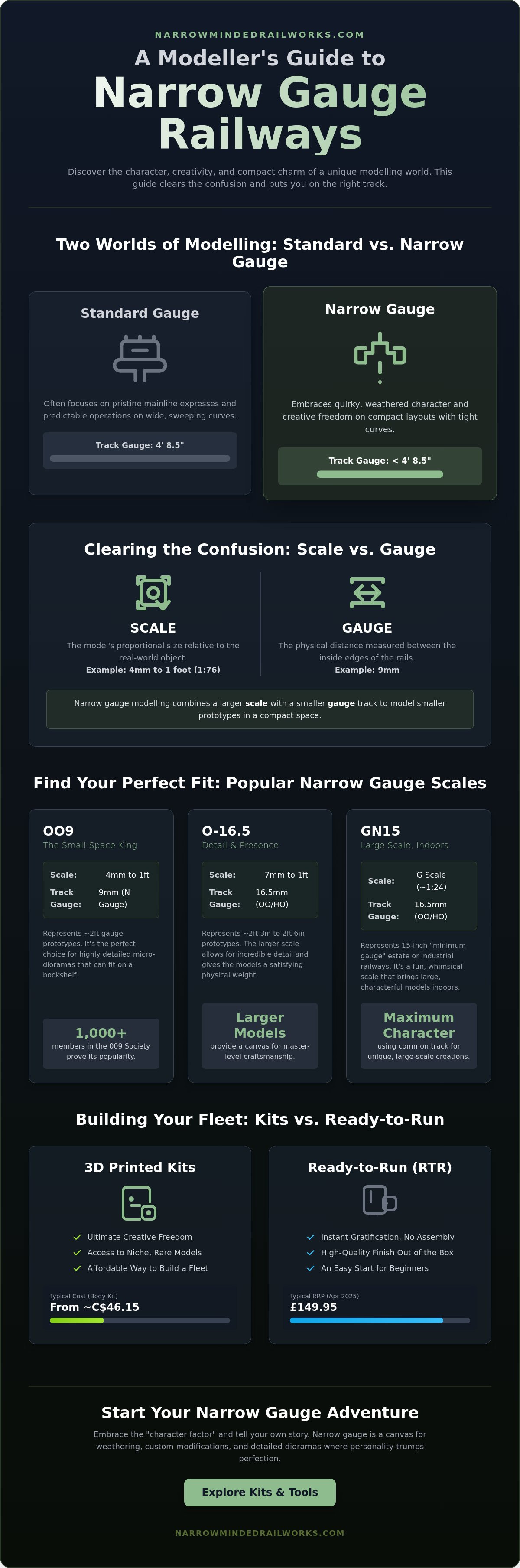
Narrow gauge isn't just a technical measurement; it's a mindset. In the real world, a narrow gauge railway is any line where the rails sit closer together than the standard 4 feet 8.5 inches. These railways were built for utility and economy, snaking through Welsh slate quarries or serving remote rural villages. For the modeller, this translates to quirky locomotives and incredibly tight curves that would be impossible to replicate on a standard gauge layout without taking up an entire room.
The appeal lies in the freedom. You don't need a massive basement to build a convincing scene. Because the prototypes were often improvised or adapted from whatever parts were available, anything narrow gauge allows you to escape the rigid, often clinical rules of mainline modelling. Whether you're inspired by the historic Ffestiniog Railway or the rugged Talyllyn, your layout becomes a playground for character and creativity. These lines were the lifeblood of industry, carrying slate, timber, and passengers through landscapes where standard trains simply couldn't go.
To see a beautifully realized example of these principles in action, watch this video of the Holsworthy layout:
Scale vs. Gauge: Clearing the Confusion
Confusion often stems from mixing up the size of the model with the distance between the rails. Scale refers to the proportion of the model relative to the real thing, while gauge is the physical width of the track. Many modellers use existing track standards to represent narrow lines. For example, OO9 scale uses 9mm track, which is the same width as N gauge, to represent two-foot gauge rails in 4mm scale. This allows for a much larger, more detailed locomotive to run on a very small footprint. You can find a complete breakdown of these relationships in this list of narrow-gauge model railway scales.
The "Character" Factor in Narrow Gauge
Standard gauge modelling often focuses on shiny, pristine expresses. In contrast, narrow gauge is about the personality of the machinery. These lines were often cash-strapped; this meant locomotives were patched up, weathered by coal dust, and modified in local sheds with whatever was on hand. This makes the hobby a haven for kit builders and those who enjoy detailed diorama work. It's a community driven by small cottage industries rather than mass-market corporations. Since 3D printing technology has advanced, modellers can now access highly detailed locomotive bodies that were once impossible to find in local shops. If you want to dive deeper into why these lines are so unique, check out our guide on the narrow gauge railway hobby.
A Reference Guide to Popular Narrow Gauge Scales
The beauty of this hobby is its sheer diversity. When you decide to explore anything narrow gauge, you aren't limited to a single box under the Christmas tree. Instead, you're choosing a "feel" for your railway. Some modellers want a tiny shelf layout that fits in a bookcase, while others prefer chunky, tactile models that fill a spare room. This choice dictates everything from the radius of your curves to the physical weight of your locomotives. Organizations like the Narrow Gauge Railway Society help enthusiasts navigate these choices by documenting the history and technical specs of the prototypes we love to replicate.
Your choice of scale often depends on the availability of a reliable donor chassis. Since many narrow gauge enthusiasts build from kits, they frequently use standard gauge N or OO chassis to power their creations. This crossover between UK and US modelling traditions means you can often find parts that work across different regional styles. Whether you're aiming for a Colorado logging line or a Welsh quarry, the right scale exists for your space.
OO9 and HOn30: The Small-Space Kings
If space is at a premium, OO9 is the gold standard. These are 4mm scale models that run on 9mm track. It's the perfect scale for highly detailed micro-dioramas. The 009 Society currently supports over 1,000 members worldwide, proving that small-scale modelling is more popular than ever in May 2026. The rise of 3D-printed resin bodies has revolutionized this scale. It allows modellers to create niche locomotives like the Andrew Barclay Douglas for around C$46.15 using a standard Kato chassis.
GN15: Large Scale Indoors
GN15 is a fascinating "minimum gauge" scale. It uses 1:24 scale bodies running on 16.5mm track, which is standard HO/OO width. This represents very narrow 15-inch gauge lines, often found on large country estates or industrial sites. It's a great choice for those who love large, characterful figures and intricate scenery without needing a garden-sized space. You can learn more about this unique niche in our gn15 scale guide.
On30 and O-16.5: The 7mm Powerhouses
For many, 7mm scale (O gauge) represents the sweet spot. On30 and O-16.5 models run on 16.5mm track, offering a satisfying weight and level of detail that smaller scales can't match. These models are easier to handle for those who find OO9 a bit fiddly. They provide plenty of room for adding realistic cab details and weathered textures. If this sounds like the right fit for your workshop, dive into our on30 gauge article. If you're ready to start building, you can browse our collection of specialist narrow gauge kits to find your next project.
Building Your Fleet: Why Kits Beat Ready-to-Run
In most areas of model railways, you walk into a shop and buy a finished train. Narrow gauge is different. While Bachmann announced a new batch of Quarry Hunslet locomotives in April 2025 with an RRP of £149.95, these ready-to-run (RTR) releases are rare and often sell out instantly. If you want a specific locomotive from a local Welsh line or a unique industrial "critter," you'll likely need to build it yourself. This isn't a barrier; it's the heart of the hobby. Choosing anything narrow gauge means embracing the role of the workshop foreman, where kit building becomes a core skill rather than a chore.
Building from a kit offers a level of creative freedom that mass-produced models can't match. You choose the livery, the weathering, and the nameplates. You aren't stuck with the same locomotive number as every other modeller. It's also a cost-effective way to grow a fleet. While high-end brass models can cost hundreds, a 3D-printed resin kit like a Doble Sentinel costs around $35.00. This approach allows you to build a diverse roster of rolling stock without the financial sting of collector-grade prices. For those looking for community support during their first build, The 009 Society provides an invaluable network of experts and a monthly journal that has been in publication since 1973.
The Evolution of 3D Printed Kits
The hobby has changed significantly since the days of heavy white metal kits. Modern resin 3D printing has replaced the rough, "stepped" look of older FDM prints with smooth, high-definition finishes. These resin bodies require very little cleanup, often needing just a quick wash in soapy water before they're ready for the paint shop. Because the material is lightweight and captures incredible detail, you get the look of a professional model with much less effort. To get the best results from these modern materials, it's vital to follow a guide on painting 3d printed models to ensure your primer and topcoat bond perfectly to the resin surface.
Matching Bodies to Commercial Chassis
You don't need to be an electrical engineer to power your kits. Most modern narrow gauge kits are designed as "body kits" that fit directly onto reliable, mass-produced chassis. Brands like Kato, Bachmann, and Graham Farish produce N gauge and OO gauge power units that are perfect donors. For instance, many OO9 locomotive kits are specifically designed to "click-fit" onto a Kato 11-109 or 11-110 chassis. This philosophy combines the best of both worlds: the smooth, reliable running of a commercial motor with the unique, characterful appearance of a specialized narrow gauge locomotive.
Creating the Scene: Scenery and Diorama Essentials
In standard gauge, the scenery often serves as a backdrop for the train. In anything narrow gauge, the scenery is the story. These layouts are frequently designed as character studies or micro-dioramas, where every square inch of the landscape reveals something about the railway's history. Because narrow gauge lines were often built on a shoe-string budget, the environment is typically cluttered with improvised repairs, overgrown trackbeds, and repurposed structures. The trains don't just pass through the scene; they're an inseparable part of it.
Tight detailing is the secret to success on a small footprint. You can use "forced perspective" to make a shelf layout feel deeper than its physical 12 inches by placing smaller-scale buildings toward the back. The goal is to create a scene so dense with detail that the viewer spots something new every time they look. To achieve this, having the right diorama tools is essential. Whether you're carving foam for a rock face or applying static grass, the textures must reflect the rugged, industrial nature of the prototype. Every layer of grit and every tuft of weeds adds to the narrative of a line that's fighting against the elements.
Detailing with 3D Printed Accessories
The shift toward high-detail resin printing has changed how we furnish our layouts. Instead of generic plastic buildings, you can now find specific, historically accurate accessories that ground your model in reality. Small items like a 7mm scale Great War Memorial, which was listed for £9.50 on the Narrow Minded Railworks website in May 2026, or a pair of Celtic Crosses for £8.75, add an immediate sense of place. These aren't just decorations; they define the era and location of your line.
Figures play an equally vital role in storytelling. Modern 3D-scanned figures capture authentic human poses that traditional molded plastic often misses. A driver leaning out of a cab or a group of workmen waiting for a skip provides a "human" element that transforms a static model into a living scene. These small details help the observer understand the scale and purpose of the railway without needing a single word of explanation.
Weathering for Realism
Narrow gauge locomotives were hard-worked machines. They rarely stayed clean for long. Weathering is the process of adding layers of "history" to your models using powders, washes, and dry-brushing techniques. Because 3D resin surfaces are non-porous, they take weathering remarkably well, allowing you to build up layers of grime, rust, and coal dust. You can depict a locomotive that hasn't seen a cleaning rag in years, with lime scale streaks on the boiler and oil stains on the frames. This level of grit is what gives the hobby its unique charm. If you're looking to enhance your layout's atmosphere, you can explore our range of diorama tools and scenery kits to find everything you need for your next character study.
Start Your Narrow Gauge Adventure with Narrow Minded Railworks
Narrow gauge can feel like a closed shop if you're only looking at expensive brass models or rare second-hand finds. At Narrow Minded Railworks, we've spent years breaking down that barrier. Our mission is to make anything narrow gauge accessible to every enthusiast, regardless of their budget or previous experience. We're a UK-based business specializing in high-quality 3D-printed resin kits that bring character and history to your layout. As of May 2026, our products are available through our website, eBay, and Etsy stores, ensuring modellers worldwide can access the specialized parts they need.
We don't just design kits; we build them. Every locomotive body and wagon we produce is designed for modellers, by modellers. This means we focus on things that matter in the workshop, like ease of assembly and sharp, crisp details that take paint beautifully. Every design goes through rigorous testing to ensure it meets our standards for print quality and fit. We understand the frustration of limited availability in local shops. That's why we maintain active storefronts on multiple platforms. Our Etsy shop showed its latest activity on April 25, 2026, reflecting our commitment to keeping stock moving and supporting the community.
Browse Our OO9 and O-16.5 Collections
Industrial and quarry lines are at the heart of our passion. Our OO9 collection includes fan favorites like the Andrew Barclay Douglas and various Quarry Hunslets, designed to fit standard Kato chassis. For those who prefer a larger, more tactile experience, our O-16.5 (7mm scale) kits offer incredible detail for two-foot gauge prototypes. We also offer a range of wagon kits specifically tailored for slate and coal haulage, allowing you to create a realistic working environment. These kits are the perfect way to build a unique fleet without the high costs of ready-to-run models. Explore our latest OO9 locomotive kits here.
Join the Narrow Minded Community
Starting a new project can be daunting, but you don't have to do it alone. We're here to help you navigate the transition from standard gauge to the quirky world of small-scale modelling. Whether you need advice on which Kato chassis fits our latest release or tips on achieving a weathered slate finish, our team is ready to support you. We pride ourselves on being a resource for the hobby, not just a shop. Because we focus on body kits and scenery, we give you the flexibility to choose your own motors and electronics. We ship our kits worldwide, from our base in the UK to modellers across the globe. Start your next build with Narrow Minded Railworks today.
Take the First Step on Your Narrow Track
Narrow gauge modelling is about the freedom to build something that reflects your personal style. You don't need a massive budget or a vast layout room to create a world filled with character. By understanding the relationship between scale and gauge, you can make informed decisions that maximize your available space. The shift toward 3D-printed resin kits has made it easier than ever to build a fleet of industrial locomotives that look and feel authentic.
If you're ready to explore anything narrow gauge, we're here to help you get started. Our specialist designs for OO9, GN15, and O-16.5 are specifically created to fit reliable, commercially available chassis. We offer worldwide shipping to support your project, no matter where your workshop is located. Don't let the lack of ready-to-run models stop you from building the railway you've always wanted.
Shop our range of 3D-printed narrow gauge kits and accessories and take the first step toward your next build today. There's nothing quite like the satisfaction of seeing a locomotive you've built yourself steaming across a hand-crafted landscape.
Frequently Asked Questions
What is the most popular narrow gauge scale for beginners?
OO9 is widely considered the most accessible scale for beginners due to the availability of reliable donor chassis from manufacturers like Kato. In the UK, the 009 Society supports over 1,000 members as of May 2026, providing a massive resource for new modellers. This scale allows you to build a complete railway on a standard shelf, making it a practical entry point for those with limited space.
Can I use standard N gauge track for my OO9 layout?
You can use standard N gauge track for an OO9 layout because the 9mm rail spacing is identical. However, standard N gauge track is designed to look like a mainline railway with sleepers that are too close together for 4mm scale. Many modellers prefer dedicated OO9 track which features wider sleeper spacing to represent the rugged look of anything narrow gauge prototypes.
Do I need a 3D printer to use Narrow Minded Railworks kits?
You don't need a 3D printer to use our kits because we ship physical, high-resolution resin prints directly to your door. We handle the technical printing process, including the cleanup and UV curing, so you can focus on the assembly and painting stages. This makes professional-grade 3D designs accessible to modellers who prefer traditional workbench tasks over managing digital hardware settings.
What is the difference between On30 and O-16.5?
The main difference lies in the scale used to represent the prototype. On30 uses American O scale, which is 1:48, while O-16.5 uses British O scale, which is 1:43.5 or 7mm to the foot. Both run on 16.5mm track, which is the same width as standard HO or OO gauge. Choosing between them usually depends on whether you want to model US logging lines or British industrial railways.
Are 3D printed resin kits durable enough for regular running?
Modern 3D-printed resin kits are highly durable and designed for regular running on a working layout. While older resins could be brittle, the high-quality materials used in 2026 are resilient enough to handle frequent handling and the vibrations of a motor. As long as you don't drop them on a hard floor, these locomotive bodies will last just as long as traditional plastic or white metal models.
How do I choose the right chassis for a 3D printed loco body?
You should always check the kit's product description for a recommended donor chassis before making a purchase. Most designers, including ourselves, build kits around specific power units like the Kato 11-109 or 11-110 to ensure a reliable fit. Since we don't sell motors or chassis, verifying the specific model required first ensures you won't need to perform complex modifications to get your locomotive running.
What glue should I use for 3D printed model railway kits?
Use cyanoacrylate, commonly known as super glue, or a two-part epoxy for the best results with resin kits. Standard plastic cement won't work because it relies on melting the surface of the material to create a bond, and resin does not react to those specific chemicals. For larger structural parts, a five-minute epoxy provides a stronger bond and gives you a little more time to adjust the alignment during assembly.
Is narrow gauge modelling more expensive than standard OO or HO?
Narrow gauge modelling is often more affordable than standard gauge if you embrace the kit building side of the hobby. While a ready-to-run Bachmann Quarry Hunslet reached an RRP of £149.95 in 2025, a 3D-printed body kit paired with a commercial chassis often costs significantly less. By sourcing your own chassis and finishing the anything narrow gauge kit yourself, you can build a high-quality fleet for a lower total investment.