

Ever heard terms like 'O-16.5' and felt a bit lost in the world of model railways? Perhaps you've dreamed of building a characterful layout with the satisfying heft of O scale, but felt constrained by the limited space in your spare room or loft. If you're nodding along, then the wonderfully versatile on30 gauge might just be the perfect solution you've been searching for. It offers the best of both worlds: large, detailed models running on readily available and space-saving HO gauge track.
This comprehensive guide is here to cut through the jargon and get you on the right track. We'll demystify exactly what On30 is, exploring why this charming combination has captured the imagination of so many modellers across the UK. From understanding the equipment you'll need to finding inspiration for your first project, consider this your complete introduction to a creative, accessible, and deeply rewarding corner of the model railway hobby. Let's dive in and discover if On30 is the right choice for your narrow gauge empire.
What is On30 Gauge? The Basics Explained
At its heart, On30 is a wonderfully simple concept that opens up a world of creative possibilities for model railway enthusiasts. Put simply, On30 describes O scale model trains that are designed to run on HO gauge track. This clever combination allows for the satisfying size and detail of O scale models while using the widely available and space-efficient track of the smaller HO scale. It’s the best of both worlds: big, detailed models on conveniently small track.
To better understand this concept and what it offers, watch this helpful video from ThunderMesaTrains:
Historically, On30 began as a practical solution for modellers wanting to replicate narrow gauge railways without needing custom-built track. It gained immense popularity in the United States for modelling the charming and often ramshackle 2'6" (30-inch) gauge lines that served logging, mining, and agricultural industries. This specific combination is why the On30 gauge has become a mainstream choice, supported by major manufacturers like Bachmann, making it more accessible than ever.
Breaking Down the Name: O-n-30
The name itself tells you everything you need to know if you break it down. 'O' refers to the model scale, which in the US is 1:48. 'n' simply stands for 'narrow gauge', indicating the track is narrower than the standard gauge for that scale. Finally, '30' signifies the prototype gauge being modelled: 30 inches, which is equivalent to two and a half feet.
Scale vs. Gauge: The Crucial Difference
Understanding the difference between scale and gauge is key to grasping On30. Scale is the ratio of the model to the real-life prototype (e.g., 1:48 means the model is 48 times smaller than the real thing). Gauge, however, is simply the physical distance between the two rails of the track. For On30, the gauge is 16.5mm-the exact same as standard HO gauge track. This convenience means you can use a vast range of readily available and affordable HO track products for your O scale narrow gauge layout.
The British Cousin: O-16.5 / 7mm Scale
Here in the UK, you will more commonly hear the term O-16.5. This is the British equivalent of On30 and uses the exact same 16.5mm gauge track. The main difference lies in the scale; British 'O' scale is slightly larger at 7mm to the foot, which is a ratio of 1:43.5. Despite this minor difference, the principles, benefits, and modelling opportunities are virtually identical, offering a fantastic route into larger-scale narrow gauge modelling.
The Appeal of On30: Why is it So Popular?
On30 has carved out a significant niche in the model railway world, often described as the 'Goldilocks' scale-it’s not too big, and not too small. It masterfully combines the impressive physical presence of O scale (1:48) models with the space-saving convenience and affordability of running on readily available HO gauge track. This unique blend removes many traditional barriers to entry for narrow gauge modelling, allowing enthusiasts to build highly detailed, characterful layouts without needing a vast amount of space or a huge budget. The result is a modelling experience that is both accessible and deeply rewarding.
The 'Heft' and Detail of O Scale
One of the most immediate attractions of On30 is the size of the models. Compared to smaller scales, O scale locomotives and rolling stock have a satisfying 'heft' and presence. This larger canvas is a modeller's dream, providing ample room for super-detailing, realistic weathering, and the straightforward installation of electronics like DCC decoders and sound systems. For those with ageing eyes or less nimble fingers, the larger components are significantly easier to handle and work on, making the entire process more enjoyable.
Perfect for Small, Characterful Layouts
The very nature of the narrow gauge railways that on30 gauge represents is a perfect match for compact layouts. Real-world narrow gauge lines often featured small locomotives, short trains, and tight-radius curves to navigate difficult terrain. This translates directly into model form, enabling you to build a complete, operational layout on a simple shelf or in a small corner. It's the ideal scale for modelling intimate scenes like a Welsh slate quarry, a Cornish clay works, or a rustic logging operation.
The Convenience of HO Gauge Track
Perhaps the most practical advantage of On30 is its use of standard HO gauge (16.5mm) track. HO track is the most popular in the world, meaning it is widely available in any UK model shop and is considerably more affordable than specialist O gauge track. A length of Peco Streamline HO track can be bought for under £5, a fraction of the cost of its O gauge equivalent. This accessibility to track, points, and accessories dramatically lowers the cost and complexity of getting started in a larger scale.
This clever combination of size and accessibility has fostered a vibrant international community. Major manufacturers like Bachmann have produced extensive ready-to-run ranges, supported by a vast ecosystem of kit builders and parts suppliers. To understand how this came to be, exploring the history and evolution of On30 reveals a fascinating story of modeller-led innovation that grew into the popular scale we know today.
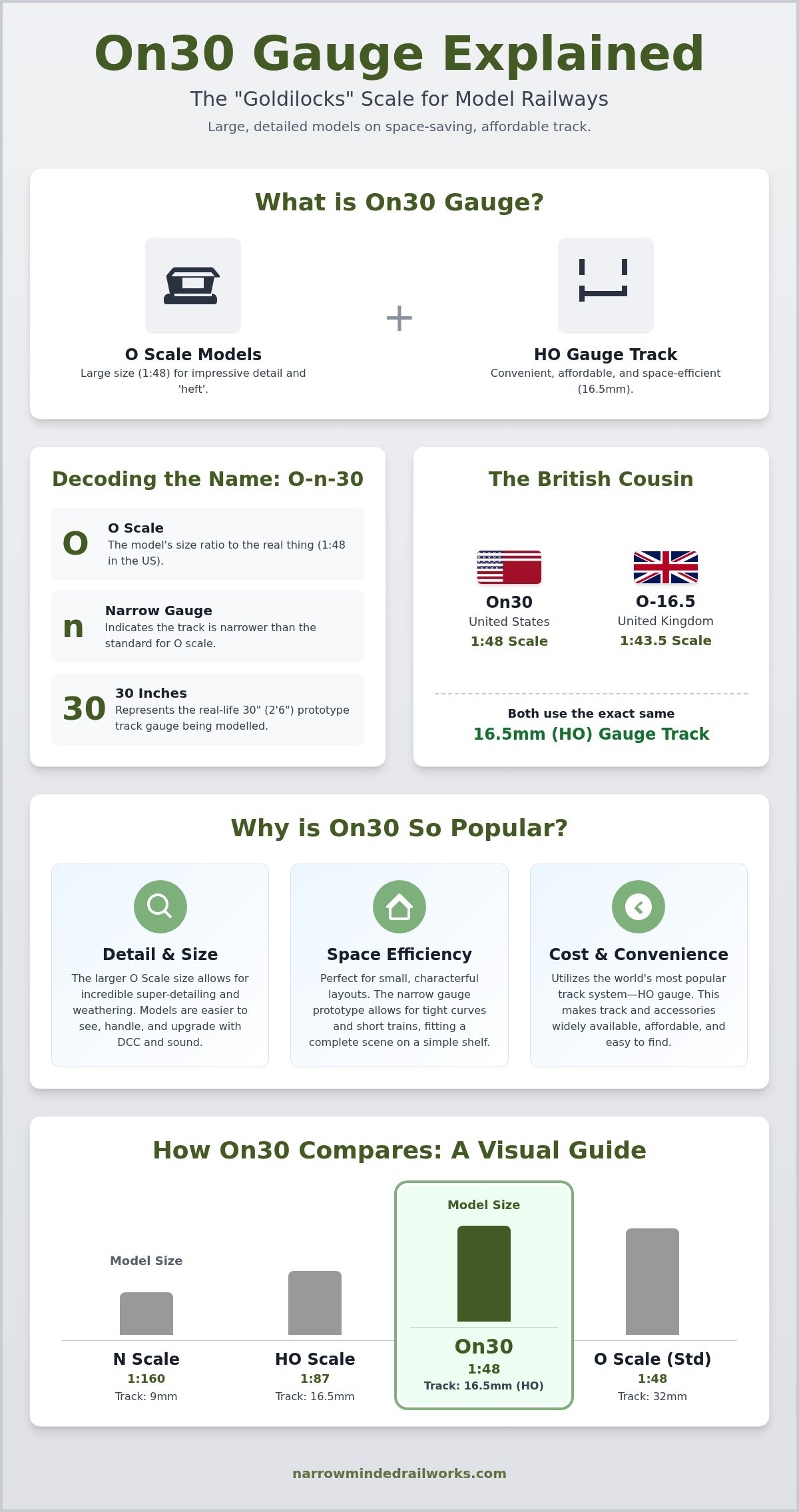
How On30 Compares to Other Popular Scales
For modellers familiar with other scales, understanding where On30 fits can be confusing at first. It occupies a unique space in the hobby, borrowing popular elements from other scales to create a distinct modelling experience. It’s a perfect blend for those who love large, detailed models but don't have the space for a traditional O gauge empire. This comparison will help you decide if it’s the right fit for your interests.
| Scale | Ratio | Track Gauge | Represents |
|---|---|---|---|
| On30 | 1:48 | 16.5mm (HO/OO) | 2'6" Narrow Gauge |
| O Gauge (UK) | 1:43.5 | 32mm | Standard Gauge |
| HO Scale | 1:87.1 | 16.5mm | Standard Gauge |
| OO9 | 1:76.2 | 9mm (N Gauge) | ~2' Narrow Gauge |
On30 vs. Standard O Gauge
While the models are the same large 7mm scale, the key difference is the track. Standard O gauge uses wide 32mm track to represent mainline railways, requiring a great deal of space for realistic curves. On30 models run on much narrower 16.5mm track, representing the quirky, industrial narrow gauge lines. This allows for sharply curved layouts that can fit on a shelf or in a small corner, offering O scale detail in a fraction of the space.
On30 vs. HO Scale
Here, the situation is reversed: the track gauge is identical, but the models are worlds apart. The fundamental concept of On30 gauge is running large 1:48 scale models on common 16.5mm HO track. This means your locomotives and wagons are nearly twice the size of their HO counterparts, offering a superb canvas for weathering and super-detailing. While HO is perfect for modelling vast mainline scenes, On30 excels at creating intimate, character-rich layouts where every small detail can be appreciated.
On30 vs. OO9
In the UK, OO9 is the most popular ready-to-run narrow gauge scale, placing 4mm scale models on 9mm N gauge track. Both OO9 and On30 are brilliant for building compact layouts. The main difference is physical presence. On30 models are significantly larger and heavier, giving them a satisfying "heft" and mechanical realism. OO9 allows for more scenery to be modelled in the same footprint, making it a great choice for those who enjoy landscape building as much as the trains themselves.
Getting Started in On30: Your First Steps
Diving into a new modelling scale can seem daunting, but one of the greatest strengths of On30 is its accessibility. Because it uses common OO/HO gauge track and equipment, the barrier to entry is surprisingly low. You don't need a massive layout to begin; a simple test track on a plank of wood or a small, detailed diorama is the perfect way to get a feel for the larger scale and start your journey.
To get a train running, you only need three core components:
- A locomotive and some rolling stock (wagons or carriages).
- A loop of track.
- A power controller to make it go.
Choosing a Locomotive and Rolling Stock
The quickest way to get started is with a ready-to-run (RTR) model. Brands like Bachmann offer a fantastic range of American-prototype on30 gauge locomotives that are ready to go straight from the box. For those wanting to model British prototypes or create something truly unique, building from a kit is an incredibly rewarding path. Many kits are designed as bodyshells that fit onto readily available and affordable OO/HO scale chassis, giving you a custom model with a reliable mechanism.
Track, Power, and Control
This is where the convenience of On30 truly shines. You can use standard, widely available OO/HO track from manufacturers like Peco. Code 100 track is robust and common, while code 83 offers a finer, more realistic appearance. Likewise, any standard 12v DC or DCC controller designed for OO/HO scale will work perfectly, meaning you may already own what you need. For a first layout, sectional track is great for quick setup, while flexible track provides the freedom to create flowing curves for a more permanent design.
The Joy of Kit Building
While RTR gets you running quickly, kit building unlocks the full creative potential of the scale. It allows you to build unique locomotives and rolling stock inspired by the UK's rich narrow-gauge heritage. Modern 3D printed kits offer stunning levels of detail and are designed for straightforward assembly, making them more accessible than ever before. Building your own models provides a deep sense of satisfaction and a connection to your layout that is second to none. Ready to create something special? Browse our range of O-16.5 / 7mm scale kits to find your first project.
Your On30 Adventure Awaits
We've explored how on30 gauge masterfully combines the impressive size of O scale models with the space-saving convenience of HO track. This unique blend of detail and practicality offers incredible freedom for creating characterful layouts that truly tell a story. Whether you're drawn to its creative potential or its accessibility for newcomers, it's clear why this scale has captured the hearts of so many model railway enthusiasts.
Now that you're ready to take the next step, the most exciting part begins: bringing your vision to life. To build a layout that is truly your own, you need models with unique character. Explore our unique O-16.5 / 7mm scale narrow gauge kits and discover exclusive 3D-printed designs you won't find anywhere else. We offer everything from locomotives and wagons to detailed scenery pieces, with worldwide shipping for modelers across the UK and beyond.
The world of narrow gauge is rich with possibility, and your journey is just beginning. Happy modelling!
Frequently Asked Questions
Is On30 the same as O gauge?
Not exactly, but they are closely related. Both On30 and standard O gauge use the same large 7mm scale (1:48), meaning the locomotives and rolling stock are the same size. The crucial difference is the track gauge-the distance between the rails. Standard O gauge uses 32mm track to represent standard gauge railways, while On30 uses 16.5mm track to represent narrow gauge railways, which is a significant visual and practical difference on a layout.
Can I use my existing HO scale track for an On30 layout?
Yes, you can, and this is one of the biggest advantages of the scale. The track gauge for On30 is 16.5mm, which is identical to the track used for both HO and British OO scale models. This means you can use readily available and affordable track, points, and crossings from popular UK brands like Peco. This compatibility makes starting out in the On30 gauge much more accessible and cost-effective for many modellers.
What is the difference between On30 and On3 gauge?
Both are O scale (7mm) narrow gauge formats, but they model different real-world track widths and are not compatible with each other. On30 models railways that used a 30-inch (2'6") gauge prototype, and it runs on 16.5mm model track (the same as HO/OO). In contrast, On3 models railways that used a 3-foot gauge prototype, requiring a wider and more specialist 19.05mm model track. On30 is more common due to its use of standard track components.
Is On30 a good scale for a very small shelf layout or diorama?
It is an excellent choice for smaller spaces. The combination of large, detailed O scale models with the tighter turning radius of narrow gauge track makes it ideal for compact designs. Unlike standard O gauge, which requires a lot of room for curves, On30 allows for intricate scenes and interesting operation on a small shelf or in a diorama. This lets you enjoy the impressive presence of 7mm scale modelling without needing a dedicated railway room.
Are On30 models expensive compared to other scales?
On30 can be very budget-friendly, especially when starting out. While some specialist kits can be pricey, ready-to-run locomotives from major brands are often priced similarly to high-end OO gauge models, typically in the £150 to £250 range. The real saving comes from using affordable and widely available HO/OO scale track and accessories. Overall, it offers a more accessible entry into large-scale modelling than traditional O gauge or other niche narrow gauge scales.
What kind of tools do I need to start building On30 kits?
You can begin with a basic hobby toolkit that is useful for any scale. Essential items include a quality craft knife (like a Swann-Morton), a steel rule, a self-healing cutting mat, small files, and tweezers. For assembling kits, you will need appropriate adhesives. For plastic kits, a liquid polystyrene cement such as Humbrol Poly Cement is ideal, while a good quality superglue (cyanoacrylate) works best for wood, resin, or white metal parts.