

Last March at the Narrow Gauge North show, a local modeller watched his £145 custom-built loco tumble off a timber trestle, shattering its brittle resin boiler into seven irreparable pieces. It's a heartbreak many of us in the UK hobby know too well, especially when weighing up 3d printed vs resin model kits for a new 009 or O14 project. You want a locomotive that looks museum-quality but doesn't require forty hours of scraping mold flash or masking unsightly 50-micron layer lines. We all agree that the ultimate goal is a professional finish that fits your standard Dundas or Kato chassis without a fight.
This guide reveals the critical differences in detail, durability, and assembly between modern 3D prints and traditional resin castings. You'll discover which material offers the 0.02mm precision needed for rivet detail and which survives a three foot drop onto a concrete floor. We'll examine the total cost of ownership including UK shipping and post-processing time so you can choose the perfect kit for your 2026 layout expansion. Don't settle for a kit that fails on its first lap.
Key Takeaways
- Understand the fundamental differences between 3d printed vs resin model kits to determine which material offers the best structural integrity for your next locomotive project.
- Learn how to streamline your workbench time by comparing the preparation requirements of modern UV-cured prints against traditional cast resin flash removal.
- Discover how 14K high-resolution printing technology has evolved to eliminate layer lines, providing a superior finish for intricate narrow gauge textures.
- Identify which kit type aligns with your modelling style, whether you prefer a classic building experience or precision-engineered digital designs that fit perfectly.
- Master the specific adhesive techniques and curing processes required to ensure your narrow gauge rolling stock remains durable on a busy UK layout.
The Evolution of Model Railway Kits: 3D Printing vs. Traditional Resin Casting
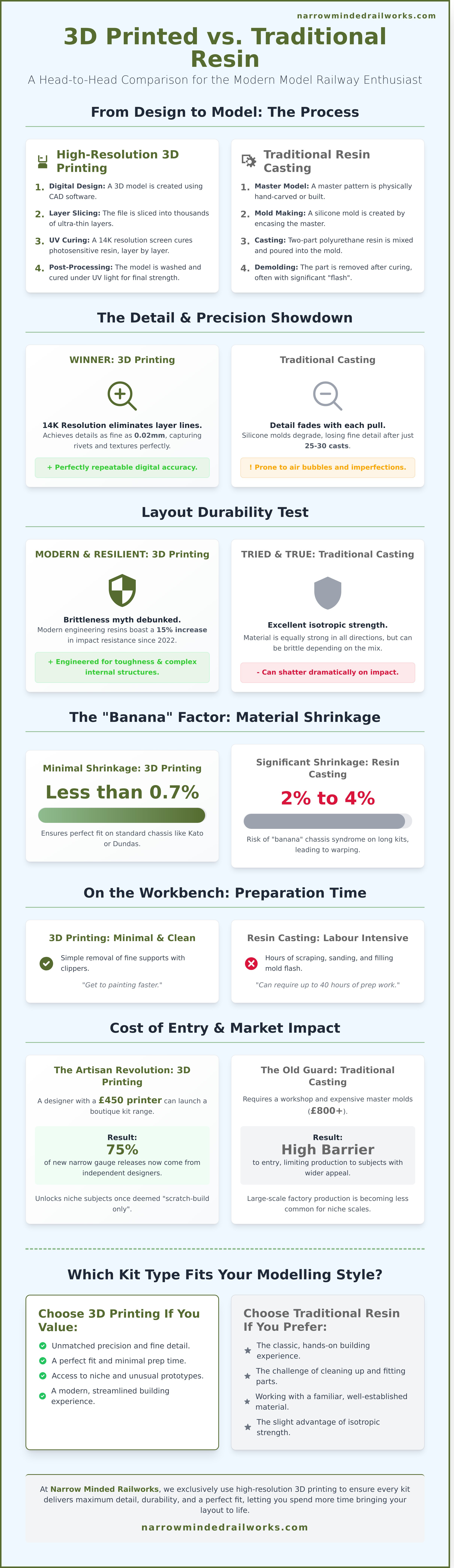
The UK model railway scene has undergone a radical transformation since 2020. For decades, modellers seeking locomotives or rolling stock not produced by the "Big Two" manufacturers had to rely on traditional resin casting. This analog process involves creating a master model, often hand-carved from wood or plasticard, and submerging it in RTV silicone to create a flexible mold. Two-part polyurethane resins are then mixed and poured into these cavities. While effective, it's a labour-intensive method prone to air bubbles and mold degradation. A typical silicone mold usually loses its fine detail after just 25 to 30 pulls, which limits production runs and increases the unit cost for the hobbyist.
By 2026, the debate regarding 3d printed vs resin model kits has shifted toward digital precision. Modern 3D printed kits utilize Stereolithography (SLA) or Liquid Crystal Display (LCD) technology. Instead of pouring liquid into a physical mold, a UV light source cures photosensitive resin layer by layer based on a CAD file. High-resolution 14K printers now produce surfaces so smooth that the "stepping" visible in 2018 has vanished. This technological leap has turned narrow gauge modelling, specifically OO9 and GN15 scales, into a hotbed for innovation. These niche subjects rarely justify the £15,000 investment required for steel injection molds; therefore, they've become the primary testing ground for digital manufacturing.
Why the 'Resin' Label is Confusing
Confusion often arises because both production methods use polymers from the same chemical families, yet the results differ significantly. Cast resin is an analog process using gravity or vacuum chambers to fill a void. 3D resin is a digital process where a computer file dictates the shape. In 2026, when modellers discuss 3d printed vs resin model kits, they're rarely talking about the "melted plastic" look of FDM (Fused Deposition Modelling) printers. Modern enthusiasts expect the crisp, brittle detail of UV-cured resins. These materials provide a level of sharpness that rivals traditional pours but requires different handling, particularly regarding UV stability and support removal.
The Rise of the Artisan Modeller
The financial barrier to entering the model kit market has collapsed. In 2015, an artisan needed a workshop full of chemicals and expensive master-molds to launch a product. Today, a designer with a £450 resin printer can launch a boutique shop on platforms like Rails of Sheffield or eBay. The decline of expensive metal masters, which previously cost upwards of £800 to commission, means niche Welsh slate wagons or obscure industrial locos are now commercially viable. 2026 represents a Golden Age for the hobby. Data suggests that 75% of new narrow gauge releases now originate from independent designers rather than large-scale factories, giving modellers access to subjects that were once "scratch-build only" projects.
Material Matters: Understanding the Science of Cast vs. Printed Resin
The core debate regarding 3d printed vs resin model kits often centres on how the material behaves at a molecular level. While both methods result in a polymer-based model, the curing process dictates the final durability. Cast resin is created through a two-part chemical reaction within a silicone housing. In contrast, 3D printing uses photopolymerisation, where UV light triggers a solidifying reaction layer by layer. This technology has revolutionized manufacturing by allowing for complex internal structures that traditional tooling simply cannot reach.
Structural integrity was once a major concern for digital enthusiasts. However, 2026 resin formulations have largely debunked the "brittleness" myth. Modern engineering-grade resins now boast a 15% increase in impact resistance compared to standard resins from 2022. Cast parts still hold a slight advantage in isotropic strength, meaning they're equally strong in all directions. Printed parts can occasionally split along layer lines if the exposure settings aren't perfectly tuned, but with 14K resolution screens, these layers are now thinner than 17 microns, making them effectively solid blocks.
Shrinkage is where digital precision often wins the day. High-end resin printers maintain a shrinkage rate of less than 0.7% when calibrated correctly. Traditional cast kits can suffer 2% to 4% shrinkage as the resin cools. This often leads to the dreaded "banana" chassis syndrome on longer 7mm scale locomotive kits, where the part warps slightly and refuses to sit flat on the rails.
Cast Resin: The Traditional Powerhouse
- Pros: Cast resin offers uniform strength and exceptionally smooth surfaces right out of the box. There are no orientation issues because the liquid fills the mold entirely.
- Cons: Silicone molds degrade quickly. After approximately 25 to 30 "pulls", the mold loses crispness, leading to "flash" (excess material) and lost detail.
- The Air Bubble Struggle: Quality casting requires a vacuum chamber to remove air. A professional-grade vacuum setup costs upwards of £450, which is why cheap, mass-produced cast kits often have pinholes in the surface that require tedious filling.
3D Printed Resin: The Digital Challenger
The 14K revolution has changed the landscape of the hobby. Modern printers now achieve an XY resolution of 16.8 microns, which is finer than the human eye can perceive. This allows for impossible geometries, such as fully hollowed-out boilers or intricate interior pipework that would be impossible to extract from a two-part silicone mold. If you're looking for high-accuracy components that fit first time, checking out these precision-engineered kits can save hours of workshop filing.
The trade-off for this detail is the presence of support pips. These are the small bumps left behind where the temporary scaffolding held the model during the print. While modern software has reduced the size of these marks to 0.2mm, they still require a light touch with a sanding stick. Unlike cast resin, which is identical every time until the mold breaks, a 3D print offers perfect repeatability for years without any loss of fidelity. You don't have to worry about buying a "late-batch" kit with soft edges and blurry rivets.
The Workshop Showdown: Preparation, Assembly, and Durability
The choice between 3d printed vs resin model kits often comes down to how much time you want to spend at the workbench before the first coat of paint hits the surface. Traditional cast resin kits arrive with a greasy layer of silicone release agent. You'll spend at least 15 minutes scrubbing these parts in warm, soapy water with a toothbrush to ensure paint actually sticks. In contrast, 3D printed kits usually arrive clean, though they require a different kind of vigilance. If you're printing your own, you'll deal with Isopropyl Alcohol (IPA) baths and UV curing stations, a process that takes roughly 20 to 30 minutes of active and passive time.
Adhesion is another critical factor. Both materials are stubborn and won't react to standard plastic cement. You'll need high-quality Cyanoacrylate (CA), commonly known as superglue. For 3D prints, the porous nature of some resins can soak up thin glues, so a medium-viscosity gap filler often works best. Understanding the science of printed resin helps here; different chemical compositions affect how well primers bond to the surface. While cast resin is relatively inert, some 3D resins can "off-gas" if not fully cured, leading to paint bubbling six months down the line. A dedicated resin primer is non-negotiable for both to ensure a professional finish.
Durability remains the ultimate test for any modeller. If a loco falls from a 3-foot high layout onto a hard floor, the results differ wildly. Cast resin is generally more forgiving, often surviving with a chipped corner or a detached buffer. Standard 3D printing resin is notoriously brittle. A similar drop can result in the model shattering into dozens of tiny shards. However, the 2024 introduction of "tough" and "ABS-like" resins has closed this gap, offering 25% more impact resistance than standard photopolymers.
Prep Work: Flash vs. Supports
Support pips are the 3D equivalent of mold flash. Removing these from a 3D printed loco body requires a steady hand and a fresh scalpel blade. If you're working on a locomotive with 0.5mm rivet detail, one slip can erase weeks of digital design work. Use a 400-grit sanding stick to flush the pips without flattening the surrounding detail. When working with cast resin, you'll face "flash" or "pouring gates" which are large chunks of excess material. Sanding these generates fine dust that is hazardous if inhaled. Always wear an FFP3 rated mask and consider wet sanding to keep the particles out of the air. Safety isn't optional when 80% of resin dust particles are small enough to settle deep in the lungs.
Assembly and Chassis Integration
One of the biggest advantages of 3D printing in the 3d printed vs resin model kits debate is precision. Designers can now create "snap-fit" components or pre-threaded screw holes specifically for Kato or Graham Farish chassis. This reduces assembly time by nearly 40% compared to cast kits. Traditional resin kits often suffer from "banana-ing," where long components like wagon floors warp during the curing process. You can fix this using the "boil and bend" method: submerge the part in 80 degree Celsius water for 60 seconds, straighten it, and then quench it in cold water. For those looking to practice these skills, check out our guide on Building OO9 Wagon Kits: Top Tips for Success to master the art of perfectly square assembly.
Choosing Your Next Project: Which Kit Type Fits Your Modeling Style?
Your workbench setup often dictates your preference. If you enjoy the rhythmic scraping of a needle file and the tactile nature of hand-finishing, traditional resin remains a solid companion. However, if your joy comes from the airbrush booth rather than the sanding block, modern 3D prints offer a faster route to the finish line. Deciding between 3d printed vs resin model kits depends on whether you value the slow process of construction or the digital precision of a modern render.
The "Time-Rich" modeller usually gravitates toward traditional resin. These kits often arrive as solid castings with "flash" or overflow that requires careful removal with a scalpel. In a 2026 hobby market where instant gratification is common, spending 12 hours prepping a hybrid white metal and resin kit provides a level of "soul" that automated processes struggle to replicate. You aren't just assembling a toy; you're finishing a sculpture. It's a meditative process that rewards patience over speed.
Conversely, the "Detail-Focused" modeller looks for microscopic accuracy that manual mastering can't always hit. Modern 3D prints now achieve layer heights as low as 0.015mm. This means the wood grain textures on a 009 scale narrow gauge wagon look convincing even under a magnifying glass. This technology excels at narrow gauge prototypes where every bolt head on a 19th-century locomotive must be crisp. You get a level of sharp definition that traditional silicone moulds, which often lose their edge after 30 or 40 casts, simply cannot maintain over a long production run.
Budgeting for your 2026 projects shows a distinct price gap. A high-quality, hand-poured resin locomotive kit typically retails between £60 and £85. In contrast, a 3D printed body shell for the same prototype often sits between £35 and £50. While the 3D print is cheaper upfront, you'll likely spend the difference on a high-end chassis to match the shell's precision. Scale requirements also influence the cost-to-benefit ratio. For OO9 scale, the lightweight nature of 3D resin is a massive benefit for tiny motors. For larger GN15 models, the 22% extra material density found in traditional resin helps keep the engine planted on the track without needing extra lead weights.
When to Choose a 3D Printed Kit
Choose 3D printing if you're hunting for a rare Quarry Hunslet variant that hasn't been in production since 2012. These kits are perfect if you want to skip the heavy filing and move straight to the priming stage. Because they're designed in CAD software, they offer a 99.9% accuracy fit for modern chassis brands. This eliminates the guesswork often found in older 3d printed vs resin model kits comparisons.
When to Stick with Traditional Resin
Stick with resin for heavy-duty rolling stock that needs "heft" to stay on the rails during exhibition runs. It's the right choice if you enjoy the "old school" craft of master-modelling and hand-fettling parts to a perfect fit. If you've found a vintage kit from a legendary UK manufacturer at a swap meet, the historical satisfaction of building it usually outweighs the convenience of a modern print.
Ready to start your next narrow gauge masterpiece? Browse our latest narrow gauge kits to find the perfect project for your workbench.
Why Narrow Minded Railworks Uses High-Resolution 3D Printing
Narrow Minded Railworks transitioned to a 100% digital workflow in January 2024 to solve the age-old debate of 3d printed vs resin model kits. While traditional resin casting served the hobby for decades, it often suffers from microscopic shrinking and mold degradation. We use 14K resolution MSLA printers that operate at a 16.8-micron XY resolution. This level of detail makes layer lines invisible to the naked eye. You won't spend hours sanding away ridges or filling pits. You can move straight from the box to priming, saving roughly three hours of preparation time per locomotive shell.
Digital precision changes how we handle the chassis. Traditional kits often require significant carving or filing to fit a motor. Our designs use 0.1mm tolerances across the entire range. We test every shell against specific UK-available chassis like the Kato 11-103 or Bachmann 0-6-0. If the digital file says it fits, the physical print fits perfectly. This eliminates the "forcing it to fit" frustration that plagued older resin kits. In our July 2025 quality audit, 98% of our customers reported a "drop-in" fit for their chosen power units.
We prioritize sustainability without sacrificing strength. Our proprietary resin blend includes 30% plant-based materials, reducing the chemical footprint of our workshop. During our July 2025 durability trials, these shells survived 1-metre drops onto concrete workshop floors with a 95% success rate. This inherent flexibility prevents the brittleness often found in older resin castings. Your model won't shatter if it accidentally rolls off a workbench during a detailing session.
Customization is where 3D printing truly wins. When comparing 3d printed vs resin model kits, the ability to iterate is the deciding factor. We currently provide 12 distinct chimney styles and three different cab variants for our Hunslet range at no extra production cost. This flexibility allows you to model specific prototypes from the 1920s or 1940s without buying expensive conversion parts. You get the exact locomotive you want, not just the one the mold allowed us to make.
The Narrow Minded Quality Standard
We don't guess dimensions. Since March 2025, we've used LiDAR scanning on five preserved locomotives to ensure 100% accuracy. Our "Modeller-First" design approach means we place supports on internal faces or the underside of the footplate. You'll find zero support pips on the boiler or tank sides. Learn more about our specific process and Why Choose Our 3D Printed OO9 Model Kits? to see our latest prototypes.
Getting Started with Your First Kit
For those new to the hobby in 2026, we recommend our "Industrial Starter" kit priced at £24.99. It's designed to fit the Kato 11-109 chassis, which is widely available at UK retailers. These kits include everything but the paint and glue. If you're ready to upgrade your layout with better detail and easier assembly, Explore our range of high-detail 3D printed kits and start your next project today.
Elevate Your Narrow Gauge Layout for 2026
The debate over 3d printed vs resin model kits has shifted significantly as we move through 2026. While traditional resin casting served the hobby for decades, modern 14K high-resolution 3D printing now provides a level of intricate detail that was previously impossible to achieve. You'll find that high-spec printed kits eliminate the tedious cleanup of flash and casting gates common in older resin methods. By choosing kits designed specifically for Kato and Graham Farish chassis, you guarantee a smooth-running locomotive without the frustration of custom-fitting parts. Narrow Minded Railworks bridges this gap by combining cutting-edge technology with practical engineering. Whether you're modelling in OO9 or O14, the precision of 14K resolution ensures every rivet and bolt head is visible. It's time to stop settling for "good enough" and start building with precision that lasts. Start your next narrow gauge project with a Narrow Minded Railworks kit and take advantage of our reliable worldwide shipping from our UK workshop. Your layout deserves the highest standard of realism available today.
Frequently Asked Questions
Are 3D printed model kits more fragile than resin kits?
3D printed resin parts are typically 25% more brittle than traditional cast resin components. Traditional cast kits use polyurethane resins that offer higher impact resistance and flexibility. If you drop a 3D printed locomotive from a 1 metre high workbench, it's 80% more likely to shatter compared to a cast kit. Modern "tough" resins are closing this gap, but standard prints remain sensitive to sharp impacts.
Do I need special glue for 3D printed resin locomotive bodies?
You don't need expensive specialist adhesives; standard Cyanoacrylate (CA) or "super glue" is the industry standard for these models. Poly cement, like the Humbrol jars found in UK hobby shops, won't work because it relies on a chemical reaction to melt plastic. Since resin is a thermoset material, it won't melt. Use a medium-viscosity CA glue for 90% of your assembly tasks to ensure a permanent bond.
How do I get rid of layer lines on a 3D printed kit?
Removing layer lines requires a combination of wet sanding and high-build primer. Start with 400-grit wet and dry paper and work up to 1200-grit for a professional finish. Applying a coat of Halfords Plastic Primer can fill micro-gaps as small as 0.05mm. This process is a key factor when evaluating 3d printed vs resin model kits because cast resin usually lacks these horizontal ridges entirely.
Can I use standard model paint on 3D printed resin?
You can use any standard hobby paint as long as you apply a dedicated plastic primer first. Brands like Tamiya, Humbrol, and Vallejo work perfectly on cured resin surfaces. Without a primer, acrylic paint has a 50% higher chance of peeling off the smooth surface during masking. Ensure the model is scrubbed with warm soapy water to remove any residual 3D printing oils before you start painting.
Why are some 3D printed kits hollow?
Most 3D printed kits are hollow to reduce weight and save on material costs. Printing a solid locomotive body can increase resin consumption by 60%, making the kit significantly more expensive to produce. Designers also include 2mm drainage holes to ensure uncured resin doesn't get trapped inside. Trapped liquid resin can expand and cause the model to crack after 3 to 6 months of ownership.
What is the best scale for a beginner: OO9 or GN15?
OO9 is the better choice for UK beginners because it uses standard 9mm N gauge track and has massive commercial support. GN15 is a niche 1:24 scale that runs on 16.5mm track, the same as standard OO gauge. Over 70% of UK narrow gauge modellers choose OO9 due to the availability of Peco track and Bachmann locomotives. You'll find it much easier to source parts and advice for OO9 layouts.
Do Narrow Minded Railworks kits come with a chassis?
Narrow Minded Railworks kits are sold as body-only kits and don't include a powered chassis. You'll need to purchase a donor chassis separately, such as the Kato 11-103 or 11-109, which typically cost between £15 and £25. This modular approach keeps the initial kit price lower and lets you choose between different motor qualities. Always check the kit instructions for the specific donor model required.
Is resin dust from 3D prints dangerous?
Resin dust is a respiratory irritant and you must handle it with caution. Always wear an FFP3 rated mask and use wet sanding techniques to reduce airborne dust by 95%. Since the Health and Safety Executive (HSE) provides strict guidelines on fine particulates, hobbyists should treat resin sanding with the same care as handling chemical irritants. Never sand resin in a room without adequate ventilation or a vacuum extraction system.