

What if the most characterful locomotive on your layout didn't come from a high street retailer, but from a specialist resin printer in a small UK workshop? Many enthusiasts find that mainstream hobby shops focus almost exclusively on standard gauge, leaving those in the narrow gauge community searching for reliable sources. It's frustrating to spend hours looking for where to buy narrow gauge model railway kits only to end up with a poorly designed print that shows every layer line. We understand that finding a kit which actually fits a readily available commercial chassis can feel like a secondary hobby in itself.
This guide provides a transparent look at the specialist market in 2026, helping you bypass the common pitfalls of impossible motor requirements and brittle materials. We will identify the most reliable boutique manufacturers currently producing OO9, GN15, and O-16.5 kits. You will also learn how to evaluate 3D-printed resin against traditional materials and discover which designers prioritize chassis compatibility. By the end of this article, you'll have a clear roadmap for sourcing high-quality models that bring authentic narrow gauge charm to your next project.
Key Takeaways
- Identify the transition from mass-market products to boutique craftsmanship and why specialist designers now lead the narrow gauge scene.
- Evaluate the practical differences between kit materials, specifically how modern 3D-printed resin provides superior detail for narrow gauge prototypes.
- Navigate the selection process between OO9, GN15, and O-16.5 scales to ensure your choice matches your available layout space.
- Discover exactly where to buy narrow gauge model railway kits by assessing supplier reliability through instruction clarity and chassis fitment documentation.
- Learn how to avoid the common frustration of sourcing rare motors by choosing body kits designed for modern, commercially available chassis.
The Landscape of Model Railway Kits: Mainstream vs. Specialist
The model railway hobby has undergone a significant transformation. While it once centered on mass-produced train sets found in local toy shops, the focus has shifted toward bespoke craftsmanship. This evolution is particularly evident in the narrow gauge community. Modellers now prioritize unique, prototype-accurate designs over generic, off-the-shelf products. Building a layout with a distinct personality requires a move away from the "out of the box" mentality, embracing the challenge of assembly and finishing. This shift has turned the 2020s into an era of the boutique manufacturer, where small-scale designers provide the innovation that larger corporations cannot justify.
Standard gauge modellers often rely on a single large manufacturer for their entire fleet. However, those working in OO9 or GN15 must adopt a more diverse sourcing strategy. Because these scales represent niche industrial or rural prototypes, they are rarely catered for by the industry giants. You might find a comprehensive guide to narrow gauge scales helpful for understanding the specific dimensions involved, but finding the physical models requires looking toward independent makers. This diversity allows for a layout that feels curated rather than bought, offering a profound sense of accomplishment once a locomotive is finally weathered and placed on the rails.
Mainstream Retailers: Best for Standard Projects
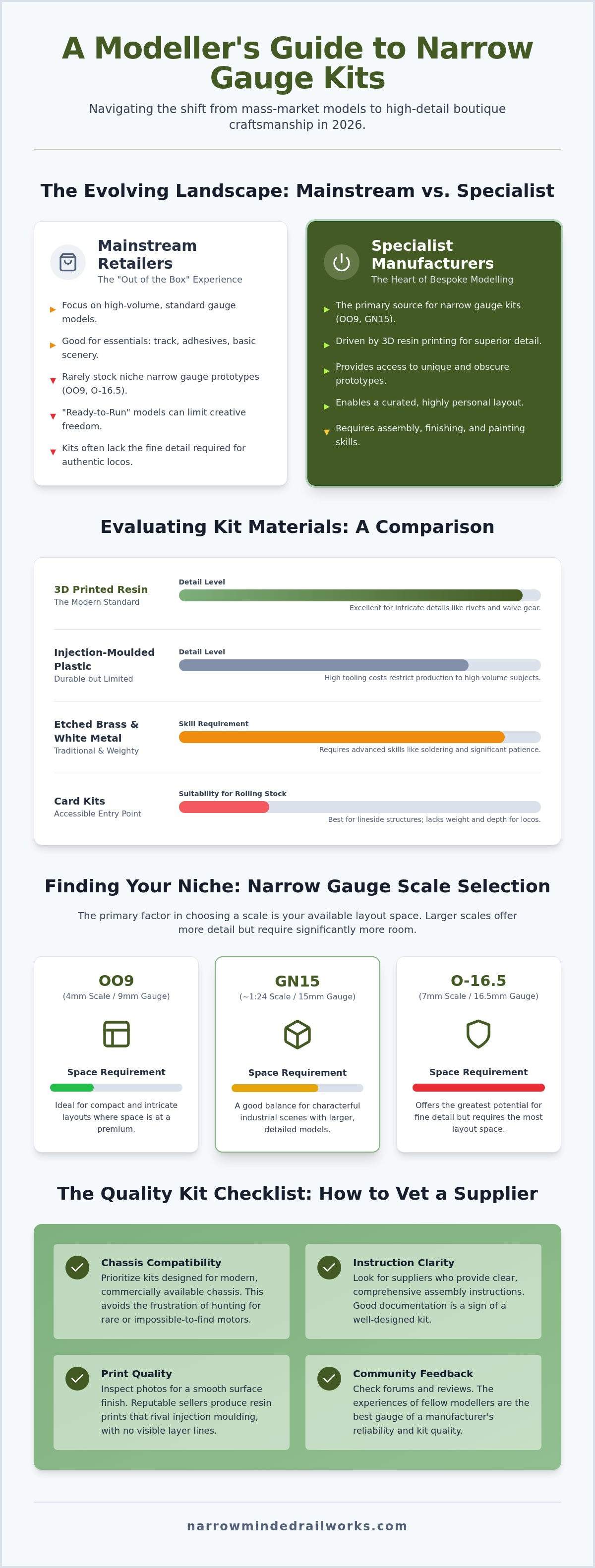
Large retailers provide efficient access to essentials like track, adhesives, and basic scenery materials, but they rarely stock niche narrow gauge prototypes. Their inventory usually prioritizes high-volume sales, which means specialist scales like O-16.5 are often overlooked. While "Ready-to-Run" models from these hubs offer a quick start, they can sometimes stifle the creative freedom that defines the narrow gauge hobby. Mass-market plastic and card kits serve a purpose for background buildings, yet they often lack the fine detail required for a convincing narrow gauge locomotive or wagon.
Specialist Manufacturers: The Heart of Narrow Gauge
Independent designers are now the primary heartbeat of the community. The rise of the boutique manufacturer has been driven by advancements in resin technology, making obscure prototypes accessible to everyone. When researching where to buy narrow gauge model railway kits, you should look for makers who understand the practicalities of the build. 3D printing has revolutionized this space, allowing for intricate details that were previously only possible in expensive brass. Reliability is best gauged through community forums and reviews, where modellers share their experiences with fit and finish. These specialist kits bridge the gap between historical accuracy and modern build-ability, ensuring your layout remains entirely unique.
Evaluating Kit Materials: Resin, Plastic, and Beyond
The material of a kit dictates more than just the assembly process; it determines the level of prototype accuracy you can achieve. Injection-moulded plastic remains a standard for durability, yet the high tooling costs mean large manufacturers rarely produce niche narrow gauge subjects. Card kits offer an accessible entry point for lineside structures, but they lack the three-dimensional depth and structural weight required for convincing rolling stock. Researching historical prototypes at the Narrow Gauge Railway Museum reveals intricate details, such as external rivets and complex valve gear, that card simply cannot replicate. For the advanced modeller, etched brass and white metal provide a traditional, weighty alternative, though these require significant soldering skills and patience.
Deciding where to buy narrow gauge model railway kits in 2026 often depends on which material matches your specific layout goals. While traditional media have their place, modern technology has introduced more efficient ways to populate a freelance or prototype-based line without the steep learning curve of metalwork.
The Rise of 3D Printed Resin Kits
3D-printed resin has become the gold standard for high-detail locomotive bodies. Unlike the early days of "home printing" which suffered from visible layer lines, modern commercial resin prints offer a smooth surface finish that rivals injection moulding. These kits allow independent designers to produce obscure prototypes in small batches, making the hobby more diverse than ever. Preparation is straightforward but essential. You must clean the parts in warm, soapy water to remove any residual release agents before support removal. Once dry, a high-quality primer ensures your paintwork adheres correctly. For those new to this medium, following a Painting 3D Printed Models: A Beginner’s Guide will help you achieve a professional, streak-free result.
Durability and Buildability
Longevity is a common concern when moving away from traditional plastics. Modern resins are engineered to be stable and resilient, resisting the warping that affected older polyurethane versions. These materials are exceptionally easy to modify, or "kit-bash," because resin can be sanded and drilled without the splintering risks associated with white metal. When assembling your models, skip the standard plastic cement. You'll need cyanoacrylate (super glue) or two-part epoxy to create a permanent bond between resin components and metal chassis. If you want to start your next project with high-fidelity parts, exploring detailed resin kits is a proactive way to ensure your fleet stands out on the track.
Finding Your Niche: Narrow Gauge Scale Selection
Success in this hobby depends on selecting a scale that fits both your physical constraints and your modelling ambitions. Narrow gauge is celebrated for its flexibility; it allows you to build a complete world in a space that would barely accommodate a standard gauge siding. Before you decide where to buy narrow gauge model railway kits, you must evaluate your available space. While a shelf layout measuring just four feet can host a complex OO9 industrial scene, a dedicated room might be better suited for the imposing presence of 7mm scale (O-16.5).
Matching your scale to a prototype theme is the next logical step. You might be inspired by the rugged quarry lines of North Wales or the historic operations of Maine's two-foot gauge railways. Once you have a theme, follow these four steps to ensure a successful build:
- Assess your space: Determine if you are building a micro-layout, a shelf, or a full-room empire.
- Match visual preference: Decide if you prefer the delicate intricacy of 4mm scale or the chunky, tactile nature of 7mm.
- Verify chassis availability: Never buy a locomotive body without first identifying a compatible motor unit. Many modern kits are engineered for specific donor chassis from brands like Kato or Graham Farish.
- Select your theme: Choose between industrial quarrying, agricultural tramways, or passenger-carrying common carriers.
Focusing on OO9 Scale Kits
OO9 is currently the most popular entry point because it utilizes 9mm track, the same gauge as N scale. Standard N gauge track might look slightly out of proportion for some, but it provides a reliable and affordable foundation for any OO9 project. Because it's so popular, the variety of available kits is vast. If you're ready to start your journey, reading Your First OO9 Loco Kit: A Beginner’s Guide will help you avoid common purchasing mistakes.
The Appeal of GN15 and O-16.5
For those who want maximum detail and "quirky" character, larger scales offer a different experience. GN15 involves modelling 15-inch gauge prototypes in G scale (1:22.5) but running them on 16.5mm track. Larger scales like GN15 require more vertical clearance, yet they offer unparalleled opportunities for adding individual figures and intricate scenery. You can learn more through this Getting Started in GN15 Scale: Your Complete Guide. Similarly, O-16.5 (or On30) provides the weight and presence of 7mm modelling on standard HO/OO gauge track. If this larger scale interests you, check out this Introduction to On30 Gauge to see if it fits your vision.
How to Vet a Quality Kit Supplier
Determining where to buy narrow gauge model railway kits requires looking beyond the product photo to evaluate the technical support behind the design. Navigating online marketplaces often leads to kits that look impressive in digital renders but fail to fit together in reality. A high-quality supplier should demonstrate design transparency by showing photos of finished, painted models rather than just raw computer graphics. This proof of buildability ensures that the physical resin or plastic matches the digital promise, preventing you from wasting money on a kit that requires significant correction.
Instructions and Support
Instruction quality is often the first casualty in boutique manufacturing. While some independent designers provide only a single exploded-view diagram, leading specialists offer comprehensive, step-by-step guides. We understand that assembly can be daunting for newcomers; therefore, we prioritize clear documentation that addresses common build hurdles. Proactive technical advice from a real person is invaluable when you encounter a specific issue, a service that mainstream retailers simply cannot provide. Before you commit to a purchase, check community forums or dedicated narrow gauge groups to see if other modellers have successfully completed the kit. A supplier with a strong reputation for after-sales support is always a safer investment than an anonymous seller on a generic auction site. Building this kind of trust requires a commitment to helping the customer rather than just making a sale; to explore this philosophy further, you can learn more about How to 'Sell' The Way People Buy!.
Compatibility and Parts
The most critical factor in narrow gauge modelling is chassis compatibility. Many locomotive kits are sold as "body-only" units, meaning you're responsible for sourcing a separate motor. We recognize that finding the correct motor can be a challenge; however, designing kits specifically for commercially available chassis, such as those from Kato or Graham Farish, simplifies this process significantly. A reliable supplier will explicitly name the required donor unit in the product description. You should also verify if the kit includes necessary accessories like bogies or couplers, as these often require separate sourcing in the 7mm or GN15 scales. Since many of the best narrow gauge prototypes are British, sourcing from a UK-based specialist ensures you get the correct historical character. If you're looking for designs that have been rigorously tested for fit and finish, you can browse our range of specialist narrow gauge kits to find your next project.
Why Narrow Minded Railworks is the Choice for Specialists
Enthusiasts searching for where to buy narrow gauge model railway kits often encounter retailers who stock numerous brands but lack deep technical knowledge of the products they sell. We operate differently. As a modeller-led business, we provide a cohesive design philosophy specifically tailored for niche prototypes. Our comprehensive range covers OO9, GN15, and O-16.5 scales, ensuring that whether you model in 4mm or 7mm, you have access to high-quality, 3D-printed resin components that meet modern standards of detail.
We understand that sourcing a motor can be a significant barrier to starting a new project. To solve this, we don't just sell generic locomotive bodies; we engineer our kits for easy commercial chassis fitment. While we don't sell the chassis or motors ourselves, we explicitly design our models to fit specific, readily available units from manufacturers like Kato or Graham Farish. This transparent approach sets realistic expectations from the start, providing a proactive solution to the common frustration of "impossible-to-find" mechanical parts.
Designed by Modellers, for Modellers
Our commitment to prototypical accuracy is reflected in our high-quality resin finishes. We've moved past the era of visible layer lines by utilizing precise 3D printing technology that captures the unique character of narrow gauge steam and diesel prototypes. We realize that the community is global. Although we are a UK-based company, we offer worldwide shipping to bring British narrow gauge character to modellers across the globe. Whether you're building a Welsh slate line or a freelance industrial tramway, our designs provide a reliable, professional foundation for your craftsmanship. For those who also enjoy the bold character of 1980s pop culture, you can discover Mr T and his enduring influence on iconic fashion.
A layout requires more than just rolling stock to feel authentic. To help you bring your diorama to life, we provide a range of 3D-scanned figures and unique scenery items designed to match our locomotive scales perfectly. These accessories add the human element and "quirky" character that defines the narrow gauge scene. If you're interested in specific prototypes, you might find our Modeller’s Guide to Tram Locos useful for understanding the history and types of kits available. We're here to help you navigate the complexities of the hobby with professional advice and transparent design. You can browse our full range of specialist narrow gauge kits to find the perfect addition to your next layout.
Start Your Next Narrow Gauge Project Today
Building a distinctive narrow gauge layout requires moving beyond the limited stock of mainstream retailers. We've examined why high-detail resin has become the gold standard for modern prototypes and why verifying chassis compatibility is essential for a stress-free build. Finding where to buy narrow gauge model railway kits that actually fit commercially available motor units can be difficult; however, choosing a specialist designer ensures your project remains both achievable and historically accurate.
We recognize that sourcing niche parts is a constraint for many modellers; therefore, we offer worldwide shipping from the UK to support the community globally. Our specialist designs for OO9, GN15, and O-16.5 are engineered specifically for easy fitment to commercial chassis, helping you bypass common assembly frustrations. Whether you're constructing a rugged quarry scene or a delicate rural tramway, the right components are now accessible. We're committed to providing the transparency and technical support you need to succeed.
Explore our range of unique narrow gauge kits and accessories to find the perfect addition to your collection. Your next masterpiece is only a few clicks away, and we can't wait to see your vision come to life on the tracks.
Frequently Asked Questions
Where is the best place to buy OO9 locomotive kits?
Specialist boutique manufacturers are the most reliable source for OO9 locomotive kits because they focus on niche prototypes that mainstream shops ignore. While large retailers stock standard gauge, enthusiasts looking for where to buy narrow gauge model railway kits should visit independent designers. We provide 3D-printed bodies specifically designed for commercial chassis, ensuring that your project is supported by modern engineering and prototypical accuracy. This approach guarantees a unique result for your layout.
What tools do I need to build a 3D-printed model railway kit?
You'll need a basic set of modelling tools, including sharp side cutters, a fine needle file, and cyanoacrylate glue. 3D-printed resin cannot be joined with standard plastic cement; therefore, we recommend a high-quality gap-filling super glue for a permanent bond. You'll also need warm soapy water for cleaning parts and a grey primer to prepare the surface for painting. These simple additions to your workbench ensure a professional and lasting finish for any kit.
Are 3D-printed resin kits better than plastic ones?
Resin kits offer superior detail for small-batch prototypes, whereas injection-moulded plastic is better for high-volume, durable rolling stock. While plastic kits often have higher tooling costs and fewer niche options, 3D printing allows for intricate textures and rivets that are difficult to achieve in other media. We utilize high-fidelity resin to capture the character of narrow gauge lines, providing modellers with a level of detail previously reserved for expensive and difficult brass models.
Do model railway kits come with the motor and chassis?
Most specialist narrow gauge kits are sold as body kits and don't include the motor or chassis. We recognize that sourcing mechanical parts can be complex; therefore, we design our locomotive bodies to fit specific, commercially available chassis from brands like Kato. This approach allows you to benefit from reliable, factory-made running gear while customizing the aesthetic of your locomotive with our detailed 3D-printed bodies. It's a practical way to ensure smooth operation.
Can I buy narrow gauge kits if I live outside the UK?
Yes, you can order specialist kits from anywhere in the world. While we are a UK-based company, we offer worldwide shipping to ensure that modellers in North America, Europe, and beyond can access authentic British narrow gauge designs. We provide transparent shipping rates and secure packaging to protect your resin models during transit, making it easy to find where to buy narrow gauge model railway kits regardless of your physical location.
How do I know if a kit is suitable for a beginner?
A beginner-friendly kit should have a low part count and clear, step-by-step instructions. Look for designs that explicitly state which commercial chassis they fit, as this eliminates the need for complex metalwork or soldering. We suggest starting with a simple wagon kit or a locomotive body designed for a drop-in Kato chassis. These projects build confidence by providing a proactive solution to the common challenges of your first narrow gauge build.
What is the difference between a body kit and a complete kit?
A body kit contains only the upper structure of the locomotive or wagon, whereas a complete kit includes the wheels, axles, and sometimes the chassis. Most of our offerings are locomotive bodies designed to fit donor chassis that you purchase separately. This distinction is important because it allows you to choose the specific motorization level you require, ensuring that your model runs as smoothly as it looks. It prioritizes flexibility for the individual builder.
Which scale is best for a small shelf-style narrow gauge layout?
OO9 is the most effective choice for small shelf layouts due to its compact footprint. It allows for tight radius curves and intricate scenery in a space as narrow as 20cm. If you prefer a larger visual presence, O-16.5 also works well for micro-layouts, provided you have slightly more vertical clearance. Both scales offer a wealth of character without requiring the extensive room needed for standard gauge projects, making them ideal for modern homes.