

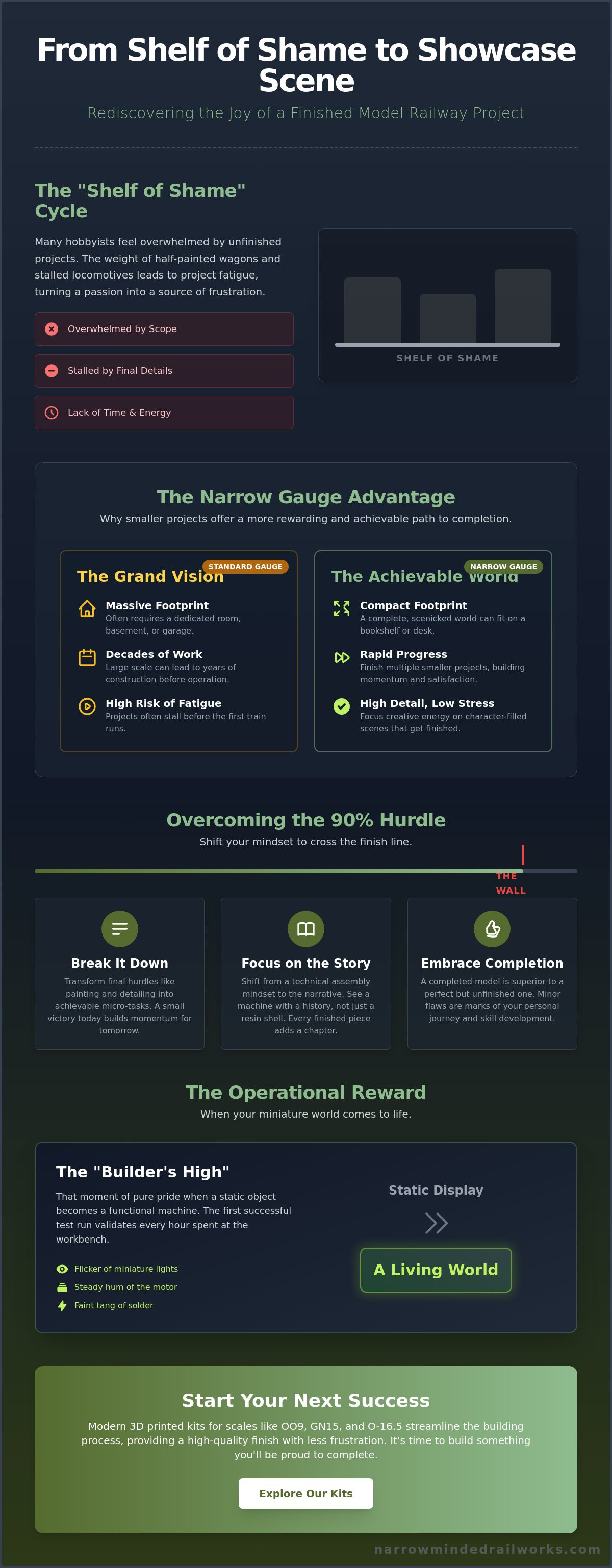
What if the most rewarding part of your hobby isn't the grand vision of a massive layout, but the simple click of a finished kit finally meeting the rails? We've all looked at a "Shelf of Shame" filled with half-painted wagons and unfinished OO9 locomotives, feeling the weight of projects that stalled during the final weathering stages. It's common to feel overwhelmed by the sheer scope of a model railway, yet the joy of a finished model railway project offers a level of psychological satisfaction that no unfinished masterpiece can match.
You likely understand the frustration of project fatigue, especially when the fine details of GN15 or 7mm scale kits seem to demand more patience than you have left. While time and energy are often limited during these intricate finishing steps, focusing on manageable narrow gauge models provides a proactive path to success. This article promises to help you rediscover your creative spark by breaking down the final hurdles of kit building and highlighting the immense sense of accomplishment that comes with a functional, detailed miniature world. We'll explore why completing specialized models is more sustainable than chasing infinite goals, providing you with the confidence to tackle your next complex build with ease.
Key Takeaways
- You'll learn how to shift your perspective from technical assembly challenges to the narrative atmosphere of a completed scene.
- Discover why narrow gauge scales like OO9 and GN15 provide a more manageable and character-filled path to completion than sprawling layouts.
- Experience the joy of a finished model railway project by breaking down the final hurdles of painting and detailing into achievable micro-tasks.
- Understand the transition from a static display to a living world where operational realism brings your miniature locomotives and scenery to life.
- Explore how specialized 3D printed kits for O-16.5 and other niche scales streamline the building process for a high-quality finish.
What Is the Joy of a Finished Model Railway Project?
Many hobbyists experience a period where their workbench is cluttered with half-finished kits. While this state of limbo can feel frustrating, the shift from technical problem-solving to creative appreciation is profound. Rail transport modelling is often viewed as a series of assembly tasks, but the true transformation occurs when the builder steps back to view the scene as a whole. You stop seeing a 3D printed resin shell and start seeing a living, breathing machine with a history. This transition marks the beginning of the joy of a finished model railway project, where the narrative of the layout finally takes precedence over the mechanics of construction.
To better understand the atmosphere of a completed scene, watch this footage of a highly detailed layout:
The Narrative Transition: From Parts to Stories
Every finished wagon or building adds a distinct chapter to your railway’s history. You might spend weeks agonizing over the correct shade of weathered rust for an OO9 locomotive, but that effort pays off the moment it pulls a train across a viaduct. Finishing a project allows you to finally see the world you've created. A completed model is superior to a perfect but unfinished one because it exists in the physical world as a functional part of a story. It anchors the atmosphere, turning a collection of track and wood into a cohesive environment where the quirky character of narrow gauge can shine.
The Builder’s High: Overcoming the Technical Challenge
The technical challenges of model building often present significant hurdles, yet overcoming them results in a unique dopamine hit. We recognize that fine-scale assembly can be taxing; therefore, we design our kits to be approachable without sacrificing detail. There is a specific sensory reward when the miniature world wakes up. You smell the faint tang of solder, hear the steady hum of the motor, and watch the flicker of miniature carriage lights. This first successful test run on the track validates every hour spent at the workbench. It is a moment of pure pride that transforms a static object into a functional machine.
The Narrow Gauge Advantage: Why Smaller Projects Offer More Joy
Standard gauge layouts often demand a dedicated room and decades of work. This massive scale can lead to project fatigue before the first train even runs. Choosing a narrow gauge railway theme instead allows for a high level of detail within a compact, manageable footprint. You don't need a basement or a spare garage to experience the joy of a finished model railway project; a bookshelf or a small desk is often sufficient for a complete, scenicked world. While space might be a limiting factor for some, adopting a micro-layout scale provides a high-density creative outlet that fits into any home.
Achievability in OO9 and GN15
Finishing three small wagons provides a greater sense of momentum than half-completing a single large coach. Smaller projects reduce the "Shelf of Shame" by offering clear finish lines. While complex locomotive bodies were once difficult to scratch-build, modern 3D printed kits now provide a streamlined path to a high-quality finish. This technology ensures that even builders with limited time can achieve professional results without the frustration of traditional fabrication. By focusing on a specific theme, you can complete a subset of rolling stock and see immediate results on your track. This rapid progress builds the confidence necessary to tackle more ambitious dioramas later.
The Charm of the Unusual
Narrow gauge prototypes possess a quirky character that standard gauge often lacks. Modelling these unique machines feels personal because they aren't mass-produced as ready-to-run items. The GN15 scale specifically encourages whimsical and creative diorama work. You can build a complete scene that tells a story of a rural industrial line or a garden railway in just a few square feet. While finding unique prototypes can be a challenge, specialized kits offer a proactive way to represent the rare and unusual on your layout.
The satisfaction of explaining a rare narrow gauge prototype to a curious visitor is a distinct pleasure for any modeller. It turns a simple hobby into a conversation about history and engineering. If you're looking to start a project that you can actually finish, our range of OO9 and GN15 kits offers the perfect entry point. The smaller the project, the more likely you are to reach that final stage of weathering and operation. Each finished model becomes a permanent part of your miniature world, providing a sense of closure that sprawling, unfinished layouts rarely offer.
Overcoming the 90% Hurdle: How to Actually Finish Your Kit
Many modellers hit a wall when a project is nearly complete. This is the "90% hurdle," where the initial excitement of a new build fades and the tediousness of finishing takes over. To experience the joy of a finished model railway project, you must first identify what's stopping you. Is it the fear of ruining a good build with a bad paint job? Or perhaps it's the fiddly nature of final assembly? Acknowledging these specific friction points is the first step toward a proactive solution.
Break the final 10% of your build into micro-tasks that take less than 15 minutes. Instead of telling yourself to "finish the locomotive," try "apply three decals" or "install the couplings." Setting a "Good Enough" standard is also vital to prevent perfectionism from stalling the project indefinitely. A finished model with a small paint smudge looks much better on a layout than a perfect, unpainted shell in a drawer. Use the "First Run" incentive by promising yourself a dedicated operating session as soon as the final coat is dry.
Conquering the Paint Shop
Painting is often the most feared stage for kit builders because it feels permanent. While this stage requires patience, using the correct techniques for painting 3d printed models ensures a professional look. Weathering is your best ally here. It doesn't just add realism; it's a functional way to hide minor imperfections from the assembly phase. A bit of soot or grime can turn a small assembly mistake into a realistic, hard-worked detail.
Detailing and Decals
Small details like petrol pumps or phone boxes bring a miniature scene to life. While precise application is necessary for a finished feel, using the right tools like fine tweezers and decal softeners reduces frustration in the final stages. Once these details are in place, transition the model from the workbench to the layout for final testing. This shift allows you to finally appreciate the joy of a finished model railway project in its intended environment. Viewing your handiwork under layout lighting provides the closure needed to call the project complete and move on to your next success.
The Operational Reward: When the Miniature World Wakes Up
A static model on a shelf is a trophy, but an operational railway is a living story. While the construction phase focuses on technical precision, the operational phase offers a different kind of satisfaction. The joy of a finished model railway project truly peaks during that first quiet evening of operation. Watching a narrow gauge train traverse a well-scenicked layout has a meditative quality that rewards your patience. You stop analyzing the glue joints and start appreciating the rhythmic movement of the rolling stock you assembled by hand.
Accessibility and Layout Design
Accessibility is the key to ensuring your finished project remains enjoyable. If a layout is buried under boxes or requires complex setup, you're unlikely to run it. Micro-layouts and dioramas offer a proactive solution to space constraints, allowing for immediate operational joy. These smaller formats encourage you to flick the switch every day rather than waiting for a special occasion. Reliability is also a factor; therefore, choosing a high-quality chassis for your narrow gauge builds ensures that your finished project is a reliable runner. A smooth-running train prevents the frustration that often leads to projects being abandoned or relegated to storage.
Sharing the Success
The satisfaction of completion often grows when it is shared with others. Exhibiting a finished project at a local club or a model railway show provides a unique sense of pride. Seeing your OO9 locomotive kits operating flawlessly in a public setting validates the hours spent at the workbench. If you don't belong to a club, social media offers a vast community where you can celebrate your completion and inspire other modellers who might be struggling with their own "Shelf of Shame."
Sharing your progress helps demystify the building process for beginners. When you showcase a weathered, finished locomotive, you provide a tangible goal for others to reach. This community interaction reinforces the value of your work and often provides the spark of inspiration for your next build. If you're ready to experience this operational reward for yourself, explore our latest OO9 and GN15 locomotive kits to find your next successful project. Every finished model is a step toward a more complete and vibrant miniature world.
Starting Your Next Success with Narrow Minded Railworks
The transition from a box of parts to a living world requires more than just patience; it requires the right starting point. We understand that the most significant barrier to the joy of a finished model railway project is often the sheer complexity of traditional kit building. While older white metal or brass kits offer great detail, they often demand advanced soldering skills that can lead to project fatigue. Our proactive solution is to utilize high-resolution 3D printing technology, providing you with a precise, durable foundation that streamlines the assembly process from the very first day.
We believe that every modeller deserves the sense of accomplishment that comes with a completed build. By choosing manageable, high-detail projects in scales like OO9 and GN15, you can avoid the "Shelf of Shame" and focus on the creative aspects of the hobby. Whether you're a veteran builder or a newcomer to narrow gauge, our kits are designed to help you reach that final coat of paint with confidence and speed.
Why Our Kits Are Different
While some resin kits require hours of tedious sanding and filing, our high-resolution 3D prints are designed for minimal clean-up. We recognize that mechanical reliability is a major concern for kit builders; therefore, we design our locomotive shells to fit perfectly onto proven, commercially available chassis. This ensures that once your bodywork is finished, you have a reliable runner that performs as well as it looks. Our focus remains on unique, characterful narrow gauge subjects that are frequently overlooked by large manufacturers, giving your layout a distinct personality that is entirely your own.
Your Next Project Awaits
If you're ready to experience the joy of a finished model railway project, your next success is just one kit away. We support our community of modellers by providing specialized designs for OO9, GN15, and O-16.5 enthusiasts across the globe. You don't have to tackle the "90% hurdle" alone. By joining our network of narrow gauge modellers, you gain access to a wealth of shared knowledge and inspiration that makes every build more rewarding.
Take the first step toward your next "finished project" feeling by exploring our range of specialized models. You can browse our latest tram loco and wagon kits to find a subject that sparks your imagination. Don't let another project stall on the workbench. Explore the Narrow Minded Railworks Shop today and discover how our kits can help you transform a collection of parts into a detailed, operational masterpiece.
Bringing Your Miniature World to Life
Completing a model railway project transforms a collection of technical challenges into a cohesive, living story. We've discussed how narrow gauge scales like OO9 and GN15 offer a distinct advantage by providing highly detailed results within a manageable footprint. While the final stages of painting and detailing can feel daunting, focusing on small, proactive steps ensures you don't leave another kit on the "Shelf of Shame." Experiencing the joy of a finished model railway project is the ultimate psychological and creative reward for your patience at the workbench.
We recognize that reliability and ease of assembly are essential for a successful build. Our specialist 3D printed OO9 and GN15 kits are designed specifically for operational success, allowing you to focus on the artistry of weathering and scenery. With worldwide shipping available for global enthusiasts, your next functional masterpiece is within reach. Browse our latest narrow gauge kits and start your next project today. There is no better feeling than watching your own handmade rolling stock wake up on the rails for the very first time.
Frequently Asked Questions
Why do I struggle to finish my model railway kits?
You likely struggle to finish kits because the initial excitement of assembly often gives way to the repetitive nature of final detailing. While this "90% hurdle" is a common constraint, you can overcome it by dividing the final steps into 15-minute micro-tasks. This proactive approach helps maintain momentum and ensures you experience the joy of a finished model railway project rather than staring at an unfinished shell on your workbench.
Is it better to build a kit or buy a ready-to-run model for more joy?
Building a kit generally provides more lasting joy than buying a ready-to-run model because it fosters a deeper personal connection to the finished locomotive. While purchasing a finished train is convenient, building a kit allows you to customize every detail to your specific vision. This creative investment results in a unique sense of pride that makes the operational reward much more significant when the train finally takes its first run.
How can I stay motivated during the weathering stage?
You can stay motivated during the weathering stage by viewing it as a functional way to hide assembly imperfections and enhance the model's history. Weathering is often intimidating because it feels like you might damage your hard work. To overcome this fear, try weathering a single wagon first to see the immediate improvement in character. Seeing the transformation from a plastic-looking model to a realistic machine provides the spark needed to finish the entire project.
What is the best scale for someone who wants to finish projects quickly?
Narrow gauge scales such as OO9 and GN15 are the best choice for modellers who want to finish projects quickly without sacrificing detail. Large-scale layouts often become overwhelming due to the sheer volume of work required. These compact projects provide a faster path to the joy of a finished model railway project, ensuring you spend more time operating your miniature world and less time stuck in the construction phase.
How do I handle mistakes in a nearly finished model?
You should handle mistakes in a nearly finished model by masking them with weathering or additional details rather than starting over. Discovering a flaw late in the build is frustrating, but it doesn't have to be a project-ender. While stripping paint is an option, a more proactive solution is to cover the error with a patch of rust or a piece of miniature equipment. This approach maintains your progress while adding to the model's unique personality.
What are the essential tools for finishing a 3D printed locomotive kit?
The essential tools for finishing a 3D printed kit include high-grit sandpaper, specialized resin primer, and fine-point tweezers for delicate assembly. Finishing 3D printed resin requires different handling than traditional materials to ensure a smooth, professional result. While standard tools work for most tasks, you'll need specific abrasives for smoothing layer lines. Having the correct tools reduces technical friction and allows you to focus on the creative aspects of the build.
Can a small diorama be as satisfying as a large layout?
A small diorama is often as satisfying as a large layout because it allows for a higher concentration of detail and a faster sense of completion. It's a common misconception that satisfaction is tied to the size of your railway. While massive projects are impressive, a diorama allows you to achieve atmospheric realism that is difficult to maintain over a large area. This manageable scope makes it easier to reach the finish line and enjoy a fully operational scene.
How do I know when a model railway project is truly "finished"?
A model railway project is truly finished when it meets your pre-set quality standards and performs reliably as part of your operational world. A project can feel infinite because there's always one more detail you could add. While perfection is a noble goal, it can also lead to stagnation. Once the model transitions from the workbench to the track and functions correctly, it has fulfilled its purpose. At that point, it's time to start your next success.