

The best-looking locomotive kit may be the wrong choice if its body won’t fit your chassis or its footprint overwhelms a small layout. Choosing OO9 rolling stock kits means looking beyond appearance: check what each kit includes, what you’ll need to source separately, and how the finished stock will work together on your railway.
That can be less straightforward than it sounds. A locomotive kit may be a body kit rather than a complete, powered model, and a wagon kit may require running gear bought separately. Compatibility also varies, so check the details for each kit, including any stated chassis requirements. Some Narrow Minded Railworks locomotive kits are designed to fit commercially available chassis, but that doesn’t mean every body fits every chassis.
This guide compares locomotive and wagon options, explains how to check kit contents and chassis fit, and helps you match stock to your layout and modelling plans. You’ll be better placed to choose models that suit the railway you want to build, rather than choosing by appearance alone.
Key Takeaways
- OO9 combines OO-scale models with 9 mm track, so choose scenery and stock that look proportionate together.
- Match locomotive, wagon and carriage choices to the role each needs to play on your layout.
- Check the exact chassis reference and listing contents before choosing a locomotive kit. A body kit may not include a chassis or motor.
- Before ordering, consider layout space, model dimensions, scale, compatibility, included parts and your confidence with the build.
- Choose OO9 rolling stock kits by layout role first, then narrow your options by fit and confirmed kit contents.
What OO9 rolling stock kits include and how they fit your layout
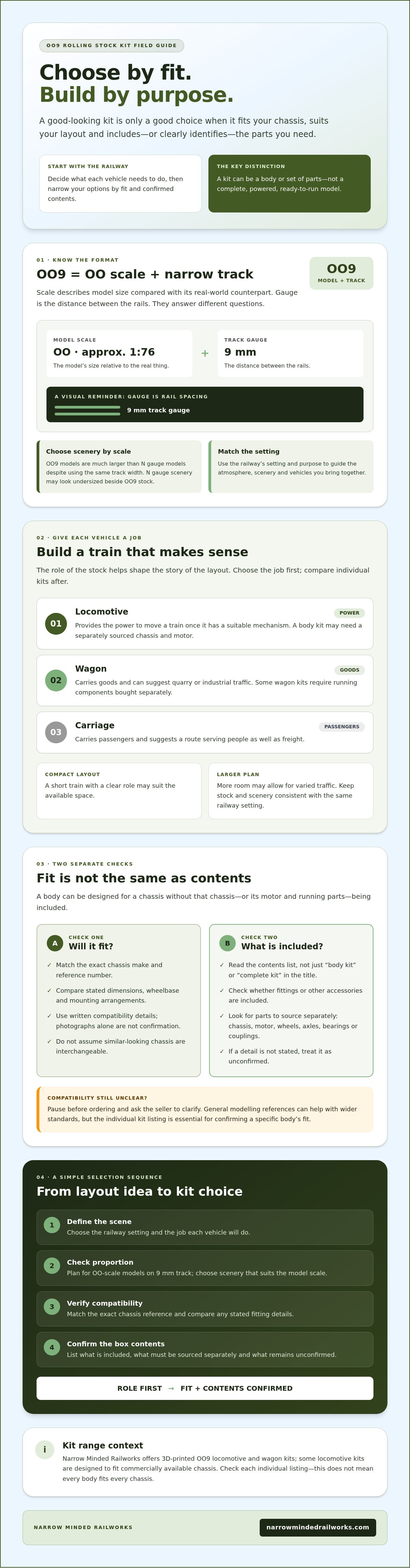
OO9 combines OO-scale models with track that is 9 mm wide. Scale describes the size of a model compared with its real-world counterpart; gauge is the distance between the rails. OO9 models are built at approximately 1:76 scale, so they’re much larger than N gauge models despite using the same track width. The OO9 scale reference offers more background on this narrow-gauge modelling convention.
That distinction matters when planning a layout. Choose buildings, figures and scenery that suit the model’s scale, not the track gauge alone. The real railway’s setting and purpose can also guide the atmosphere you create.
A short video showing a wagon kit build can help clarify the difference between a kit and a finished model:
How OO9 scale and track gauge work together
Scale and gauge answer different questions: scale tells you how large a model is compared with its real-world counterpart, while gauge tells you how far apart the rails are. OO9’s 9 mm track gives the appearance of narrow-gauge track beneath OO-scale models. Keep this difference in mind when choosing scenery and stock. For example, scenery intended for N gauge may look undersized beside OO9 models.
What counts as locomotive and wagon rolling stock
A locomotive provides the power to move a train once it has a suitable mechanism. Wagons carry goods, while carriages carry passengers. Together, these vehicles give a layout a working purpose: a locomotive with goods wagons can suggest quarry or industrial traffic, while passenger carriages imply a route serving people as well as freight.
A kit isn’t automatically a complete, ready-to-run model. Some locomotive kits are body kits intended to fit a separately sourced chassis, and wagon kits may require additional running components. Check each listing for included parts, chassis compatibility information and anything you’ll need to obtain separately. Narrow Minded Railworks offers 3D-printed OO9 locomotive and wagon kits, with some locomotive kits designed for commercially available chassis.
Decide what scene you want to build before comparing OO9 rolling stock kits. A compact layout may suit a short train with a clear role, while a larger plan might allow for varied traffic. Matching the vehicles and scenery to the same railway setting helps the whole layout feel coherent.
Check chassis fit and kit contents before choosing an OO9 kit
A locomotive body can look right for your layout and still be incompatible with your chassis. Check compatibility and kit contents separately: a body may be designed for a particular chassis, but that doesn’t mean the chassis, motor or other running parts are included.
How to verify a locomotive body fits its chassis
Match the make and reference number in the product listing to the chassis you plan to use. Don’t assume two chassis are interchangeable because they look similar or share a manufacturer. Check fitting notes and available dimensions, including wheelbase and mounting arrangements, then compare them with your chassis. Photographs can help, but they shouldn’t replace written compatibility details.
If the listing doesn’t clearly confirm the fit, pause before ordering and ask the seller to clarify. The 009 Society is another useful reference for the wider modelling community and its standards, but the individual kit listing remains essential for confirming a specific body’s fit.
What to confirm about kit contents
Descriptions such as “body kit” and “complete kit” can mean different things, so read the contents list rather than relying on the title. Check whether the box includes a body, fittings or other accessories, and whether you must source the chassis, motor, wheels, axles, bearings or couplings separately. If a component or compatibility detail isn’t stated, treat it as unconfirmed.
Before deciding, check these points against the current listing:
- Chassis: Is the exact make and reference specified, and does it match your chassis?
- Fit: Are dimensions, wheelbase or mounting details provided for comparison?
- Contents: Which parts are included, and which must be sourced separately?
- Uncertainties: Do photos or fitting notes leave questions that need answering before purchase?
Some Narrow Minded Railworks locomotive kits are designed to fit commercially available chassis, but compatibility and included parts can vary by kit. Once you’ve identified the chassis and components your build requires, you can consult The 009 Society for broader OO9 context, then browse the OO9 locomotive and wagon kit range and check each listing against your requirements.
Compare OO9 locomotive and wagon kits by the job they do
Choose stock as a small, coherent fleet rather than a collection of unrelated models. Start with the scene you want the railway to suggest, then consider which vehicles would plausibly work together. A locomotive’s character and role can help shape the train: a small industrial engine might suit a short goods movement, while a passenger-focused scene calls for carriages and somewhere for people to travel to or from.
| Vehicle | Possible layout role | What to consider |
|---|---|---|
| Locomotive | Provides motive power and establishes the railway’s character. | Confirm the intended role and any chassis compatibility before building. |
| Wagon | Represents goods traffic, such as materials moving to or from an industrial site. | Check that its load or design suits your chosen setting and that it works with the locomotive. |
| Carriage | Suggests passenger services and gives the line a people-carrying purpose. | Consider where passengers board and whether the layout has room for the train. |
When an OO9 locomotive kit is the right next project
A locomotive body kit may be a good next build if you already have a suitable chassis or have confirmed the stated chassis fit. Also consider the impression it creates: a compact, utilitarian outline may support an industrial scene, while a more passenger-oriented choice can help define a different kind of railway. For more detail on choosing a locomotive, use the separate beginner guide to choosing an OO9 locomotive kit.
When OO9 wagon and carriage kits add more value
If your layout already has a locomotive, additional stock can give it a clear job without requiring a larger track plan. A few complementary wagons can suggest goods traffic; a carriage can turn a simple run into a passenger service. The right number depends on available storage, passing space and the scene you’re depicting. For example, a short siding may look more convincing with only the stock it can reasonably hold.
As you compare OO9 rolling stock kits, check that the vehicles work as a group in both purpose and appearance. Construction details matter too, so consult a dedicated guide to building OO9 wagon kits for practical advice on assembling wagon stock. A restrained selection with a clear role often tells a stronger layout story than a larger, mixed collection.
Use this OO9 rolling stock kit checklist before you order
A few checks before buying can prevent a kit from being an awkward fit for your railway or your available build time. Use this sequence to assess the layout role, physical fit, compatibility, contents and work involved. Product details and availability can change, so check the live listing before ordering rather than relying on an old note or photograph.
A five-point check for compatibility and completeness
- 1. Define the layout role. Decide where the vehicle will run and what it should add to the scene, such as goods traffic, passenger service or motive power. This helps you avoid choosing stock that looks appealing but has no clear place in your plan.
- 2. Confirm scale and gauge. Check that the kit is intended for your OO9 layout. Scale and track gauge describe different things, so verify both rather than assuming a model will suit because its track or wheels look familiar.
- 3. Compare dimensions with your space. Review listed measurements and photographs, then consider whether the vehicle will fit your track plan, sidings and storage area. Check overall length and, for a locomotive body, wheelbase where provided.
- 4. Verify chassis fit and separate parts. Match any stated chassis make and reference exactly. Check what you’ll need to source separately, which may include a chassis, motor, wheels, axles, bearings or couplings. Don’t assume these are included unless the listing says so.
- 5. Assess the build work. Read the assembly notes and check what preparation, assembly and finishing the kit requires. Be realistic about the tools and experience you have available before committing to the project.
Plan the build around your layout and experience
Even a compatible kit may not suit your plans if the finished vehicle is too long for a siding or doesn’t fit the railway you’re modelling. Check clearances and available track space, then consider the likely assembly and painting work. If you’re new to finishing 3D-printed models, the separate guide to painting 3D-printed models can help you plan that stage.
Use the checklist for all OO9 rolling stock kits, and revisit the individual product page if a detail is unclear. For a project that fits your layout and build plans, browse the OO9 locomotive and wagon kits and confirm the current listing details before selecting a kit.
Find OO9 rolling stock kits for your next layout project
A suitable kit starts with a clear job on your layout. Decide whether you need a locomotive, wagons or passenger stock to support the scene, then check that the model fits your available space. Before choosing, confirm any chassis compatibility and read the listing carefully to establish what the kit includes and which components you’ll need to source separately.
Narrow Minded Railworks offers 3D-printed narrow-gauge OO9 locomotive and wagon kits, with worldwide shipping. That gives you a clear starting point when looking for this type of kit, but it doesn’t replace checking the specifications of an individual product. Confirm contents, fit and current availability on its product listing.
Which Narrow Minded Railworks OO9 kits to explore
Start with the OO9 locomotive and wagon kit categories, then narrow your search according to the role each model will play. A locomotive body may suit your project only if it matches the chassis you intend to use. Don’t assume compatibility from appearance or from another listing. Check the specific product information for its stated chassis reference, included components and fitting notes before settling on a kit.
For wagons, consider whether their purpose and appearance support the railway setting you’ve planned. A small, consistent selection can help a compact layout feel purposeful without filling its sidings with stock that has no clear role.
What to do if you still have a compatibility question
Review the listing’s specifications, photographs and assembly information first. If the chassis fit or kit contents remain unclear, contact the business before ordering and ask about that specific kit and chassis reference. This is safer than relying on a general assumption, particularly when your build depends on a particular mounting arrangement or separately sourced part.
Once you’ve matched the kit to your layout role and checked its stated fit and contents, review the live product listing for current availability and specifications.
Choose stock that brings your layout to life
The right OO9 rolling stock kits are the ones that fit both your railway and your build plans. Start with the role each vehicle will play, then check dimensions, chassis compatibility and exactly what the listing includes. A well-matched locomotive and a few complementary wagons or carriages can give a compact layout a clear sense of purpose.
Narrow Minded Railworks offers a specialist range of 3D-printed narrow-gauge OO9 locomotive and wagon kits, with worldwide shipping. Kit contents and chassis requirements can differ, so review the individual product details before choosing, especially if your project depends on a specific chassis.
Ready to find a kit for your next project? Browse Narrow Minded Railworks’ OO9 locomotive and wagon kits, compare the listing details with your layout needs, and choose a kit that suits your project.
Frequently Asked Questions
Can OO9 rolling stock kits run on standard N gauge track?
Often, because OO9 and N gauge use track with a 9 mm gauge, but the models represent different scales. OO9 models are built to OO scale, so they’re larger than N gauge models. Check the kit’s stated scale and intended track, then confirm that its wheel arrangement and any supplied running components suit your layout. Don’t assume a kit includes wheels, a chassis or other parts needed to run it.
Do OO9 locomotive kits include a chassis and motor?
Not necessarily. Some OO9 locomotive products are body kits designed to fit a separately sourced chassis, and contents vary by listing. Check the product description for the exact chassis make and reference, along with a clear list of included components. If it doesn’t say whether a motor, wheels or other running gear is supplied, ask the seller before ordering rather than relying on the product title or photographs alone.
Are OO9 wagon kits suitable for beginners?
They can be, but the work involved depends on the individual kit and your experience. Read the assembly notes and check which parts, materials and tools are required. A wagon body kit may need separately sourced wheels, axles or other running components. If you’re new to model building, look for a project with clear instructions and requirements that match your confidence and the time you want to spend assembling and finishing it.
What is the difference between OO9 and 009 rolling stock?
OO9 and 009 are commonly used names for narrow-gauge modelling that combines OO-scale models with 9 mm track. Naming can vary between manufacturers and hobby communities, so the label alone isn’t enough to confirm a kit’s fit. Check both the stated scale and track gauge, then compare them with your layout and existing stock. This helps avoid mixing models that run on the same track but appear out of proportion.
Can I mix OO9 locomotives and wagons from different manufacturers?
Often, yes, but check more than the OO9 label. Compare scale, gauge, coupling arrangements and any chassis or running-component requirements. Look at product dimensions and photographs too, especially on a compact layout where differences in vehicle size may be noticeable. If a listing doesn’t specify a compatibility detail you need, contact the seller before buying. A consistent railway setting can also help different models look as though they belong together.
What should I check before ordering an OO9 rolling stock kit?
Confirm the kit’s scale, gauge, layout role and dimensions, then read its contents list and assembly notes. For a locomotive body, match the stated chassis reference exactly and check whether the chassis or other running parts must be sourced separately. Review the current product listing for specifications and availability. If an essential detail is missing or unclear, ask the seller before ordering so you can make an informed choice.
Are OO9 kits ready to run straight from the box?
Don’t assume they are. A kit generally needs assembly, and some locomotive products are body kits intended to fit a compatible chassis. The work involved and parts supplied vary by product, so read the listing to understand what’s included and what you must provide. Allow for any assembly and finishing required, and confirm chassis compatibility where relevant. This helps you choose a project that suits your modelling plans and experience.