

What if the future of model railways isn’t a choice between a printer and a traditional workbench? The question “is 3d printing the future of model railways” matters because the technology can open up unusual prototypes and niche scales, but it doesn’t automatically make every model more reliable or easier to build.
It’s reasonable to be cautious. A printed kit can offer distinctive designs, but finish, assembly and suitability for your layout still matter. Established manufacturing methods and hands-on modelling remain valuable, especially when you need familiar components or enjoy traditional techniques.
This article explores what 3D printing is changing, where its limits remain and how to assess printed models without getting swept up in technology hype. We’ll compare printing methods, look at the appeal of less common narrow-gauge subjects, and consider the work modellers bring to a kit through assembly and finishing. The practical takeaway: 3D printing expands what can be made, while traditional methods continue to shape how model railways are built.
Key Takeaways
- 3D printing expands design options for model railways, but it works alongside traditional production rather than replacing every method.
- Digital design can make niche prototypes more accessible, though flexibility doesn’t guarantee that every kit can be customised.
- Compare printed and traditionally produced kits by design flexibility, suitability for the subject, production scale and the work you’ll do yourself.
- Before choosing a kit, check its scale, prototype, included components and whether it’s designed for a separate chassis.
- So, is 3d printing the future of model railways? Its potential for narrow-gauge modelling is promising, but adoption and results will vary.
Is 3D Printing the Future of Model Railways, or One Tool Among Many?
Is 3d printing the future of model railways? It’s part of the future, but it won’t replace every established method. 3D printing creates a physical object from a digital design, building it layer by layer. For modellers, that means a design can be developed on screen before it becomes a physical part. It opens new possibilities without removing the value of proven components or traditional skills.
The appeal is especially clear when a modeller wants a less common subject, a particular variation or a part that’s difficult to find in a standard range. Narrow-gauge locomotives and scenery, for example, can suit small-run production because they serve specific prototypes and scales. Design flexibility is an opportunity, not a promise of unlimited customisation. Judge each kit by its actual design and contents.
For a concise introduction to the process and its wider applications, see What is 3D Printing? To see the technology applied to model trains, watch this video:
What does 3D printing change for railway modellers?
A digital design can be adjusted before anything is printed. A designer might refine a body shape, change a detail or adapt a part to suit a specific prototype. This can make unusual subjects more practical to produce than methods that depend on larger production runs. You’ll still need to assess proportions, fit and how the part will work in the finished model.
In narrow-gauge modelling, this approach can bring more attention to subjects that serve a small but dedicated audience. Narrow Minded Railworks produces 3D-printed kits and accessories in OO9, GN15 and O-16.5 / 7mm scales, including locomotive bodies, wagons and scenery. These products show how digital production serves specialist interests, without implying that every niche subject is available.
Does new technology make traditional modelling obsolete?
No. Printing describes how a component is made; it doesn’t determine how a modeller assembles, paints or integrates it into a layout. A printed kit may need careful preparation and finishing, and choices about colour, weathering and setting help give it character. A locomotive body designed around a commercially available chassis is one example of printed and conventional components working together.
3D printing changes how some parts are made, not what makes a layout personal. Conventional kits, commercially available components and modeller-made details can all sit alongside printed parts. The right combination depends on the subject, the components needed and the skills you want to use.
Looking ahead, as a forecast rather than a certainty, continued development of digital designs could widen the choice of specialist prototypes and refine how parts are adapted. How quickly that happens, and which designs prove useful, will vary. For now, printing expands the modeller’s toolkit, while traditional methods and individual craft remain important to the finished railway.
How Digital Design and 3D Printing Expand Model Railway Possibilities
A printed railway component begins as a digital design, not a finished model. The designer creates or adapts the geometry, prepares the file for production, then inspects and finishes the physical output. Each stage matters: a design needs to suit its intended scale and purpose, and the printed part may need preparation before assembly or painting.
Additive manufacturing builds an object by adding material in layers according to a digital design. It’s a broad term, not a single method: different processes suit different parts and requirements. Digital geometry can also be saved and reused, giving a designer a consistent starting point for related components. That repeatability doesn’t remove the modeller’s decisions about assembly, paint, weathering or how a model fits into a particular layout.
Why niche prototypes can benefit from digital design
A specialist subject may appeal to a small group rather than a mass market. Digital design can make it practical to develop a component for that interest without relying only on demand for large production runs. The design still needs to be workable and appropriate to the intended model, and digital tools alone don’t guarantee that an unusual prototype will be produced.
OO9 and GN15 are narrow-gauge scales represented in Narrow Minded Railworks’ range. Locomotives, wagons and scenery in these scales show how digital design can serve focused modelling interests. The designer shapes a part around a particular subject, while the modeller decides how to assemble and integrate it. Broader supply-chain forecasts, such as ASCM’s discussion of Future Trends in 3D Printing, provide context for possibilities such as more flexible production, not a guarantee that every model will be made to order.
From a digital model to a kit component
A digital file is only one stage in making a kit. After the design is prepared and produced, the component needs to be inspected and may require assembly, surface preparation and painting. The work depends on the part and kit, so read the supplied instructions and plan for finishing tasks that suit your experience. For practical finishing ideas, consult Painting 3D Printed Models: A Beginner's Guide to a Perfect Finish.
Customisation needs the same care. A digital design can be adjusted before production, but that doesn’t mean every kit offers bespoke changes. Treat flexibility as a design possibility, then judge the component against your project’s scale, prototype and intended use. To see how the approach is applied to narrow-gauge subjects, explore 3D-printed narrow-gauge kits and scenery.
3D-Printed Kits vs Traditional Model Railway Production: What Each Does Well
Neither a printed kit nor a traditionally produced model is automatically the better choice. Compare how each method serves the subject and what you want from the build. Results depend on the design, production process, material, scale and finishing, so don’t assume that printing always means more detail, strength or speed.
| Consideration | 3D-printed production | Traditional production |
|---|---|---|
| Design flexibility | Digital geometry can be revised before a component is produced. | Changes depend on the established design and production approach. |
| Niche subjects | May suit specialist prototypes that appeal to a focused group of modellers. | Can serve subjects supported by established kits and production ranges. |
| Production scale | Can be appropriate for limited runs, depending on the design and process. | Can suit established production, with practical choices shaped by the method. |
| Modeller input | Parts may need assembly, preparation, painting and layout integration. | Assembly and finishing also vary by kit; the modeller’s choices remain central. |
Where 3D printing can be a strong fit
Digital design offers a useful route to specialist components and distinctive subjects, especially when a designer can revise geometry before producing a part. That makes it a potential fit for focused small-scale and narrow-gauge kit ranges, including OO9 and GN15. It doesn’t guarantee that every unusual prototype can be reproduced well or that every design will suit a particular layout.
In narrow-gauge modelling, printed locomotive bodies, wagons and scenery can serve subjects beyond the priorities of larger production ranges. Narrow Minded Railworks’ kits and accessories in OO9, GN15 and O-16.5 / 7mm scales are examples of this specialist application. The method’s value lies in the options it can create, not in a blanket promise of superior results.
Where traditional methods and modeller skills still matter
Production method is only part of a model’s story. Assembly, painting, added details and careful placement help make a kit part of a coherent layout, whether its components are printed or traditionally produced. Modellers can also combine printed pieces with conventional components to suit their project.
A printed body or shell is not automatically a complete, powered, ready-to-run model. The running mechanism and chassis are distinct components, and some kits are designed to fit commercially available chassis. Check what the kit includes and what the build requires before choosing it. The right production method depends on the subject, intended use and the work you want to do yourself. That’s a more useful answer to “is 3d printing the future of model railways” than treating either approach as a universal winner.
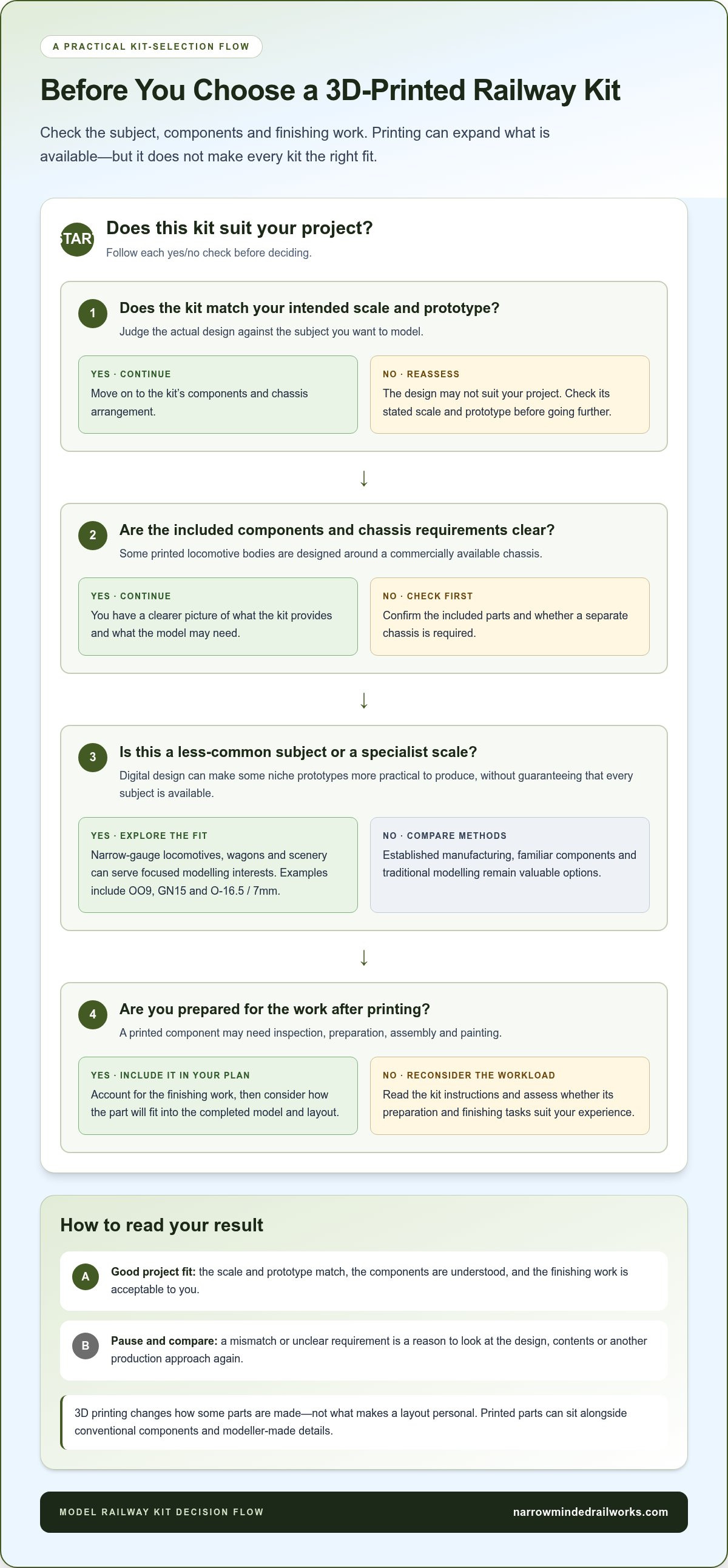
What Modellers Should Consider Before Choosing a 3D-Printed Kit
A kit’s appearance is only one part of the decision. Work through these practical checks before choosing, so the model suits your layout and you know what the build involves.
- Match the scale and gauge. Check that the model is the right scale for your layout and sits consistently with your existing stock. Similar-looking scales or gauges aren’t automatically interchangeable.
- Check the intended prototype. Compare the model’s subject and proportions with the locomotive, wagon or scenery you want to represent. A kit designed for one prototype may not suit another without changes.
- Read what the kit includes. Identify whether you’re buying a body, a group of components or a more complete kit. A body designed to fit a commercially available chassis doesn’t necessarily include that chassis.
- Be realistic about the work. Consider your experience with assembly, surface preparation and painting, as well as the time and tools you want to bring to the project.
Check scale, intended chassis, included components and required finishing before choosing a kit. This helps prevent a common misunderstanding: a 3D-printed kit isn’t automatically a complete, powered, ready-to-run model. The printed parts may form a body or other components, while the running mechanism is separate. Compatibility depends on the particular kit and chassis, so don’t assume a universal fit.
Check scale, prototype, and chassis compatibility
Start with your layout. Confirm that the kit’s stated scale and gauge suit your track and the stock it will run alongside. For an OO9 locomotive kit, consider which chassis the design is intended to fit and whether that chassis is included. A useful starting point for OO9-specific buying decisions is Your First OO9 Loco Kit: A Beginner's Guide to Choosing and Buying.
Set expectations for assembly and finishing
Product descriptions help establish what you’re purchasing and what remains to be done. Look for a clear account of the kit form and components supplied, then consider whether you’re prepared to assemble parts, prepare surfaces and paint the model. These finishing steps can be part of completing a printed kit, rather than a sign that it’s unsuitable. If you’re new to kit building, choose a project whose requirements align with your experience, then take on more involved work as your confidence grows.
These checks matter whether you’re considering a locomotive body, wagon or scenery for a narrow-gauge layout. Browse OO9, GN15 and O-16.5 / 7mm kits with your scale, intended prototype and build plans in mind. Asking “is 3d printing the future of model railways” is useful, but choosing a kit that fits your project is the practical next step.
What the Future of 3D Printing Means for Narrow-Gauge Modelling
Is 3d printing the future of model railways? For narrow-gauge modellers, it may broaden the range of subjects designers can explore, but that possibility shouldn’t be mistaken for a guaranteed industry-wide shift. Adoption and results will vary between designs, kits and modelling projects. Traditional production methods and hands-on work remain part of the picture.
What developments are worth watching?
One area to watch is how designers refine digital models. CAD, or computer-aided design, is the use of software to create or adjust a model on screen. Additive manufacturing describes making an object by adding material in layers, though the process depends on the part and production approach. Together, digital design and additive manufacturing may make it easier to revise a specialist component before producing it.
That could create opportunities for more niche subjects, where interest is focused on a particular prototype, scale or railway. It’s a possibility, not a promise that every unusual locomotive or wagon will become available. Claims about future adoption, production costs or technical results need evidence for the specific context. There’s no sound basis for predicting that other methods will disappear.
For modellers, a useful development to follow is whether digital designs are carefully adapted to their intended kits and scales. Better design decisions could help components fit their purpose, but the quality of the finished model will still depend on the design, production and modeller’s finishing work. Treat forecasts as forecasts until supported by reliable evidence.
How narrow-gauge kits show the technology in practice
Narrow Minded Railworks’ range provides a current example, with kits and accessories in OO9, GN15 and O-16.5 / 7mm scales. The range includes locomotive, wagon and scenery kits for specialist modelling interests. These products don’t predict how quickly the wider hobby will change, but they show one way 3D printing is already being used.
A kit supports a modelling project; it isn’t automatically a finished running model. Assembly, painting and integration into a layout remain part of the modeller’s work. For readers considering GN15, Getting Started in GN15 Scale: Your Complete Guide offers a relevant next step for exploring the scale and planning a project.
As the technology develops, watch for thoughtful design iteration and new specialist subjects, rather than assuming every forecast will become reality. The best production method is the one that suits the prototype, layout and kind of work you enjoy. If you’re exploring narrow-gauge modelling, browse the OO9, GN15 and O-16.5 / 7mm kits for examples of printed kits in practice.
Make Your Next Model Railway Project Your Own
The answer to “is 3d printing the future of model railways” depends on what you want to create. Rather than choosing a method because it seems newest, start with a subject that interests you and a build that fits your skills. A manageable project can help you discover whether printed components suit your approach, without changing how you enjoy the hobby.
The most promising future is one where modellers have more ways to bring personal ideas to life, while retaining the freedom to combine techniques. Each project can be a chance to test a design, learn a finishing skill or add a distinctive detail to your layout. You don’t need to predict where the technology will lead; judge it by how well it serves the railway you want to build.
For inspiration for a future narrow-gauge project, explore Narrow Minded Railworks’ narrow-gauge kits. Choose a subject that captures your imagination, take the build one step at a time, and enjoy making the finished layout unmistakably yours.
Frequently Asked Questions
Is 3D printing replacing traditional model railway manufacturing?
No, 3D printing is adding another way to produce model railway parts, rather than replacing every established method. The answer to “is 3d printing the future of model railways” is qualified: it can help bring certain designs to modellers, while conventional production remains useful for other subjects and components. For your own layout, compare the kit’s suitability and required work, not just its production method.
Can you 3D print a working model train?
It’s possible to print components for a working model, but printing a body alone won’t make a powered train. A running model needs a suitable mechanism and compatible parts, such as wheels and a chassis, as well as a body that fits the design. Read “3D-printed train” carefully in product descriptions: it may refer to a shell or kit, not a complete locomotive ready to run.
Are 3D-printed model railway kits durable?
Durability depends on the particular design, production process, material and how the model will be handled or used. A delicate detail part has different demands from a body handled during regular layout operation. Read the kit’s description and care guidance, and inspect small or thin components during assembly. Don’t assume that all printed parts have the same strength or withstand identical use.
Do 3D-printed railway models need painting?
Often, painting is part of turning a kit component into a finished model, but the work required depends on the kit. Check whether the parts are supplied finished or intended for preparation and painting. Before applying paint, follow the maker’s guidance for preparing the surface and choosing suitable products. A test on an inconspicuous area can help you assess the result before finishing visible surfaces.
Can a 3D-printed locomotive body fit an existing chassis?
Yes, if the body has been designed for that particular chassis, but compatibility isn’t universal. Compare the kit description with the chassis you own, paying attention to the stated model or fitting requirements. Even when a design is intended for a commercially available chassis, the chassis may be a separate component. Don’t assume a similar-looking mechanism will fit without modification.
Is 3D printing environmentally friendly for model railways?
There isn’t enough information to call 3D printing inherently environmentally friendly or harmful for every model railway project. The overall impact can depend on the production process, material, energy use, failed or unused parts, packaging and transport. A useful assessment needs evidence about the specific kit and its full production lifecycle. Don’t rely on the printing method alone as proof of a lower environmental impact.