

A standard A4 box file is not just office storage; it is the most efficient baseboard you will ever own. You likely feel that a lack of permanent hobby space or the daunting complexity of traditional timber construction is holding your narrow gauge ambitions back. It's a common hurdle, but these constraints actually offer a unique creative advantage. This guide shows you how to design and build a high-quality oo9 layout in a box file, transforming a simple stationery item into a professional-grade railway showcase.
You deserve a functional outlet for your OO9 locomotive kits that doesn't require a dedicated spare room or a massive financial investment. We will walk you through the essential steps of micro-modelling, from track planning in tight spaces to applying intricate scenery and diorama details. You will learn how to create a portable, finished layout that captures the charm of narrow gauge railroading. Let's explore how to turn a compact office file into a masterpiece of miniature engineering.
Key Takeaways
- Learn how to utilize standard office supplies to create a portable, dust-proof diorama that fits conveniently on a bookshelf.
- Master space-saving track techniques like sector plates and adapted Inglenook sidings to maximize playability in a 14-inch footprint.
- Discover how to reinforce your oo9 layout in a box file using foam board liners for a rigid, lightweight foundation.
- Explore scenic layering methods and vertical detailing that create an immersive atmosphere regardless of the layout's small size.
- Identify the best locomotive and wagon kits to match your specific layout theme while ensuring reliable operation in micro-environments.
What is an OO9 Box File Layout?
A box file layout is a portable diorama housed within a standard office storage container. While the physical space is limited, these boundaries actually drive higher standards of detailing and creativity. This format has seen a surge in popularity in the 2026 modelling community because it provides a proactive solution to the modern problem of shrinking living spaces. An oo9 layout in a box file acts as a self-contained theatre for your models, often featuring an integrated lighting rig and a framed fascia that focuses the viewer's eye on the fine details of your work.
To understand this medium, you must look at the technical standards of the scale. This OO9 scale overview clarifies that the scale uses a ratio of 4mm to the foot, which is the same as standard OO gauge. However, it runs on 9mm gauge track, which is the standard for N gauge. This combination allows you to model characterful locomotives while maintaining a footprint small enough to fit inside a file box. The 9mm track gauge is widely available, which simplifies the procurement of reliable track components. By utilizing this gauge for 4mm scale models, you achieve a heavy, narrow gauge aesthetic that feels substantial despite the restricted dimensions.
Why OO9 is the Perfect Scale for Micro-Modelling
Space is the primary constraint in micro-modelling, as standard OO scale footprints often require large radii for curves. Because a narrow gauge railway prototype often used extremely tight curves in real life, your models can navigate sharp turns without looking unrealistic. Shorter trains consisting of two or three wagons are typical for industrial or rural settings. This makes every locomotive kit and wagon kit you build a focal point rather than just another piece of rolling stock in a long train. The scale's inherent charm lies in its ability to represent rugged, hardworking lines within a tiny area.
The Anatomy of a Standard Box File
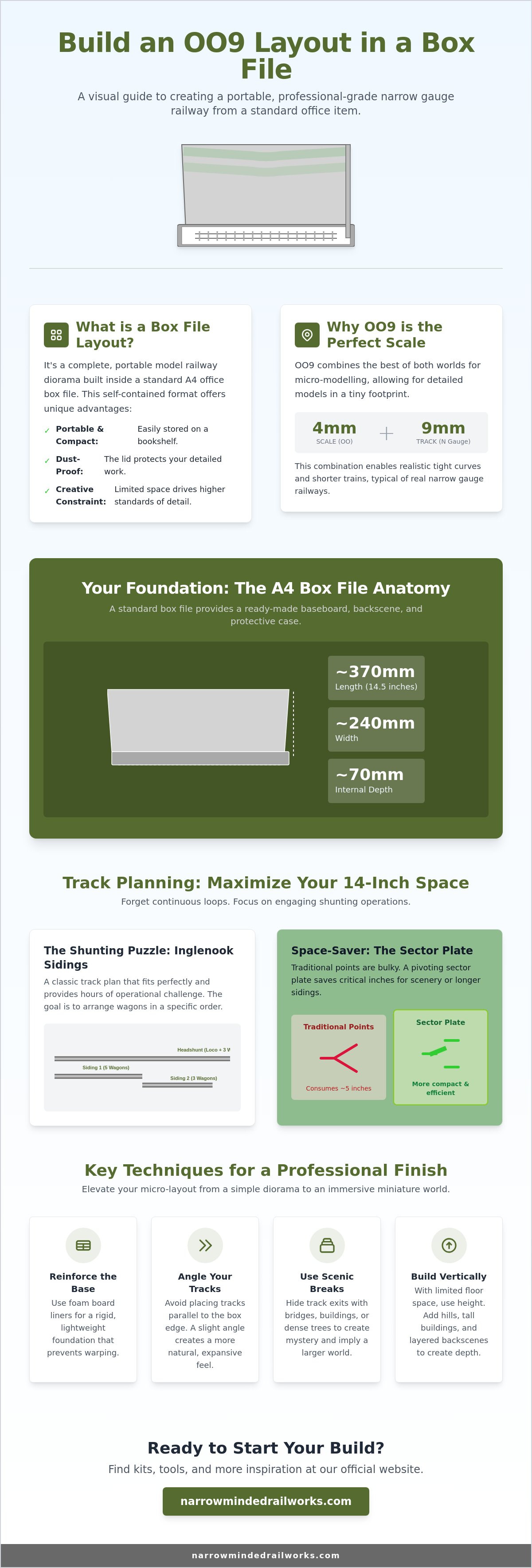
A standard A4 box file typically measures approximately 370mm by 240mm with a depth of about 70mm. These dimensions dictate your track plan, but they also provide built-in structural benefits. The hinged lid serves as a ready-made backscene, providing a vertical canvas for sky or distant landscapes. You must consider the internal depth carefully; buildings and scenery must be low-profile enough to allow the lid to close. This constraint encourages the use of low-relief structures and clever forced perspective, ensuring your finished oo9 layout in a box file remains truly portable and protected when not in use.
Designing Your Track Plan for Maximum Playability
Designing a track plan for a 14-inch space requires a shift in perspective. You don't have room for a continuous loop, but you have ample space for an engaging shunting puzzle. The "Inglenook Sidings" concept is a perfect fit for an oo9 layout in a box file. It uses three sidings of varying lengths, typically holding five, three, and three wagons respectively, to create a logic game where you rearrange rolling stock into a specific order. This approach transforms a small shelf-top project into a long-term operational challenge that tests your shunting skills.
To keep the project manageable, adopt the "one-engine-in-steam" principle. Since the layout is small, you only need one locomotive operating at a time. This removes the need for complex wiring or section switches, allowing you to focus on smooth power delivery. You can find regular inspiration for these minimalist track plans in Railway Modeller Magazine, which frequently features micro-layout designs. By focusing on a single locomotive, you can dedicate more time to the fine detailing of your kits.
The Sector Plate vs. Traditional Points
While traditional points often consume four or five inches of precious linear space, a sector plate offers a more compact alternative. A sector plate is a pivoting section of track that aligns with multiple exit tracks, acting as a manual turnout. This method saves several inches of space that you can then dedicate to scenery or longer sidings. You can build a reliable 9mm sector plate using a small brass bolt as a pivot point and copper-clad PCB strips for electrical continuity. It's a proactive solution for modellers who want maximum trackage without the bulk of standard turnouts.
Visual Tricks to Enhance Space
Visual presentation is key to making a micro-layout feel substantial. Avoid placing track perfectly parallel to the box edges. Angling the rails even by five degrees creates a more natural, expansive feel. Use "scenic breaks" like a stone bridge, a tall warehouse, or thick foliage to hide where the track enters the hidden "fiddle yard." These view-blockers force the viewer to imagine the line continues beyond the box. Once the track is laid, you can begin selecting OO9 locomotive and wagon kits that suit your specific industrial or rural theme. This ensures your rolling stock fits the narrative of your miniature world.
Building the Foundation: Box Preparation and Electrics
A standard cardboard box file lacks the structural integrity required for a permanent oo9 layout in a box file. Over time, atmospheric humidity or the moisture from scenic glues can cause the thin cardboard to warp, which inevitably ruins your track alignment. You need a proactive solution to ensure your layout remains flat and functional. Strengthening the base and sides with 5mm foam board or 3mm plywood creates a rigid "box-within-a-box" that resists twisting. This reinforcement provides a stable surface for trackwork and ensures the hinged lid continues to close precisely.
Choosing the right track is your next critical decision. While standard N gauge track is functional, Peco Crazy Track (SL-400) offers the irregular sleeper spacing that defines the narrow gauge aesthetic. This flexible track allows you to create the organic, slightly weathered look typical of industrial lines. According to 2026 market data from retailers like Frizinghall Models & Railways, Peco SL-400 flexible track is available for approximately £7.60 per length. Investing in specialized track ensures your finished model looks like a authentic narrow gauge line rather than a converted mainline railway.
Baseboard Reinforcement Techniques
Start by lining the internal floor and walls of the box with 5mm foam board. You must avoid using standard PVA glue for this step because its high water content causes cardboard to curl almost immediately. Instead, utilize a high-tack spray adhesive or contact cement for a dry bond. This method provides an instant, permanent fix without introducing moisture. Utilizing professional diorama tools for precise cutting will result in a snug fit that significantly increases the box's torsional strength. Once the liners are in place, you have a solid foundation that can support heavy scenery and precise locomotive movement.
Wiring and Powering Your Micro-Layout
Simple two-wire DC wiring is usually sufficient for a micro-layout, as you'll likely only operate one locomotive at a time. For ultimate portability, you can use a 9V battery-powered controller hidden within a scenic structure like a water tower or small shed. This makes your oo9 layout in a box file completely self-contained. If you require advanced features like independent sound or light control, you should check with specialized electronics retailers for Digital Command Control (DCC) systems. Finally, install a strip of self-adhesive 12V LEDs along the inside of the lid. This provides consistent, professional lighting that highlights the detail in your locomotive and wagon kits.
Scenic Detailing: Creating an Immersive Miniature World
Detailing is where an oo9 layout in a box file truly comes to life. Because the viewing area is so concentrated, every square inch must be intentional. A layering approach works best to build realism; you should start with a base of fine earth or ballast before adding progressively larger textures like weeds and scrub. This method creates a sense of "grounding" for your models, ensuring they look like they belong in the environment rather than just sitting on top of it. Forced perspective also plays a major role here. By using slightly smaller figures or buildings toward the back of the box, you trick the eye into seeing a much deeper scene than the 240mm width allows.
Narrow gauge railways are rarely pristine. They're often characterized by "clutter" like discarded oil barrels, timber crates, and rusting tools scattered near the track. These small details provide essential context and character, telling a story about the industry your line serves. Utilizing 3D printed accessories is a proactive solution for adding this level of complexity without spending weeks on scratch-building. These small touches transform a simple track plan into a living, breathing miniature world.
Verticality in Small Spaces
You only have about 70mm of internal depth to work with, so you must use height to create visual interest. Embankments and stone retaining walls break up flat surfaces and add structural depth to the scene. Low-relief buildings are particularly effective in this format. You can cut 3D printed building kits in half and mount them directly against the backscene, which provides a full-scale appearance while consuming only a few millimeters of space. Framing the edges of your oo9 layout in a box file with a tall tree or a telegraph pole helps draw the viewer's eye into the center of the action.
Finishing Touches and Weathering
Raw 3D prints often show subtle layer lines that can break the illusion of reality. It's helpful to follow a structured guide for painting 3d printed models to achieve a smooth, professional finish before you install them. Once the base colors are dry, apply dark acrylic washes to crevices to accentuate shadows and highlight fine textures. For ground cover, 2mm static grass generally looks more realistic in 4mm scale than bulky ground foams, which can appear oversized. You can find everything you need to complete these steps in our collection of diorama tools and scenery, designed specifically for high-detail micro-modelling.
Selecting Locomotives and Wagons for Micro-Layouts
Choosing the right rolling stock is the final step in bringing your miniature world to life. You might feel that high-quality performance requires expensive ready-to-run models, but these often lack the specific industrial charm required for a niche micro-project. 3D printed kits offer a proactive solution, providing the flexibility to model unique prototypes that commercial manufacturers often overlook. For an oo9 layout in a box file, these kits allow you to tailor your roster to a specific narrative, whether it's a slate quarry, a timber yard, or a remote village line.
Technical constraints in a box file require careful selection of wheelbases. Because micro-layouts often utilize tight curves to maximize space, you should prioritize short-wheelbase locomotives that can navigate sharp radii without binding. Reliability during slow-speed shunting is also vital. You can achieve this by weighting your wagons with small lead or tungsten strips hidden beneath the chassis or within the load. This extra mass ensures that your rolling stock stays on the rails when being pushed through points, providing the smooth operational experience that makes an oo9 layout in a box file so satisfying to use.
Building Your First OO9 Kit
If you're new to the scale, you should consult our beginner’s guide to choosing an OO9 loco kit before making your first purchase. Most 3D printed locomotive kits are designed to fit onto existing commercial N gauge chassis, which handle the mechanical movement while the kit provides the visual character. You don't need a workshop full of heavy machinery to succeed. A few essential diorama tools, such as fine-grit sanding sticks and high-quality cyanoacrylate adhesive, are all you need to assemble a professional-looking wagon or locomotive kit.
The Role of Narrow Minded Railworks in Your Build
We specialize in providing the components that turn a standard box into a detailed narrow gauge scene. Our range of OO9 locomotive and wagon kits focuses on industrial and "freelance" designs that feel right at home in the cramped confines of a micro-layout. To add a human element, you can utilize our scanned figures, which are scaled precisely to 4mm to match your rolling stock. These details, combined with our specialized scenery parts, allow you to customize every aspect of your build. By focusing on high-quality kits rather than mass-produced models, you ensure your layout remains a unique creative outlet that reflects your personal modelling style.
Start Your Narrow Gauge Journey Today
Building an oo9 layout in a box file is a proactive solution for any modeller facing space or budget constraints. You've seen how a reinforced office file provides a stable base for intricate shunting operations and immersive scenic detailing. By focusing on smart track geometry and layered textures, you can create a professional-grade railway that fits on a standard bookshelf. The key to a successful micro-layout lies in the character of your rolling stock and the fine details that tell a story.
You can browse our range of OO9 locomotive and wagon kits to start your build. We offer specialist 3D printed kits designed specifically for narrow gauge enthusiasts, along with detailed figures scanned from real people for ultimate realism. We provide worldwide shipping for all loco bodies and accessories, ensuring you have the tools needed regardless of your location. Don't let a small footprint limit your creativity. Your first micro-masterpiece is just one box file away.
Frequently Asked Questions
Can I use DCC on a box file layout?
Yes, you can install DCC systems on an oo9 layout in a box file to gain independent control over sounds and lighting. While we specialize in locomotive kits rather than electronics, you should check with digital control specialists for compatible decoders. Using DCC in a small space allows you to keep multiple engines on the track without the need for complex section switches or isolated sidings.
What is the best track to use for an OO9 box file build?
Peco SL-400 flexible track is the industry standard for narrow gauge micro-layouts. It utilizes 9mm gauge rails but features the irregular sleeper spacing required for a realistic 4mm scale appearance. Standard N gauge track is a functional alternative if you are on a strict budget, but it lacks the rugged, industrial aesthetic that defines authentic narrow gauge lines.
How do I stop the cardboard box from warping over time?
You must line the interior of the box with 5mm foam board or 3mm plywood to prevent warping. Cardboard is highly susceptible to moisture from scenic glues and environmental humidity. A proactive solution is to use spray adhesives or contact cement instead of water-based PVA when you are securing your reinforcement panels to the box walls.
What is the minimum radius for OO9 locomotives in a micro-layout?
Most small OO9 locomotive kits can handle a minimum radius of approximately 6 to 9 inches. Since a standard box file is only about 14 inches long, you should avoid using tight loops. Instead, utilize a sector plate or straight shunting sidings to keep your rolling stock moving smoothly without the risk of frequent derailments on sharp curves.
Do I need to build my own baseboard for a box file railway?
You don't need to construct a traditional timber baseboard because the box file serves as the primary structure. This is a significant advantage for modellers with limited tools or restricted workspace. Simply focus on strengthening the existing shell with internal liners to create a rigid foundation that supports your track and scenery work.
How many wagons can a typical box file layout handle?
A typical box file layout handles between three and five wagons effectively. This number is based on the traditional Inglenook shunting puzzle which fits perfectly within the 14-inch linear footprint of a standard file. Keeping your trains short ensures that your locomotive has enough room to maneuver without fouling the points or the sector plate.
Can I link two box file layouts together?
You can definitely link multiple boxes together to create a larger modular system. By aligning the track precisely at the edges of each box, you can expand your oo9 layout in a box file into a series of connected scenes. Use simple track cassettes or bridge rails to span the gap between the individual files for seamless operation.
Is OO9 scale the same as HOn30?
OO9 and HOn30 both run on 9mm track, but they utilize different scales for their models. OO9 is 4mm to the foot (1:76), while HOn30 is 3.5mm to the foot (1:87). While the track gauge is identical, the physical size of the locomotive bodies and figures will differ slightly between these two international modelling standards.