

What if you could capture the heavy, tactile presence of 7mm modeling without sacrificing an entire spare room to do it? While standard O gauge offers incredible detail, the physical footprint often makes it impractical for smaller homes. O-16.5 scale model railway kits provide a proactive solution by combining the larger 7mm scale with the compact geometry of standard 16.5mm track.
You likely appreciate the unique character of narrow gauge prototypes but feel frustrated by the confusion between O-16.5 and On30 standards or the difficulty of finding affordable locomotive bodies. This guide will show you exactly how to build a highly detailed 7mm narrow gauge layout using versatile kits and common track systems. We'll clarify the relationship between scale and gauge, identify compatible chassis for your builds, and explore how modern 3D printing makes niche prototypes more accessible than ever.
Key Takeaways
- Understand how O-16.5 uses 7mm scale on 16.5mm track to accurately represent prototypes between 2ft and 2ft 6in gauge.
- Learn why adapting standard OO/HO track with wider sleeper spacing is essential for achieving an authentic narrow gauge aesthetic.
- Identify the best O-16.5 scale model railway kits, including locomotive bodies and wagons designed for simple assembly on commercial chassis.
- Master professional techniques for cleaning, support removal, and priming 3D printed resin kits to ensure a durable and high-quality finish.
- Discover how modern 3D printing provides a proactive solution for modeling rare and niche narrow gauge prototypes that are otherwise difficult to find.
What is O-16.5 Scale and Why Choose It?
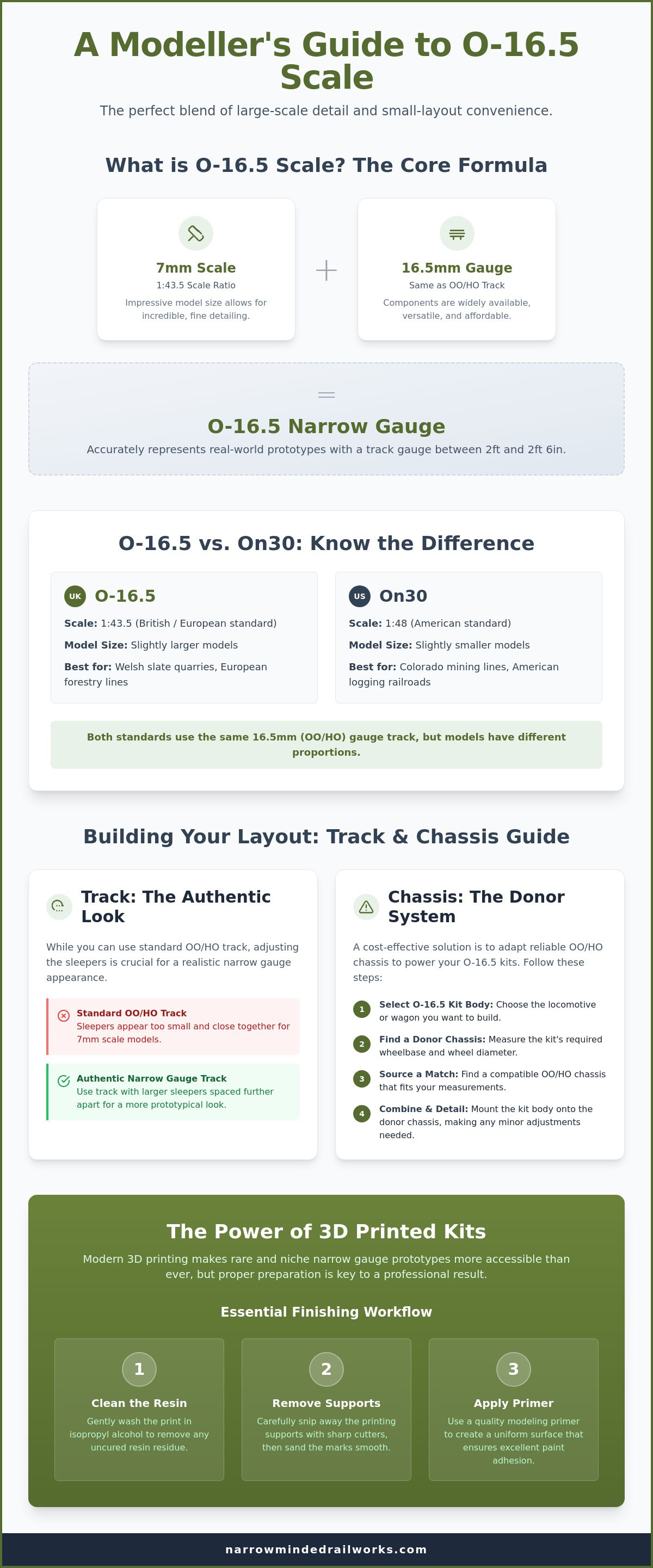
O-16.5 scale represents a specific intersection of size and accessibility. It utilizes a scale of 7mm to the foot (1:43.5) while running on 16.5mm gauge track. This combination allows modellers to represent narrow gauge prototypes with an actual track gauge between 2ft 3in and 2ft 6in. Because 16.5mm is the standard gauge for OO and HO scales, finding track and chassis components is straightforward. This accessibility reduces the initial cost of entry for those moving up from smaller scales.
Choosing O-16.5 scale model railway kits allows you to achieve the high level of detail associated with O gauge without requiring a massive layout room. It's a "large scale, small model" philosophy. You get the presence of a 7mm locomotive, but the tight radiuses of narrow gauge track mean the layout fits into spaces usually reserved for smaller scales. While standard O gauge might feel restrictive in a small apartment, the narrow gauge alternative offers a realistic path forward for ambitious modellers.
To better understand how these components come together in practice, watch this overview of a popular wagon kit:
O-16.5 vs On30: Understanding the Differences
Newcomers often encounter confusion between O-16.5 and On30 scale standards. While both use 16.5mm track, they're not identical. O-16.5 follows the British and European 1:43.5 scale. On30 is the American equivalent, built to 1:48 scale to represent 30-inch (2ft 6in) gauge prototypes. The physical models in O-16.5 are slightly larger than their On30 counterparts. Mixing them is possible, but the slight difference in proportion can be noticeable on a layout. Selecting the right standard depends on whether your inspiration comes from a Welsh slate quarry or a Colorado mining line.
The Appeal of 7mm Narrow Gauge
Investing in high-quality O-16.5 scale model railway kits opens significant opportunities for fine detailing that are often impossible in smaller gauges. You can model individual rivets, intricate cab controls, and realistic weathering textures with greater ease. These models have a distinct "heft" and physical presence. They feel like heavy machinery rather than delicate toys. Because the scale is popular, you'll find excellent compatibility with a wide range of scenery and accessories originally designed for standard O gauge. This makes it easier to populate your layout with high-quality figures and structures without starting from scratch.
The Mechanics of O-16.5: Track and Chassis Standards
The primary draw of O-16.5 is the ability to use 16.5mm track, the same gauge used by millions of OO and HO modellers worldwide. This provides a significant head start in terms of availability and cost. However, simply laying standard OO track often fails the "eye test" because the sleepers are scaled for 4mm or 3.5mm models. For a 7mm narrow gauge layout, the sleepers should be larger and spaced further apart to reflect the lighter, often improvised nature of narrow gauge permanent way.
The 7mm Narrow Gauge Association provides the definitive standards for this scale, ensuring that wheels, track, and couplings from different manufacturers work together seamlessly. By following these established guidelines, O-16.5 scale model railway kits allow you to move beyond the limitations of mass-produced models. These kits act as a bridge, offering the detail of a custom build with the structural integrity of a professionally designed product. They provide a proactive way to build a unique fleet without the complexity of scratchbuilding every component from metal or wood.
Selecting a Chassis Donor for Your Kit
One common constraint in 7mm narrow gauge is the lack of dedicated, affordable power units. A proactive solution is to repurpose reliable OO or HO scale locomotive chassis as "donors." For example, many Hungarian forestry or industrial diesel bodies are designed to fit the wheelbase of standard OO gauge shunters. When selecting a donor, you'll need to measure the wheelbase and wheel diameter carefully to ensure it aligns with the kit's proportions. While some modification to the donor's plastic frame is occasionally necessary, most 3D printed bodies provide clear mounting points to simplify the conversion process. By browsing our collection of O-16.5 scale model railway kits, you can find bodies specifically designed for these popular donor chassis.
Trackwork Considerations for 7mm
If you're building a dedicated narrow gauge railway, track choice is critical. While you can manually remove every second sleeper from OO gauge track, using purpose-made PECO O-16.5 track is often more efficient. This track features the correct sleeper dimensions and spacing for 7mm scale right out of the box. Keep in mind that larger 7mm locomotives require more clearance on curves than their OO counterparts. Aiming for a minimum radius of 18 to 24 inches will ensure smooth operation for most rolling stock. If you're ready to start your next project, exploring our range of locomotive and wagon kits is an excellent first step toward a realistic layout.
Choosing Your First O-16.5 Model Railway Kits
Selecting the right O-16.5 scale model railway kits is a pivotal step in defining the character of your layout. While standard gauge modelling often relies on off-the-shelf purchases, narrow gauge enthusiasts frequently turn to kits to represent the quirky, industrial nature of their prototypes. As organizations like The Model Railway Club have historically demonstrated, the joy of the hobby often lies in the building process. Modern 3D printing has revolutionized this by making niche prototypes accessible without the high cost of traditional brass or white metal kits. High-quality resin bodies provide a proactive solution for modellers who want crisp detail and smooth surfaces without the need for extensive cleaning or soldering.
Most kits consist of a primary body shell and a set of detail parts such as handrails, chimneys, and couplings. Because these kits are designed for commercial chassis, you avoid the complexity of building a motor unit from scratch. This transparency in design ensures that you know exactly which parts you need before you start, setting realistic expectations for the build time and final result. It's a structured approach that allows you to focus on the creative aspects of painting and weathering.
Locomotive Kits: From Industrial to Tram Engines
For those starting out, industrial diesel and steam engines are popular choices. These prototypes were the workhorses of British and European narrow gauge lines. A tram loco is an exceptionally practical entry point for beginners. Their enclosed bodies hide the chassis entirely, which solves the common problem of trying to fit a motor into a tiny, open-cab locomotive. Before purchasing, always verify that the kit's internal dimensions match your intended motor unit. This proactive check prevents frustration during the assembly phase and ensures a smooth fit.
Rolling Stock: Wagons and Coaches
Building a consistent fleet requires a mix of rolling stock. You might choose slate wagons for a Welsh-inspired line or tippers for a construction-heavy industrial layout. Because O-16.5 models are larger, they're lighter than they look. Adding lead or tungsten weight to the underside of wagon kits is a proactive step that ensures reliable tracking over pointwork. You'll also need to decide on a coupling standard. While Greenwich and Bemo couplings are common, many modellers prefer the simplicity of link-and-pin for that authentic narrow gauge feel. Using 3D printed wagon kits allows you to rapidly expand your fleet with identical units, creating a cohesive visual narrative across your railway.
Building and Finishing 3D Printed O-16.5 Kits
Finishing O-16.5 scale model railway kits requires a different approach than traditional injection-moulded plastic. While 3D printed resin offers exceptional detail, the surface often features small support "pips" from the manufacturing process. A proactive cleaning routine is essential to ensure these marks don't compromise the final appearance of your 7mm locomotive. By using a combination of fine-grit sandpaper and precision hobby snips, you can achieve a factory-smooth finish that serves as the perfect canvas for paint. This stage is where the transparency of the 3D printing process becomes an advantage, as the material remains consistent across the entire body shell.
Surface Preparation and Assembly
While resin provides a crisp level of detail, it doesn't react to standard plastic cement. A proactive solution is to use high-viscosity cyanoacrylate (super glue) for all structural bonds. Before you apply any adhesive, you must test-fit the 3D printed body to your chosen chassis. If the fit is tight, you can gently sand the interior of the body shell without affecting the exterior detail. This step ensures that once the model is painted, the body and power unit will align perfectly without the need for forceful assembly. Removing support pips is best done with a fresh scalpel blade, followed by a light buffing with a 1000-grit sanding pad to eliminate any remaining texture.
Painting and Detailing Your Model
Bare resin can sometimes repel certain hobby paints if not treated correctly. A proactive first step is to wash the kit in warm, soapy water to remove any residual manufacturing oils, followed by a high-quality primer. Following a structured guide to painting 3D printed models will help you avoid common pitfalls like paint pooling or obscured details. Because 7mm is a larger scale, you have ample room to add realistic touches such as etched nameplates, cab controls, and 3D scanned crew figures. These details transform a simple body shell into a convincing piece of heavy machinery.
Narrow gauge railways were rarely pristine. While your base coat might look professional, adding layers of weathering provides the hardworking look essential for industrial prototypes. Use a combination of dry-brushing and weathering washes to highlight the rivets and panels that O-16.5 scale model railway kits capture so well. If you're ready to apply these techniques to your own fleet, explore our collection of 3D printed narrow gauge kits to find your next project.
Why Narrow Minded Railworks is Your O-16.5 Partner
Narrow Minded Railworks recognizes that finding high-quality, affordable locomotive bodies is a common pain point for narrow gauge enthusiasts. While many manufacturers focus on mass-market items, we provide a proactive solution through our specialized range of O-16.5 scale model railway kits. Our commitment to 3D printing allows us to offer niche Hungarian forestry diesels, industrial shunters, and unique wagons that would otherwise be unavailable to the average modeller. Every kit we produce is designed by modellers who understand the practicalities of the workbench, ensuring a transparent and helpful building experience from start to finish.
We understand that international modellers often worry about the logistics of sourcing specialized parts from niche suppliers. To solve this, we offer worldwide shipping from our UK base, ensuring that our 7mm narrow gauge solutions reach layouts from Europe to North America and beyond. Beyond locomotive and wagon kits, we provide the diorama tools and scenery necessary to ground your models in a realistic, hardworking environment. This holistic approach ensures you have a reliable partner for every stage of your layout's development, from the first locomotive body to the final scenic details.
Designed for Ease of Use
While some traditional kits require the complex scratchbuilding of power units, we've optimized our O-16.5 scale model railway kits to fit standard, easily sourced commercial chassis. This proactive design choice removes the technical barrier of motorization, allowing you to focus on the creative aspects of the hobby like painting and weathering. We regularly update our catalogue with rare and interesting prototypes, ensuring there's always a fresh project waiting for your workshop. If you encounter an assembly hurdle, we take a proactive approach to helping customers solve technical challenges through clear communication and design transparency.
Expanding Your 7mm World
Your modeling journey doesn't have to be restricted by specific scale designations. While O-16.5 is a primary focus, many of our custom scenery items and detail parts integrate perfectly with our On30 gauge accessories. This versatility allows you to mix and match components to create a truly bespoke narrow gauge environment that reflects your specific prototype inspiration. We encourage you to join the Narrow Minded community, where you can share your build showcases and exchange tips with fellow enthusiasts. By choosing us as your partner, you're joining a group of modellers dedicated to making the 7mm narrow gauge hobby more accessible and rewarding for everyone.
Build Your Ideal Narrow Gauge Layout
Modeling a detailed narrow gauge railway often feels restricted by space or the complexity of scratchbuilding. O-16.5 scale model railway kits provide a proactive solution by offering high-fidelity 7mm designs that utilize reliable, standard-gauge track systems. You've learned how to identify compatible chassis and master the finishing process for 3D printed resin, turning niche prototypes into the centerpieces of your collection.
Narrow Minded Railworks supports your hobby with specialist 3D printed designs and worldwide shipping from the UK. Our kits prioritize transparency and ease of assembly, ensuring compatibility with standard chassis so you can focus on the creative joy of modeling. Explore our full range of O-16.5 and 7mm scale kits today and start bringing your unique vision to life. Your next great project is just a few clicks away.
Frequently Asked Questions
Is O-16.5 the same as O gauge?
No, they are distinct standards that share the same 7mm to the foot (1:43.5) scale. While standard O gauge represents broad, 4ft 8.5in prototypes on 32mm track, O-16.5 represents narrow gauge prototypes on 16.5mm track. This allows you to model industrial or rural railways with the high detail of O gauge but within a much smaller physical footprint.
Can I use standard OO gauge track for O-16.5 kits?
Technically, the 16.5mm gauge is identical, so your models will run on standard OO or HO track. However, the sleeper size and spacing on standard track look incorrect for 7mm scale. A proactive solution is to use purpose-made O-16.5 track or manually remove and reposition sleepers on OO track to achieve a more authentic narrow gauge appearance.
What is the best chassis to use for an O-16.5 locomotive kit?
The ideal chassis depends on the specific prototype, but many O-16.5 scale model railway kits are designed around common OO gauge donor units. While finding a perfect match can be difficult, most kits specify a compatible wheelbase from manufacturers like Hornby or Bachmann. Always verify the internal dimensions of the body kit against your donor chassis before starting your build.
How do I paint a 3D printed model railway kit?
Begin by washing the resin body in warm, soapy water to remove any residual oils from the printing process. Once dry, you must apply a high-quality primer specifically formulated for plastic or resin to ensure the topcoat adheres properly. You can then finish the model using standard acrylic or enamel hobby paints, applying thin layers to preserve the fine surface details.
Do I need special tools to build O-16.5 kits?
You don't need heavy machinery, but a few precision tools are essential for a professional finish. We recommend a sharp scalpel, precision side cutters for removing supports, and various grits of fine sandpaper. Because resin doesn't react to plastic cement, you'll also need a high-quality cyanoacrylate (super glue) for all assembly tasks.
What is the difference between O-16.5 and On30?
The primary difference is the scale ratio used to represent the same 16.5mm track gauge. O-16.5 uses the British 1:43.5 scale, while On30 follows the American 1:48 scale. While they look similar at a distance, O-16.5 models are slightly larger. You should choose the standard that best matches your prototype inspiration to maintain consistent proportions across your layout.
Are the kits suitable for beginners?
Yes, body-only O-16.5 scale model railway kits are an excellent starting point because they eliminate the need for complex motor construction. While finishing 3D printed resin requires some patience during the sanding and priming stages, the actual assembly is often simpler than traditional etched brass kits. Starting with a basic wagon or a tram locomotive body is a proactive way to build your confidence.
Where can I find couplers for O-16.5 rolling stock?
You can find suitable couplers through specialist narrow gauge retailers or by repurposing standard OO gauge versions. Many modellers prefer Greenwich or Bemo couplings for their reliability, while others choose link-and-pin styles for maximum authenticity. Most 3D printed kits provide a flat mounting surface, giving you the flexibility to install whichever coupling system you prefer for your fleet.