

3D printing is no longer a budget alternative; it's the superior method for achieving the fidelity required by 4mm narrow gauge prototypes. Many modellers feel restricted by the limited selection of ready-to-run models, yet the thought of tackling 3d printed oo9 kits often brings concerns about brittle materials or confusing assembly. While early prints sometimes lacked durability, 2026 technology has changed the landscape by offering high-resolution resins that rival traditional materials. You can now access niche prototypes that major brands ignore without sacrificing the structural integrity of your locomotive.
We understand that finding the right match between a body shell and a commercial chassis can be a frustrating hurdle. Although the variety of options might seem overwhelming, this guide simplifies the process by showing you exactly how to choose, build, and finish a unique locomotive for your layout. You'll learn how to identify professional-grade prints and pair them with reliable power units like the Kato 11-109 for a smooth running experience. By the end of this article, you'll have the confidence to create a highly detailed model that stands the test of time.
Key Takeaways
- Understand why high-resolution engineering resins have surpassed traditional white metal for capturing the intricate details of 4mm scale locomotives.
- Discover how modern 3d printed oo9 kits provide the durability and rivet-head accuracy needed for a layout-ready model that lasts.
- Learn to navigate the chassis matching process by identifying which commercial power units from Kato or Graham Farish are designed to fit specific locomotive bodies.
- Master professional finishing techniques, including proper IPA cleaning and specialized priming, to prepare your resin kits for a realistic paint job.
- Gain the confidence to build unique, niche prototypes that aren't available as ready-to-run models, using kits designed for straightforward assembly.
The Evolution of OO9 Modelling: Why 3D Printing is the New Standard
Narrow gauge modelling captures the unique charm of small, hardworking railways that once served remote industries and rural communities. The OO9 model railway scale specifically represents these 2-foot gauge prototypes using 4mm to the foot scale on 9mm track. This clever combination allows for significant detail while utilizing widely available N gauge track components. For years, modellers relied on white metal or etched brass to build their fleets, but the rise of 3d printed oo9 kits has redefined the hobby. This technology enables the production of complex, organic shapes that were previously impossible or too expensive to manufacture in small batches.
The shift toward resin isn't just about cost; it's about prototype freedom. Big manufacturers usually stick to famous lines like the Ffestiniog or Lynton & Barnstaple because they need high sales volume to succeed. If you want a specific industrial locomotive from a remote Welsh quarry or a peat bog in Ireland, you're often left to scratch-build from raw materials. 3D printing changes that. It allows designers to create accurate bodies for niche prototypes that would never justify the high tooling costs of injection-moulded plastic. This technology has effectively lowered the entry barrier, allowing newcomers to build a professional-looking fleet without needing a workshop full of specialized tools.
To see how these modern prints transform the building experience, watch this helpful video:
The Limitations of Traditional Kit Manufacturing
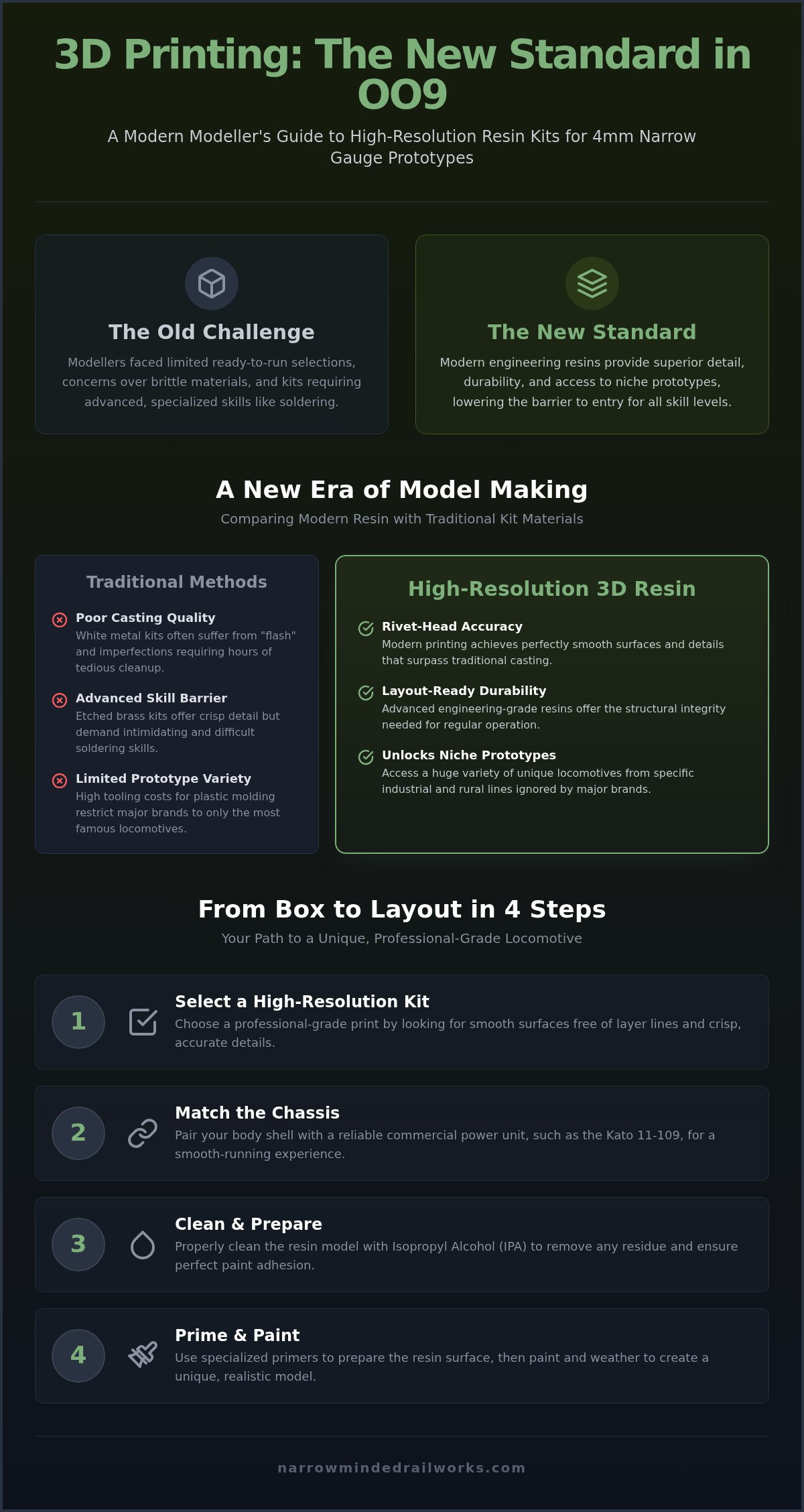
Traditional manufacturing presents several hurdles for the average hobbyist. Tooling for plastic models costs thousands of pounds, which limits the variety available on the market to only the most popular engines. White metal kits provide helpful weight, but they can suffer from poor casting quality or "flash" that requires hours of tedious cleaning. Etched brass offers crisp lines, yet it requires advanced soldering skills that many beginners find intimidating. In contrast, 3d printed oo9 kits arrive as high-resolution pieces that eliminate complex sub-assemblies while maintaining better surface detail than traditional casting. While resin was once considered fragile, the engineering-grade materials used in 2026 provide the durability required for regular layout operation.
OO9 vs N Gauge: Understanding the Narrow Gauge Appeal
While OO9 uses N gauge track, the appeal is entirely different. N gauge often focuses on long trains and vast landscapes, whereas OO9 is about the character of the "Great Little Trains of Wales" and tight, winding industrial lines. It offers a unique opportunity to build a complete, characterful layout in a very small space. Modern 3D printed kits bridge the gap between toy-like entry models and museum-quality pieces. They allow you to focus on the creative aspects of the hobby, such as painting and weathering, rather than struggling with basic construction. This shift ensures that even a modest layout can feature a diverse and historically accurate roster of locomotives.
Anatomy of a High-Resolution OO9 Kit: Material and Detail
The quality of 3d printed oo9 kits has undergone a fundamental transformation by 2026. While early resin models often suffered from visible "stepping" or layer lines, modern high-resolution printers utilize advanced light-processing to eliminate these surface imperfections. This progress ensures that even the most complex curves on a locomotive boiler appear perfectly smooth under a coat of paint. You don't have to spend hours sanding a body shell to achieve a professional finish; instead, you can focus on the artistic aspects of the build. These advancements mean that 3D printing is now the primary choice for capturing the delicate aesthetics of narrow gauge steam and diesel prototypes.
Detail levels in this scale are now truly remarkable. We can achieve rivet-head accuracy and crisp cab interiors that were previously the exclusive domain of expensive brass kits. Modern prints allow for integrated details like boiler bands, handrail knobs, and even delicate window frames to be part of the primary shell. This integration reduces the number of tiny parts you need to glue, which simplifies the assembly process for modellers of all skill levels. If you're looking for high-fidelity models, you might explore the locomotive and wagon kits available today that prioritize this level of prototype accuracy.
SLA vs DLP Printing for Model Railways
Achieving smooth, high-fidelity surfaces relies on the specific technology used during the printing process. SLA (Stereolithography) and DLP (Digital Light Processing) both use UV light to cure liquid resin, but the pixel density in 2026 machines has reached a point where individual layers are virtually invisible to the naked eye. This precision is vital for 4mm scale modelling where a fraction of a millimetre can change the look of a locomotive. Proper post-print UV curing is the final, essential step to ensure the long-term stability and hardness of the model shell.
Durability and Longevity of 3D Printed Bodies
Many hobbyists still hold onto the myth that resin is inherently brittle. While basic hobbyist resins can be fragile, the professional-grade engineering resins used for modern kits offer significant impact resistance and slight flexibility. Modern UV-curable resins are formulated for chemical stability, ensuring they remain archival-quality and do not degrade or warp when exposed to standard indoor environments over several decades. These 2026 materials resist environmental degradation far better than the plastics used in the past. You'll find that a 3D printed wagon body can now match or exceed the strength of a traditional injection-moulded counterpart during regular layout use.
The Chassis Challenge: Matching 3D Bodies to Mechanisms
A highly detailed body shell is only half of the equation for a successful build. While the visual fidelity of 3d printed oo9 kits has reached new heights, the model must perform reliably on the track to be more than a static ornament. Many modellers find the prospect of building a locomotive motor from scratch quite intimidating. To solve this, the modern design philosophy focuses on creating body shells that utilize ready-to-run N gauge mechanisms. This approach allows you to benefit from the smooth slow-speed running of a factory-tuned motor while enjoying the unique character of a niche narrow gauge prototype.
Wheelbase accuracy remains a critical factor when selecting a donor mechanism. If the wheel spacing doesn't match the prototype's frames, the locomotive will look "off" regardless of how well it is painted. Finding an exact match for every obscure industrial engine can be difficult. We address this by engineering our kits to fit the most reliable and widely available chassis on the market, ensuring that your finished model looks correct and operates without hesitation. By using standard power units, you avoid the frustration of troubleshooting complex gearboxes or soldering tiny motor leads.
Popular Chassis for OO9 Locomotive Kits
- Kato 11-103 and 11-109: These four-wheel power units are the undisputed workhorses of the narrow gauge community. They are compact, affordable, and offer exceptional reliability for small steam and diesel models.
- Graham Farish 0-6-0: For larger locomotives like the Manning Wardle or various quarry Hunslets, Graham Farish N gauge mechanisms provide the necessary power and the correct six-wheel configuration.
- Arnold and Minitrix: These options are frequently used for European-style narrow gauge prototypes or larger industrial engines that require a more robust footprint.
Mounting and Securing Your 3D Printed Body
Securing the resin shell to the chassis requires a careful approach to ensure everything remains aligned. For initial testing, many builders use a small amount of "Blu-Tack" to hold the body in place. This allows you to check for clearance around moving parts and valve gear before committing to a permanent fix. Once you're satisfied with the fit, permanent screw mounts or small resin clips provide a more stable solution. It's also vital to manage the weight of the model. Because resin is lighter than white metal, adding small pieces of lead or tungsten putty into the side tanks or boiler will significantly improve traction and electrical pickup on your layout. Using these 3d printed oo9 kits with a weighted chassis creates a locomotive that feels substantial and handles heavy trains with ease.
From Box to Layout: Finishing and Painting 3D Printed Kits
The transition from a raw resin shell to a layout-ready locomotive is where your model truly gains its personality. While modern 3d printed oo9 kits arrive with exceptional surface quality, the printing process involves support structures that can leave tiny "nibs" or marks on the surface. These are a natural constraint of the technology. To solve this, you should carefully remove any remaining supports with a sharp hobby knife and wash the entire body in Isopropyl Alcohol (IPA) to ensure no residue interferes with your paint. Taking these small steps early prevents issues that are much harder to fix once the first coat of colour is applied.
Once the body is clean and dry, priming becomes the most critical step. Resin is a non-porous material; this means standard acrylic paints might struggle to adhere without a proper foundation. Using a specialized plastic or resin primer provides the "bite" necessary for subsequent layers. Whether you choose to airbrush for a factory-smooth finish or use a traditional brush for smaller industrial details, a solid primer prevents the paint from chipping during handling or operation. This extra layer of protection is essential for 3d printed oo9 kits that will see regular service on a working layout.
Surface Preparation and Sanding
Even high-resolution prints might occasionally show a minor support contact point that needs attention. You can use fine-grit sanding sticks, typically around 400 to 600 grit, to gently smooth these areas without losing the surrounding rivet detail. If you find any minor surface imperfections, a tiny amount of model filler or even a dab of thick primer can rectify the issue quickly. For a deeper dive into achieving a professional finish, you can read our guide on painting 3d printed models.
Weathering Your OO9 Rolling Stock
Narrow gauge railways are rarely pristine. To achieve a realistic "industrial look," you should focus on adding layers of soot, rust, and grime, especially on quarry wagons and hardworking tank engines. Weathering powders are excellent for creating a dusty, matte finish on resin surfaces, while thin oil washes help highlight the deep recesses of cab interiors and underframes. This process ensures your models reflect the harsh, muddy environments of a typical 2-foot gauge line. If you're ready to start your next project, you can browse our latest OO9 locomotive and wagon kits to find the perfect prototype for your layout.
Why Narrow Minded Railworks is the Choice for Modern Modellers
Choosing the right supplier for your narrow gauge project involves more than just picking a body shell. While the market for 3d printed oo9 kits has expanded, finding a designer who understands the practicalities of a working layout remains a challenge. We focus on delivering high-resolution, layout-ready prints that prioritize ease of assembly without compromising on prototype accuracy. Our catalogue is built by modellers who have faced the same constraints as you, from tight clearances on industrial lines to the nuances of GN15 scale modelling. This hands-on experience ensures that every kit we produce is engineered for success on your workbench.
We recognize that chassis matching can be a complex part of the hobby. While we don't sell the motors themselves, our support team is always available to help you identify the correct donor mechanism for your specific locomotive body. This proactive approach sets us apart from general marketplaces; we're here to guide you through the build process from start to finish. With worldwide shipping and a commitment to professional-grade resin, we provide global narrow gauge communities with the tools they need to build unique, high-fidelity fleets.
Unique Prototypes You Won’t Find Anywhere Else
Mainstream manufacturers often overlook the fascinating variety of UK industrial and heritage narrow gauge railways. While popular engines are well-served, the smaller quarry locomotives and specialized wagons that defined these lines are frequently ignored. Our range addresses this gap by offering a diverse selection of locomotive bodies and wagon styles that capture the true spirit of narrow gauge history. If you're just starting your journey into this scale, you can explore our beginner's guide to OO9 kits to help you choose your first project.
Supporting the Narrow Gauge Community
A thriving hobby relies on constant innovation and shared knowledge. While we maintain a set catalogue, customer feedback frequently drives our new product development and refinements. We don't just provide locomotive shells; we also offer diorama tools and scenery kits to help you build a complete, immersive environment for your rolling stock. This holistic approach ensures your layout feels like a cohesive piece of history rather than just a collection of models. If you're ready to transform your railway with high-detail prototypes, you can Browse our 3D printed OO9 kits today and join a growing community of narrow gauge enthusiasts.
Elevate Your Narrow Gauge Layout with Modern Precision
Narrow gauge modelling has entered a new era where prototype accuracy and ease of assembly finally coexist. You've seen how the shift toward high-resolution resin eliminates the constraints of traditional white metal, offering unparalleled detail and surface smoothness. By choosing modern 3d printed oo9 kits, you can build a unique fleet of industrial and heritage locomotives that big manufacturers simply don't offer. While the technical aspects of chassis matching or resin finishing might seem daunting at first, the availability of reliable donor mechanisms and specialized primers makes the process straightforward for any modeller.
We're committed to helping you achieve a professional finish through our use of high-resolution engineering resins and designs optimized for easy chassis integration. Whether you're modelling a quiet rural branch line or a busy industrial quarry, your layout deserves locomotives that run as well as they look. With worldwide shipping available, the perfect addition to your roster is within reach. Explore Our Full Range of 3D Printed OO9 Locomotive and Wagon Kits and start your next project today. We look forward to seeing your unique narrow gauge vision come to life.
Frequently Asked Questions
Are 3D printed OO9 kits suitable for beginners?
Yes, 3d printed oo9 kits are an excellent starting point for beginners because they arrive as a single, highly detailed shell. Unlike traditional white metal or etched brass, there is no complex soldering required to achieve a professional result. You only need to focus on painting and mounting the body onto a ready-to-run chassis. This simplicity allows new modellers to produce high-quality locomotives without investing in expensive specialized workshop tools.
What is the best glue for 3D printed resin kits?
Cyanoacrylate, commonly known as super glue, is the most effective adhesive for joining 3D printed resin parts. Standard plastic solvent or poly cement won't bond with resin because it doesn't melt the material like it does with injection-moulded plastic. For adding internal weights or larger components, a two-part epoxy resin provides a stronger, more permanent bond. Always ensure the surfaces are clean and free of any residual IPA before you apply your adhesive.
Do 3D printed locomotive bodies come with a chassis?
No, 3d printed oo9 kits typically consist of the detailed body shell and specific fittings only. You'll need to purchase a motorized chassis separately from manufacturers like Kato or Graham Farish to complete the model. We design our kits to fit these reliable, commercially available mechanisms to ensure your locomotive runs smoothly from the first day. This approach keeps the initial kit cost lower and lets you choose a power unit that fits your budget.
How do I remove the visible lines from a 3D printed model?
While modern high-resolution prints have virtually invisible layer lines, any remaining artifacts can be removed with fine-grit sanding sticks. Using 400 to 600 grit abrasive allows you to smooth the surface without damaging delicate rivet details or boiler bands. Following this with a high-build primer will fill any microscopic gaps, resulting in a perfectly smooth finish once your final colour coat is applied to the locomotive shell.
Can I paint 3D printed kits with standard acrylic paints?
You can use standard acrylic paints, but you must apply a specialized resin primer first. Because resin is non-porous, acrylic paint will not bond directly to the surface and may peel or chip during handling. A light coat of a high-quality primer provides the necessary "key" for the paint to stick. Once primed, you can use any model-grade acrylics, whether you prefer airbrushing for a smooth finish or traditional brush techniques for weathering.
Are 3D printed wagons heavy enough to stay on the track?
Resin wagons are inherently lighter than their white metal counterparts, so adding internal weight is usually necessary for reliable tracking. You can easily glue small strips of lead or tungsten putty into the floor or underframe of the wagon to improve its stability. This extra weight ensures the rolling stock stays on the rails when navigating tight curves or complex pointwork, providing the reliable operation needed for a busy industrial layout.
What is the difference between OO9 and HOe scale?
The primary difference lies in the scale ratio, even though both run on 9mm track. OO9 is 4mm to the foot (1:76.2), which is the standard for British narrow gauge modelling. HOe is 3.5mm to the foot (1:87), which is commonly used for European prototypes. Because OO9 models are slightly larger, they often feature more prominent internal cab detail and have a more substantial presence when placed alongside HOe rolling stock.
How long do 3D printed resin models last?
Modern 3D printed resin models are designed for long-term durability and can last for decades. The engineering-grade resins used in 2026 are chemically stable and resistant to environmental degradation once they are properly UV-cured and painted. Unlike early hobbyist materials, these professional-grade prints won't become brittle or warp over time. This ensures that your locomotive remains a reliable and structurally sound part of your collection for many years to come.