

Did you know the Interborough Express is projected to carry 48 million passengers annually, more than any other light rail system in the United States? If you've been tracking the (inurl:news) queens railroad landscape, you know the borough is at the heart of a massive $5.5 billion transit transformation. It's easy to feel overwhelmed by the fragmented reports on $3.00 fare hikes starting January 2026 or the engineering phase of the IBX that began in summer 2025. You deserve a clear picture of these projects and a creative way to celebrate them.
This article explores the latest developments in Queens rail infrastructure and explains how to translate these urban trends into stunning narrow gauge model layouts. We'll examine the ridership growth since the January 5, 2025 congestion pricing launch and show you how to use 3D printed kits to build realistic, modern dioramas on your workbench.
Key Takeaways
- Stay informed on the latest (inurl:news) queens railroad updates, from the East River tunnel renovations to the evolving mix of LIRR and subway infrastructure.
- Uncover the "lost" history of the Rockaway Beach Branch and the technical evolution of Queens rail from steam to modern electric lines.
- Evaluate the impact of the Queensway and the Interborough Express projects on modern transit trends and urban revitalisation.
- Identify the essential visual cues, such as elevated tracks and specific masonry styles, needed to build an authentic New York City atmosphere on your layout.
- Discover how narrow gauge modelling kits provide a space-saving solution for hobbyists looking to recreate complex urban environments in small apartments.
Current Headlines: What’s Making News on the Queens Railroad?
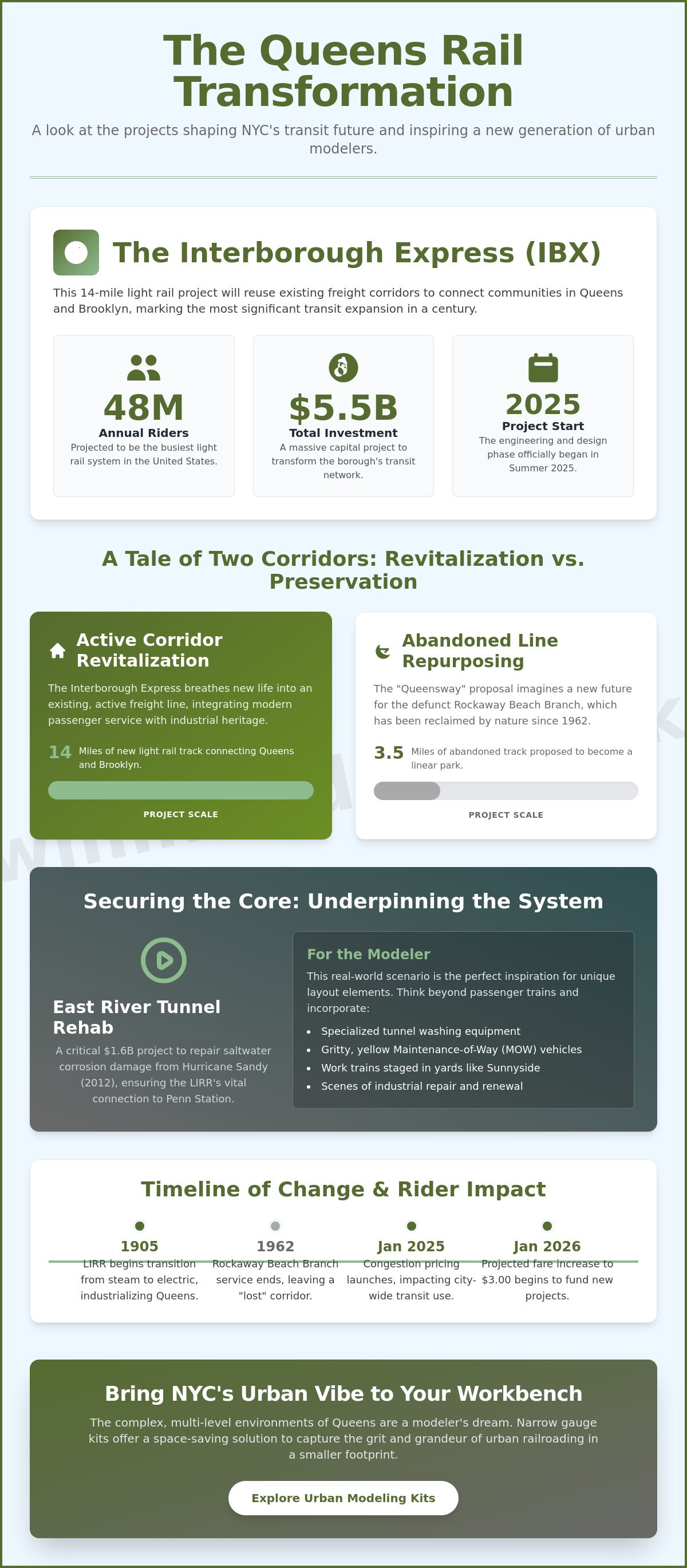
The "Queens Railroad" isn't a single entity. It's a sprawling ecosystem where the Long Island Rail Road (LIRR), the New York City Subway, and lingering freight corridors intersect. Staying current with (inurl:news) queens railroad reports requires looking past daily delays to see the massive infrastructure shifts happening under our feet. For enthusiasts and modellers, these headlines aren't just inconveniences; they're the blueprint for a modern urban landscape. From the $1.6 billion East River Tunnel rehabilitation to the 14-mile Interborough Express project, the borough is currently undergoing its most significant transit expansion in a century.
To better understand the scale of these urban rail operations, watch this helpful video regarding recent safety and transit developments in the area:
LIRR and the East River Tunnel Challenges
The biggest story in Queens rail today is the fight against saltwater corrosion. When Hurricane Sandy hit in October 2012, it flooded two of the four East River Tunnels with millions of gallons of seawater. This event triggered a decade of "invisible" decay that Amtrak and the LIRR are now finally tackling through a massive renovation program. Understanding the History of the Long Island Rail Road helps clarify why these tunnels are so vital. They carry hundreds of trains daily into Penn Station. For modellers, this news provides a perfect excuse to feature work trains, specialized tunnel washing equipment, and the gritty, industrial yellow of maintenance-of-way vehicles on a layout.
The Shift Toward Urban Rail Revitalisation
We're seeing a pivot from basic maintenance to bold expansion. The (inurl:news) queens railroad cycle is now dominated by the Interborough Express (IBX). This project entered its engineering and design phase in the summer of 2025. It aims to use existing freight right-of-ways to connect Jackson Heights to Brooklyn. Simultaneously, the "Queensway" proposal seeks to turn 3.5 miles of the abandoned Rockaway Beach Branch into a linear park. These projects prove that Queens is the focal point for New York's rail innovation. They offer a unique mix of old-growth overgrowth and sleek, modern light rail aesthetics that are ripe for creative modelling projects.
Beyond the Delays: The Fascinating History of Queens’ Narrow and Standard Lines
Queens transit history resembles a complex archaeological dig. Beneath the layers of modern concrete and steel lie the remnants of 19th-century ambitions that still shape the borough today. If you track the (inurl:news) queens railroad narrative, you'll find that current revitalisation efforts aren't just new construction; they're a return to form for corridors that have been active for over a century. The Long Island Rail Road (LIRR) led this charge when it began its massive transition from steam to electric power in 1905. This shift turned Queens from a collection of quiet towns into a dense industrial powerhouse, creating the multi-level track intersections and massive yards like Sunnyside that define the skyline.
This historical density makes the borough a unique hub for rail enthusiasts. While standard gauge dominates the main lines, the history of Queens is also tied to industrial short-lines and dockyard shunting. These smaller operations often relied on tight clearances and sharp curves, mirroring the technical challenges modellers face. To understand the modern plans for these corridors, such as the Interborough Express project, one must first look at the "lost" branches that once connected the borough's diverse communities.
The Rockaway Beach Branch: A Modeller’s Dream
The Rockaway Beach Branch is perhaps the most famous "lost" line in New York City. Since its closure in 1962, this 3.5-mile stretch of track has become a sanctuary for urban decay and overgrowth. For anyone building a narrow gauge railway diorama, this branch offers endless inspiration. The visual cues are striking: rusted steel trestles, platforms reclaimed by nature, and graffiti-covered signal boxes. It represents a specific era of New York history where industry and nature began a slow, beautiful collision. Recreating this atmosphere allows you to experiment with advanced weathering techniques and intricate scenery work.
Industrial Rails and Urban Short-Lines
Beyond the passenger lines, Queens once buzzed with street-running freight and dockside shunting. Small-scale locomotives navigated narrow alleys and tight warehouse districts, moving goods from the East River docks to local factories. This "micro-railroading" is a perfect entry point for modellers with limited space. The (inurl:news) queens railroad archives show that these short-lines were the lifeblood of neighborhoods like Long Island City. If you want to capture this gritty, functional aesthetic on your own bench, you can explore our latest 3D printed kits designed to bring these compact urban scenes to life.
Revitilisation Trends: The Queensway and the Interborough Express
The conversation surrounding the (inurl:news) queens railroad landscape has shifted dramatically from mere maintenance to ambitious revitalisation. Two projects currently dominate the headlines: the Interborough Express (IBX) and the Queensway. These initiatives represent a historic fork in the road for the borough's transit future. One project aims to breathe new life into existing rails for high-capacity transit, while the other seeks to transform abandoned corridors into public green space. For the rail enthusiast, this era offers a rare glimpse into how aging industrial infrastructure is being reimagined for a 2026 audience.
The Interborough Express (IBX) Explained
The Interborough Express is arguably the most significant rail news in decades. This 14-mile line will connect Sunset Park in Brooklyn to Jackson Heights in Queens, using the existing Bay Ridge Branch freight corridor. In the summer of 2025, the project officially entered its engineering and design phase with a total estimated cost of $5.5 billion. The MTA's 2025-2029 Capital Plan has already allocated $2.75 billion to ensure this project moves forward.
The decision to use Light Rail Transit (LRT) instead of conventional heavy rail is a game-changer for the project's aesthetic. LRT offers the flexibility needed to navigate the tight clearances of the existing freight line while supporting a projected annual ridership of 48 million. If you're a modeller, this creates a fascinating opportunity. You can contrast sleek, modern trams against the gritty, weathered backdrop of the old freight tracks. It's a perfect way to represent the modern NYC transit era, where a $3.00 base fare buys a ride on some of the most advanced light rail tech in the country.
The Queensway: A New Perspective on Rail Trails
While the IBX focuses on moving people, the QueensWay rail-to-trail project focuses on community revitalisation. This project targets the northern portion of the abandoned Rockaway Beach Branch, proposing a conversion into a linear park similar to the High Line. The debate between "rail-to-trail" and "rail-to-rail" remains a hot topic in (inurl:news) queens railroad circles, as some advocates still push for restored train service on this corridor.
Modellers can capture this "transitional" state by using scenery kits to depict the gradual reclamation of tracks by nature. You don't have to choose between a working railroad and a park; you can model the exact moment of change. Think about adding small details like construction crews clearing 60 years of overgrowth or community gardens springing up next to rusted signal towers. This juxtaposition of "lost" history and new growth provides a rich, layered narrative for any urban-themed layout.
Bringing the Queens Rail Vibe to Your Layout: A Modeller’s Perspective
The news cycle for (inurl:news) queens railroad projects focuses on large-scale infrastructure, but for the modeller, the real story is found in the grit of the details. Urban narrow gauge is gaining traction because it allows us to build dense, vertical scenes in a fraction of the space. You don't need a massive basement to recreate the feel of a Sunnyside yard or a Long Island City industrial spur. By focusing on elevated tracks, aged red brickwork, and the inevitable layers of graffiti, you can pack the essence of the borough into a compact shelf layout.
Urban Narrow Gauge: Thinking Outside the Quarry
Traditionally, narrow gauge meant slate quarries or rural hillsides. However, adapting OO9 locomotive kits for industrial urban settings is a creative way to reflect modern transit trends. Imagine a small diesel shunter navigating a tight curve between a 1920s tenement building and a modern light rail station. This juxtaposition defines the Queens experience.
Micro-layouts are perfect for this approach. They capture the claustrophobic, busy energy of NYC street scenes where space is at a premium. Adding 3D printed figures waiting on a subway platform or leaning against a chain-link fence brings an immediate sense of scale and life to these dioramas. Using 3D printed kits also allows you to represent unique urban rolling stock that standard manufacturers often overlook.
Weathering and Finishing Urban Rail Models
To match the gritty aesthetic found in current news reports, you need to master the art of weathering. Modern Queens isn't pristine. It's a mix of 100-year-old steel and fresh concrete. When painting 3D printed models, start with a base of urban grime to ground the piece in reality. Focus on representing the specific rust patterns found on the elevated "L" structures or the fine concrete dust from the $1.6 billion East River tunnel renovations.
When you're following the latest (inurl:news) queens railroad updates, you see a borough that is constantly under construction. You can use diorama tools to add small details like abandoned phone boxes, fuel pumps, or even discarded newspapers on the tracks. These elements turn a simple model into a snapshot of New York history. Creating realistic urban clutter is the final step in making your layout feel like a living, breathing part of the city.
Ready to start your own urban masterpiece? Browse our 3D printed urban modelling kits to find the perfect foundation for your next project.
Why Narrow Gauge Kits are Perfect for Urban Modelling Projects
If you live in a borough where space is at a premium, building a massive HO or O scale layout isn't always realistic. Narrow gauge scales like OO9 and GN15 offer a sophisticated solution for urban apartment dwellers who want to capture the (inurl:news) queens railroad revolution without sacrificing their entire living room. These scales allow for tight radius curves and compact scenes that perfectly mirror the narrow alleys and dense industrial corridors found in Long Island City or Jackson Heights. While the Interborough Express project covers 14 miles of physical track, your recreation of its most iconic segments can fit comfortably on a single bookshelf.
Our Narrow Minded Railworks kits bridge the gap between the borough's gritty history and your modeling bench. By choosing narrow gauge, you're not just saving space; you're embracing the "micro-railroading" philosophy that matches the real-world constraints of New York City infrastructure. Whether you're modeling the 19 new stations planned for the IBX or the overgrown remnants of the Rockaway Beach Branch, these smaller scales provide the level of detail necessary to make a small scene feel vast and lived-in.
The Versatility of OO9 and GN15 Scales
The GN15 scale is particularly ideal for heavy industrial urban scenes. It utilizes O scale figures with 16.5mm track, creating a chunky, purposeful look that matches the grit of NYC freight history. You can easily adapt tram-style locomotives for street-running scenarios, mimicking the way rails once shared the pavement with trucks in Queens' busiest manufacturing districts. This scale allows you to tell a story of urban rail evolution, from the historic steam-to-electric transition to the sleek modern light rail trends projected to carry 48 million riders annually by the end of the decade.
Starting Your Urban Rail Project
Starting your first Queens-inspired project doesn't require a workshop full of heavy machinery. Our 3D printed kits are designed for ease of assembly while maintaining high levels of customization. You can add borough-specific details like the unique brick textures seen near the East River tunnels or the modern signage required for the $3.00 fare systems taking effect in January 2026. To assemble these 3D printed locomotive bodies, you'll only need basic tools like fine-grit sandpaper, cyanoacrylate adhesive, and a steady hand for painting. Joining the community of urban narrow gauge modellers means you're part of a growing movement that values creativity and historical storytelling over massive square footage.
Building the Future of Queens on Your Workbench
The $5.5 billion investment in the Interborough Express and the rising transit ridership since the January 5, 2025 congestion pricing launch prove that Queens is the current epicenter of American rail innovation. You've seen how the (inurl:news) queens railroad landscape is shifting from abandoned tracks like the Rockaway Beach Branch to high-tech light rail corridors. This evolution offers a unique creative challenge for modellers. You can capture the gritty history of the LIRR or the sleek future of the IBX using narrow gauge scales that fit into any home.
Narrow Minded Railworks helps you bridge this gap with unique 3D printed designs you won't find in mass-produced ready-to-run ranges. We specialize in OO9, GN15, and O-16.5 scales, providing the specific details needed to recreate a convincing NYC atmosphere. With worldwide shipping available for all model kits, you can bring the energy of the borough to your bench regardless of where you live.
Explore our range of 3D printed kits and start your urban rail project today! It's time to stop just reading the headlines and start building them.
Frequently Asked Questions
What is the latest news on the Queensway rail project?
The Queensway project is currently advancing through the Metropolitan Hub phase, which secured $117 million in federal funding in March 2024. This specific phase focuses on converting a segment of the abandoned Rockaway Beach Branch into parkland. While transit advocates continue to debate the merits of rail restoration, the city is moving forward with designs to provide green space for 322,000 residents living within a one-mile radius of the corridor.
Is the Interborough Express (IBX) going to be a subway or a train?
The Interborough Express is officially designated as a Light Rail Transit (LRT) system. This choice was finalized in early 2023 because light rail can better navigate the existing freight corridor's constraints, including tight clearances and steep grades. The system will connect with 17 different subway lines and is projected to serve 48 million annual riders, offering a 40-minute travel time between Brooklyn and Queens once operational.
How can I model the Long Island Rail Road in a small space?
Modeling the LIRR in a compact environment is most effective when you focus on "micro-layouts" of industrial spurs or elevated segments. By using narrow gauge scales like OO9 or GN15 to represent short-line connections, you can fit high levels of detail into a 4-foot shelf. This allows you to capture the gritty (inurl:news) queens railroad aesthetic without the massive footprint required for full-length 12-car passenger train sets.
What is the difference between standard gauge and narrow gauge for urban models?
Standard gauge represents the 4-foot 8.5-inch width used by the NYC Subway and LIRR, while narrow gauge refers to any track width smaller than that. In urban modeling, narrow gauge is frequently used to represent specialized industrial lines, dockyard shunters, or construction railways. Choosing narrow gauge allows for tighter curves and higher vertical complexity, which are essential for capturing the dense, layered environment of a borough like Queens.
Why are 3D printed kits better for urban railway modelling?
3D printed kits provide a level of architectural specificity that mass-produced plastic models rarely achieve. You can find designs for specific Queens-style tenements, unique elevated track supports, or specialized maintenance vehicles. Because these kits are produced in smaller batches, they often feature finer textures like aged brickwork or rusted steel. These details are vital for recreating the weathered, realistic look of New York's aging transit infrastructure.
Can I use OO9 kits to represent New York City industrial lines?
Yes, OO9 kits are highly effective for representing the "micro-railways" that once served the Queens waterfront. While OO9 traditionally models 2-foot gauge prototypes on 9mm track, the scale is perfect for depicting small diesel shunters and tight clearances. These kits allow you to build realistic street-running scenarios where tracks emerge from factory gates directly onto the pavement, a common sight in the borough's (inurl:news) queens railroad history.
What happened to the Rockaway Beach Branch in Queens?
Passenger service on the Rockaway Beach Branch officially ended in 1962 following a series of infrastructure fires and declining ridership. For over 60 years, the 3.5-mile corridor has remained largely abandoned and overgrown. Today, it serves as the foundation for the Queensway park project, though the southern portion of the original line was successfully incorporated into the A-train subway route decades ago to maintain transit access.
Where can I find narrow gauge kits for urban tram-style locomotives?
Specialized designers like Narrow Minded Railworks offer 3D printed kits specifically tailored for urban and industrial themes. These include tram-style locomotive bodies and compact shunters that fit easily onto standard N-gauge or HO-gauge power chassis. These kits are ideal for modellers who want to recreate the sleek light rail look of the upcoming Interborough Express or the historic street-running freight lines of Long Island City.