

The most valuable locomotive in your display case might be the one that cost you the least to buy. While a single, high-end ready-to-run locomotive can cost upwards of £250 in 2026, these mass-produced models often lack the soul and individuality that dedicated hobbyists crave. You might feel that your layout looks exactly like every other collection, yet you can solve this lack of uniqueness by shifting your focus toward assembly and craft. Developing a genuine sense of pride in a hand-built model collection is about more than just saving money; it's about the psychological connection formed when you invest your own time into a project.
This article explores why moving from buying to building creates a more meaningful and unique railway experience. We acknowledge that the fear of "not being good enough" for kit building is a common hurdle, but we provide the path to overcoming that anxiety through steady skill development. You'll learn how the IKEA effect increases the perceived value of your work and why a bespoke OO9 or GN15 fleet offers a level of satisfaction that no off-the-shelf purchase can ever replicate.
Key Takeaways
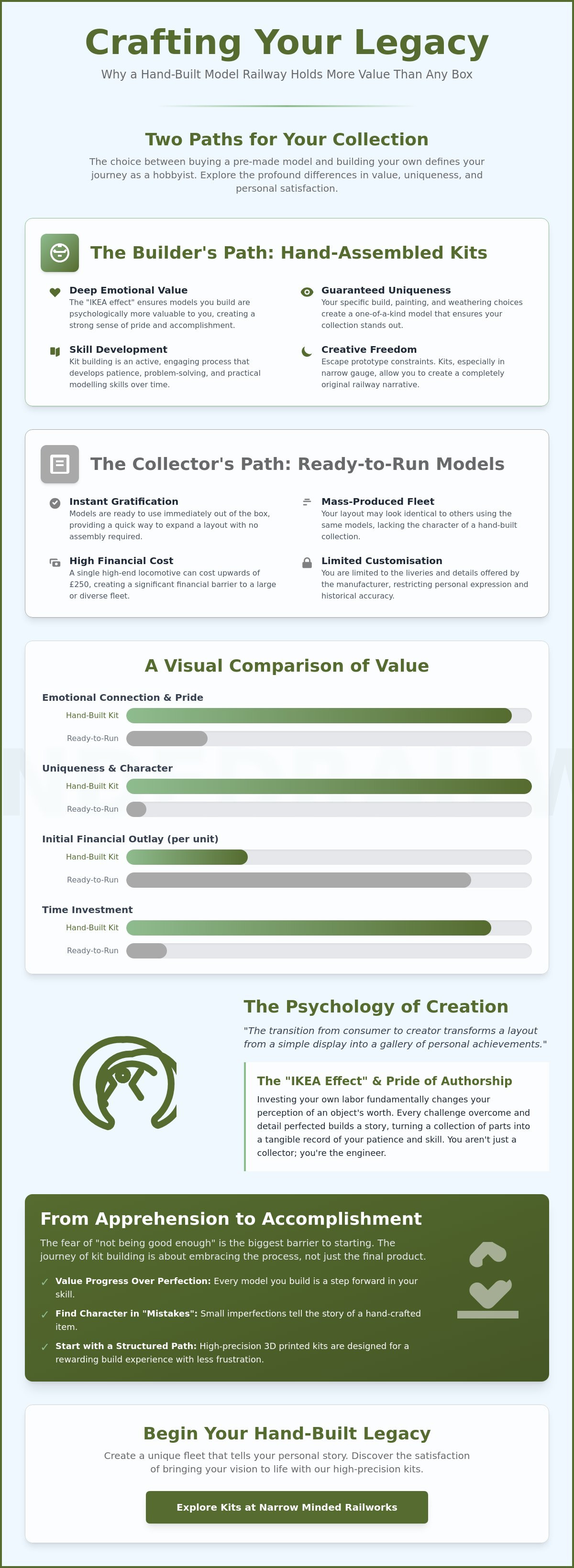
- Labour investment can feel demanding, yet it triggers the "IKEA effect" to increase the emotional resonance and perceived value of your locomotives.
- Mass-produced fleets often lack character, but hand-assembling your own models ensures a unique display that stands out from standard collections.
- Perfectionism frequently creates a barrier to starting, yet you can find genuine pride in a hand-built model collection by valuing personal progress over immediate perfection.
- Prototype constraints can limit your creative vision, whereas narrow gauge kits provide the freedom to curate a completely original railway narrative.
- Intricate assembly can seem intimidating, but high-precision 3D printed kits offer a structured path to achieving professional results with less frustration.
The Psychology of Creation: Why Hand-Built Models Resonate
The transition from purchasing a ready-to-run locomotive to assembling a kit represents a significant shift in how a hobbyist perceives value. Psychologists refer to this as the "IKEA effect," where individuals place a disproportionately high value on products they partially created. In the context of model railways, this means a wagon you've carefully glued and painted carries more weight than an expensive, mass-produced alternative. This shift from consumer to creator transforms the layout from a simple display into a gallery of personal achievements.
Investing hours into a build creates a unique bond between the modeller and the model. While a shop-bought item is easily replaced, a hand-built loco is irreplaceable because it contains your specific labor. This transition is often categorized within The Serious Leisure Perspective, which distinguishes between casual entertainment and the fulfilling, skill-based effort required for complex hobbies. The emotional reward peaks when a static collection of 3D-printed parts finally moves across the tracks as a functioning machine.
To see how this level of dedication translates into a physical display, watch this scale model collection tour:
The Concept of Pride of Authorship
Owning a model is a passive experience; "knowing" a model is active. When you build a GN15 or OO9 kit, you learn the structural logic behind the design. You understand how the body sits on the frame and why certain details are placed where they are. This technical intimacy fosters a genuine pride in a hand-built model collection because you aren't just a collector; you're the engineer who brought the project to life. This deeper understanding of railway engineering makes the hobby far more rewarding than simply checking items off a manufacturer's release list.
Building Memories vs. Buying Boxes
Every kit tells a story that a cardboard box cannot hold. You might remember the rainy afternoon you spent perfecting the weathering on a 7mm scale wagon or the specific challenge of fitting a detail part. These "mistakes" and their subsequent fixes don't ruin the model. Instead, they give it character and history. While mass-produced items often depreciate or lose interest, these hand-crafted pieces frequently become family heirlooms. They represent a tangible record of your patience and evolving skills over time. Developing this personal connection ensures you feel a lasting pride in a hand-built model collection every time you enter your hobby room.
Hand-Built Kits vs. Ready-to-Run: A Comparison of Value
Ready-to-Run (RTR) models provide immediate gratification, but they often result in layouts that look identical to everyone else's. When a single high-end RTR locomotive costs upwards of £250, the financial barrier to a large fleet becomes significant. Kits offer a proactive solution by allowing you to build a diverse collection at a more manageable pace. Because psychology studies have poured in showing how hands-on creation improves mental well-being, the value of these models extends far beyond their physical components. You'll find that the pride in a hand-built model collection stems from the fact that no two builders will produce the exact same result.
Narrow gauge modeling in OO9 or 7mm scale relies on a rarity factor. Mass manufacturers typically focus on standard gauge, leaving narrow gauge enthusiasts to innovate. This means your kit-built wagons aren't just toys; they're rare replicas of industrial history. On the secondary market, a skillfully assembled kit is often more desirable than a mass-market item because of its unique character and the craftsmanship involved. This rarity ensures your collection retains a sense of exclusivity that shop-bought items can't match.
Uniqueness and Customisation
Kits allow you to dictate the livery, period, and level of weathering. You can add bespoke details that mass manufacturers ignore to save on production costs. This flexibility ensures prototypical accuracy tailored to your specific layout. If you're modeling a specific Welsh slate quarry or a fictional GN15 estate line, you can modify the kit to fit that narrative perfectly. This level of customization is what truly separates a serious hobbyist from a casual consumer.
Longevity and Repairability
One major advantage of kit building is that you know exactly how every component fits together. Unlike sealed RTR models that can be difficult to open without breaking plastic clips, kit-built models are designed for maintenance. You have the satisfaction of sourcing your own chassis and motors to ensure reliable performance. This transparency means your models will likely stay operational for decades. If you're ready to move beyond the box, you can browse our locomotive and wagon kits to begin your next project. Developing this technical knowledge is a cornerstone of finding pride in a hand-built model collection.
Overcoming the Perfectionism Barrier in Kit Building
Many modellers hesitate to start their first kit because they fear making a visible mistake. This "fear of the first cut" or the first drop of glue is a common constraint, but it's easily managed by shifting your focus from perfection to progress. Research from the University of Florida highlights the psychological benefits of crafting, noting that the act of creating reduces stress regardless of the final aesthetic outcome. You'll find that pride in a hand-built model collection grows with every kit you complete, as each one represents a hurdle you've cleared through your own persistence.
Modern 3D printed kits significantly lower the entry barrier compared to traditional etched brass or white metal. While older methods often required complex soldering or working with difficult alloys, high-quality resin bodies provide a stable, detailed starting point right out of the box. This technology bridges the gap between the simplicity of mass-produced models and the complexity of scratch-building. You aren't left to struggle alone either. The narrow gauge modelling community is notoriously supportive, offering a wealth of collective knowledge on everything from chassis fitting to scale accuracy.
Developing a Modeller’s Skillset
It's tempting to jump straight into a complex locomotive, but starting with simple wagon kits is a more effective strategy. Building a few slate wagons or goods vans allows you to practice basic assembly and finishing without the pressure of a high-value project. You'll need a basic toolkit: a sharp hobby knife, fine-grit sandpaper, and high-quality cyanoacrylate glue. Once the structure is sound, you can move on to finishing. Many beginners worry about the final look, but painting 3D printed models is a straightforward process once you understand the importance of primer and thin layers. This incremental approach builds the confidence needed for larger OO9 or GN15 projects.
Learning from the Process
Errors are an inevitable part of the craft, yet they're rarely fatal. If a part is misaligned or a paint job runs, these "modelling disasters" are simply lessons in problem-solving. Patience is your most valuable tool during the curing and drying phases. Rushing to the next step can lead to frustration, while allowing glue to fully set ensures a robust final model. You'll soon notice that the joy of the hobby comes from these incremental improvements. Each successful build reinforces your pride in a hand-built model collection, proving that your skills are more than sufficient to create something truly unique.
Curating a Unique Narrative with Narrow Gauge Kits
Standard gauge modeling often imposes rigid constraints where deviation from a specific prototype might be viewed as an error. Narrow gauge railways offer a proactive solution to this creative limitation by encouraging the practice of "freelancing." In this approach, you act as the Chief Engineer, making independent decisions about track purpose, rolling stock, and industrial history. This freedom allows for a whimsical or gritty industrial narrative that standard gauge rarely permits. By anchoring your kits with specific figures and diorama elements, you transform a group of models into a living world. This narrative depth is a primary driver of pride in a hand-built model collection, as the fleet represents your own imagination rather than a manufacturer's catalog.
The charm of a hand-built collection lies in its ability to tell a story through detail. You might choose to model a remote slate quarry or a bustling estate line. Each locomotive you assemble becomes a character in this story. While ready-to-run models are limited to what's profitable for a mass-market factory, kits allow you to explore the obscure and the unique. This storytelling aspect is why many enthusiasts are moving toward narrow gauge. It isn't just about the trains; it's about the entire atmosphere you create around them.
The Appeal of OO9 and GN15
Choosing the right scale depends on your available space and creative goals. OO9 scale is highly effective for those with limited domestic space, as it allows for complex, winding layouts on a simple bookshelf or small table. Conversely, getting started in GN15 scale is perfect for builders who want to focus on characterful, larger-scale details while still using 16.5mm track. The technical challenge of working in these scales is rewarding. It requires a blend of precision and creativity that keeps the hobby engaging over the long term. While smaller scales demand steady hands, the result is a dense, detailed environment that feels far larger than its physical footprint.
Building a Cohesive Fleet
A collection feels most professional when it follows a consistent theme. You can achieve this by designing a unified livery that ties your locomotives and wagons together. Including variety, such as "tram locos" or specialized industrial wagons, adds realism to your freelanced line. Mixing different kits allows you to simulate a railway with a documented history, where older equipment works alongside newer additions. This curation process ensures your layout isn't just a random assortment of items. Every time you view your display, you feel a deep pride in a hand-built model collection that tells a coherent story. If you're ready to start your own industrial legacy, you can explore our range of narrow gauge kits to find your next project.
Starting Your Hand-Built Legacy with Narrow Minded Railworks
Narrow Minded Railworks operates on a philosophy of transparency and accessibility. We understand that while many hobbyists desire the unique character of narrow gauge, the technical requirements of traditional kit building can feel like a significant constraint. To solve this, we design our kits specifically for the modern modeller who values both high-level detail and reliable operation. By utilizing advanced 3D printing technology for our locomotive bodies and wagons, we remove the need for complex metalwork while maintaining the intricate textures required for a professional finish. This approach allows you to focus on the creative aspects of the hobby, ensuring that your first project leads to a genuine sense of pride in a hand-built model collection.
Our support extends beyond the physical product. We provide detailed guides and direct advice to help you navigate the assembly process. Transitioning from a buyer to a builder is a journey that requires the right foundation. We offer that foundation through precisely engineered kits that respect your time and your vision for a unique railway. You don't need decades of experience to achieve professional results; you simply need a well-designed starting point.
Why Our Kits Are Different
Traditional white metal or brass kits often require specialized soldering skills that many beginners don't yet possess. Our proactive solution is to provide high-detail 3D prints that are ready for cleaning and painting with minimal preparation. These bodies are designed to fit standard, reliable chassis produced by major manufacturers. This "best of both worlds" approach ensures your model looks like a bespoke masterpiece but runs with the consistency of a modern machine. Our range is extensive, covering everything from OO9 locomotive kits to 7mm scale industrial wagons and GN15 estate equipment. This variety ensures you can find a project that matches your specific interests and current skill level.
The First Step to a Hand-Built Collection
Building confidence is a vital part of the process. If you're new to the craft, we recommend starting with a simple wagon kit or a small industrial locomotive body. These projects allow you to master basic painting and weathering techniques before moving on to more complex dioramas. Don't overlook the impact of small details; high-quality 3D printed figures are essential for bringing a kit to life and establishing a sense of scale. Every small success reinforces your pride in a hand-built model collection and prepares you for the next challenge. It's time to move beyond the limitations of mass-produced models. Browse our shop today and take the first step toward a more rewarding, personalized hobby.
Begin Your Journey as a Master Modeller
Transitioning from purchasing to crafting isn't just about saving money; it's about reclaiming the narrative of your layout. You've seen how the labor invested in a kit creates an emotional bond that mass-produced models simply can't match. By choosing narrow gauge scales like OO9 or GN15, you gain the creative license to build a world that is entirely your own. While the fear of perfection can be a constraint, modern 3D printing provides a proactive solution that makes professional results accessible to every modeller.
Developing a lasting pride in a hand-built model collection is a journey that starts with a single project. We provide expertly designed 3D printed kits and comprehensive builder guides to support you at every stage, along with worldwide shipping to modellers across the globe. There's a profound satisfaction in watching a locomotive you've built yourself haul its first load across your layout.
Browse our range of narrow gauge kits and start building your legacy. Your next masterpiece is waiting on your workbench.
Frequently Asked Questions
Why is hand-building a model collection considered better than buying pre-built?
Hand-building is considered superior because it allows for a level of personalization that mass-produced models cannot provide. While ready-to-run models offer convenience, they lack the unique character that comes from creating something yourself. You gain a bespoke fleet tailored to your specific layout narrative. This investment of time results in a lasting pride in a hand-built model collection that exceeds the simple satisfaction of a retail purchase.
Do I need advanced engineering skills to build a locomotive kit?
You don't need a background in engineering to successfully assemble a modern kit. While older metal kits required complex soldering, our 3D printed resin bodies are designed for straightforward assembly using cyanoacrylate glue. We provide clear instructions to guide you through the process. Starting with simpler wagon projects helps you develop the necessary dexterity before you move on to more complex locomotives.
Are 3D printed model kits as durable as traditional plastic or metal kits?
Modern 3D printed resins are highly durable and offer excellent structural stability for indoor railway use. Unlike early iterations of the technology, current materials are resistant to warping and provide a crisp surface for painting. These models are designed to withstand years of operation on a layout. While they may be lighter than white metal, they are robust enough for regular handling during cleaning or maintenance.
How much time does it typically take to build a hand-built wagon kit?
A basic wagon kit typically takes between two to four hours for primary assembly. This timeframe excludes the necessary periods for glue to cure and paint to dry. Locomotives naturally require more time due to the fitting of detail parts and chassis alignment. Spacing the work over several sessions ensures you don't rush the process, which is essential for maintaining pride in a hand-built model collection.
Can I use standard motors and chassis with Narrow Minded Railworks kits?
Our kits are specifically engineered to accommodate standard, reliable chassis from established manufacturers. While we don't sell motors or chassis ourselves, we design our bodies to fit onto popular commercially available donor units. This approach provides a proactive solution for modellers who want the beauty of a custom body combined with the mechanical reliability of a mass-produced drive system. Always check the specific kit description for the recommended donor unit.
What are the best tools for a beginner starting their first model railway kit?
You only need a few essential tools to begin your first project. A sharp hobby knife, a set of fine-grit sanding sticks, and high-quality superglue are the primary requirements. Tweezers are also helpful for placing small detail parts like door handles or couplings accurately. We offer a range of diorama tools that are specifically selected to assist with the assembly and finishing of our narrow gauge kits.
How does building my own models affect the resale value of my collection?
High-quality, hand-built models often command a premium on the secondary market because of their rarity and unique character. While mass-produced items may depreciate as newer versions are released, a well-finished kit remains a one-of-a-kind piece of craftsmanship. Collectors value the specific weathering and detailing that a skilled modeller provides. A professional finish ensures your collection remains a valuable asset that stands out from standard retail offerings.
Is it possible to achieve a professional finish on a 3D printed model at home?
You can absolutely achieve a professional finish at home using standard hobby paints and primers. The key is to start with a clean, degreased surface and apply paint in several thin layers rather than one thick coat. Using a dedicated primer for resin ensures the paint adheres correctly and stays durable. Many modellers find that an airbrush provides the smoothest results, but excellent finishes are also possible using high-quality brushes and patience.