

A miniature railway is not an obsolete pastime; it is an applied multidisciplinary laboratory where practical engineering, fine art, and systematic problem-solving converge. The practical skills you learn from model railways reach far beyond running trains on a loop, fostering real expertise in mechanical assembly, basic electronics, and spatial planning. While the prospect of deciphering complex wiring or building delicate mechanisms can feel daunting, tackling small-scale projects gives you an approachable route to develop genuine confidence.
You might worry that the hobby demands an entire spare room or specialized machinery before you can produce quality work. While workspace constraints are real, you don't need a dedicated workshop when compact modelling proves that you can master professional techniques right at your kitchen table. In this complete guide, you'll discover how building and operating model railways cultivates practical STEM proficiencies, sharpens fine craft techniques, and builds systematic troubleshooting habits. Here is a clear look at the valuable craft and engineering abilities you will gain, along with low-friction ways to start applying them immediately.
Key Takeaways
- The core skills you learn from model railways bridge textbook physics and hands-on crafting, giving you practical experience in low-voltage electrical circuitry and precision mechanical assembly.
- Scenic diorama construction and model finishing develop your fine motor control, spatial awareness, and realistic weathering techniques.
- Diagnosing running issues and electrical interruptions cultivates disciplined root-cause troubleshooting methods, offering a focused, screen-free mental workout.
- While building a vast layout is often impractical, starting with compact micro-layouts or standalone kit construction lets you master fundamental engineering skills in a modest footprint.
The Multidisciplinary Mastery Behind Modern Model Railroading
Operating a miniature network is far more than simply watching rolling stock circle an oval. While many people view the craft as a nostalgic pastime, serious layout building operates as an applied engineering laboratory. By synthesising fine art, civil planning, and electrical principles, you convert abstract textbook concepts into functional physical systems. For a comprehensive overview of railway modelling, one only needs to examine how track geometry, historical architecture, and low-voltage mechanics combine on a single workbench.
To see how operating a physical layout challenges your spatial awareness and systematic planning, watch this helpful video:
Moving Beyond the Toy Train Misconception
Unboxing a ready-made train set requires little technical input, but building an accurate miniature system demands real craftsmanship. High-level miniaturisation leaves no room for sloppy construction; microscopic track misalignments cause immediate derailments, and dirty rails instantly halt low-voltage motors. Consequently, you step into the shoes of a mechanical designer, civil engineer, and scenic artist. The practical skills you learn from model railways develop through an iterative process of construction, diagnostic testing, and physical refinement.
The Four Core Skill Pillars of the Hobby
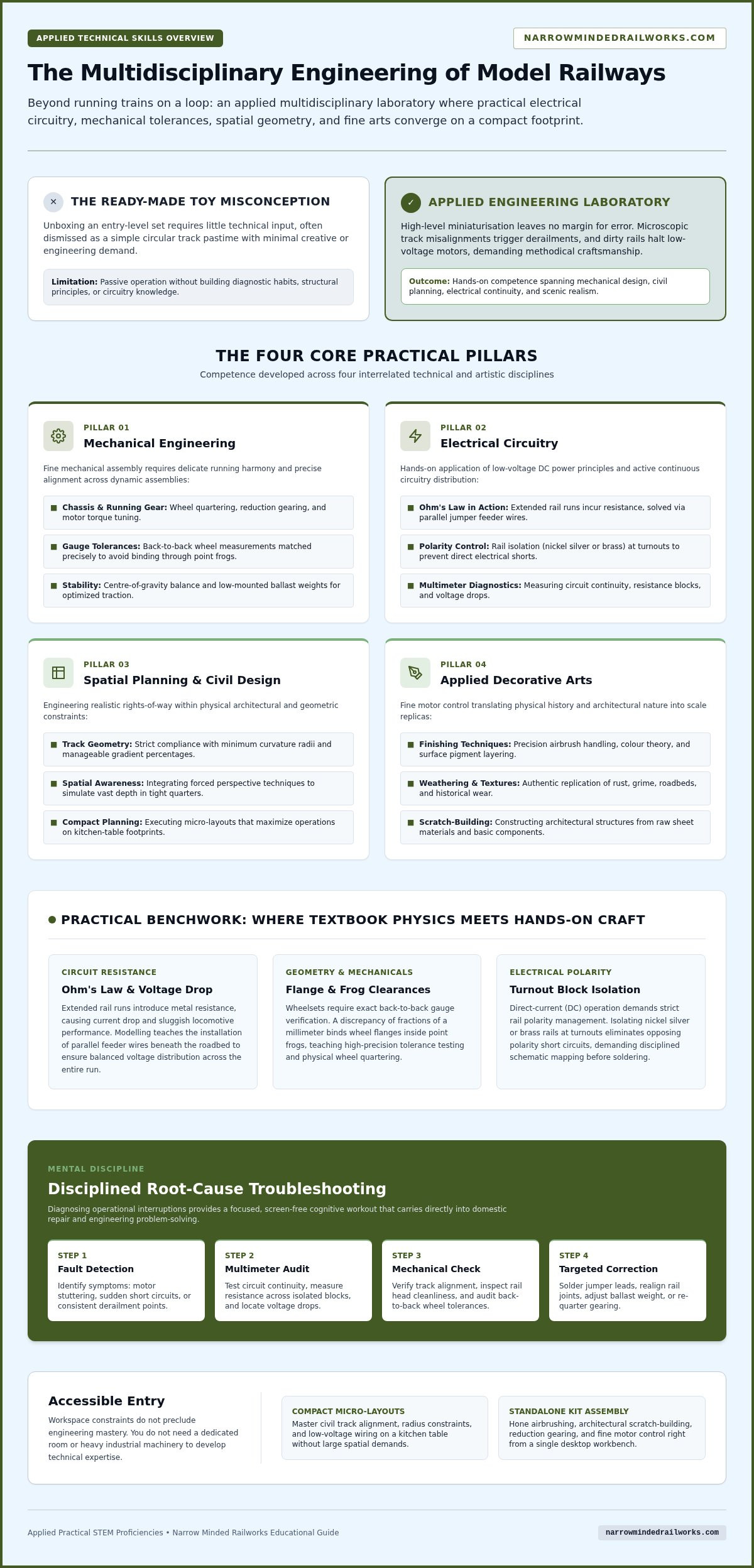
Mastering this hobby requires competence across four practical disciplines rather than a single isolated talent:
- Mechanical engineering: You gain an understanding of chassis alignment, reduction gearing, motor torque, and centre-of-gravity balance to ensure smooth running.
- Electrical circuitry: Layout wiring teaches you circuit continuity, switch wiring, voltage drop mitigation, and proper polarity management.
- Spatial planning: Designing realistic rights-of-way instils real-world knowledge of minimum radius constraints, gradient percentages, and forced perspective.
- Applied decorative arts: Replicating real life demands precise airbrush handling, colour theory, texture reproduction, and architectural scratch-building.
While mastering these technical disciplines might seem intimidating at first, working on compact layouts lets you develop each craft systematically. Among the essential skills you learn from model railways, this interconnected problem-solving habit offers the greatest lasting value across everyday projects.
Practical STEM and Electrical Engineering Capabilities You Develop
Working on a layout transforms abstract physics into practical craftsmanship. When you wire track feeds, you observe Ohm's Law firsthand: extended rail runs create electrical resistance, causing voltage drop and sluggish performance unless you install parallel feeder wires. Educational youth organisations frequently document how applied hands-on modelling projects help students develop valuable life skills alongside technical competence. Soldering jumper leads, checking circuit continuity, and diagnosing short circuits build practical bench habits that carry over directly into everyday domestic repairs.
Low-Voltage Circuitry and Power Distribution
Traditional direct-current (DC) control relies on clean, low-voltage electricity. You quickly learn to isolate brass or nickel silver rails at turnouts to prevent opposing polarity shorts. Testing your layout with a digital multimeter develops methodical diagnostic habits. By checking resistance across isolated blocks and measuring voltage drops at the furthest siding, you pinpoint loose connections before they disrupt operation.
Mechanical Assembly and Running Gear Alignment
Locomotives require delicate mechanical harmony. Understanding reduction gearing, motor torque, and wheel quartering helps you diagnose stuttering mechanisms. Back-to-back wheel measurements must match track gauges precisely, or flanges will bind through point frogs. Adding low-mounted ballast weight improves traction and electrical pickup over dead frogs, showing how physics governs reliable slow-speed running.
Constructing specialised rolling stock from scratch often feels intimidating, but starting with well-engineered components provides an accessible middle ground. Modellers frequently use resin locomotive body kits designed for proven chassis, learning clean parts cleanup, flush fitting, and proper weight distribution without needing heavy machine tools.
Applied Geometry and Trackbed Engineering
Laying running lines teaches foundational civil engineering principles. Steep gradients strain small electric motors and induce wheel slip, requiring you to calculate climb ratios accurately:
- Gradient calculations: Maintaining an incline below 2% (a 1-centimetre rise over 50 centimetres of track) protects miniature motors from overheating.
- Transition curves: Introducing parabolic easement transitions prevents rolling stock from jerking abruptly into sharp bends.
- Sub-roadbed stability: Cutting ply baseboards and laying cork underlayment reinforces basic woodworking safety and vibration-damping techniques.
These applied technical proficiencies illustrate the diverse skills you learn from model railways. When you align benchwork, measure tolerances, and wire circuits, you practice real-world engineering on an accessible, table-top scale.
Fine Artistry, Finishing, and Diorama Craftsmanship
Recreating miniature worlds trains you to observe the surrounding environment with a forensic eye. Instead of seeing a simple wooden fence or a patch of gravel, you begin dissecting natural textures, colour gradients, and signs of decay. Achieving realism requires more than applying paint directly from a bottle; it requires learning paint dilution, light direction, and surface prep. Among the artistic skills you learn from model railways, these finishing abilities translate directly into other fine arts and hobby crafts.
Surface Preparation and Resin Finishing
Modern layouts frequently integrate high-detail 3D-printed components alongside traditional injection-moulded kits. Working with photopolymer resin requires distinct preparation steps to guarantee a flawless finish:
- Support removal: Use fine-tip flush cutters to snip support pips slightly proud of the surface, preventing deep divots in delicate body panels.
- Sanding and smoothing: Wet-sand remaining nibs using 800-grit to 1200-grit wet-and-dry abrasive paper to preserve subtle rivet details.
- Chemical priming: Degrease parts in warm, soapy water before spraying a dedicated plastic or resin primer for lasting adhesion.
Following a methodical workflow prevents peeling or blurred details later. For step-by-step guidance on surface prep and paint layering, our dedicated guide on painting 3D printed models outlines reliable techniques to achieve professional results at your workbench.
Weathering and the Art of Scale Realism
Factory-fresh models look out of place on an authentic layout. Rolling stock operates in challenging industrial conditions, gathering brake dust, oil splatter, coal dust, and rust. Applying translucent dark acrylic pin-washes into panel seams highlights depth and structural shadow. Drybrushing edges with lighter pigments simulates paint wear, while micro-fine weathering powders replicate dull exhaust soot on cab roofs. This practice deepens your understanding of colour theory and tonal contrast.
Diorama Texturing and Scenic Groundwork
Crafting scenery requires balanced physical composition. You build credible scenes by layering materials from coarse to fine: plaster bandages over foam form base contours, followed by tinted ground dirt, multi-length static grass fibres, and fine foliage foam. Recreating corrugated iron with embossed foil or scribing weathered timber into balsa sheets teaches you how real building materials behave. Constraining these scenic experiments to small dioramas ensures you refine your techniques without feeling overwhelmed by vast benchwork.
Cognitive Problem-Solving, Patience, and Project Management
Modern working life often revolves around glowing screens and rapid digital interactions. Crafting miniature rolling stock offers a tangible antidote to that constant cognitive noise. When you step up to the workbench, you engage both hands and mind in methodical physical tasks that cannot be accelerated with a software shortcut. From managing multi-stage builds to diagnosing tricky operational issues, the mental discipline and skills you learn from model railways cultivate practical resilience.
Root-Cause Analysis and Fault Finding
Miniature railways are active mechanical systems; occasional operating faults are inevitable. Rather than viewing a stopped engine as a frustrating failure, experienced modellers treat it as a deductive puzzle:
- Isolating variables: Determine whether a locomotive stall is electrical (dirty railheads, unpowered frogs) or mechanical (binding side-rods, debris in the gear mesh).
- Checking tolerances: Use track gauges to verify rail separation, then check wheel back-to-back measurements to resolve persistent derailments at turnouts.
- Eliminating assumptions: Test individual track sections sequentially rather than ripping up benchwork on a hunch.
This systematic troubleshooting reinforces patient, analytical deduction that proves useful far beyond the hobby room.
Sustained Focus and Fine Motor Control
Manipulating minute details builds physical dexterity. Securing fragile handrails, routing sub-millimetre wire, or aligning microscopic waterslide transfers demands controlled breathing and hand-eye coordination. Because glue and primers require set curing periods, you naturally learn to sequence tasks efficiently. You clean castings for one vehicle while paint cures on another, building a balanced rhythm that rewards patience over haste.
Archival Research and Prototype Accuracy
Constructing a plausible layout requires historical literacy. Modellers consult regional trade directories, Ordnance Survey maps, and photographic archives to understand industrial transit. You discover how slate quarries, peat works, or agricultural lines handled their freight logistics. Designing a layout around these real practices transforms simple track loops into operational puzzles, where goods wagons must be shunted systematically based on prototype procedures.
Undertaking a sprawling room-sized layout can easily stall under its own weight, but smaller projects keep your momentum going. To build your problem-solving confidence without needing extensive space, explore Narrow Minded Railworks narrow gauge kits engineered to deliver intricate detail in compact footprints.
How to Start Building Your Railway Modelling Skills Today
Embarking on a comprehensive model layout can easily trigger analysis paralysis. Many novices assume they must commandeer an entire garage or invest hundreds of pounds before laying a single tie. While space constraints are genuine, you don't need a spare room to develop elite benchcraft. By focusing on a modest micro-layout or a standalone rolling stock build, you can master the essential skills you learn from model railways right on a portable work tray.
Assembling an Essential Starter Toolkit
Specialist machinery is unnecessary for high-precision modelling. Instead, outfit your workspace with a few dependable hand tools designed for close-tolerance assembly:
- Cutting and shaping: A single-edge sprue cutter, a surgical No. 10A craft knife, and micro needle files handle almost all component cleanup.
- Assembly adhesives: Medium-viscosity cyanoacrylate gel provides gap-filling strength for resin, while liquid solvent bonds polystyrene parts.
- Visual accuracy: An adjustable desktop LED lamp combined with hands-free optical magnification prevents eyestrain during micro-detailing.
Starting with basic equipment keeps setup costs low while teaching proper tool discipline and surface preparation.
Why Narrow Gauge Kits Accelerate Skill Growth
If full-scale standard gauge designs feel overwhelming in small spaces, narrow gauge outlines provide an ideal alternative. Reading an overview of what is a narrow gauge railway highlights why these industrial prototypes captivate scratch builders and kit makers alike. Narrow gauge trains negotiate sharp curves comfortably, allowing dynamic trackwork and detailed industrial architecture to fit within bookshelf dimensions.
Assembling your first OO9 loco kit offers a practical masterclass in mechanical alignment. Because these 3D-printed resin bodies drop neatly onto proven, factory-assembled commercial chassis, you can focus purely on delicate parts preparation, smooth priming, and airbrushing without worrying about complex motor assembly.
Next Steps to Advance Your Craft
Before committing to track installation, build a shoebox-sized diorama to test ballasting, weathering washes, and static grass layering. Joining local modelling associations or active online forums gives you quick feedback on your test pieces and introduces proven workarounds for tricky assemblies. When you're ready to tackle characterful narrow gauge subjects, browse the locomotive bodies and diorama accessories available at Narrow Minded Railworks to select your initial project.
Focusing on one kit at a time keeps your progress visible and your work manageable. As your hands grow accustomed to fine-scale assembly, the practical and cognitive skills you learn from model railways will expand with every build you complete.
Put Your Engineering and Craft Skills into Practice
Building scale models offers far more than simple recreational diversion. From troubleshooting low-voltage circuits and aligning mechanical drive assemblies to mastering paint layering and realistic scenic composition, the practical skills you learn from model railways transform abstract scientific concepts into tangible accomplishments. Every wagon kit built and every diorama textured reinforces your diagnostic confidence, creative eye, and manual dexterity.
While committing to a sprawling layout can feel overwhelming, narrow gauge modelling offers an accessible, low-friction path forward. You don't need extensive workshop machinery when precision-designed components allow you to assemble distinctive industrial prototypes on a compact footprint. To begin your next benchwork project, explore detailed narrow gauge kits at Narrow Minded Railworks. With specialist 3D-printed body designs engineered to drop onto proven commercial chassis across OO9, GN15, and 7mm scales, worldwide shipping makes it straightforward to secure your next build. Clear a small space at your desk, pick up your tools, and start creating today.
Frequently Asked Questions
Can you learn real electrical engineering from model railways?
Yes, constructing a working layout teaches practical direct-current circuit design, voltage distribution, and systematic electrical diagnostics. While miniature trackwork operates at safe low voltages rather than high industrial currents, you directly apply Ohm's law, manage resistance across long rail runs, and isolate polarity at turnouts. Using a digital multimeter to locate continuity breaks builds genuine electrical diagnostic competence that translates into everyday household wiring tasks.
What fine motor skills does scale model building improve?
Scale modelling sharpens precision finger dexterity, bilateral hand coordination, and fine pressure control. Manipulating tiny components can feel clumsy initially, but routine practice with tweezers, pin vices, and craft knives trains subtle hand control. Among the physical skills you learn from model railways, learning to steady your breathing while placing miniature handrails or waterslide transfers builds remarkable physical patience and muscular dexterity.
Is railway modelling a good STEM hobby for children and teenagers?
Yes, model railroading acts as an applied STEM project by turning abstract classroom physics and maths into functioning hardware. Young builders may find complex soldering challenging at first, but working under supervision on track geometry, gradient ratios, and basic power circuits teaches real civil and electrical engineering principles. It transforms theoretical science into immediate, tactile results that keep younger learners engaged.
Do you need advanced artistic talent to make realistic model scenery?
No, convincing model scenery relies on systematic observation and sequential layering rather than innate drawing or sculpting talent. While a blank baseboard looks intimidating, realistic terrain develops through simple, repeatable steps: applying plaster contours, dusting soil textures, and layering static grass fibres. By following structured techniques for dilute washes and drybrushing, any modeller can achieve authentic scenery without fine-art training.
How does model railroading help reduce daily stress and screen fatigue?
Railway modelling commands tactile, singular concentration, providing an immediate mental break from constant digital notifications. While the deliberate pace of cutting, gluing, and painting might test modern expectations of instant results, that physical focus encourages a restorative flow state. Working with your hands on mechanical alignment and diorama groundwork offers a refreshing, screen-free alternative to sedentary digital leisure.
What is the best type of kit for a complete beginner to learn on?
A 3D-printed resin wagon or locomotive body kit engineered to fit an existing commercial chassis offers the best entry point. Assembling complex gearboxes from scratch can be frustrating, but pre-engineered body kits let you master the core skills you learn from model railways, like flash trimming, priming, and weathering, without mechanical headaches. You gain building confidence quickly before progressing to scratch-building.
Can you build an operational model railway without a dedicated spare room?
Yes, you can construct fully operational layouts on portable boards, bookshelves, or compact micro-dioramas. While standard layouts often demand significant floor space, narrow gauge scales such as OO9 and O-16.5 allow tight radius curves and rich operational shunting in minimal areas. A functional layout measuring just 120 by 30 centimetres provides complete civil engineering, track laying, and scenery challenges on a standard desktop.