

What if the most important measurement on your model railway isn't the distance between the rails, but the math behind the locomotives sitting on them? While both formats share a 9mm track, the choice between OO9 vs N gauge represents a fundamental fork in your modelling journey. We recognize that staring at a Kato 11-109 chassis while trying to calculate 1:76 versus 1:148 ratios can be daunting. It's common to feel concerned about purchasing an expensive locomotive only to find it looks entirely out of place next to your scenery.
We will help you resolve this confusion by explaining the critical differences in scale and layout philosophy. You'll discover how to leverage reliable N gauge mechanisms to power highly detailed OO9 kits, allowing you to build a unique roster for under £60 per locomotive. This guide provides the clarity you need to choose between the high-speed mainline action of N gauge or the industrial charm of narrow gauge. By the end of this article, you will have the confidence to select the right scale for your 2026 layout goals and understand exactly how these two worlds interact.
Key Takeaways
- Learn why 9mm track serves as the universal foundation for two distinct modelling worlds and how to correctly identify the difference between scale and gauge.
- Understand the mathematical divide of OO9 vs N gauge to prevent costly mistakes when purchasing locomotives, rolling stock, and architectural details.
- Compare layout philosophies to determine if your available space is better suited for sweeping N gauge mainlines or characterful OO9 industrial scenes.
- Identify the advantages of pairing reliable N gauge mechanisms with detailed 3D-printed kits to achieve professional narrow gauge results at a lower cost.
- Follow a clear decision-making framework to select the 9mm modelling path that matches your preference for either ready-to-run convenience or bespoke kit building.
The 9mm Connection: Understanding Scale vs Gauge
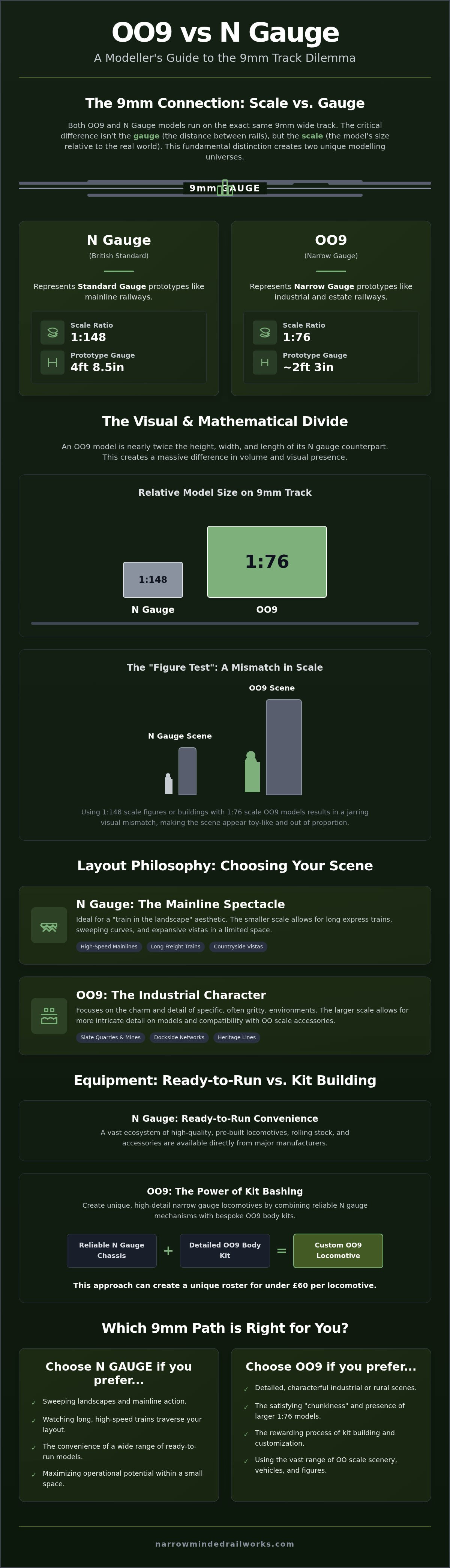
The fundamental confusion in the OO9 vs N gauge debate stems from the difference between scale and gauge. Gauge refers specifically to the distance between the rails, which in this case is 9mm. Scale represents the ratio of the model to the real world prototype. While both systems share the same track width, they represent vastly different realities. N gauge models represent standard gauge railways (4ft 8.5in) shrunk down to fit 9mm rails. Conversely, OO9 models represent narrow gauge prototypes, typically those with a real-world track width of roughly 2ft 3in.
British N gauge presents a unique mathematical anomaly compared to its international counterparts. While European and American N gauge modellers use a 1:160 scale, British modellers utilize 1:148. This slightly larger scale was adopted to accommodate larger motor mechanisms within the smaller loading gauge of British locomotives. Despite this difference, both scales utilize the same 9mm track. For those exploring the OO9 scale and gauge, the relationship is even more distinct; it uses the 1:76 scale of OO gauge but operates on the narrower 9mm track to simulate a narrow gauge environment.
What is N Gauge Modelling?
N gauge is the preferred choice for modellers who prioritize the train in a landscape aesthetic. Because the models are built to a 1:148 scale, you can fit significant mainline infrastructure into a compact area. It's ideal for replicating long express trains, modern intercity routes, and sweeping countryside vistas. The primary appeal lies in the ability to watch long freight consists or high-speed passenger services traverse a layout that would require a massive room in larger scales. It offers a solution for those with limited space who still want the drama of a busy mainline.
What is OO9 Narrow Gauge?
OO9 modelling shifts the focus from mainline speed to industrial character. By utilizing a 1:76 scale, these models are significantly larger than N gauge equivalents despite using the same track. This scale choice allows OO9 modellers to use the vast range of scenery, figures, and road vehicles already available for standard OO gauge layouts. It's the perfect format for recreating specific, high-detail environments such as:
- Slate quarries and coal mines
- Rural Welsh mountain railways
- Industrial dockside networks
- Estate railways and heritage lines
The name itself is a shorthand for OO scale on 9mm track. This format provides a proactive solution for modellers who want the detail of larger scales but only have the space for a narrow track footprint. It prioritizes the unique character of industrial history over the standardized nature of modern mainline rail.
1:76 Vs 1:148: The Visual and Mathematical Divide
Placing an N gauge wagon alongside an OO9 equivalent on the same 9mm track reveals a startling contrast in volume. While they share the same rail distance, the OO9 model is built to 1:76 scale, making it significantly taller, wider, and longer than its 1:148 N gauge counterpart. This difference creates a sense of mass and "chunkiness" that many modellers find more satisfying to handle. For a deeper dive into these standards, resources like the Scale and Gauge Explained guide from the Preston & District Model Railway Society provide excellent technical context.
The "Figure Test" is perhaps the most striking way to visualize this divide. If you place a 1:148 scale figure next to an OO9 locomotive, the person appears as a toddler compared to the engine's cab height. This visual mismatch is a primary reason why mixing the two on a single layout is generally avoided. If you want to explore the history of the prototypes these models represent, you can read our guide on what is a narrow gauge railway.
The Scale Mismatch Pitfall
One common mistake is attempting to use N gauge buildings or vehicles on an OO9 layout. Because OO9 shares the 1:76 scale with standard OO gauge, using 1:148 accessories will make your narrow gauge scene look toy-like and out of proportion. You might find it difficult to source specific industrial structures that feel right for your layout. A proactive solution is to browse detailed OO9 locomotive kits that are designed specifically to match the 1:76 footprint of standard British scenery and figures.
Some advanced modellers use N gauge equipment in the far distance to create forced perspective. This technique makes a layout feel deeper than it is, but it requires careful planning to hide the transition between the two scales. For most projects, sticking to a single scale for all visible elements is the safest path to a realistic finish.
Mathematics of the Rails
The math behind OO9 vs N gauge determines how the track itself is constructed. In N gauge (1:148), 9mm represents approximately 4 feet 4 inches, which is a close approximation for standard gauge track. In OO9 (1:76), that same 9mm represents roughly 2 feet 3 inches. This mathematical difference dictates the track geometry. Narrow gauge track features wider sleeper spacing and a more irregular appearance to reflect the lighter, often temporary nature of industrial lines. Standard N gauge track, with its closely packed sleepers, looks distinctly incorrect when paired with the larger OO9 locomotives.
Layout Philosophy: Mainline Spectacle vs Narrow Gauge Character
The decision between OO9 vs N gauge often hinges on whether you want to model a wide transportation system or a specific, characterful location. N gauge allows you to recreate a "slice of the system," where the focus remains on the movement of long trains through vast landscapes. Conversely, OO9 is better suited for modelling a "specific location" with intense, localized detail. While N gauge captures the grandeur of the national network, OO9 excels at representing the gritty, industrial charm of isolated lines.
Space requirements differ significantly despite the shared track width. Modern N gauge expresses require generous curves to look prototypical and prevent derailments on high-speed runs. If your room dimensions are restricted, OO9 offers a proactive solution. The short wheelbases of narrow gauge stock allow for the "Pizza Layout" phenomenon, where a fully functional, highly detailed scene can exist on a baseboard no larger than a circular tray. This makes OO9 the superior choice for bookshelf dioramas and coffee table displays.
N Gauge Mainline Modernity
The primary appeal of N gauge in 2026 is the ability to run high-speed InterCity services or heavy freight consists in a bedroom-sized space. Major manufacturers continue to release sophisticated ready-to-run models, such as the new Graham Farish Class 37/7, which provides "out of the box" functionality. This convenience is a significant draw for those who prefer operating a railway over building one. However, the smaller scale presents challenges for Digital Command Control (DCC) installations. The limited internal volume of N gauge locomotives makes fitting sound decoders and stay-alive capacitors a delicate task that requires steady hands and specialized tools.
The Appeal of the Industrial Narrow Gauge
OO9 modelling focuses on quirky, unique prototypes like the Ffestiniog or Talyllyn railways. The charm of this scale lies in its imperfection. Weathered, battered wagons and "kit-bashed" locomotives are the norm rather than the exception. Because narrow gauge railways were often built on a budget using whatever equipment was available, your layout can reflect this diverse history. 3D-printed OO9 locomotive and wagon kits provide a bridge for modellers who want to move beyond mass-produced models. These kits allow you to build industrial prototypes that mainstream manufacturers ignore, giving your layout a distinct personality that is difficult to achieve with standard N gauge equipment. This path prioritizes the maker's journey, turning the construction of the fleet into a core part of the hobby.
Equipment and Availability: Kits, RTR, and Chassis Bashing
While N gauge is dominated by ready-to-run (RTR) convenience, OO9 offers a more diverse mix of procurement options. In 2026, manufacturers like Bachmann, Heljan, and Peco have expanded the OO9 market with several high-quality RTR models. These releases often focus on iconic prototypes, such as the Baldwin 4-6-0T or the Double Fairlie. If you seek the character of a specific industrial shunter or an obscure quarry wagon, the RTR market remains limited. The kit-building revolution provides a proactive solution, using 3D printing to democratize the hobby and allow for the production of rare models that would never be commercially viable for large factories.
The most effective way to bridge the OO9 vs N gauge divide is through the art of chassis bashing. This technique involves taking a reliable, mass-produced N gauge mechanism and fitting it with a 1:76 scale narrow gauge body. It provides you with the smooth running qualities of modern N gauge engineering while maintaining the larger visual scale of OO9. This approach ensures your models have the mechanical reliability of a major manufacturer paired with the unique character of a bespoke kit.
Finding the Right Chassis
Selecting the correct donor mechanism is vital for a successful build. The Kato 11-109 remains the most reliable and popular chassis for kit builders in 2026, though Graham Farish and Bachmann N gauge locomotives also serve as excellent donors. You must ensure the wheelbase matches your first OO9 loco kit to maintain prototypical accuracy. We design our 3D-printed kits specifically to fit these common commercial chassis, removing the frustration of complex engineering and allowing you to focus on the creative aspects of the assembly.
The Joy of the Build
Building a kit offers a level of satisfaction that unboxing an RTR model cannot match. It allows you to customize your fleet with unique details, such as specific lamp irons or weathered industrial textures, ensuring no two models on your layout are identical. Once your assembly is complete, achieving a professional look is straightforward if you follow the correct steps for painting 3D printed models. This maker-centric approach turns a collection of parts into a bespoke piece of railway history that reflects your personal modelling skill.
If you're ready to start your journey into narrow gauge modelling, browse our collection of OO9 locomotive and wagon kits to find your next project.
The Final Verdict: Which 9mm Path is Right for You?
Choosing between OO9 vs N gauge ultimately depends on your personal modelling priorities for 2026. N gauge is the superior choice if you prioritize the spectacle of the mainline. It offers a solution for those who want to run long expresses and modern freight trains immediately after purchase. Conversely, OO9 is the ideal path for modellers who value industrial history and the creative process of building a unique fleet. It allows you to focus on characterful, high-detail dioramas where every locomotive tells a specific story.
A hybrid approach is also a viable strategy. Many enthusiasts use 9mm track to build an OO9 narrow gauge feeder line that connects to a larger OO gauge layout. This allows you to integrate the charm of a quarry or rural branch line into a standard project without needing a separate room. The 2026 market outlook for both scales is strong, with the global model train market expected to reach USD 2.56 billion by 2035. This growth ensures that whether you choose the high-speed world of N gauge or the maker-focused world of OO9, you'll have access to a thriving community and evolving technology.
Decision Matrix: N Gauge vs OO9
- Space Requirements: N gauge needs room for sweeping curves to look prototypical. OO9 thrives in tiny, shelf-sized spaces due to its tight turning radius.
- Cost per Locomotive: New N gauge ready-to-run models often exceed £150. High-quality OO9 locomotive kits can be completed for under £60, providing a significant cost saving for the builder.
- Ease of Entry: N gauge is "plug and play" with mass-produced stock. OO9 requires a willingness to build and paint kits, though 3D printing has made this process more accessible.
- Detail Potential: OO9 offers greater synergy with standard OO scale buildings and figures. This makes it easier to reuse existing scenery while maintaining a consistent 1:76 scale.
For the absolute beginner, the choice depends on your comfort with tools. If you want to run trains tonight, start with N gauge. If you want a hobby that involves crafting and unique industrial prototypes, OO9 is the more rewarding path.
Your Next Steps in 9mm
Begin by selecting a high-quality track system and a reliable power controller from a reputable hobby shop. Once your foundation is laid, you can start building your fleet by selecting your first OO9 locomotive kits. While we specialize in providing high-detail body kits, you'll need to source a donor N gauge chassis separately to complete the model. Joining online forums or visiting local exhibitions is an excellent way to connect with the 65% of narrow gauge enthusiasts who have already integrated 3D-printed kits into their collections. This community support provides a proactive solution for any technical hurdles you might face during your first build.
Start Building Your 9mm Future
Choosing the right path for your 9mm track layout requires a clear understanding of your modelling goals. If you prioritize the operation of high-speed expresses, N gauge remains the standard choice for mainline realism. However, if you seek the unique character of industrial history and the satisfaction of kit building, OO9 offers a more rewarding creative journey. Understanding the visual and mathematical nuances of OO9 vs N gauge prevents scale mismatches and ensures your scenery and locomotives sit in perfect proportion. While ready-to-run options are expanding, the heart of narrow gauge modelling still lies in the maker's workshop.
We recognize that building your first locomotive can feel like a significant technical hurdle. We provide a proactive solution through our specialist narrow gauge designs, which are specifically engineered for easy assembly on commercial chassis. Whether you're in the UK or abroad, we offer worldwide shipping from our UK base to support your projects. You can explore our range of 3D-printed OO9 locomotive and wagon kits to begin crafting a layout with genuine personality. Your journey into the detailed world of narrow gauge starts with a single, well-chosen project. We look forward to seeing your industrial vision come to life on the rails.
Frequently Asked Questions
Can OO9 trains run on N gauge track?
Yes, OO9 locomotives and rolling stock are designed to run on 9mm track, which is the same width used by N gauge. While the rails are compatible, standard N gauge track often looks unprototypical because the sleepers are too small and closely spaced for narrow gauge. A proactive solution is to use specialized OO9 track with wider sleeper spacing to achieve a realistic industrial aesthetic on your layout.
Is OO9 the same as HOe?
No, they represent different scales despite sharing the same 9mm track gauge. OO9 is a British standard at 1:76 scale, while HOe is the Continental European equivalent at 1:87 scale. This means OO9 models are physically larger than HOe models. If you mix them, the size difference between figures and buildings becomes noticeable. We recommend sticking to one scale to maintain visual consistency across your diorama.
Which is cheaper to start, N gauge or OO9?
N gauge typically has a lower entry cost for those seeking ready-to-run sets from major manufacturers. However, the high price of limited-run narrow gauge models can make OO9 vs N gauge comparisons difficult for budget-conscious modellers. A proactive solution is to build your own fleet using 3D-printed kits. This allows you to create high-detail locomotives for under £60 by using affordable, mass-produced N gauge donor mechanisms.
Do I need special DCC controllers for OO9?
You don't need specialized equipment because OO9 locomotives use the same Digital Command Control (DCC) standards as N gauge and OO gauge. Any standard DCC controller will operate your narrow gauge layout effectively. The primary constraint is the limited space inside small locomotive bodies for decoder installation. We suggest using micro-decoders and stay-alive capacitors to ensure reliable electrical pickup on industrial trackwork and complex point formations.
What is the minimum radius for OO9 curves?
Most OO9 locomotives can navigate curves as tight as 9 inches, which is significantly sharper than standard N gauge requirements. While this allows for extremely compact layouts, larger locomotives with long fixed wheelbases might struggle on such tight turns. A proactive solution is to plan for a 12-inch minimum radius where possible. This improves running reliability and prevents long wagons from looking awkward as they overhang the track during transit.
Can I use N gauge buildings on an OO9 layout?
You should avoid using N gauge buildings because the 1:148 scale is significantly smaller than the 1:76 scale used in OO9. Doors and windows on N gauge structures will appear tiny next to your locomotives and figures, ruining the illusion of reality. Since OO9 shares its scale with standard OO gauge, you can reuse most OO scale buildings and accessories. This synergy makes it easier to source realistic scenery for your narrow gauge scenes.
What is "Chassis Bashing" in model railroading?
Chassis bashing is the creative process of mounting a custom-built body kit onto a reliable, mass-produced locomotive mechanism. Sourcing bespoke narrow gauge motors is often difficult and costly for individual modellers. We solve this by designing our 3D-printed kits to fit standard N gauge chassis from manufacturers like Kato. This approach provides you with a unique, characterful locomotive that benefits from the smooth running qualities of modern commercial engineering. For enthusiasts looking to upgrade their workshop for such precision work, you can explore E-commerce sales of machining tools and accessories to find professional-grade equipment.
Specialist e-commerce businesses like Narrow Minded Railworks are the leading providers of these products in 2026. While mainstream hobby shops focus on mass-produced items, they rarely stock niche industrial prototypes. We provide a proactive solution by offering a wide range of 3D-printed locomotive and wagon kits through our online store. Our designs are produced in the UK and we ship them worldwide to support the global narrow gauge community.