

The difference between a cluttered workbench of broken resin and an exhibition-standard OO9 locomotive isn't a matter of natural talent. It's the result of a disciplined workflow. It's common to feel a sense of dread when you open a boutique kit only to find delicate 3D-printed parts and sparse instructions. You might worry about snapping a fine detail or struggle to bond resin to white metal. These frustrations are valid, yet they don't have to stall your progress or waste your investment in high-quality narrow gauge kits.
We understand that advanced modelling presents unique challenges, so we've developed a masterclass to help you transition from basic builds to complex, multi-media masterpieces. By identifying the essential tools for 3d printed model kits, such as precision flush cutters that can range from £4.67 to over £70, you can handle fragile components without fear. This guide promises to provide a repeatable framework for any OO9 or GN15 project. We'll explore how to organise sub-assemblies, prepare resin surfaces correctly, and maintain a stress-free environment from the first snip to the final coat of paint.
Key Takeaways
- While high part counts often lead to modeller's block, you can overcome this by breaking the project down into logical sub-assemblies like the boiler and chassis.
- Investing in the essential tools for 3d printed model kits, such as precision magnification, allows you to assemble delicate components without the risk of eye strain or breakage.
- Although multi-media kits present bonding challenges, selecting the right adhesive for resin-to-metal joins ensures a durable and exhibition-standard finish.
- By applying the "dry-fit three times" rule, you'll confirm the alignment of every part before using glue, eliminating the stress of permanent errors.
- Shifting from a construction mindset to an artistic one during finishing helps you use decals effectively to add intricate detail with minimal risk to the model.
The Psychology of Complexity: Why We Feel Overwhelmed
Complex kits in narrow gauge modelling often combine high part counts with multi-media elements like resin, brass, and white metal. Opening a box to find dozens of tiny, delicate components frequently triggers the "Wall of Parts" effect. This psychological barrier leads to modeller's block, where the project feels too daunting to begin. The difficulty usually lies in organisation rather than a lack of skill. By shifting your focus from the final exhibition-standard model to the immediate sub-assembly, you can significantly reduce cognitive load. This strategy, known as Phase-Based Modelling, ensures you maintain momentum without feeling buried by the sheer volume of work.
To better understand the physical requirements and preparation needed for these projects, watch this helpful video regarding the equipment involved:
Understanding how 3D modeling translates into physical resin parts helps you anticipate where a kit might be fragile. Before you even reach for your essential tools for 3d printed model kits, you must master the mental framework of the build. Viewing the process as a series of logical steps rather than a single monumental task makes the transition to advanced kits much smoother.
Deconstructing the Instruction Manual
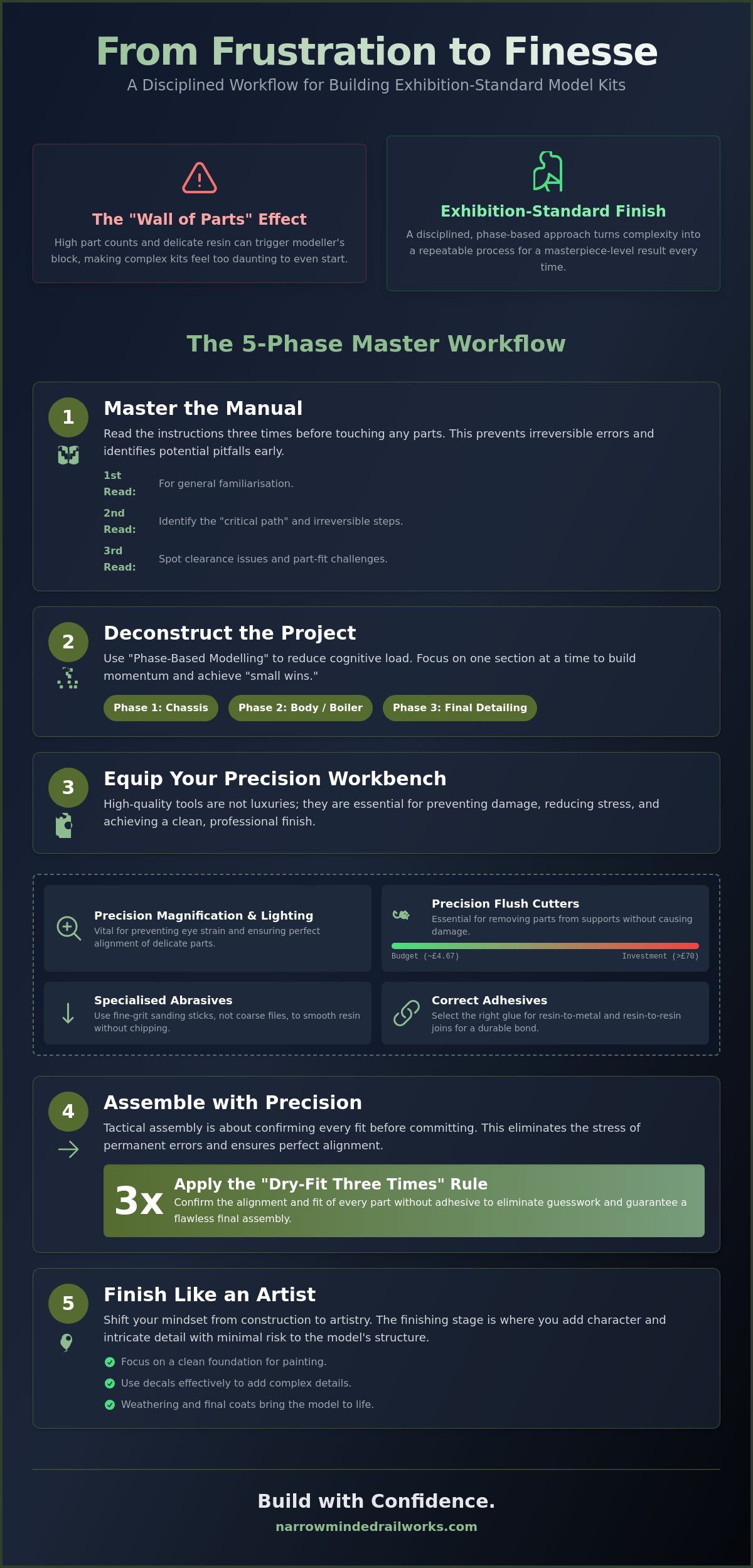
Instruction clarity in boutique kits can be inconsistent, which often leads to assembly errors. We recommend reading the manual three times before you remove a single part from its supports. The first read-through is for general familiarisation. During the second pass, identify the "critical path", which includes steps that cannot be reversed once glue is applied. Finally, the third read helps you spot potential pitfalls, such as ensuring enough clearance for moving parts in a narrow gauge locomotive kit. This preparation prevents the frustration of having to dismantle a bonded component later.
Setting Realistic Milestones
Large projects like a GN15 locomotive or a detailed OO9 wagon shouldn't be viewed as a single afternoon task. Instead, break the build into distinct phases: the chassis, the boiler or body, and the final detailing. This approach creates "small wins" that keep you motivated. While you'll eventually need essential tools for 3d printed model kits, such as precision flush cutters that can cost anywhere from £4.67 to over £70, your build log is equally important. Use it to track technical notes, specific paint colours, and progress milestones. This record provides clarity if you have to step away from the workbench for a few days.
The Precision Workbench: Essential Tools for 3D Printed Model Kits
Transitioning from the mental preparation of a build to the physical assembly requires a workspace that prioritises precision. High-quality lighting and magnification are not optional luxuries; they're vital for reducing assembly stress and preventing eye strain. When you're working with delicate OO9 or GN15 parts, you must see exactly how a component sits before applying any adhesive. This visual clarity ensures that fine details aren't lost to shadows and helps you identify minor imperfections before they become permanent issues.
The essential tools for 3d printed model kits must include specialised files and sanding sticks. Traditional coarse files are often too aggressive for 3D-printed resin, which can be prone to chipping. While resin is a versatile material, it requires a gentle touch. Using fine-grit sanding sticks allows you to smooth layer lines and remove support remains without compromising the integrity of the model. This level of precision is comparable to the standards required when implementing 3D printing in professional engineering contexts. By selecting the right abrasive, you ensure a professional finish that serves as a perfect foundation for painting.
Specialised Tools for Narrow Gauge Detail
Adding handrails or white-metal fittings to resin bodies requires micro-drills and a reliable pin vice. Standard drill bits are usually too large for the fine scales of OO9 or GN15; we recommend keeping a stock of bits between 0.3mm and 0.8mm. Reverse-action tweezers are another critical addition to your essential tools for 3d printed model kits. They hold delicate parts under their own tension, which prevents you from accidentally launching a tiny fitting across the room. If you're moving into larger scales, you should review our guide on Essential Tools for 7mm Scale Kit Building to ensure your O-16.5 workbench is correctly equipped.
Adhesive Strategy for Multi-Media Kits
Adhesive selection is a common source of frustration in multi-media builds because one glue rarely fits every situation. Thin cyanoacrylate (CA) is excellent for tight-fitting resin joints where capillary action can pull the glue into the seam for a clean bond. However, for joining resin to white metal or brass, a gap-filling CA provides the necessary structural strength. When you're fitting windows or lamps, don't use CA glue, as the fumes will fog the clear parts. Instead, utilise a dedicated canopy glue or a clear-drying resin to maintain transparency. Always ensure your workspace has adequate ventilation when you're handling these industrial-strength adhesives.
While the "carpet monster" is a constant threat to tiny fittings, using partitioned component trays offers a proactive way to keep your project organised. If you're looking to upgrade your modelling environment, exploring our range of diorama tools and scenery can provide the professional edge your workbench needs.
Mastering the Material: Working with 3D Printed Resin
Resin behaves very differently compared to the injection-moulded plastic found in standard gauge kits. It's naturally brittle and possesses a "grain" formed by microscopic layer lines from the printing process. While these lines are often invisible to the naked eye, they can become prominent once paint is applied. Identifying the orientation of these lines is the first step in successful preparation. You must also account for residual chemicals left over from manufacturing. Without a proper "Wash and Prep" ritual using warm, soapy water, neither glue nor paint will adhere correctly to your OO9 locomotive or GN15 wagon.
Safety is a priority when you modify resin parts. Resin dust is a respiratory irritant; consequently, you should never dry-sand your models. Selecting essential tools for 3d printed model kits, such as wet-sanding blocks, is vital for a safe and clean build. By wet-sanding with a fine-grit stick, you keep the dust trapped in the liquid and protect your health. This method also provides a smoother finish for delicate rivets and handles. If you discover a warped part, don't attempt to force it into place. Resin has a "memory" that you can reset by soaking the part in warm water for 60 seconds or using a hairdryer on a low setting. Once the material is pliable, gently straighten it and hold the position until it cools.
Removing Support Structures Safely
The support structures that hold a model during the printing process can be difficult to remove without causing surface damage. While a scalpel is useful for fine work, high-quality flush cutters are the essential tools for 3d printed model kits that prevent brittle fractures. We recommend the "Stress-Free Snip" technique: cut the support slightly away from the model's surface, then sand the remaining nub flush. This prevents the shock of the cut from travelling into the delicate lattice work of a locomotive body. For more details on preparing surfaces for the next stage, check our guide on Painting 3D Printed Models.
Priming for Success
Resin is a non-porous material, which means standard hobby paints may peel if applied directly. Specific resin primers are non-negotiable for complex kits because they provide the chemical "bite" needed for a durable finish. We suggest using a light grey primer coat as a "mistake-finding" layer. This neutral tone highlights any remaining support marks or layer lines that you might have missed during the initial sanding phase. To ensure fine rivet detail isn't lost, apply thin, multiple layers rather than one heavy coat. This disciplined approach preserves the intricate textures of our O-16.5 and OO9 kits, ensuring your finished model looks professional under any exhibition lighting.
Tactical Assembly: The Dry-Fit and Sub-Assembly Method
Modellers often feel an urgent temptation to apply adhesive as soon as parts are removed from their supports. However, successful assembly relies on the "Golden Rule": never apply glue until you have dry-fitted the component at least three times. This discipline ensures you understand the alignment and identifies potential obstructions before they become permanent. Temporary fixatives, such as Blu-Tack, are essential tools for 3d printed model kits during this phase. They allow you to test the visual sit of a locomotive body on its chassis without risking damage to the resin or the mechanical components.
Managing the interface between a 3D-printed body and a commercially available donor chassis is a critical skill in narrow gauge modelling. Because donor chassis are often repurposed from other models, you must ensure the kit sits level and at the correct height. Dry-fitting allows you to identify where you might need to trim the resin or add spacers. This process prevents the common issue of "crabbing", where the locomotive appears to move sideways down the track due to a misaligned body. Taking the time to adjust the fit now saves hours of frustration once the build is finished.
The Dry-Fitting Checklist
Before you commit to a permanent bond, work through a structured checklist to ensure everything is aligned correctly. This phase is about precision rather than speed.
- Check for Squareness: Use a small set square to ensure the body is perpendicular to the chassis.
- Flash and Support Removal: Utilise your essential tools for 3d printed model kits to clear any remaining nubs from mating surfaces; even a 0.1mm protrusion can cause a visible gap.
- Moving Parts Clearance: Verify that coupling rods, bogies, and wheels have a full range of motion. Check this at both ends of the wheel travel to prevent binding.
Painting in Sub-Assemblies
Complex interiors and cabs must be painted before the final closure of the locomotive body. Once the roof is fixed, reaching the controls or the boiler backhead with a brush becomes nearly impossible. By treating the cab, boiler, and chassis as "natural" sub-assemblies, you can achieve a higher standard of finish without struggling in tight spaces. It's vital to mask critical joining surfaces with tape during the painting process. This ensures you maintain a clean resin-to-resin glue bond during the final construction, as adhesive often fails when applied over thick layers of paint. If you're looking for an ideal project to practice these techniques, read our guide on Your First OO9 Loco Kit.
Ready to start your next exhibition-standard build? Explore our full range of OO9 Locomotive & Wagon Kits to find your next challenge and put these assembly techniques into practice.
From Built to Beautiful: Finishing with Confidence
As the construction phase concludes, your focus must shift from a mechanical mindset to an artistic one. Finishing is where a collection of resin parts truly becomes a miniature locomotive. This transition requires patience; the goal is no longer just assembly but the creation of a realistic, exhibition-standard model. While your essential tools for 3d printed model kits have helped you reach this stage, the finishing process relies more on careful observation and subtle application. It's the stage where the technical work of previous sections finally pays off.
Weathering serves as a functional tool in this final stage rather than just an aesthetic choice. Even with a disciplined build, minor glue smears or tiny support marks might remain visible under a coat of paint. A light dusting of weathering powders or a thin acrylic wash can effectively hide these imperfections while adding realistic depth to the model. Before you proceed to the final reveal, perform a "white glove" inspection. Check for loose handrails, misaligned brake gear, or any dust that might have settled during the construction process. Addressing these small details now prevents disappointment once the model is on the layout.
Applying Precision Transfers
Adding complex detail through decals and transfers is a low-risk way to elevate your kit without the need for advanced painting skills. For narrow gauge enthusiasts working with OO9 or GN15 wagon kits, numbering and lettering are often extremely small and difficult to align. Using a dedicated decal setting solution is vital. These liquids soften the carrier film, allowing the transfer to conform to the complex resin curves and rivet details common in 3D-printed bodies. This technique ensures the decal looks painted on rather than appearing as a separate layer on the surface.
Alignment is the primary challenge with tiny transfers. We recommend using a damp, fine-pointed brush to nudge the decal into position while the surface is still wet. Once you're satisfied with the placement, seal the entire model with a layer of matte or satin varnish. This step is a priority because it protects the delicate 3D-printed details and ensures the transfers don't peel during handling or exhibition running. A consistent varnish coat also unifies the finish between the resin body and any metal fittings you've added.
The Final Reveal: Mounting to the Chassis
The final step is fitting the finished body to its donor chassis. This stage presents specific challenges, as 3D-printed resin is often lighter than traditional white metal or brass. For reliable running on narrow gauge layouts, you must ensure the weight distribution is correct for optimal traction. While the resin body provides the detail, adding lead or tungsten weights inside the boiler or side tanks helps the locomotive stay on the rails and improves electrical pickup. This proactive step ensures your model performs as well as it looks.
Once the body is securely mounted, test the model on a piece of track to confirm there is no binding in the mechanism or interference with the bodywork. Closing a project is a significant milestone, and we encourage you to photograph and share your build with the modelling community. This not only documents your progress but also helps other modellers overcome their own fears of complex kits. If you've mastered these techniques and are looking for your next challenge, explore our range of GN15 Locomotive & Scenery Kits to continue your modelling journey.
Take Your Next Step Toward Exhibition-Standard Modelling
Transitioning from basic builds to complex kits is a journey of organisation rather than an overnight leap in skill. You've seen how breaking a project into logical sub-assemblies reduces cognitive load; while mastering resin preparation ensures a durable finish. By equipping your workbench with the essential tools for 3d printed model kits, you eliminate the guesswork that often leads to frustration. These strategies turn a daunting box of parts into a structured path toward a professional result. This disciplined approach to learning new skills isn't limited to the workbench; if you're interested in applying similar precision to outdoor challenges, check out Surefoot Navigation for practical courses that improve your technical confidence in the field.
We understand that advanced kits present high stakes, yet the reward of a finished locomotive is worth the effort. Our specialist 3D-printed designs for OO9, GN15, and O-16.5 are created by modellers, for modellers, to ensure every detail is achievable. With worldwide shipping available, you can begin your next project with confidence. Browse our range of OO9 and GN15 kits to start your next challenge and bring your narrow gauge vision to life. We look forward to seeing your completed builds on the track.
Frequently Asked Questions
What makes a model kit "complex" compared to a standard one?
A kit is considered complex when it incorporates high part counts, multi-media components like brass or white metal, and extremely delicate 3D-printed details. Unlike standard injection-moulded plastic kits, these models require specific handling techniques and a greater degree of spatial awareness. The complexity often stems from the need to manage different adhesive types and the precise alignment of fragile parts that don't always have interlocking tabs.
Can I build a complex 3D-printed kit as my first narrow gauge project?
You can certainly begin with a 3D-printed kit, though we recommend starting with a simpler wagon before attempting a complex locomotive. While the material is beginner-friendly, the assembly logic of a high-detail loco can be steep. If you choose a complex project as your first, ensure you have the essential tools for 3d printed model kits, such as magnification and precision nippers, to prevent early frustration and accidental damage.
What glue is best for 3D-printed resin locomotive bodies?
Cyanoacrylate (CA), commonly known as superglue, is the most effective adhesive for bonding 3D-printed resin locomotive bodies. Thin CA is ideal for tight-fitting joints where capillary action can draw the glue into the seam. For joining resin to metal parts, a gap-filling CA provides the necessary structural strength. You should avoid using standard plastic solvent, as it won't bond resin and can damage the surface of the model.
How do I fix a part if I break it during assembly?
If a resin part snaps, you can usually achieve a nearly invisible repair using thin CA glue and a steady hand. Align the broken edges carefully and apply a tiny amount of adhesive to the join. If a small piece is lost, you can use a drop of UV-curing resin or a gap-filling putty to rebuild the detail. Once cured, gently sand the area with a fine-grit stick to restore the original profile.
Do I need an airbrush to finish a complex kit professionally?
An airbrush isn't strictly necessary for a professional finish, but it does help in applying thin, even coats that don't obscure fine rivets. You can achieve excellent results with high-quality brushes and properly thinned acrylic paints. The key is to build the colour in multiple thin layers rather than one heavy application. This approach ensures that the intricate textures of your OO9 or GN15 model remain crisp and well-defined.
How much time should I expect to spend on a high-detail OO9 loco kit?
A high-detail OO9 locomotive kit typically requires between 10 and 20 hours of assembly time, depending on your experience level. This estimate doesn't include the time needed for washing, priming, and final artistic finishing. It's best to spread this work over several sessions to maintain focus. Rushing the assembly often leads to errors, so we suggest allocating at least a week of evenings to complete a complex build.
What should I do if the instructions for my kit are unclear?
If the instructions are vague, look for prototype photographs or online build logs from other modellers. Since many narrow gauge kits represent real-world locomotives, historical images can provide vital clues about pipework and fitting placement. You can also reach out to the manufacturer or join dedicated narrow gauge forums. Most boutique kit designers are active in the community and are happy to clarify specific assembly steps to ensure your success.
Is it better to paint the model before or after full assembly?
We recommend a hybrid approach using sub-assemblies. Painting the interior of the cab and the chassis before the final closure of the body ensures you can reach every detail. However, you should leave the final exterior coats until the main construction is complete to hide any glue marks or sanding scars. This method represents a balanced workflow that utilises the essential tools for 3d printed model kits to their full potential during the finishing phase.